Best Thermal Monoculars Under £1,000 for UK Stalking & Foxing
By Peter Makulek · Senior Optics Editor · · Live prices from UK retailers
Thermal spotting monoculars have transformed how UK stalkers and fox shooters locate quarry in low light, thick cover and adverse weather. Unlike image-intensifier night vision, a thermal spotter reads heat signatures rather than amplifying ambient light, so it works equally well in total darkness, fog and drizzle — conditions that define half the British shooting calendar. For deer stalkers picking out a roe doe bedded in long grass at dawn, or a fox shooter scanning pasture after lambing season, a thermal monocular can save hours of fruitless glassing and dramatically improve shot placement by confirming the species, sex and posture of your quarry before you even raise a rifle.
The good news for UK shooters in 2026 is that the sub-£1,000 bracket is fiercely competitive. Pulsar and Hikmicro have driven resolution and refresh rates upward while pushing prices down, and even traditionally rifle-scope-focused brands like Leupold and Bushnell now offer handheld thermal units at accessible price points. You no longer need to spend £2,000-plus to get a genuinely usable spotter with a 384×288 or even 640×512 sensor. This guide focuses exclusively on handheld thermal monoculars — not clip-on weapon sights or binoculars — because this is the most versatile and legally straightforward category for UK field use.
Choosing the right thermal monocular depends on balancing four key factors: sensor resolution (pixel count on the detector), pixel pitch (physical size of each sensor pixel, typically 12 µm or 17 µm), lens diameter (which governs field of view and detection range), and refresh rate (measured in Hz — higher is smoother). A 384×288 sensor with a 17 µm pitch and a 25 mm objective is the entry point for serious field use; stepping up to a 640×512 sensor or a 35 mm lens delivers noticeably better image clarity and longer detection distances, but at a higher price. We will explain all of these figures in the buying advice below.
Throughout this guide we focus on UK quarry, UK terrain and UK conditions. That means roe, muntjac and fallow deer stalking across woodland edges, open hill ground and arable margins, plus fox control on farmland and rough pasture — often conducted at night under lamping permissions. We also consider legal context: a handheld thermal spotter requires no licence or certificate in England, Wales and Scotland (it is not a weapon sight), though the firearms you pair it with obviously do. As always, check current legislation with BASC or your local police firearms licensing department if you are in any doubt about your specific situation.
Top Picks — Live UK Prices
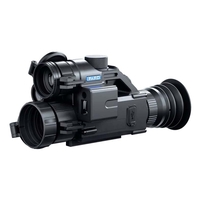
Pard Landsat 256 Mini Mulit-Spectral LRF Thermal/Night Vision Scope
via Uttings
£599.00
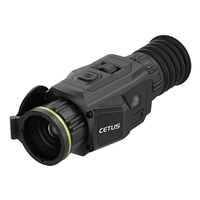
Pixfra Cetus C225 Thermal (256x192) Rifle Scope
via Uttings
£679.95
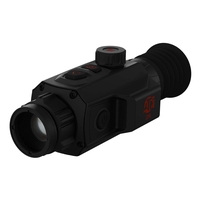
ATN Thor 6 Mini 215 (2-16x) Compact Thermal (256x192) Rifle Scope
via Uttings
£699.00
Buying Advice
Understanding sensor specifications is critical. The detector resolution — usually 256×192, 384×288 or 640×512 — determines how many thermal pixels make up your image. More pixels mean finer detail at longer range, making it easier to distinguish a fox from a badger or confirm a buck's antler status. Pixel pitch (12 µm vs 17 µm) affects sensitivity; a 12 µm pitch sensor packs more pixels into a smaller area, allowing a physically smaller lens to achieve the same field of view, which keeps the unit compact and light. NETD (Noise Equivalent Temperature Difference, measured in millikelvin) indicates thermal sensitivity — under 40 mK is excellent and helps pick out cool quarry against cool backgrounds on mild nights. Finally, refresh rate matters: 50 Hz gives smooth, real-time panning, whereas 25 Hz can judder when scanning quickly across a hedge line.
In the sub-£1,000 bracket you can broadly identify three tiers. Below £400 you will find 256×192 sensor units with smaller lenses (typically 15–19 mm), adequate for ratting or confirming a fox at 100–150 metres but lacking the detail for reliable deer ID beyond short range. Between £400 and £700 sits the sweet spot: 384×288 sensors with 25 mm objectives, 50 Hz refresh rates and detection ranges of 1,000–1,500 metres on a human-sized target (quarry detection will be shorter). From £700 to £999 you enter 640×512 territory or 384 sensors with 35 mm lenses, delivering substantially better image quality, longer identification range and features like onboard recording, Wi-Fi streaming and picture-in-picture zoom. For most UK stalkers and fox shooters, the £400–£700 tier offers the best value-for-money balance.
A common mistake UK buyers make is fixating on quoted detection range without understanding what the figure actually means. Manufacturers typically cite MRTD-based detection distance for a 1.7 m × 0.5 m target (roughly human-sized). Detection means you can see that something warm is there, not that you can identify what it is. Recognition and identification ranges are far shorter — often one-third and one-quarter of the detection figure respectively. A spotter quoting 1,500 m detection may only let you confirm species at 350–400 m, which is still perfectly useful for UK foxing and stalking but not the miracle range the headline number implies. Another error is ignoring battery life: British winter nights are long, and a three-hour battery will leave you short on a November evening. Look for units offering at least five hours, or carry a spare.
UK-specific context matters more than many guides acknowledge. Our maritime climate means frequent rain, mist and high humidity — so IP ratings are important. Look for at least IP66 or IP67 waterproofing. British stalking often involves long walks-in over rough ground before a sit, so weight and form factor count: anything over 350 g gets tiresome on a neck lanyard. For fox control at night, integration with your rifle setup is key: many thermal monoculars can stream video via Wi-Fi to a phone mounted on your stock, giving you a rough aiming reference without a dedicated weapon sight. This is not a substitute for a properly zeroed thermal or night-vision scope, but it is a pragmatic option for shooters who cannot justify a separate £2,000 clip-on. For deer stalking, remember that thermal cannot be legally used as a weapon sight for deer in England and Wales — it is a spotting tool only, used to locate quarry before you shoot with conventional optics in lawful shooting hours.
Matching the monocular to your use case prevents overspending or underbuying. If you primarily fox on open arable land and need to scan large fields quickly, prioritise a wider field of view and a 50 Hz refresh rate over maximum detection range — a 384 sensor with a 25 mm lens is ideal. If you stalk woodland edges and need to pick out a muntjac bedded in bramble at 80 metres, image detail matters more: a 640 sensor or a 384 with 35 mm lens will show you body shape and head position far more clearly. If you do both, a 384×288 / 35 mm combination with a good zoom function is arguably the most versatile single unit in this budget.
The brand landscape in 2026 is dominated by Pulsar and Hikmicro at this price point. Pulsar's Axion 2 range sits at the upper end of the bracket, offering excellent image processing, robust build quality and strong after-sales support via UK distributors such as Thomas Jacks. Hikmicro's Falcon and Condor series have gained enormous traction among UK shooters for delivering 640-sensor performance close to or under the £1,000 mark, with solid IP ratings and good battery life. Bushnell offers one or two handheld units at the top of this range, while Leupold's LTO series sits at the budget end. Vortex does not currently produce a sub-£1,000 handheld thermal. Swarovski and Nightforce have no thermal monocular offerings. Always buy from an authorised UK dealer — units imported via grey-market routes may lack a UK warranty and will not be supported by the manufacturer's UK service centre.
Frequently Asked Questions
Do I need a licence to own a thermal monocular in the UK?
No. A handheld thermal monocular is an observation device, not a weapon or weapon sight, and requires no firearms certificate or other licence in England, Wales or Scotland. However, any firearm or air rifle you use alongside it is subject to the usual licensing requirements. If you are considering a thermal weapon sight (clip-on or dedicated), check with your local police firearms licensing department, as some forces may want it noted on your FAC variations. BASC can also advise on current best practice.
What sensor resolution do I need for UK foxing?
For typical UK fox-control ranges of 100–250 metres across open farmland, a 384×288 sensor with a 25 mm or 35 mm objective lens is more than adequate. This will let you detect a fox-sized heat source at several hundred metres and positively identify it at realistic shooting distances. A 256×192 sensor will work at closer ranges but starts to struggle with species identification beyond 100–120 metres, which can be a problem when you need to distinguish a fox from a farm cat or badger.
Can I use a thermal spotter for deer stalking at night?
You can use a thermal monocular to locate and observe deer at any time, as it is simply a spotting tool. However, in England and Wales it is illegal to shoot deer at night except under specific licence from Natural England or Natural Resources Wales. In Scotland, night shooting of certain deer species is permitted under authorisation from NatureScot. The thermal monocular is only an observation aid — you must still comply with all legal shooting hours and use lawful sighting equipment on your rifle.
What does NETD mean and why does it matter?
NETD stands for Noise Equivalent Temperature Difference and is measured in millikelvin (mK). It indicates how small a temperature difference the sensor can detect. A lower NETD figure means greater thermal sensitivity — useful on mild UK nights when the temperature difference between quarry and background is small. Most decent sub-£1,000 units have an NETD of 25–40 mK. Anything under 35 mK is considered very good for UK field conditions.
How long does the battery last on a thermal monocular?
Battery life varies considerably. Budget units may last only three to four hours, while mid-range and higher-end monoculars typically deliver five to eight hours on a single charge. For UK use, where winter nights can exceed 14 hours and you may be out for an extended session, we strongly recommend choosing a unit with at least five hours of runtime and ideally one that accepts a USB-C power bank as a backup. Some Pulsar and Hikmicro units use swappable battery packs, which is extremely convenient in the field.
Is a 12 µm or 17 µm pixel pitch sensor better?
Neither is inherently better — they involve different engineering trade-offs. A 12 µm pitch sensor packs more pixels into a smaller detector area, allowing manufacturers to use a smaller, lighter objective lens while maintaining resolution and field of view. A 17 µm pitch sensor with the same pixel count needs a larger lens but can offer slightly better per-pixel sensitivity. In practice, at this price point, 12 µm sensors tend to produce more compact, lighter units, which is a real advantage for UK stalkers covering ground on foot.
What IP rating should I look for in a UK thermal monocular?
Given the UK's consistently wet climate, we would not recommend anything below IP66 for regular field use. IP66 means the unit is fully dust-tight and protected against powerful water jets — more than adequate for rain and heavy dew. IP67 adds brief submersion protection, which gives peace of mind if you drop it crossing a burn or ditch. Most serious units from Pulsar and Hikmicro in this bracket meet IP67 or better.
Can I record video through my thermal monocular?
Many mid-range and upper-tier units include onboard video and still-image recording, saving files to internal memory. Some also offer Wi-Fi streaming to a smartphone app, which is useful for sharing footage or reviewing observations after a session. If recording is important to you — for crop-damage evidence or simply keeping a record of your outings — check that the unit has at least 16 GB of onboard storage and that the companion app is compatible with your phone's operating system.
Where should I buy a thermal monocular in the UK?
We recommend purchasing from an authorised UK dealer to ensure you receive a valid UK warranty, manufacturer support and correct UK-spec firmware. Specialist retailers such as Optics Warehouse, Sporting Saint, CHGFD and county gun shops with thermal demonstration stock are good starting points. Online marketplaces can offer savings, but grey-market imports may ship with non-UK chargers, foreign-language firmware and no local warranty. Thomas Jacks is the official UK distributor for Pulsar, and Hikmicro has its own UK distribution network — both can confirm authorised dealer lists.
Related guides
Our 2026 UK buyer's guide to the best thermal scopes and clip-ons for foxing under £500. Compare Pard, Hikmicro and more for affordable night-time vermin…
Best Budget Thermal Scopes Under £1,000 (UK 2026)Our expert guide to the best budget thermal scopes under £1,000 for UK fox and vermin shooting in 2026.
HIKMICRO Stellar 3.0 Price Reductions ExplainedHIKMICRO Stellar 3.0 thermal scope prices have dropped across UK dealers. Our 2026 guide covers what you get, how it compares…
GOYOJO GRL335 Thermal Scope – Initial UK ThoughtsFirst impressions of the GOYOJO GRL335 thermal scope for UK shooters. We cover specs, image quality, build, value for money…
Not sure which scope is right for you?
Try our AI-powered scope finder — answer a few questions and get personalised recommendations.
Find My Scope →Get a UK scope tip every day
Follow AiScopes on Facebook for daily buying guides, deals and gear advice.
Follow on Facebook