HIKMICRO Stellar 3.0 Price Reductions Explained
By Peter Makulek · Senior Optics Editor · · Live prices from UK retailers
The HIKMICRO Stellar 3.0 series has been one of the most talked-about thermal rifle scope ranges in the UK market since its release, and recent price reductions across multiple UK dealers have pushed it firmly back into the spotlight. For stalkers, pest controllers, and foxing enthusiasts, a genuine price drop on a premium thermal optic is a significant event. These reductions appear to reflect both increased competition in the thermal imaging space and HIKMICRO's aggressive strategy to consolidate its position as the dominant thermal brand among UK shooters. Whether you are upgrading from an older unit or buying your first clip-on or dedicated thermal scope, the timing deserves serious consideration.
Thermal scopes have transformed night-time pest control and deer management across the UK. Where shooters once relied on lamp-and-NV combinations, a quality thermal rifle scope now offers detection ranges measured in hundreds of metres and identification capabilities that make positive species confirmation far more reliable. The Stellar 3.0 line sits in HIKMICRO's mid-to-upper tier, offering a 384×288 or 640×512 sensor depending on the model variant, along with improved image processing algorithms, onboard recording, and recoil-rated durability. Understanding the specification differences between the variants is essential before committing to a purchase at any price point.
For UK shooters, the practical context matters enormously. Thermal scopes are overwhelmingly used on centrefire rifles for fox control and deer stalking — activities requiring a Firearms Certificate. They can also be mounted on FAC-rated air rifles for pest control, though the effective engagement ranges of even a powerful FAC airgun are modest compared to a centrefire platform. The ability to detect quarry at range, confirm it is the correct species, and place a humane shot is the core value proposition of any thermal optic, and the Stellar 3.0 delivers this well. UK terrain — from Scottish hillsides to East Anglian sugar beet fields — demands different detection and recognition ranges, so matching the right Stellar variant to your ground is crucial.
In this guide we break down what the Stellar 3.0 actually offers, how the recent UK price reductions compare to the broader thermal market, and what you should weigh up before buying. We also address common questions about sensor resolution, refresh rates, zeroing stability, and how the Stellar 3.0 stacks up against thermal scopes from competitors such as Pulsar and InfiRay, as well as how traditional optics brands like Vortex, Leupold, and Zeiss are beginning to respond to the thermal revolution.
Top Picks — Live UK Prices
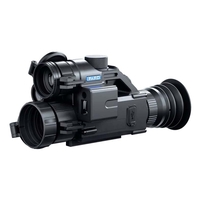
Pard Landsat 256 Mini Mulit-Spectral LRF Thermal/Night Vision Scope
via Uttings
£599.00
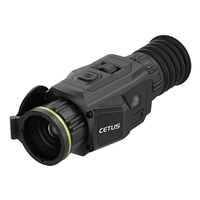
Pixfra Cetus C225 Thermal (256x192) Rifle Scope
via Uttings
£679.95
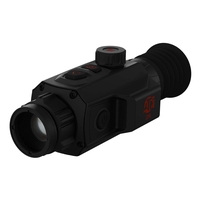
ATN Thor 6 Mini 215 (2-16x) Compact Thermal (256x192) Rifle Scope
via Uttings
£699.00
Buying Advice
The headline specifications of any thermal scope are sensor resolution, pixel pitch, NETD (thermal sensitivity), refresh rate, and objective lens diameter. The Stellar 3.0 range offers either a 384×288 or 640×512 VOx sensor with a 12µm pixel pitch, giving a notably tighter pixel density than older 17µm sensors. NETD below 25mK means the scope can distinguish very small temperature differences — critical for spotting a rabbit tucked against warm soil. A 50Hz refresh rate ensures smooth tracking when panning across a hedgerow or following a moving fox. Objective lens size (typically 35mm or 50mm in the Stellar line) determines your base magnification and field of view: a larger objective gathers more thermal energy but adds weight and length. Understanding these numbers lets you compare meaningfully rather than relying on marketing claims.
Before the recent reductions, the Stellar 3.0 range sat roughly between £2,500 and £4,500 depending on sensor and lens configuration, placing it in the mid-tier of dedicated thermal rifle scopes. Entry-level thermal units from HIKMICRO and competitors start around £1,200–£1,800 but typically use lower-resolution sensors and simpler image processing. At the top end, flagship units from Pulsar, InfiRay, and the HIKMICRO Panther series can exceed £5,000. The price reductions on the Stellar 3.0 appear to bring certain configurations closer to the £2,000–£3,500 band, which is significant because that is where many serious UK pest controllers and part-time stalkers set their budget ceiling. Always check current prices with authorised UK dealers such as those listed on HIKMICRO's UK distributor pages, Thomas Jacks, or specialist retailers.
A common mistake UK buyers make is over-specifying detection range while ignoring recognition and identification range. A scope may detect a heat signature at 2,000 metres, but if you cannot tell whether it is a fox or a farm cat at 200 metres, the detection figure is irrelevant for ethical shooting. The Stellar 3.0's improved image processing helps close the gap between detection and identification, but you should still check the DRI (Detection, Recognition, Identification) figures for the specific variant you are considering. Another frequent error is assuming any thermal scope can be mounted on a spring-powered air rifle. Thermal scopes are recoil-rated for centrefire rifles, not the unique double-recoil pulse of a springer, which can destroy electronics. If you shoot a spring-piston airgun, consult the manufacturer explicitly.
UK-specific considerations are important. You will need a Firearms Certificate to own any rifle above the sub-12 ft-lb air rifle threshold in England and Wales, and thermal scopes are overwhelmingly used on FAC-rated centrefire rifles for foxing and deer stalking. There is no legal restriction on owning a thermal scope itself, but its use must comply with your certificate conditions and permissions. For deer, remember that close seasons apply: roe does have a close season from 1 November to 31 March in England and Wales, and different dates apply in Scotland. Night shooting of deer is not generally permitted except under specific licence conditions. For pest species such as rabbits, corvids, and pigeons, thermal-equipped rifles can be used year-round where you have permission. Always check current guidance from BASC or your local police firearms licensing department.
Matching the scope to your use case is the single most important decision. If you primarily fox over open farmland at ranges out to 250 metres, a 640×512 sensor with a 50mm objective gives you the detection and identification confidence you need. If you are lamping rabbits at closer quarters — say inside 150 metres — a 384×288 sensor with a 35mm lens is lighter, cheaper after the price drop, and perfectly adequate. For driven or walked-up pest control in woodland, a wider field of view and faster target acquisition matter more than outright magnification. Consider whether you also want a handheld thermal spotter (HIKMICRO's Falcon range, for instance) to scan before committing to the rifle, as this two-unit approach is increasingly popular among UK shooters.
The broader brand landscape is shifting. HIKMICRO has captured enormous UK market share by offering competitive pricing and reliable performance, and these price reductions reinforce that position. Pulsar and InfiRay remain strong competitors, particularly at the premium end. Traditional optics giants — Vortex, Leupold, Zeiss, Swarovski, Kahles, Bushnell, and March — dominate the daylight rifle scope and spotting scope market but have been slower to enter dedicated thermal. Vortex has made moves into the thermal space, and others are watching closely. For now, HIKMICRO's combination of sensor technology, software maturity, and aggressive UK pricing makes the Stellar 3.0 a compelling option, especially at reduced prices. However, do not buy on price alone: handle the scope, check the warranty terms (HIKMICRO offers a multi-year warranty through UK distributors), and confirm it suits your rifle's rail system and balance.
Frequently Asked Questions
Why has the HIKMICRO Stellar 3.0 dropped in price in the UK?
Several factors appear to be driving the reductions, including increased competition from InfiRay and Pulsar, maturing production costs for 12µm sensor technology, and HIKMICRO's strategy to expand its UK user base ahead of newer model releases. Price drops on thermal optics often coincide with distributor promotions or updated firmware-enhanced models replacing older stock. Check with authorised UK dealers to confirm whether the unit you are buying is current production or previous batch.
Can I use the HIKMICRO Stellar 3.0 on a sub-12 ft-lb air rifle?
While there is no legal prohibition on mounting a thermal scope on a sub-12 ft-lb air rifle in England and Wales, it is rarely practical. Sub-12 airguns are humane-kill effective on rabbits and squirrels only out to roughly 35–45 yards, where a thermal scope's long-range detection capability adds limited value. Additionally, if your airgun is a spring-piston design, the double-recoil impulse can damage electronics not specifically rated for it. A PCP air rifle is far safer for the optic, but confirm recoil compatibility with HIKMICRO before mounting.
What is the difference between the 384 and 640 sensor variants?
The 384×288 sensor produces a lower-resolution thermal image than the 640×512 variant, which directly affects identification range — the distance at which you can confirm what species you are looking at. The 640 sensor variant typically offers roughly 40–60% greater identification range for a given target size. However, it is also significantly more expensive even after the price reductions. For close-to-mid-range pest control, the 384 sensor is perfectly adequate; for longer-range foxing or open-ground stalking, the 640 sensor is worth the premium.
How does the Stellar 3.0 compare to Pulsar and InfiRay thermal scopes?
All three brands produce competitive thermal rifle scopes for the UK market. Pulsar's Thermion 2 range is well established and has a loyal following, while InfiRay's Tube series offers impressive image quality. The Stellar 3.0 sits competitively on sensor specification and price, particularly after the recent reductions. Image processing quality, ergonomics, and battery life vary between brands, so handling all three before buying is strongly recommended. Warranty and UK service support should also factor into your decision.
Is the Stellar 3.0 suitable for UK deer stalking at night?
Night shooting of deer in England, Wales, and Scotland is heavily restricted and generally requires a specific licence or authorisation — it is not a standard activity permitted under a Firearms Certificate alone. The Stellar 3.0 is technically capable of being used for deer stalking in legal shooting hours where thermal detection aids species identification in low light at dawn and dusk. Always check current legislation and your certificate conditions before using any thermal scope for deer. BASC and the British Deer Society publish up-to-date guidance.
Do I need any licence to buy a thermal scope in the UK?
No. Thermal scopes, night vision devices, and spotting scopes are not controlled items in the UK — you can purchase them without any licence. However, the firearm you mount them on may require a Firearms Certificate (for centrefire rifles and FAC-rated air rifles) or, in Scotland, an Air Weapon Certificate for any air weapon. The scope itself is simply an accessory. Always ensure your use of the equipped firearm complies with your certificate conditions and the permissions granted by the landowner.
Will the Stellar 3.0 hold zero on a heavy-recoiling centrefire rifle?
HIKMICRO rates the Stellar 3.0 series for use on centrefire rifles, and UK users regularly mount them on calibres from .223 Remington through to .308 Winchester and .243 Winchester without issues. For heavier-recoiling calibres, ensure the mounting system is robust — a quality one-piece Picatinny mount is recommended over budget rings. After initial zeroing, fire a confirming group and re-check zero periodically throughout a session, particularly if the rifle is subject to vehicle vibration on the way to your ground.
What accessories should I budget for alongside the Stellar 3.0?
Budget for a quality mount or rail adapter compatible with your rifle (typically £50–£150), spare rechargeable batteries or an external power bank (the Stellar 3.0 uses internal rechargeable batteries with USB-C charging on some models), and a protective lens cover for the germanium objective lens, which is expensive to replace if scratched. A handheld thermal spotter such as the HIKMICRO Falcon or a competitor monocular is also highly recommended for scanning before shouldering the rifle, and these typically cost £300–£900.
Where can I buy the HIKMICRO Stellar 3.0 at the reduced price in the UK?
Authorised UK dealers include specialist firearms and optics retailers, many of whom list stock online. Thomas Jacks is HIKMICRO's primary UK distributor, and their dealer network spans most regions. Buying from an authorised dealer ensures you receive the full UK warranty and after-sales support. Avoid grey-market imports, as these may not carry a valid UK warranty and could have firmware configured for a different region. Prices vary between dealers, so comparing across several authorised stockists is sensible.
Related guides
NocPix ACE thermal scopes have seen major UK price drops in 2026. Our guide covers every model, what you get at each tier…
Best Thermal Monoculars Under £1,000 for UK Stalking & FoxingOur expert-tested guide to the best thermal spotter monoculars under £1,000 for UK deer stalking and foxing.
GOYOJO GRL335 Thermal Scope – Initial UK ThoughtsFirst impressions of the GOYOJO GRL335 thermal scope for UK shooters. We cover specs, image quality, build, value for money…
Infiray TH50 V2 Thermal Scope — Is £1,600 the Sweet Spot?Is the Infiray TH50 V2 thermal scope worth £1,600 for UK night shooting? Our 2026 guide covers specs, detection range, rivals, and where to buy in the UK.
Thermal & Night Vision Optics: UK Buyer's Guide 2026Expert UK guide to thermal and night vision rifle scopes for 2026. FFP vs SFP, MOA vs MRAD, legal considerations, budget tiers in GBP…
Not sure which scope is right for you?
Try our AI-powered scope finder — answer a few questions and get personalised recommendations.
Find My Scope →Get a UK scope tip every day
Follow AiScopes on Facebook for daily buying guides, deals and gear advice.
Follow on Facebook