Thermal & Night Vision Optics: UK Buyer's Guide 2026
By Peter Makulek · Senior Optics Editor · · Live prices from UK retailers
Thermal and night-vision optics have transformed UK shooting over the past few years, and 2026 sees more capable, more affordable units than ever reaching the British market. Whether you are a farmer dealing with foxes on lambing fields, a stalker pursuing muntjac at last light, or a pest controller working rats and rabbits around farm buildings after dark, the right electro-optic scope can turn a frustrating night into a safe, effective outing. Interest in clip-on thermal units such as the DNT Optics Beast of Prey and the Thermnight 635R continues to grow, alongside dedicated weapon-mounted thermals from Pulsar and others.
Before spending a penny, it is worth understanding what separates these technologies. A thermal imaging scope detects radiated heat, rendering warm-bodied quarry as bright shapes against cooler backgrounds regardless of ambient light. Night-vision devices, by contrast, amplify existing light — starlight, moonlight, or an IR illuminator — to produce a recognisable image. Each has strengths: thermal excels at detection across open fields, while digital night vision often provides better target identification at closer ranges, which matters hugely for safe backstop confirmation on UK permissions.
For UK shooters the legal landscape adds another layer. In England and Wales, using thermal or night-vision equipment on a firearm is lawful provided you hold the appropriate Firearms Certificate or are shooting with a sub-12 ft-lb air rifle (which needs no licence in England and Wales). Scotland requires an Air Weapon Certificate for any air weapon. Northern Ireland operates under its own firearms legislation. Always check your specific conditions of certificate and consult your local police force or BASC before heading out at night. Some permissions may restrict night shooting regardless of the law.
This guide walks you through the technical fundamentals — FFP versus SFP reticles, MOA versus MRAD adjustments, parallax considerations, and sensor resolution — then recommends products across realistic budget tiers in GBP. We focus on what UK shooters actually need: compact thermals for fox and corvid control, clip-on units that pair with an existing day scope on a .223 or 6mm ARC stalking rifle, and affordable digital night-vision scopes for farmyard rat work with a sub-12 air rifle. Every recommendation reflects genuine UK use cases, ranges, and quarry.
Top Picks — Live UK Prices
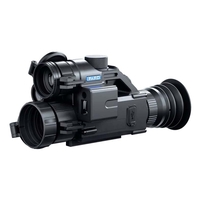
Pard Landsat 256 Mini Mulit-Spectral LRF Thermal/Night Vision Scope
via Uttings
£599.00
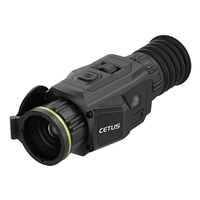
Pixfra Cetus C225 Thermal (256x192) Rifle Scope
via Uttings
£679.95
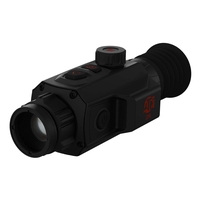
ATN Thor 6 Mini 215 (2-16x) Compact Thermal (256x192) Rifle Scope
via Uttings
£699.00
Buying Advice
Understanding the key specifications is essential before you compare thermal or night-vision scopes. Thermal sensor resolution is stated in pixels — common figures are 384×288 and 640×512. Higher resolution means finer detail at range, critical when you need to distinguish a fox from a farm cat at 250 metres. NETD (Noise Equivalent Temperature Difference) measures thermal sensitivity; look for figures below 40 mK for cleaner images in cool, damp UK conditions. Refresh rate matters too: 50 Hz gives smoother tracking of moving quarry versus cheaper 25 Hz panels. For digital night vision, sensor resolution and IR illuminator range are the headline figures. Parallax adjustment is less critical on thermal scopes than on conventional glass, but if you are running a clip-on unit ahead of a day scope, ensure the day scope's parallax is correctly set for your engagement distance.
Budget tiers in the UK market break down roughly as follows. Entry-level thermal weapon sights — think Pulsar Thermion 2 LRF XL50 alternatives and smaller-sensor units — start around £1,500 to £2,500. Mid-range options from £2,500 to £4,500 bring 640-core sensors, onboard laser rangefinders, and better glass. Premium clip-on thermals and dedicated scopes from brands such as Pulsar, and specialist units like the DNT Optics Beast of Prey series, can run from £4,500 well beyond £7,000. Digital night-vision scopes for air-rifle pest control are far cheaper, with capable units from £300 to £800. At every tier, buy from a UK-based retailer who can handle warranty claims without transatlantic shipping delays.
Common mistakes UK buyers make include over-specifying for their actual quarry and range. A 640-core thermal with a 50 mm objective is magnificent on open moorland fox control at 300 metres, but it is wasted — and far too heavy — if your primary use is lamping rabbits at 60 yards with a .22 LR. Conversely, a cheap 256-core thermal may detect a fox-sized target at 800 metres on paper, but positive identification at humane-shot distance in a British hedgerow landscape is another matter entirely. Another frequent error is ignoring battery life in cold weather; lithium cells lose capacity in a January frost, so always carry spares and check real-world runtime reviews, not just manufacturer claims.
UK-specific context matters more than many guides acknowledge. Our quarry calendar is fixed: roe deer bucks open 1 April to 31 October in England and Wales, does 1 November to 31 March. Muntjac and Chinese water deer have no close season for bucks but does are protected 1 April to 31 October (muntjac) or 1 March to 31 October (CWD). Fox, rabbit, and rat have no close season, making them the primary quarry for thermal night shooting. If you shoot with an air rifle under 12 ft-lb, remember that humane-kill range on rabbits and rats is roughly 35 to 45 yards — a lightweight digital night-vision scope or a clip-on monocular ahead of a short-range optic is the sensible pairing, not a bulky long-range thermal.
Matching the optic to your use case avoids expensive regret. A stalker running a 6mm ARC or .243 Win on a bolt-action for foxes and small deer will benefit from a clip-on thermal that preserves zero on the day scope — no re-zeroing when swapping between daylight stalking and night fox control. A dedicated pest controller covering multiple farms may prefer a standalone thermal weapon sight with onboard recording for evidence and reporting. An airgunner controlling rats in barns needs a compact, lightweight digital NV scope with close-focus parallax adjustment — ideally down to 10 yards — and gentle recoil tolerance if fitted to a spring-piston rifle. Springer double-recoil destroys optics not designed for it, so always confirm the scope is springer-rated before mounting it on a break-barrel.
The brand landscape in 2026 is competitive. Pulsar remains the dominant thermal brand in UK retail, with wide dealer networks and good warranty support. Newcomers like DNT Optics are generating buzz among UK fox shooters with modular clip-on units. For conventional glass to pair with clip-ons, Vortex, Nightforce, and March offer excellent FFP and SFP options across budget tiers, while Leupold and Athlon provide solid mid-range choices. Bushnell's digital night-vision units offer entry-level affordability. Whatever you choose, buy from an authorised UK dealer — grey imports may lack CE/UKCA markings and will almost certainly have no local warranty. Check retailer reviews on Trustpilot and ask on forums like Shooting Sports Forum or The Stalking Directory before committing.
Frequently Asked Questions
What is the difference between thermal and night-vision rifle scopes?
Thermal scopes detect infrared radiation emitted by warm objects, rendering animals as bright shapes against cooler backgrounds regardless of ambient light levels. Night-vision scopes amplify existing visible or near-infrared light to produce an image, so they require at least some ambient light or an IR illuminator. Thermal is generally superior for detection across open ground, while night vision can offer better target identification and scene detail at closer ranges. Many UK shooters use thermal for fox control on open fields and digital night vision for close-range pest work around farm buildings.
Do I need a licence to use a thermal or night-vision scope in the UK?
The optic itself does not require a licence, but the firearm it is mounted on may. In England and Wales, air rifles producing up to 12 ft-lb (or air pistols up to 6 ft-lb) do not require a licence; anything above is FAC-rated and needs a Firearms Certificate. Scotland requires an Air Weapon Certificate for any air weapon. Northern Ireland has its own separate regime. Always check your certificate conditions and consult your local police firearms licensing department or BASC for guidance specific to your situation.
What does FFP versus SFP mean, and which is better for a day scope paired with a thermal clip-on?
FFP (First Focal Plane) reticles scale with magnification, so holdover marks and windage references remain accurate at any power setting. SFP (Second Focal Plane) reticles stay the same apparent size regardless of magnification, meaning subtension values are only correct at one specific power, usually the maximum. For a day scope used with a clip-on thermal at night — where you are often shooting at a single known magnification — SFP is perfectly adequate. If you also use the scope for daytime shooting at varied magnifications, FFP offers more flexibility.
Should I choose MOA or MRAD turrets for a rifle scope?
Both systems work equally well; the choice is largely personal preference. MRAD (milliradian) adjustments are metric-friendly — 0.1 mil moves the point of impact 1 cm at 100 metres — which suits UK shooters who think in metric. MOA (minute of angle) adjustments are finer per click (typically 0.25 MOA versus 0.1 MRAD), with 1 MOA equalling approximately 1.047 inches at 100 yards or roughly 2.9 cm at 100 metres. Most UK long-range and PRS shooters have moved towards MRAD, but MOA remains popular among stalkers and airgunners.
Can I mount a thermal scope on a sub-12 ft-lb spring-piston air rifle?
You can, but you must choose a unit rated for springer double-recoil. Spring-piston air rifles produce a unique two-directional recoil impulse that destroys optics not designed for it, including many thermal and night-vision scopes. Lightweight clip-on monoculars mounted ahead of the objective bell avoid this problem entirely, as they experience no recoil forces. If you want a dedicated thermal weapon sight on a springer, confirm with the manufacturer or retailer that it is springer-rated. Alternatively, consider a PCP (pre-charged pneumatic) air rifle, which produces negligible recoil.
What thermal sensor resolution do I need for fox shooting in the UK?
For fox-sized quarry at typical UK engagement distances of 100 to 250 metres, a 384×288 sensor with a 35 mm or larger objective lens is a workable minimum, but a 640×512 sensor provides significantly better identification confidence. Detection range and identification range are very different figures — you may detect a heat signature at 1,000 metres but only positively identify the animal at 300 metres. In the UK, where safe backstop confirmation and positive quarry ID are essential, prioritise identification range over headline detection figures.
How does parallax adjustment matter for night-vision scopes on air rifles?
Parallax error occurs when the target image does not sit precisely on the reticle plane, causing apparent point-of-aim shift as your eye moves behind the scope. At the short ranges typical of sub-12 ft-lb airgun shooting — 10 to 45 yards — parallax error can be significant if the scope is set for 100 yards. A good airgun-suitable night-vision or day scope should offer parallax adjustment down to at least 10 yards. Without this, you may see consistent grouping errors at close range that no amount of re-zeroing will fix.
Are clip-on thermal units worth the extra cost over standalone thermal scopes?
Clip-on thermals mount ahead of your existing day scope, letting you switch between day and night use without altering your zero or carrying a second rifle. This is a major advantage for UK stalkers who may shoot roe deer in daylight and foxes after dark on the same outing. The trade-off is cost — quality clip-ons from DNT Optics, Pulsar, and similar brands often cost more than a comparable standalone thermal. They also add weight and length to the rifle. If your shooting is exclusively nocturnal pest control, a dedicated thermal weapon sight is simpler and often lighter.
Where can I buy thermal and night-vision scopes in the UK?
Authorised UK dealers include online specialists such as Thomas Jacks (Pulsar's UK distributor), Optics Warehouse, and sporting retailers like Uttings, John Norris, and Edgar Brothers-stocked shops. Buying from a UK-authorised dealer ensures your product carries valid UKCA markings, a UK-backed warranty, and access to local service support. Grey-market imports from European or US sellers may be cheaper but often lack warranty coverage and can present issues with firmware and calibration support. Always verify dealer authorisation on the manufacturer's website before purchasing.
Related guides
Understand UK law on night vision and thermal optics for deer stalking, fox control, and lamping. Scotland vs England rules, legal kit…
Trading a PVS-14 for Thermal & LPVO: Is It Worth It?Should you swap a used PVS-14 for a thermal scope and LPVO? We break down the trade-offs, UK legalities, top picks and budget tiers for night vision…
Best Thermal Monoculars Under £1,000 for UK Stalking & FoxingOur expert-tested guide to the best thermal spotter monoculars under £1,000 for UK deer stalking and foxing.
HIKMICRO Stellar 3.0 Price Reductions ExplainedHIKMICRO Stellar 3.0 thermal scope prices have dropped across UK dealers. Our 2026 guide covers what you get, how it compares…
TKN-1 Night Vision Periscope: Your Questions AnsweredExplore the TKN-1 night vision periscope with real pictures, technical breakdown, and UK-relevant buying advice.
What Are the 3rd and 4th Dials on a Rifle Scope?Confused by the extra turrets on your rifle scope? Our 2026 UK guide explains the 3rd and 4th dials — parallax, illumination, zero stop…
Not sure which scope is right for you?
Try our AI-powered scope finder — answer a few questions and get personalised recommendations.
Find My Scope →Get a UK scope tip every day
Follow AiScopes on Facebook for daily buying guides, deals and gear advice.
Follow on Facebook