What Are the 3rd and 4th Dials on a Rifle Scope?
By Peter Makulek · Senior Optics Editor · · Live prices from UK retailers
If you have ever picked up a rifle scope and wondered what the third or fourth dial actually does, you are far from alone. Most newcomers recognise the windage and elevation turrets — the two dials that move your point of impact left/right and up/down — but once a scope adds a side-focus parallax wheel or an illumination dial, the turret count climbs and the confusion begins. This guide is written for UK shooters across every discipline, from sub-12 ft-lb airgun pest control to FAC-rated deer stalking, and it aims to demystify every turret you will encounter on a modern scope.
The 'third dial' on most scopes is the parallax adjustment, sometimes called the side focus or adjustable objective (AO). It removes parallax error — the apparent shift of the reticle against the target when your eye moves off the optical axis. On airgun-rated scopes this typically adjusts down to around 10 yards, which is essential because sub-12 ft-lb shooting often happens at 25–45 yards where parallax is most pronounced. On centrefire and long-range scopes the parallax dial usually starts at 50 yards or even 100 yards, reflecting the longer engagement distances. Getting parallax right is not optional: it directly affects both image sharpness and point-of-impact consistency.
The 'fourth dial' is almost always an illumination control for the reticle. This is a small rotary or push-button mechanism — often integrated into the side-focus turret or mounted on the eyepiece bell — that lights up all or part of the reticle in red, green, or occasionally amber. It is most useful in low-light conditions at dawn and dusk, exactly when UK quarry such as rabbits, pigeons, and corvids are most active. On tactical and PRS-style scopes, illumination is typically a centre-dot only, allowing the rest of the reticle — be it MOA or MRAD hash marks — to remain unlit so you can still read your holdover references clearly.
Understanding these dials matters because a scope with the wrong parallax range or an illumination system you never use adds weight, cost, and potential failure points. UK shooters also need to factor in the recoil profile of their rifle: a spring-piston air rifle generates harsh, bi-directional recoil that can destroy scopes not built to handle it, and additional internal mechanisms like illumination modules can be particularly vulnerable. Throughout this guide we will reference real-world brands — Vortex, Leupold, Swarovski, March, Athlon, and others — to help you match the right scope to your shooting discipline and budget.
Top Picks — Live UK Prices

Richter Optik Crystal 4x20 Riflescope with Mounts
via BushWear
£9.99

Caldwell Orange Peel Silhouette Target 12x18 5pk
via BushWear
£10.39
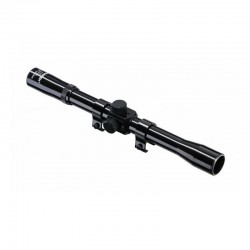
Umarex 4x20 Scope
via DAI Leisure
£19.95
Buying Advice
When evaluating the dials on any scope, start with the parallax adjustment range. For sub-12 ft-lb rimfire or airgun use, you need a scope whose parallax wheel goes down to at least 10 yards; many scopes marketed as 'rifle scopes' bottom out at 50 yards and will never focus properly at typical airgun distances. Conversely, a centrefire deer-stalking scope rarely needs parallax below 50 yards. The markings on a parallax dial are approximate — always fine-tune by looking through the scope and adjusting until the image is sharpest at your actual shooting distance. Side-focus parallax is far more convenient to adjust from a shooting position than a front-mounted adjustable objective ring, which is why almost all modern scopes above entry level have moved to the side-focus design.
Budget tiers in the UK roughly break down as follows. Below £150, expect a scope with a fixed parallax or a basic AO ring on the objective bell, and possibly no illumination — perfectly adequate for a rimfire or sub-12 ft-lb airgun if the parallax is correctly set. From £150 to £400, side-focus parallax and basic illumination become standard; brands like Vortex Diamondback Tactical and Athlon Midas sit here. Between £400 and £800, you enter the territory of March, Leupold, and higher-tier Vortex models, where turret mechanics, glass coatings, and illumination brightness all improve markedly. Above £800, Swarovski, top-tier March, and Vortex Razor lines deliver exceptional optical clarity, extremely precise turret tracking, and illumination systems bright enough for use in daylight against dark backgrounds.
A common mistake UK buyers make is assuming that more dials mean a better scope. An illuminated reticle adds complexity, weight, and a battery dependency that may not suit your needs. If you shoot exclusively in daylight — say, paper targets at a club range — illumination is unnecessary, and you would be better served spending that portion of the budget on superior glass or a finer reticle. Another frequent error is buying a scope with exposed, locking tactical turrets for a hunting rifle that will be carried through rain and brambles: capped turrets protect your zero far better in the field. Always match the scope's features to how you actually shoot, not to what looks impressive on a spec sheet.
UK-specific considerations are important. If you shoot a spring-piston air rifle, the savage bi-directional recoil will eventually destroy scopes not rated for it — this applies to internal illumination modules especially. Brands like Hawke, MTC, and certain Vortex lines explicitly rate some models for spring-piston use. For deer stalking with centrefire calibres, check that the scope's turret adjustment range covers your ballistic drop at realistic UK distances, which for most roe and muntjac stalking is well under 300 yards. Scottish shooters should note that any air weapon requires an Air Weapon Certificate; always confirm the current legal requirements with your local police force or BASC before purchasing any optic-and-rifle combination.
Matching the scope to your use case is ultimately about deciding which dials you need. A benchrest or field target competitor will prioritise a precise side-focus parallax wheel with fine gradations, possibly on a first focal plane (FFP) scope so the MRAD or MOA reticle scales correctly at every magnification. A rough shooter lamping rabbits at dusk will value a bright illuminated reticle and fast parallax adjustment, perhaps on a second focal plane (SFP) scope with a bold crosshair. A long-range target shooter will want exposed, zero-stop elevation turrets with well-defined clicks — each click being 0.1 MRAD (1 cm at 100 m) or ¼ MOA (~0.7 cm at 100 m) — and the parallax dial becomes critical at extended distances where even small parallax error shifts the group.
The brand landscape in the UK is healthy and competitive. Vortex dominates the mid-range with excellent warranties and a huge scope lineup spanning rimfire, hunting, and tactical disciplines. Leupold remains popular for lightweight stalking scopes with capped turrets and clean, American-made glass. March and Swarovski sit at the premium end, offering benchmark optical clarity and turret feel for those willing to invest. Athlon and Weaver provide strong value at the entry and mid tiers, while Pulsar and HikMicro lead the thermal and night-vision scope market — these digital optics have their own control interfaces and do not follow the traditional turret layout at all. Whatever your budget, the key is understanding precisely what each dial does before you hand over your money.
Frequently Asked Questions
What is the third turret on a rifle scope?
On the vast majority of scopes, the third turret is the parallax adjustment dial, mounted on the left side of the scope body (opposite the windage turret). It removes parallax error by aligning the reticle's focal plane with the target's distance, sharpening the image and preventing point-of-impact shift when your eye is slightly off-centre. On airgun-rated scopes this typically adjusts down to around 10 yards, while centrefire models usually start at 50 yards.
What is the fourth dial on a scope used for?
The fourth dial is almost always the illumination control for the reticle. It switches on a lit element — usually red or green — so the crosshair remains visible against dark backgrounds or in low-light conditions such as dawn and dusk. On some scopes this is a separate rotary dial near the eyepiece; on others it is integrated into the parallax turret as a push-button or concentric ring. Off positions between brightness settings help preserve night-adapted vision.
Do I need a side-focus parallax dial for airgun shooting?
Yes, for most airgun shooting it is highly recommended. Sub-12 ft-lb airguns are typically used at distances between 10 and 45 yards, where parallax error is most significant. A side-focus dial that adjusts down to 10 yards lets you eliminate this error without lifting your cheek from the stock. A front-mounted adjustable objective (AO) ring does the same job but is less convenient to reach from a shooting position.
Can the extra dials on a scope break from springer recoil?
They can. Spring-piston air rifles produce a unique bi-directional recoil — a sharp forward kick followed by rearward movement — that is far harsher on optics than conventional firearm recoil. Illumination modules with small batteries and fragile wiring are particularly vulnerable. Always choose a scope explicitly rated for spring-piston use if you shoot a springer; brands like Hawke, MTC, and certain Vortex models publish springer-safe ratings.
What is the difference between a side-focus dial and an adjustable objective?
Both do the same thing — adjust the parallax — but in different locations. An adjustable objective (AO) is a ring on the front bell of the scope, while a side-focus dial sits on the left turret saddle. Side focus is more ergonomic because you can adjust it without breaking your cheek weld or changing your shooting position. Most modern scopes above entry level have adopted side focus as the standard layout.
Do FFP scopes have different dials compared to SFP scopes?
The physical dials — elevation, windage, parallax, illumination — are the same on both first focal plane (FFP) and second focal plane (SFP) scopes. The key difference is in the reticle behaviour: an FFP reticle scales proportionally with magnification changes, so MRAD or MOA holdover marks remain accurate at any power setting. This does not change the number or function of the turrets, but FFP scopes are generally favoured by shooters who rely heavily on their reticle for range estimation and holdover corrections.
Is an illuminated reticle essential for UK hunting at dawn and dusk?
It is not essential, but it can be extremely helpful. UK quarry such as rabbits, pigeons, and corvids are often most active in low-light conditions, and a thin black crosshair can become invisible against a dark hedgerow or woodland backdrop. An illuminated centre dot solves this without cluttering the field of view. That said, many experienced stalkers and rough shooters manage perfectly well with a bold, unlit duplex reticle, so it depends on your typical shooting conditions and personal preference.
Do thermal or night-vision scopes have traditional turrets?
Generally no. Digital optics from brands like Pulsar and HikMicro use electronic controls — buttons, scroll wheels, or touchscreen menus — to adjust zero, colour palette, and image settings. They do not have mechanical elevation or windage turrets in the traditional sense. Zeroing is done digitally by moving the on-screen reticle to match the point of impact. Parallax is not a factor because the image is generated by a sensor, not a conventional glass optical system.
How do I know whether my scope turrets are MOA or MRAD?
Check the markings on the turret caps or the scope's specification sheet. MRAD (milliradian) turrets are typically marked in 0.1 mil increments, where each click moves the point of impact 1 cm at 100 metres. MOA (minute of angle) turrets are usually ¼ MOA per click, which is approximately 0.7 cm at 100 metres or about 1/4 inch at 100 yards. Ensure your turret unit matches your reticle unit — mixing MOA turrets with an MRAD reticle makes holdover calculations needlessly complicated.
Related guides
Comparing the Kahles K540i DLR, K540i Refined, Zero Compromise ZC527 and Nightforce ATACR for UK precision rifle shooters.
Custom Slide Work, Dome Cuts & RMR Plates: Your First Optic MountPlanning your first custom slide work, dome cut or RMR plate in the UK? Our 2026 guide covers optic mounting, plate selection…
Not sure which scope is right for you?
Try our AI-powered scope finder — answer a few questions and get personalised recommendations.
Find My Scope →Get a UK scope tip every day
Follow AiScopes on Facebook for daily buying guides, deals and gear advice.
Follow on Facebook