Kahles K540i DLR vs Refined vs ZCO & ATACR
By Peter Makulek · Senior Optics Editor · · Live prices from UK retailers
Choosing your first serious precision scope is one of the most consequential decisions you will make as a UK competitive or long-range shooter. The Kahles K540i family, the Zero Compromise ZC527, and the Nightforce ATACR 5-25×56 sit at the apex of current first-focal-plane optics — and each attracts fierce loyalty. For a UK shooter spending north of £2,000 on glass, the stakes are high: you need an optic that tracks perfectly, delivers honest and repeatable adjustments in MRAD (or MOA if that is your preference), and survives the damp, blustery conditions that define shooting on ranges from Bisley to Diggle and beyond. This guide breaks down every relevant difference so you can commit with confidence.
The Kahles K540i line now splits into two distinct variants. The DLR (Dynamic Long Range) model is purpose-built for the PRS/NRL-style competition format growing rapidly in the UK, with a lighter weight, a slightly shorter overall length, and a locking elevation turret designed for fast positional stages. The Refined model retains the classic K525i heritage — superb glass quality, a silky smooth erector, and a focus on outright optical fidelity for disciplines where you can afford to take your time, such as F-Class, ELR, or long-range deer stalking with a centrefire FAC rifle. Both share the 5-40× magnification range and 34 mm main tube, but differ meaningfully in turret feel, weight, and reticle options.
Zero Compromise Optics (ZCO) and Nightforce occupy a similar price bracket but approach the problem differently. The ZC527, made in Vienna, offers an extraordinarily rigid mechanical platform, class-leading tracking consistency, and a broad internal adjustment range — critical if you shoot at extreme distances or need large elevation dials for .308 Win or 6.5 Creedmoor trajectories. The Nightforce ATACR 5-25×56, long established as a benchmark in tactical and competition circles, counters with arguably the most battle-proven reputation in the field, outstanding ED glass, and a wide accessory ecosystem including the celebrated Mil-XT and Mil-C reticles. Both are FFP, both are 34 mm tube, and both are trusted at the very top of UK PRS and F-Class.
Before we dive into head-to-head comparisons and buying advice, it is worth noting the UK-specific context. These scopes are overwhelmingly paired with FAC-rated centrefire rifles — typically 6.5 Creedmoor, .308 Win, .223 Rem, or dedicated ELR chamberings like 6mm Dasher or .300 Norma Mag — and used at MOD and civilian ranges from 100 to 1,200+ yards. Import availability in the UK can be patchy, so buying from an established UK dealer (rather than a grey-import channel) matters for warranty and after-sales support. We will cover pricing tiers, reticle choices, ring and mounting considerations, and common pitfalls throughout this guide.
Top Picks — Live UK Prices

Nikko Stirling Diamond Long Range 30mm Tactical 4-16x50 IR Rifle Scope
via Uttings
£199.00

Hawke Endurance 30 WA 1-4x24 IR (Tactical Dot 4x) Telescopic Sights
via BushWear
£251.10
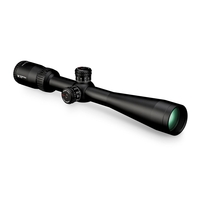
Vortex Diamondback Tactical 4-12x40 Riflescope - VMR-1 Reticle (MOA)
via Uttings
£299.00
Buying Advice
Understanding the key specifications is essential before committing at this price level. All four scopes discussed are first-focal-plane (FFP), meaning the reticle scales proportionally with magnification — your hold-offs and range-finding subtensions remain valid at any power setting, not just one reference magnification as with second-focal-plane (SFP) designs. Adjustments are typically in 0.1 MRAD (1 click = 1 cm at 100 metres) or, for MOA models, 0.25 MOA (roughly 0.7 cm at 100 m). Parallax adjustment via a side-focus dial is standard on all four, calibrated from around 50 yards to infinity — perfectly adequate for centrefire precision but not suitable for close-range rimfire or airgun work without checking the minimum focus distance. Total internal elevation travel and per-revolution values differ: the ZC527 offers roughly 36 MRAD total, whereas the ATACR and K540i variants sit around 29–30 MRAD. More travel means fewer revolutions to reach extreme distances, and fewer opportunities for revolution-counting errors under match pressure.
In terms of UK pricing tiers, expect to pay in the region of £2,800–£3,400 for a Nightforce ATACR 5-25×56, depending on reticle and retailer. The Kahles K540i Refined typically sits between £3,200 and £3,700, while the DLR variant commands a small premium, often landing around £3,500–£4,000. Zero Compromise ZC527 models generally range from £3,400 to £4,200 depending on configuration. For context, a step down into the £1,500–£2,200 bracket opens up excellent alternatives such as the Vortex Razor HD Gen III 6-36×56 or the March FX 5-42×56, both of which are strong performers but concede ground in either optical clarity, mechanical robustness, or turret feel compared to the top tier. Below £1,200, scopes from Athlon (Cronus BTR Gen II) and Vortex (Viper PST Gen II) offer remarkable value for newer competitors, but the gap in glass quality and tracking reliability becomes apparent over extended round counts.
Common mistakes UK buyers make at this level include over-prioritising magnification range while neglecting image quality at the top end — a scope that advertises 40× or 50× but produces a dim, soft image above 30× is less useful than one with superb clarity at 25×. Another frequent error is mismatching scope rings or mounts to the rifle and scope combination. A 34 mm main tube requires 34 mm rings (not 30 mm), and the ring height must clear both the objective bell and any night-vision or thermal clip-on device you intend to use. Many UK PRS shooters now run clip-on thermals from Pulsar or HikMicro for night-legal fox control on their stalking rifles, and this demands specific ring height and rail clearance. Finally, buying from overseas to save a few hundred pounds often means voiding the UK distributor warranty and facing costly return shipping if a fault develops — a poor trade-off on a £3,500 optic.
From a UK-specific perspective, these scopes are almost exclusively relevant to FAC-rated centrefire rifles. You will need a valid Firearms Certificate, and any conditions relating to calibre, quantity, and land clearance must be observed. If you are considering one of these optics for deer stalking — whether roe, muntjac, fallow, or red — ensure your rifle and ammunition combination meets the legal minimum calibre and muzzle energy requirements for the species and jurisdiction (these differ between England/Wales and Scotland). A 5-25× or 5-40× FFP scope is arguably over-specified for woodland stalking at 80 yards, but it becomes invaluable for open-hill red deer in the Scottish Highlands or for doubling as a competition optic on the same rifle. Spotting scopes remain essential companions at the range; no rifle scope replaces a dedicated spotter for reading wind and scoring targets.
Matching the scope to your specific use case is the single most important step. If you are primarily a PRS or NRL22-style competitor shooting positional stages under time pressure, the Kahles K540i DLR or the ATACR with its proven Mil-XT reticle are outstanding choices — both offer fast, tactile turrets, manageable weight, and reticles designed for rapid hold-offs. If your priority is F-Class, ELR, or pure accuracy from a bench or bipod at known distances, the ZC527 or the K540i Refined reward patience with superior optical resolution, wider adjustment range, and smoother mechanical action. For .22 LR precision (NRL22 or club-level rimfire benchrest), these flagship centrefire scopes are viable but arguably overkill; a dedicated rimfire scope with parallax adjustment down to 10–25 yards — from March, Sightron, or Athlon — will serve better and cost significantly less.
The brand landscape in 2026 is broader than ever. Kahles (a Swarovski subsidiary) carries decades of Austrian optical heritage and benefits from Swarovski's glass supply chain. ZCO is a newer but rapidly maturing Austrian manufacturer that has won serious credibility through transparent testing and professional endorsements. Nightforce, despite being a US brand, has excellent UK distribution and a deep aftermarket of accessories, shade kits, and throw levers. Vortex continues to push the value boundary with its Razor line and industry-leading warranty, making it the natural stepping stone for shooters not yet ready for the £3,000+ bracket. Leupold, March, and Swarovski itself all field competitive optics at various price points. Whichever brand you choose, buy from a reputable UK dealer — companies like Optics Warehouse, RUAG UK, Alan Rhone, or Viking Arms — to ensure proper warranty coverage, import compliance, and expert fitting advice.
Frequently Asked Questions
What is the main difference between the Kahles K540i DLR and the K540i Refined?
The DLR (Dynamic Long Range) is optimised for PRS-style competition: it is lighter, features a locking elevation turret to prevent unintended rotation, and prioritises speed of adjustment under match conditions. The Refined model focuses on outright optical quality and smoothness of the erector mechanism, making it better suited to F-Class, ELR, or precision stalking where you are not fighting a shot timer. Both share the same 5-40× magnification range, 34 mm tube, and FFP design, but reticle options and turret tactility differ.
How does the Zero Compromise ZC527 compare to the Nightforce ATACR 5-25×56?
The ZC527 generally offers more total internal elevation adjustment (around 36 MRAD vs roughly 29 MRAD), which is advantageous for ELR shooting or cartridges with significant bullet drop. Its mechanical tracking is considered benchmark-level. The ATACR counters with a longer track record, a wider range of proven reticle options (Mil-XT, Mil-C), and a slightly lower price point in the UK. Optically both are superb; the ATACR has a slight edge in chromatic aberration control according to many users, while the ZC527 is praised for edge-to-edge sharpness.
Is a 5-25× or 5-40× FFP scope suitable for .22 LR precision shooting?
You can certainly mount one on a .22 LR rifle and it will function, but it is rarely the best choice. Rimfire precision demands parallax adjustment down to very close distances — often 25 yards or less — and many centrefire-focused scopes only adjust to 50 yards minimum. Additionally, the weight of a 34 mm tactical scope can upset the balance of a lightweight rimfire platform. Dedicated rimfire scopes from March, Sightron, or Athlon typically offer closer parallax settings, lighter weight, and lower cost. For NRL22 competition specifically, a mid-range FFP scope in the £500–£1,200 bracket often makes more sense.
What scope reticle should I choose for UK PRS competition?
Most UK PRS and NRL competitors shoot MRAD-based reticles with a Christmas-tree or grid-style hold-off pattern. The Nightforce Mil-XT, Kahles SKMR4, and ZCO MPCT3 are all popular choices. These reticles provide fine hash marks or dots at known MRAD intervals, enabling rapid wind and elevation holds without dialling the turret — critical during timed stages. Choose a reticle that is intuitive to you; overly busy designs can slow target acquisition, while overly sparse ones limit your hold-off range.
Do I need 34 mm scope rings, and how do I choose the right height?
All four scopes in this comparison use 34 mm main tubes, so you must use 34 mm rings — never attempt to force a 30 mm ring onto a 34 mm tube. Ring height depends on your objective lens diameter, the height of your rifle's action and rail, and whether you plan to use a clip-on thermal or night-vision device ahead of the scope. As a general rule, choose the lowest ring height that provides adequate clearance (typically 2–3 mm between the objective bell and the barrel or rail). Brands like Spuhr, Hawkins Precision, and ARC offer excellent 34 mm mounts popular with UK precision shooters.
Can I use these scopes for deer stalking in the UK?
Absolutely, provided your rifle and ammunition meet the legal minimum requirements for the deer species and country in question — for example, England and Wales mandate a minimum bullet weight and muzzle energy for deer of different sizes. A 5-25× or 5-40× FFP scope is highly versatile: at lower magnifications it handles woodland stalking of roe and muntjac perfectly well, while higher magnifications are useful for open-hill shooting. Bear in mind that these scopes are heavy and large; for a dedicated lightweight stalking rifle you might prefer a more compact optic. Always check current deer legislation with BASC or your local police force.
What is the advantage of FFP over SFP at this price level?
In a first-focal-plane scope the reticle subtensions are accurate at every magnification, so you can hold off or range-find without remembering which power setting the reticle was calibrated for. This is nearly essential in competition where you constantly change magnification between stages. SFP scopes — where the reticle stays the same apparent size — can offer a cleaner sight picture at high magnification, and some stalkers prefer them for that reason. At the £2,800–£4,200 bracket, almost every serious precision scope is FFP because the optical engineering has matured to the point where FFP reticles remain crisp and usable even at low magnification.
Are these scopes affected by springer double-recoil?
These scopes are designed for centrefire rifle recoil, not the bidirectional recoil pattern of a spring-piston air rifle. Springer recoil drives the scope forward then backward in rapid succession, which can destroy the erector mechanism and shatter lenses in optics not specifically engineered for it. If you shoot a spring-piston airgun, you need a scope explicitly rated for that application. These £3,000+ precision scopes should only be mounted on PCP air rifles (which have negligible recoil) or, as intended, FAC-rated centrefire and rimfire firearms.
Where should I buy these scopes in the UK?
Purchase from an authorised UK dealer to ensure full manufacturer warranty and proper import compliance. Reputable UK stockists for these brands include Optics Warehouse, Alan Rhone, RUAG Ammotec UK (Kahles distributor), Viking Arms, and specialist precision-rifle retailers. Grey imports from the US or mainland Europe may save £200–£400 initially but can void your warranty and leave you without UK-based service support. Some UK dealers also offer demo or try-before-you-buy programmes at events such as the British Shooting Show, which is well worth attending before committing to a purchase at this price level.
Related guides
Choosing a scope for urban precision rifle shooting in the UK? Our 2026 guide covers magnification, reticle, turret specs…
Best PRS & Precision Rifle Scopes for UK Competitors in 2026Our expert UK guide to the best scopes for PRS and precision rifle competition in 2026. Covers FFP vs SFP, MRAD turrets, budget tiers…
Best Budget PRS Scopes Under £500 (UK 2026)Find the best scope for PRS and precision rifle competition under £500 in the UK. Our 2026 guide covers FFP vs SFP, MRAD turrets…
Best PRS Scopes UK 2026Top-rated scopes for PRS rifles and practical precision shooting in the UK. Compare FFP, MRAD and zero-stop options from Nightforce, Vortex…
Custom Slide Work, Dome Cuts & RMR Plates: Your First Optic MountPlanning your first custom slide work, dome cut or RMR plate in the UK? Our 2026 guide covers optic mounting, plate selection…
Trading a PVS-14 for Thermal & LPVO: Is It Worth It?Should you swap a used PVS-14 for a thermal scope and LPVO? We break down the trade-offs, UK legalities, top picks and budget tiers for night vision…
Not sure which scope is right for you?
Try our AI-powered scope finder — answer a few questions and get personalised recommendations.
Find My Scope →Get a UK scope tip every day
Follow AiScopes on Facebook for daily buying guides, deals and gear advice.
Follow on Facebook