Urban Precision Rifle Optics: UK Buyer's Guide
By Peter Makulek · Senior Optics Editor · · Live prices from UK retailers
"Urban" precision rifle — sometimes called urban PRS or urban sniper matches — is one of the fastest-growing competitive shooting disciplines in the UK. Courses of fire simulate close-to-mid-range engagements from barricades, windows, rooftops, and improvised positions, typically inside 300 metres and often well under 100. That might sound easy compared to a mile-long F-class string, but the time pressure, awkward positions, and small or partially occluded targets make optic choice absolutely critical. A scope that excels on a flat 1,000-yard range may be too heavy, too slow to adjust, or simply wrong in magnification profile for this discipline.
In the UK context, urban precision rifle is most commonly shot with centrefire bolt-action rifles in .308 Winchester or 6.5 Creedmoor, though a growing number of clubs run dedicated .22 LR precision rimfire stages as well. The legal framework is straightforward: centrefire and FAC-rated rimfire rifles require a Firearms Certificate, and your ticket conditions must permit the type of shooting you intend to do. If you are unsure, speak to your local police firearms licensing department or contact BASC for guidance before purchasing any optic or rifle.
The ideal urban PRS scope balances several competing demands. You need enough top-end magnification to positively identify and engage small steel at 200–300 metres, but you also need a low-end setting — ideally 4× or below — that lets you rapidly acquire close targets inside 25 metres. A first focal plane (FFP) reticle is near-universal at this level, because holdovers remain valid at every magnification. Parallax adjustment, a reliable zero stop, and exposed, locking turrets with tactile clicks round out the essentials.
Budget matters, of course, and the UK market spans everything from solid entry-level options around £400–£600 to top-tier Japanese and European glass north of £2,500. In this guide we walk through the specs that matter, the mistakes UK shooters commonly make when buying their first precision scope, and the brands that dominate the podiums at UK PRS and NRL-style events. Whether you are kitting out your first .22 LR trainer or upgrading the glass on a centrefire match rifle, this guide is for you.
Top Picks — Live UK Prices

Nikko Stirling Diamond Long Range 30mm Tactical 4-16x50 IR Rifle Scope
via Uttings
£199.00
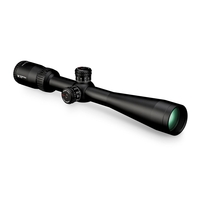
Vortex Diamondback Tactical 4-12x40 Riflescope - VMR-1 Reticle (MOA)
via Uttings
£299.00

Vortex Diamondback Tactical 4-12x40 VMR-1 Riflescope
via BushWear
£315.00
Buying Advice
Start with magnification range. Urban precision stages rarely exceed 300 metres and frequently include targets inside 50 metres, so a 4-24× or 5-25× scope is the default sweet spot. If most of your shooting sits under 200 metres — common in .22 LR precision — a 3-18× or even a 3-15× saves weight and money while giving you everything you need. Avoid the temptation to over-magnify: cranking a 6-36× scope down to 6× often gives a noticeably smaller exit pupil and narrower field of view than a scope designed around a 4× low end. FFP is strongly preferred so your mil-based holds stay correct as you rapidly shift magnification between stages.
Budget tiers in the UK break down roughly as follows. Below £500 you will find credible entry points from Athlon and Vortex — scopes with exposed turrets, FFP MRAD reticles, and acceptable glass clarity for club-level competition. Between £500 and £1,200 the field widens considerably: Vortex Viper and Razor lines, Athlon Ares and Cronus models, and selected Leupold Mark series scopes all compete here, offering improved optical coatings, more precise turret tracking, and better illumination. Above £1,500 you enter territory dominated by March, Swarovski, and premium Leupold offerings, where edge-to-edge sharpness, colour fidelity, and mechanical repeatability are demonstrably superior. Spend what you can justify, but know that a well-tracked £600 scope beats a poorly mounted £2,000 one every time.
Common mistakes UK buyers make include choosing MOA turrets when the rest of their shooting community (and most PRS-style match stages) call corrections in milliradians, buying a second focal plane scope because it was cheaper without understanding that their reticle holdovers only read true at one magnification, and neglecting to check the parallax adjustment range. For .22 LR precision work you will regularly shoot inside 50 metres, so you need a scope with parallax adjustable down to at least 25 yards — ideally 10 yards. Many tactical scopes designed purely for centrefire bottom out at 50 yards, which can cause visible parallax error at rimfire distances.
UK-specific considerations extend beyond the law. Our maritime climate means anti-fog purging (nitrogen or argon) and robust waterproofing are not optional extras — they are essentials. Lens coatings that shed moisture help on those inevitable damp range days. If you are also using your scope for pest control — rabbits, corvids, grey squirrels — check that your magnification range and reticle subtensions are practical at the distances you will actually shoot. Sub-12 ft-lb air rifles are effective for humane dispatch of small quarry to roughly 35–45 yards, and although they are outside the PRS world, many precision rimfire shooters also run air rifles for garden-range practice. A dedicated air rifle scope needs close-focus parallax down to around 10 yards and, if fitted to a spring-powered rifle, must be rated for the unique double-recoil impulse that destroys conventional scopes.
Matching the optic to your use case means being honest about where you shoot. If your club runs stages to 600 metres you may genuinely need 24× or 25× at the top end. If everything stays inside 200 metres — typical of many UK urban PRS events — a lighter 3-18× with a broad field of view will serve you better and save neck strain over a full match day. Weight matters more than many newcomers expect: you will be transitioning between positions quickly, sometimes sprinting between stages, and an extra 200 g on the scope (plus rings and rail) adds up. Consider a 34 mm main tube only if you need the internal elevation travel; a 30 mm tube saves weight and opens up more ring and mount options.
In the brand landscape, March dominates podiums at the highest level of UK precision competition, with exceptional tracking and outstanding glass made in Japan. Vortex offers arguably the best value across multiple tiers and backs everything with a transferable, no-questions warranty — a strong selling point in the second-hand UK market. Leupold remains a trusted name, particularly the Mark 5HD line, and Athlon has carved out a loyal following among budget-conscious UK PRS shooters. Swarovski is revered for optical quality but less commonly seen on match rifles due to weight and price. For thermal and night-vision clip-ons — increasingly popular in UK pest control — Pulsar and HikMicro lead the market, though these are separate purchases from your primary day optic.
Frequently Asked Questions
What is an urban precision rifle match?
Urban precision rifle (sometimes called urban PRS or urban sniper) is a competitive discipline where shooters engage steel targets from barricades, windows, rooftops, and unconventional positions, typically inside 300 metres. Stages are timed, rewarding speed and accuracy equally. In the UK, matches are run at a growing number of Home Office-approved ranges under club auspices.
What is the best scope for .22 LR precision shooting?
A .22 LR precision scope should be FFP with an MRAD reticle, offer parallax adjustment down to at least 25 yards (ideally 10), and cover a magnification range around 3-18× or 4-24×. Models from Athlon, Vortex, and March are popular in UK rimfire circles. Budget roughly £400–£800 for a scope that tracks reliably and handles close-focus parallax without issue.
Do I need FFP or SFP for PRS-style shooting?
First focal plane (FFP) is strongly preferred because the reticle subtensions remain accurate at every magnification setting, letting you hold over or hold off without recalculating. SFP reticles only read true at one magnification (usually maximum), which slows you down when you need to make rapid corrections at varying power settings. Almost all serious UK PRS competitors use FFP.
Should I choose MOA or MRAD turrets?
MRAD (milliradians) is the dominant system in UK PRS and precision rifle competition. One click of 0.1 mil moves your point of impact 1 cm at 100 metres, making mental arithmetic straightforward in the metric system the UK generally uses for range distances. MOA works perfectly well — 1 MOA is approximately 1.047 inches at 100 yards — but you will find that most stage cards, spotters, and training resources in UK precision circles default to MRAD.
Can I use a tactical PRS scope on an air rifle?
You can, but with caveats. The scope must offer parallax adjustment down to roughly 10 yards, as air rifles are typically shot at much closer ranges than centrefire. If you are fitting it to a spring-powered air rifle, the scope must be rated for the unique reverse-then-forward recoil impulse — standard scopes not designed for this will fail quickly. Gas-ram and PCP air rifles are gentler, but close-focus parallax remains essential. In England and Wales, air rifles up to 12 ft-lb require no licence; in Scotland an Air Weapon Certificate is needed for any air weapon.
How much should I spend on a precision rifle scope in the UK?
Functional entry-level tactical scopes with FFP reticles and exposed turrets start from around £400–£600. Mid-tier options between £700 and £1,200 deliver noticeably better glass clarity, more precise turret tracking, and improved illumination. Premium scopes from March, Swarovski, and top-end Leupold lines run from £1,500 upwards. Never spend so much on glass that you cannot afford quality rings, a base, and ammunition to practise with.
What magnification range do I need for urban PRS?
Most UK urban PRS shooters favour a 4-24× or 5-25× scope, which covers close barricade targets inside 25 metres and distant steel out to 300 metres. If your matches stay under 200 metres — common in rimfire divisions — a 3-18× is lighter and offers a wider field of view at the low end. Avoid over-magnification; it costs you speed and adds weight you will notice during positional transitions.
What tube diameter should I choose — 30 mm or 34 mm?
A 34 mm main tube provides more internal elevation travel, which matters if you are dialling large corrections at extended range. For urban PRS, where targets rarely exceed 300 metres, a 30 mm tube often provides sufficient travel while saving weight and giving you more ring and mount options. Check the scope's total elevation travel in mils or MOA against your ballistic needs before assuming you need the larger tube.
Are thermal or night-vision optics useful for precision rifle in the UK?
Thermal clip-ons from Pulsar and HikMicro are increasingly used by UK shooters who also do pest control — rabbits, corvids, and grey squirrels — during low-light conditions where legal. They mount ahead of your day scope and overlay a thermal image. They are not used in PRS competition but are a valuable addition to a precision rifle also used for land management. Night-vision and thermal use for shooting is subject to UK law and landowner permissions; always check your local regulations.
Related guides
Comparing the Kahles K540i DLR, K540i Refined, Zero Compromise ZC527 and Nightforce ATACR for UK precision rifle shooters.
.22 Long Range Scope Recommendations for UK ShootersExpert UK guide to choosing the best scope for .22 long range shooting. Covers magnification, turrets, reticles, budget tiers in GBP…
Best Long-Range Scopes 2026: BDC Reticles vs Exposed TurretsDefinitive UK buyer's guide to the best scopes for long-range shooting in 2026. Compare BDC reticles vs exposed turrets for 300–1,000 yard shots…
Best Long-Range Scopes UK 2026: Mid-Budget Buyer's GuideDiscover the best scopes for long-range shooting in the UK for 2026. Our expert guide covers FFP vs SFP, MOA vs MRAD…
Best Long-Range Rifle Scopes 2026: Match Your Optic to Your CalibreOur 2026 UK guide to the best scopes for long range shooting. Learn how to match reticle, turrets and magnification to your calibre's ballistic profile…
Discovery XED 6-36×56: Is It Worth It for UK Shooters?In-depth UK guide to the Discovery Optics XED 6-36×56 FFP rifle scope. We cover reticle, turrets, parallax, build quality, and how it compares to Vortex…
NocPix ACE Thermal Scope Series – Price Drops ExplainedNocPix ACE thermal scopes have seen major UK price drops in 2026. Our guide covers every model, what you get at each tier…
Not sure which scope is right for you?
Try our AI-powered scope finder — answer a few questions and get personalised recommendations.
Find My Scope →Get a UK scope tip every day
Follow AiScopes on Facebook for daily buying guides, deals and gear advice.
Follow on Facebook