Custom Slide Work, Dome Cuts & RMR Plates: Your First Optic Mount
By Peter Makulek · Senior Optics Editor · · Live prices from UK retailers
Having custom slide work done — whether that is a dome cut, an RMR-pattern plate fitted, or a full optic milling job — represents a significant step for any UK shooter. Whether you hold a Section 1 Firearms Certificate for a target pistol (long-barrelled, as required under UK law) or you are fitting a micro red-dot to a PCC or FAC-rated rifle, getting the metalwork and optic choice right the first time saves money and frustration. This guide walks you through everything you need to know before committing to that first custom job, with a UK-market focus on pricing, gunsmiths, and legal context.
A dome cut refers to the reshaping of a slide or receiver to accept a miniature reflex sight — typically to the Trijicon RMR footprint, which has become the de facto standard. An RMR plate acts as an adaptor, bolting to a pre-machined cut on the slide or receiver and allowing you to mount compatible optics without permanent modification. The advantage of a plate system is flexibility: you can swap between optic brands sharing the same footprint. The disadvantage is added height over bore, which affects co-witness with iron sights and, for some shooters, cheek weld on a rifle.
In the UK, most custom slide and dome work is carried out by registered firearms dealers (RFDs) who also hold proof-house accreditation or work closely with the Birmingham or London Proof House. Any modification that alters the breech or barrel of a Section 1 firearm must be re-proved, though fitting an optic plate to the top of a slide does not usually fall into this category. Always confirm with your gunsmith and local firearms licensing department if you are unsure — BASC can advise on the legalities specific to your certificate conditions.
The optic you choose must suit the discipline. For practical shooting (UKPSA/IPSC), a durable micro red-dot with a wide window and long battery life is essential. For pest control with an FAC-rated rifle or PCC, a slightly larger reflex sight or even a compact prism scope may be preferable. Night-vision and thermal-scope compatibility is another consideration: some plates and mounts are designed to sit behind or ahead of a clip-on device. We will cover all of these angles below, alongside budget tiers, brand recommendations, and the technical detail that matters.
Top Picks — Live UK Prices

Richter Optik Crystal 4x20 Riflescope with Mounts
via BushWear
£9.99

Caldwell Orange Peel Silhouette Target 12x18 5pk
via BushWear
£10.39
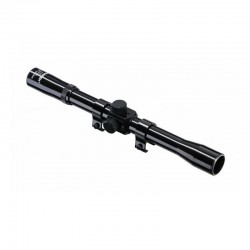
Umarex 4x20 Scope
via DAI Leisure
£19.95
Buying Advice
Understanding the key specifications of a micro reflex sight is essential before you commission any custom metalwork. MOA dot sizes typically range from 1 MOA (a fine, precise aiming point useful for longer-range target work) up to 6.5 MOA (faster acquisition for close-range practical shooting). Remember that 1 MOA subtends approximately 1.047 inches at 100 yards, so a 3.25 MOA dot covers roughly 3.4 inches at that distance. Adjustment clicks are usually 1 MOA per click. Parallax is minimal on quality red dots at close range, but cheaper units can exhibit noticeable parallax shift — test before you trust at distance.
Budget tiers in the UK break down roughly as follows. Entry-level plates and compatible red dots (such as those from Holosun or Vector Optics) can be had for £150–£300 for the optic alone, with plate fitting from around £40–£80 at most UK gunsmiths. Mid-range optics from brands like Vortex (the Venom and Viper lines) sit between £250 and £450, offering excellent durability and warranty support through UK distributors. Premium offerings from Leupold (DeltaPoint Pro) or Aimpoint (ACRO series) run from £450 up to £700 or more. Custom slide milling — the dome cut itself — typically costs £120–£250 depending on the complexity and the smith.
A common mistake UK buyers make is ordering an optic before confirming the plate footprint their slide or receiver has been cut for. RMR-pattern, Shield RMSc, Docter/Noblex, and Aimpoint ACRO all have different hole spacings and locating lugs. Buying a Vortex Venom (Docter footprint) for an RMR-cut slide means an extra adaptor plate, adding height and potential zero-retention issues. Another frequent error is choosing a battery type that is difficult to source in the UK — CR1632 and CR2032 cells are widely available from UK retailers, but some niche optics use uncommon cells. Always check battery life claims and plan replacements accordingly.
UK-specific context matters more than many guides acknowledge. If you are mounting a red dot on a long-barrelled pistol for UKPSA competition, the firearm must remain compliant with its Section 1 certificate conditions — overall length and barrel-length minimums must not be compromised by any modification. For FAC-rated air rifles or rimfire rifles used for rabbit and grey squirrel control, a micro red dot can be superb at short range (sub-50 yards), but remember that sub-12 ft-lb air rifles are humane-kill effective only to roughly 35–45 yards on small quarry. Scotland requires an Air Weapon Certificate for any air weapon, so factor that into your plans. Always check with your local police firearms licensing team or BASC for the most current guidance.
Matching the optic to your use case is critical. Practical pistol shooters generally prefer a wide window and a 3–6 MOA dot for speed. Precision rimfire shooters may want a 1–2 MOA dot and top-loading battery so the optic never leaves the mount for battery changes. If you plan to use a clip-on night-vision or thermal device — brands like Pulsar, Hikmicro, or Swarovski's tM series — check that your mount height leaves sufficient clearance. Some shooters running thermal scopes for foxing on FAC rifles prefer a separate, QD-mounted red dot as a backup, and an RMR plate on the rifle's top rail makes this straightforward without permanent modification.
The brand landscape in the UK market is healthy. Vortex offers outstanding warranty support through their UK distributor and the Viper and Razor lines are popular for practical shooting. Leupold's DeltaPoint Pro is a favourite among stalkers who want a lightweight, low-profile option. For thermal and night-vision integration, Pulsar and Hikmicro dominate the UK thermal-scope market, and both offer clip-on units compatible with standard Picatinny mounts. Athlon is gaining traction at the value end. Swarovski and March cater to the premium buyer who wants best-in-class glass or turret engineering. Weaver mounts and rings remain a budget-friendly, widely available option for rail-mounted reflex sights on rifles. Choose the brand ecosystem that matches your long-term plans.
Frequently Asked Questions
What is a dome cut on a pistol or rifle slide?
A dome cut is a machining operation that removes material from the top of a slide or receiver to create a recessed pocket for a micro reflex sight. The cut is shaped so the optic sits lower, reducing height over bore and improving aesthetics. In the UK, this work should be carried out by a qualified gunsmith who is also a registered firearms dealer. The cost typically ranges from £120 to £250 depending on the platform and finish required.
Do I need an RMR plate or should I mill the slide directly?
An RMR plate offers flexibility — you can swap between optics sharing the same footprint without re-machining the slide. Direct milling gives a lower mount height and often better zero retention because there are fewer interfaces. If you are certain of your optic choice and plan to keep it long-term, direct milling is the more robust option. If you anticipate changing optics, a plate system is more practical.
Will fitting a red-dot sight affect my firearms certificate conditions?
In most cases, fitting an optic to a Section 1 firearm does not alter the conditions on your Firearms Certificate, provided the modification does not change overall length, barrel length, or calibre. However, certificate conditions vary by constabulary and individual grant. Always check with your local firearms licensing department before commissioning any work, and consult BASC or another recognised body if you are unsure.
Can I mount a red-dot on a sub-12 ft-lb air rifle?
Yes, many sub-12 ft-lb air rifles accept Picatinny or dovetail-mounted red-dot sights. However, remember that spring-piston air rifles produce a unique double-recoil impulse that can destroy optics not rated for it — always choose a sight explicitly rated for springer use. Also bear in mind that sub-12 ft-lb air rifles are humane-kill effective to roughly 35–45 yards on rabbit and grey squirrel, so a red dot's lack of magnification is less of a disadvantage than you might expect.
What is the difference between RMR footprint and RMSc footprint?
The RMR footprint, established by Trijicon, uses two mounting holes spaced approximately 1.535 inches apart. The Shield RMSc footprint is smaller and narrower, originally designed for concealed-carry pistol slides. They are not interchangeable without an adaptor plate. Before ordering any custom work, confirm which footprint your chosen optic uses and ensure your gunsmith cuts or plates accordingly.
How does parallax affect a micro red-dot sight?
Parallax in a red-dot sight causes the dot to appear to shift relative to the target when your eye moves off the optical axis. High-quality reflex sights are designed to be essentially parallax-free at practical distances, but cheaper units can show noticeable shift. For air-rifle use at close ranges (10–50 yards) this matters more than on a centrefire at 100 metres. Test your optic at your typical engagement distances before relying on it for live quarry.
Can I use a thermal or night-vision clip-on with an RMR-mounted red dot?
Yes, but mount height and rail space must be planned carefully. Clip-on thermal units from Pulsar or Hikmicro typically sit ahead of your primary optic on the Picatinny rail. An RMR-pattern red dot mounted via a plate on the receiver should leave sufficient rail space, but always dry-fit the combination before purchasing. Some shooters prefer a QD mount for the red dot so they can remove it quickly when switching to a dedicated thermal scope for foxing.
Which UK gunsmiths can do custom slide and dome work?
Several UK-based RFDs offer custom machining services, including well-known names in the practical-shooting community. Always verify that the smith is a registered firearms dealer, carries appropriate insurance, and has experience with your specific platform. Word-of-mouth recommendations from your shooting club or UKPSA section are often the most reliable route. Expect lead times of four to eight weeks during busy periods.
MOA or MRAD adjustments — which should I choose for a red-dot sight?
Most micro reflex sights use MOA adjustments (typically 1 MOA per click), which is intuitive for UK shooters accustomed to imperial measurements at the range. MRAD (milliradian) adjustments are more common on long-range rifle scopes, where 0.1 mil equals 1 cm at 100 metres. For a red dot used at short to medium range, the choice is largely academic — pick whichever system matches the rest of your optic setup for consistency.
Related guides
First impressions of the GOYOJO GRL335 thermal scope for UK shooters. We cover specs, image quality, build, value for money…
Trading a PVS-14 for Thermal & LPVO: Is It Worth It?Should you swap a used PVS-14 for a thermal scope and LPVO? We break down the trade-offs, UK legalities, top picks and budget tiers for night vision…
Weirdly Specific Scope Suggestions You Actually NeedStruggling to find the right scope for your exact UK shooting scenario? Our 2026 guide matches niche requirements to real optics — FFP, SFP, thermal…
Not sure which scope is right for you?
Try our AI-powered scope finder — answer a few questions and get personalised recommendations.
Find My Scope →Get a UK scope tip every day
Follow AiScopes on Facebook for daily buying guides, deals and gear advice.
Follow on Facebook