Weirdly Specific Scope Suggestions You Actually Need
By Peter Makulek · Senior Optics Editor · · Live prices from UK retailers
Every shooter has been there: you know exactly what you need from a scope, but no generic best-of list quite covers it. Perhaps you want a first focal plane reticle with close parallax for HFT, or a thermal clip-on that fits your stalking rifle without re-zeroing your day optic. Maybe you need a rimfire scope that genuinely survives springer double-recoil, or a spotting scope compact enough for hill stalking roe in the Scottish Highlands. These weirdly specific requirements are surprisingly common across UK shooting disciplines, and they deserve targeted answers rather than vague top-ten lists.
The UK market adds its own layer of complexity. Sub-12 ft-lb air rifles — which need no licence in England and Wales, though Scotland requires an Air Weapon Certificate for any air weapon — demand scopes with parallax adjustment down to around 10 yards, and you are working inside a realistic humane-kill envelope of roughly 35 to 45 yards on rabbit and squirrel. FAC-rated rifles stretch further, but the optic still needs to match the discipline: a .17 HMR for corvid control at 150 yards has utterly different magnification and reticle demands than a .308 for deer management out to 300 metres.
Then there is the technology question. First focal plane scopes keep your reticle subtensions accurate at every magnification — critical for ranging and holdover at variable power — while second focal plane models hold a cleaner, thinner reticle at low mag, which many UK stalkers prefer in poor dawn light. MOA turrets suit shooters comfortable thinking in inches at 100 yards; MRAD (where 0.1 mil equals 1 cm at 100 m) is increasingly dominant in practical rifle and long-range communities. Understanding which system serves your scenario is half the battle.
This guide does not pretend one scope fits all. Instead, we tackle the weirdly specific niches UK shooters actually struggle with, from budget rimfire optics that survive recoil to high-end thermal units from Pulsar and Hikmicro. We explain the technical specs, flag common mistakes, and point you toward the right category so you spend money once, not twice. All prices referenced are in sterling, all context is UK-specific, and every technical claim is grounded in real optical physics rather than marketing copy.
Top Picks — Live UK Prices
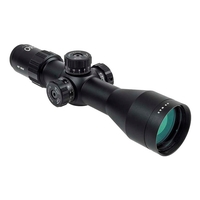
PAO HD MAX 4-16x44 SF FFP Ultra Compact Riflescope
via Uttings
£219.00
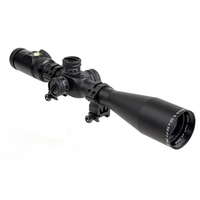
PAO F1 5-20x50 IR SF FFP Rifle Scope
via Uttings
£239.00

Wulf Tornado FFP 6-24x50 W-MIL3 Side Focus Rifle Scope
via BushWear
£249.99
Buying Advice
Start with the numbers that actually matter for your scenario. Magnification range dictates versatility: a 3-12×50 covers most UK stalking and rimfire work, while field target and benchrest shooters often want 10-50× or higher. Objective lens diameter (the second number) governs light transmission — a 50 mm objective gathers substantially more light than a 40 mm, which matters for legal shooting times at dawn and dusk. Tube diameter (30 mm vs 34 mm) affects internal adjustment range; if you are dialling for elevation at distance, a 34 mm tube with a zero stop is worth the weight penalty. For airgunners, ensure the scope's parallax knob or adjustable objective goes down to at least 10 yards — most centrefire scopes bottom out at 45 metres, which introduces significant parallax error at typical air rifle ranges.
Budget tiers in the UK break down roughly as follows. Below £150 you will find serviceable SFP scopes from brands like Athlon and certain Vortex Crossfire models — perfectly adequate for rimfire plinking and sub-12 air rifles, though glass clarity and turret repeatability have limits. Between £150 and £400 the quality jump is dramatic: expect fully multi-coated lenses, capped or exposed turrets with reliable tracking, and genuine close-parallax options. The £400 to £900 bracket is where serious FFP reticles, illuminated options, and robust MRAD turret systems from Vortex, March, and Leupold live. Above £900, and certainly past £1,500, you enter Swarovski and top-tier March territory — apochromatic glass, superb edge-to-edge sharpness, and engineering tolerances that competitive shooters and professional stalkers genuinely benefit from.
Common mistakes UK buyers make include fitting a centrefire scope to a spring-powered air rifle. Springers produce a unique double-recoil impulse — rearward then sharply forward — that destroys scopes not specifically rated for it. Always confirm the manufacturer lists springer compatibility, or choose an airgun-specific model. Another frequent error is buying scope rings of the wrong height or dovetail standard: air rifles typically use 11 mm dovetail rails, while centrefire rifles use Picatinny or Weaver mounts. Mixing these up can result in a wobbly mount at best, or a scope that physically will not fit. Finally, many buyers over-magnify: a 24× scope on a sub-12 ft-lb rifle amplifies mirage and heartbeat wobble at 40 yards, making you less accurate, not more.
UK-specific context matters enormously. For airgun quarry — rabbit, grey squirrel, corvids, and pigeon — you are operating inside short ranges where a clean, uncluttered reticle and reliable parallax-free image matter more than long-range turret precision. For deer stalking, the Deer Act 1991 (England and Wales) and the Deer (Scotland) Act 1996 set minimum calibre and muzzle-energy requirements; your scope choice should complement the rifle and calibre you are legally using. Thermal scopes from Pulsar and Hikmicro have transformed night-time pest control under General Licence conditions and foxing with FAC rifles, but check your specific permission and licensing requirements — Northern Ireland has its own firearms regime entirely. For purchasing, UK retailers such as Uttings, John Rothery, and specialist online dealers often carry stock that mainland European or US-facing shops do not prioritise.
Matching the scope to your actual use case is the single best way to avoid buyer's remorse. If you shoot HFT competitions, you want a high-magnification SFP scope with a fine reticle and parallax adjustable from 7 to 50 yards — the parallax wheel itself becomes a rangefinding tool. If you are a deer stalker walking hill ground, a lightweight 2.5-10×42 with a simple duplex reticle in SFP and a 30 mm tube keeps weight down and gives a wide field of view for snap shots in forestry. For practical rifle or NRL-style competition, an FFP MRAD scope with a Christmas-tree reticle, zero stop, and 25+ MRAD of internal elevation is virtually mandatory. Spotting scopes for the range benefit from 20-60× zoom and quality fluorite glass — Swarovski and Leupold both field excellent options here, though at very different price points.
The brand landscape in 2026 is healthier than ever for UK buyers. Vortex continues to dominate the value tier with its unconditional VIP warranty, and their Razor and Viper lines compete well above their price. Leupold's VX-Freedom and Mark series remain popular among stalkers who value lightweight American-made glass. March is a quiet favourite among benchrest and long-range competitors, offering extraordinary optical quality from a Japanese manufacturer. Swarovski sits at the pinnacle for European hunting optics — the Z8i line is a stalking benchmark. For thermal, Pulsar's Thermion and Trail series and Hikmicro's Thunder and Stellar ranges have brought clip-on and dedicated thermal scopes within reach of more UK shooters. Weaver still appears on older setups but has less market presence today. Athlon offers surprising value in the sub-£300 bracket, particularly the Argos and Midas lines.
Frequently Asked Questions
What does FFP mean and when do I actually need it?
First Focal Plane means the reticle scales in size as you change magnification, so holdover marks and ranging subtensions remain accurate at every power setting. This matters if you use your reticle to estimate range or hold off for wind at varying magnifications — common in practical rifle and long-range competition. If you always shoot at maximum magnification or use a simple duplex crosshair, an SFP scope is often cleaner and cheaper.
Why do I need a scope with close parallax for my air rifle?
Parallax error occurs when the target image and the reticle are not on the same focal plane, causing the point of aim to shift as your eye moves behind the scope. Most centrefire scopes have parallax set at 90 metres or beyond, which introduces significant error at the 10-to-45-yard distances typical of sub-12 ft-lb airgun shooting. An airgun-rated scope with parallax adjustable down to around 10 yards eliminates this, giving you a sharp, parallax-free image across your actual shooting envelope.
Can I put any rifle scope on a spring-powered air rifle?
No. Spring-piston air rifles produce a distinctive double-recoil — rearward then sharply forward — that is far more damaging to optics than centrefire recoil alone. Scopes not rated for this will suffer internal damage, often cracking lenses or shearing reticle wires. Always check that the manufacturer explicitly lists spring or gas-ram compatibility, or choose a scope specifically designed for airguns.
MOA or MRAD — which should a UK shooter choose?
Neither is inherently superior; it depends on what feels intuitive to you. MRAD (milliradians) works neatly in metric: 0.1 mil equals 1 cm at 100 metres. MOA (minute of angle) is roughly 1.047 inches at 100 yards, or about 2.9 cm at 100 metres. The UK long-range and practical rifle community has largely moved to MRAD because metric measurements dominate our range cards and mapping, but plenty of stalkers and benchrest shooters still prefer MOA for its finer adjustment increments.
Do I need an illuminated reticle for UK deer stalking?
It is not mandatory, but it is extremely useful. Legal stalking times in the UK extend into dawn and dusk when contrast is poor, and a fine black reticle can vanish against a dark woodland background. A low-intensity red dot at the centre of a duplex or BDC reticle solves this without washing out the image. Look for scopes with a wide range of brightness settings so you can dial it right down in low light.
What magnification do I actually need for rimfire shooting in the UK?
For general .22 LR or .17 HMR work on quarry and paper out to 100–150 yards, a 4-16× or 6-18× scope covers almost every scenario. Higher magnification amplifies mirage, heartbeat wobble, and every imperfection in your hold. For rimfire benchrest competition at 50 metres, some shooters go to 24× or above, but this is a specialised discipline. Avoid the temptation to over-magnify — a crisp image at 12× beats a blurry, wobbly image at 32×.
How do I choose the right scope rings and mounts for a UK rifle?
First, identify your rail type: most air rifles use an 11 mm dovetail, while centrefire bolt-actions typically have Picatinny (MIL-STD-1913) or Weaver-pattern rails. Then match ring height so the objective bell clears the barrel or rail with a few millimetres to spare — too high and you lose cheek weld; too low and the scope physically contacts the barrel. Ring diameter must match the scope tube (usually 1 inch, 30 mm, or 34 mm). Quality mounts from reputable brands prevent the zero-shift that plagues cheap alternatives.
Are thermal scopes legal for shooting in the UK?
Thermal optics themselves are not restricted items in England, Wales, or Scotland, and they can be bought and owned freely. However, what you shoot, when, and where is governed by firearms law, licensing, and the conditions on your FAC or relevant General Licences. Night shooting for pest species such as foxes typically requires landowner permission and may involve specific conditions on your certificate. Always check your individual permissions and consult your local police firearms licensing department or BASC for guidance specific to your circumstances.
Is a spotting scope worth buying for range use in the UK?
For centrefire shooting at 100 metres and beyond, a spotting scope lets you read shot placement without walking downrange, saving enormous time on ranges without electronic targets. A 20-60×60 or 20-60×80 model from brands like Vortex, Leupold, or Swarovski covers most club-range distances comfortably. Quality glass with good colour correction reduces eye strain during long sessions. Budget spotting scopes can work, but chromatic aberration and poor edge sharpness become frustrating over time — aim for at least the mid-tier bracket.
Related guides
Expert scope upgrade recommendations for UK shooters in 2026. Covers rifle, rimfire, thermal and spotting scopes, reticle choices, magnification tiers…
Rimfire Scope vs Regular Scope: The Real Differences ExplainedWhat is the actual difference between a rimfire scope and a regular centrefire scope? We cover parallax, turrets…
Burris vs Vortex: The UK Shooter's VerdictBurris or Vortex — which scope brand suits UK shooters best? We compare FFP/SFP reticles, MOA vs MRAD turrets, warranties and UK availability to help you…
DNT Zulus V2 3-12 Day/Night Scope GuideComprehensive UK buyer's guide to the DNT Zulus V2 3-12 day/night scope. Discover key specs, budget tiers in GBP, legal context…
Element Helix 6-24×50 FFP — Is It Worth It?Element Helix 6-24×50 FFP rifle scope reviewed for UK shooters. We cover FFP reticle benefits, MRAD turrets, parallax setup…
Not sure which scope is right for you?
Try our AI-powered scope finder — answer a few questions and get personalised recommendations.
Find My Scope →Get a UK scope tip every day
Follow AiScopes on Facebook for daily buying guides, deals and gear advice.
Follow on Facebook