Element Helix 6-24×50 FFP — Is It Worth It?
By Peter Makulek · Senior Optics Editor · · Live prices from UK retailers
The Element Helix 6-24×50 FFP has been generating serious buzz among UK shooters looking for a first-focal-plane scope that doesn't demand a four-figure outlay. With a 4× zoom ratio, 50 mm objective and an FFP MRAD reticle, it sits in a sweet spot that appeals to rimfire target shooters, FAC-rated air rifle owners pushing past 50 yards, and centrefire stalkers who want holdover marks that remain accurate at every magnification. For UK buyers, the key question is whether Element's optics and build quality can genuinely challenge established names like Vortex, Athlon and March at a similar or lower price point.
First-focal-plane scopes have moved from niche competition glass to mainstream choices over the past few years, and the UK market has responded enthusiastically. The practical advantage is simple: your reticle subtensions stay true whether you are dialled down to 6× for a close woodland shot on a muntjac or cranked up to 24× for a precise group at 300 yards on a range day. This matters enormously if you use mil-dot or Christmas-tree–style reticles for ranging or holdover, because with a second-focal-plane design those hash marks are only correct at one specific magnification.
Element Optics — not to be confused with other brands using the word 'Element' — has built a following by offering features typically found in scopes costing twice the price: exposed locking turrets, zero-stop mechanisms, side-focus parallax adjustable from around 10 yards upwards, and Japanese-sourced glass. The Helix 6-24×50 FFP is their mid-range workhorse, and in the UK it competes head-to-head with the Vortex Diamondback Tactical FFP, the Athlon Argos BTR Gen II, and even the lower-tier March models that UK precision-rifle shooters adore.
In this guide we break down everything a UK buyer needs to know: what the spec sheet actually means for your shooting, how the Helix performs across different disciplines from rimfire benchrest to deer-legal centrefire stalking, realistic budget tiers in sterling, and common pitfalls to avoid. Whether you are fitting glass to a .22 LR trainer, a .308 for range work, or an FAC-rated air rifle, read on before committing your money.
Top Picks — Live UK Prices
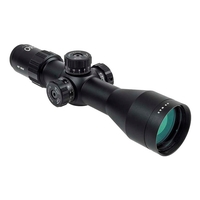
PAO HD MAX 4-16x44 SF FFP Ultra Compact Riflescope
via Uttings
£219.00
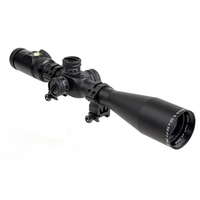
PAO F1 5-20x50 IR SF FFP Rifle Scope
via Uttings
£239.00

Wulf Tornado FFP 6-24x50 W-MIL3 Side Focus Rifle Scope
via BushWear
£249.99
Buying Advice
Understanding the key specifications helps you cut through marketing noise. The 6-24× magnification range gives a 4× erector ratio — enough versatility for most UK shooting without the optical compromises that extreme zoom ratios introduce. The 50 mm objective gathers good light but keeps the scope compact enough for most UK rifle stocks without excessively tall mounts. FFP means the MRAD reticle subtensions are valid at every power setting: 0.1 mil equals 1 cm at 100 metres, so a 0.5-mil hash mark always represents 5 cm at that distance regardless of zoom. Side-focus parallax adjustment — typically from around 10 yards to infinity — lets you eliminate parallax error at your specific shooting distance, which is critical for both close-range airgun work and longer centrefire engagements.
Budget tiers in the UK FFP market break down roughly as follows. Below £200 you find entry-level options that compromise on glass coatings and turret precision — serviceable for plinking but frustrating for serious work. Between £250 and £450 sits the competitive mid-range where the Element Helix lives alongside the Vortex Diamondback Tactical and Athlon Argos BTR Gen II; here you get usable turrets, decent glass clarity and genuine FFP reticles. From £500 to £900 you enter territory occupied by the Vortex Viper PST Gen II and Athlon Ares ETR, with noticeably better edge-to-edge sharpness and more refined turret feel. Above £1,000 the March, Swarovski and Zero Compromise optics deliver summit-level performance, but at a price that many UK club shooters cannot justify.
Common mistakes UK buyers make include fitting a heavy 50 mm-objective scope to a springer air rifle without considering recoil compatibility. Spring-piston air rifles produce a unique reverse recoil impulse that destroys internals in scopes not rated for it — the Helix is designed primarily for centrefire and PCP platforms, so check compatibility before mounting it on a break-barrel. Another frequent error is ignoring parallax adjustment range: if you shoot a sub-12 ft-lb air rifle at 25–35 yards, you need parallax that adjusts down to at least 10 yards, which the Helix offers, but many centrefire-oriented FFP scopes bottom out at 25 or even 50 yards. Finally, some buyers confuse MOA and MRAD turrets — the Helix is MRAD, so ensure your ballistic app, data cards and thinking are all in milliradians to avoid expensive confusion on the range.
For UK-specific context, sub-12 ft-lb air rifles in England and Wales require no licence but are humane-kill effective on quarry like rabbits and grey squirrels only to roughly 35–45 yards. An FAC-rated air rifle extends that range but still demands precise shot placement, and a quality FFP scope with fine parallax adjustment helps enormously. In Scotland, an Air Weapon Certificate is required for any air weapon. For centrefire stalking — roe, muntjac or fallow deer — the Helix's 6-24× range covers woodland stalking at lower magnifications and open-hill shots at higher powers. Respect close seasons: for example, roe bucks have an open season from 1 April to 31 October in England and Wales (dates differ in Scotland). Always confirm current legislation with your local police force or BASC rather than relying on any online guide, including this one.
Matching the Helix to your use case is straightforward. If you shoot NRL22 or rimfire benchrest, the FFP MRAD reticle and precise turret tracking are ideal, and the parallax adjustment range covers typical .22 LR distances. For PRS-style centrefire competition, the 6-24× range is competitive, though committed PRS shooters may eventually want the broader zoom range of a 5-25× or 5-27× optic. For deer stalking, the 6× low end is workable in woodland but not as immersive as a dedicated 2-12× or 3-18× hunting scope — consider whether you truly need 24× for your typical shot distances. And for FAC air rifle work at 50–80 yards, the Helix is genuinely excellent, offering the fine holdover capability and close parallax adjustment that PCPs demand.
The broader brand landscape matters when you are spending your money. Vortex's VIP lifetime warranty and enormous UK dealer network make them the safe default choice; Leupold offers superb American-made glass with a loyal UK following; Athlon delivers exceptional value across its BTR and ETR lines; and March remains the aspirational choice for UK precision-rifle competitors. Element Optics has earned its place in this conversation by offering a feature set that punches above its price bracket, but prospective buyers should ensure they purchase from an authorised UK dealer to secure warranty support. Pulsar and HikMicro dominate the thermal and night-vision segment, which is a different buying decision entirely — if you need a thermal scope for foxing, that is a separate guide. For daylight glass in the £250–£400 FFP bracket, the Element Helix 6-24×50 is a genuinely compelling option.
Frequently Asked Questions
Is the Element Helix 6-24×50 FFP suitable for sub-12 ft-lb air rifles?
It can work on PCP air rifles because they produce minimal recoil, and the side-focus parallax adjusts down to approximately 10 yards, which covers typical sub-12 ft-lb engagement distances of 25–45 yards. However, it is not rated for spring-piston or gas-ram air rifles, whose unique double-recoil impulse can destroy scope internals. If you shoot a springer, look for scopes specifically tested and warranted for that recoil profile.
What does first focal plane (FFP) actually mean, and why does it matter?
In an FFP scope the reticle is placed in front of the magnification-changing erector lens group, so the reticle scales up and down with the image as you change magnification. This means the subtension values — the distances represented by hash marks or dots — remain accurate at every zoom level. For MRAD users, 0.1 mil always equals 1 cm at 100 metres whether you are on 6× or 24×. In a second-focal-plane (SFP) scope, those values are only correct at one stated magnification, usually the highest.
MRAD or MOA — which turret system does the Helix use and does it matter?
The Element Helix 6-24×50 FFP uses MRAD (milliradian) turrets and reticle. One click is typically 0.1 MRAD, which equals 1 cm at 100 metres — a metric-friendly system that suits UK and European shooters. MOA (minute of angle) is the imperial-adjacent alternative: 1 MOA is roughly 1.047 inches at 100 yards, or about 2.9 cm at 100 metres. Neither system is inherently more accurate; choose whichever matches your ballistic calculator, data cards and training.
How does parallax adjustment work and why do I need it?
Parallax error occurs when the target image and the reticle are not on the same focal plane inside the scope, causing the point of aim to shift as you move your eye behind the eyepiece. The Helix's side-focus parallax knob lets you bring the target image into the same plane as the reticle at your specific shooting distance, eliminating this error. For airgun shooters engaging at 25–45 yards and centrefire shooters at 100–600 metres, correctly set parallax is essential for consistent accuracy.
Can I use the Element Helix for deer stalking in the UK?
Yes, the 6-24× magnification range covers most UK stalking scenarios, from close woodland shots on muntjac at 50–80 metres to open-ground roe deer at longer distances. The FFP MRAD reticle is useful for ranging and holdover. Bear in mind that 6× at the low end is adequate but not ideal for fast target acquisition in dense cover — dedicated stalking scopes often start at 2× or 3×. Ensure your rifle and calibre meet the minimum legal deer-legal requirements for the species and country you are hunting in.
How does the Element Helix compare to the Vortex Diamondback Tactical FFP?
Both scopes occupy a similar price bracket in the UK market and offer FFP MRAD reticles, side-focus parallax and exposed turrets. The Helix is often praised for slightly crisper glass and a more refined turret feel at the price point, while the Vortex benefits from an unconditional lifetime VIP warranty and a vast UK dealer network. Optical performance is close enough that your decision may come down to reticle preference, turret ergonomics and after-sales confidence.
Zero Compromise ZC527 5-27×56 FFP — how does it compare and is it worth the premium?
The ZC527 is a summit-tier optic costing several times more than the Element Helix, and it delivers accordingly: exceptional glass clarity, bombproof turret mechanics, and a broader 5-27× zoom range in a 56 mm package. UK PRS and F-Class competitors who have used one generally report outstanding tracking repeatability and superb low-light performance. Whether it is worth the premium depends entirely on your budget and competitive ambitions — for club-level shooting and stalking, the Helix offers remarkable value, but if you compete at national level, the ZC527 is in a different league.
Will the Element Helix survive springer air rifle recoil?
Spring-piston and gas-ram air rifles produce a violent double-recoil impulse — first rearward, then sharply forward — that is more destructive to scope internals than most centrefire cartridges. The Element Helix is not specifically marketed as springer-rated, and mounting it on a break-barrel springer risks damaging the erector assembly and voiding any warranty. If you shoot a springer, choose a scope explicitly tested and guaranteed for that recoil type, or switch to a recoilless PCP platform.
Where can I buy the Element Helix 6-24×50 FFP in the UK?
Several authorised UK optics retailers stock Element Optics, including online specialists and brick-and-mortar gun shops. Buying from an authorised dealer ensures you receive a genuine UK warranty and after-sales support. Prices fluctuate, so compare across multiple retailers, but be cautious with grey-market imports that may not carry a UK-valid warranty. Check Element Optics' own website for their current list of authorised UK dealers.
Related guides
Comprehensive UK guide to the Vortex Razor HD LHT FFP range. We cover reticle subtension, weight savings, MOA vs MRAD choices…
Vortex Viper PST Gen I 6–24×50 FFP EBR-1 MOA — Is It Worth £440?Is the Vortex Viper PST Gen I 6–24×50 FFP EBR-1 MOA scope still a smart buy in 2026? UK-focused buying guide covering specs, value, mounts…
FFP vs SFP Scopes: Which Suits Your Shooting?Confused by FFP and SFP rifle scopes? Our expert UK guide explains which reticle plane suits your discipline, from HFT to long-range PRS…
Best FFP Scopes UK: First Focal Plane Scopes ExplainedLooking for the best first focal plane (FFP) scope in the UK? We compare top-rated FFP scopes from Hawke, Vortex, Nightforce…
Nocpix D70R & NIR Series IR Illuminators ReviewedDiscover the Nocpix Nite D70R and NIR series infrared illuminators for UK night-vision shooting. We cover specs, range, wavelengths…
Smart Scopes with Ballistic Computers: SIG BDX & RivalsExplore SIG Bravo6T-BDX and similar rifle scopes with built-in ballistic computers. UK-focused buying guide covering specs, legality, budget tiers…
Not sure which scope is right for you?
Try our AI-powered scope finder — answer a few questions and get personalised recommendations.
Find My Scope →Get a UK scope tip every day
Follow AiScopes on Facebook for daily buying guides, deals and gear advice.
Follow on Facebook