Smart Scopes with Ballistic Computers: SIG BDX & Rivals
By Peter Makulek · Senior Optics Editor · · Live prices from UK retailers
The SIG Sauer Bravo6T-BDX represents a fascinating category of rifle scope: optics with an integrated ballistic computer that calculates holdover in real time and displays a corrected aiming point in your reticle. Rather than dialling turrets or memorising drop charts, the shooter pairs the scope with a rangefinder (in SIG's case, the KILO BDX series) via Bluetooth, and the system does the maths. For UK stalkers engaging roe or muntjac at variable distances across undulating Highland terrain or dense lowland woodland edges, this technology can genuinely shorten the decision cycle and increase first-round confidence at ethical ranges.
The concept is not unique to SIG. Several manufacturers now offer scopes or clip-on modules with onboard processing. Burris Eliminator, for instance, has offered a rangefinding scope with an integrated computer for years, while platforms like the Pulsar Thermion and HikMicro digital scopes incorporate ballistic calculators into thermal and night-vision-capable optics. At the premium end, dedicated smart-scope systems such as TrackingPoint have explored fully autonomous solutions, though these remain rare in the UK market. The key question for British shooters is which approach suits UK quarry, UK ranges, and UK legal frameworks.
Before diving into products, it is worth understanding what a ballistic computer actually does inside a scope. You input your cartridge data — muzzle velocity, ballistic coefficient, zero range, and environmental conditions — and the processor uses those variables to shift a dot or illuminate a specific part of the reticle at the correct holdover. SIG's BDX system uses Bluetooth Low Energy to receive range data from a paired KILO rangefinder, then lights a small dot in the scope's second focal plane reticle at the calculated aim point. Other systems use an internal laser rangefinder or rely on manual range input.
For UK shooters, this technology is most relevant on FAC-rated centrefire rifles used for deer stalking, fox control, or longer-range target shooting. Sub-12 ft-lb air rifles operate at ranges where holdover is modest and predictable, so a ballistic computer adds limited value — though FAC-rated air rifles extending effective range towards 80–100 yards could theoretically benefit. The real sweet spot is stalking with calibres like .243 Win, .308 Win, or 6.5 Creedmoor at 100–400 metres, where wind, angle, and range uncertainty can all affect point of impact meaningfully.
Top Picks — Live UK Prices

Richter Optik Crystal 4x20 Riflescope with Mounts
via BushWear
£9.99

Caldwell Orange Peel Silhouette Target 12x18 5pk
via BushWear
£10.39
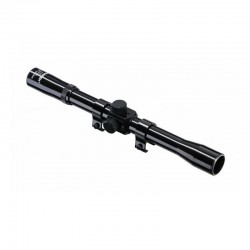
Umarex 4x20 Scope
via DAI Leisure
£19.95
Buying Advice
When evaluating a smart scope, start with the optical fundamentals before you even consider the electronics. The SIG Bravo6T-BDX is a 1–6× LPVO-class optic in the second focal plane, which means its BDX holdover dot is always correctly scaled regardless of magnification — a deliberate design choice. Competing systems may use FFP reticles where the subtension remains accurate across the zoom range, which can be advantageous if you also want to use the hash marks for wind holds. Check whether the scope's base reticle is calibrated in MOA or MRAD: SIG's BDX reticles are typically MOA-based, while European-leaning brands may favour MRAD (where 0.1 mil equals 1 cm at 100 metres). Parallax adjustment range matters too — most centrefire scopes adjust from around 45 metres to infinity, but if you intend to use the optic on a rimfire or FAC air rifle at closer distances, you will need a model that focuses down to 10–25 yards.
Budget tiers for smart scopes in the UK spread across a wide range. Entry-level systems such as certain Burris Eliminator configurations start from roughly £1,200–£1,500 for the scope alone. SIG's BDX scopes, including the Bravo6T-BDX, typically sit in the £900–£1,600 bracket depending on the specific model and magnification range, but remember you also need a compatible KILO rangefinder (around £300–£700), bringing the total system cost to £1,200–£2,300. At the upper end, premium thermal scopes from Pulsar or HikMicro with integrated ballistic calculators can reach £2,500–£5,000 or more. Traditional high-end optics from Swarovski, March, or Leupold generally do not include onboard computers, but pairing them with a standalone ballistic solver on your phone and a quality rangefinder can replicate much of the functionality for less outlay.
A common mistake UK buyers make is over-specifying their optic relative to the ranges they actually shoot. Most UK deer stalking takes place inside 200 metres, and a great many shots are under 120 metres. At those distances, a well-zeroed scope with a simple duplex reticle and solid knowledge of your cartridge's trajectory is often all you need. A ballistic computer adds genuine value when you regularly shoot beyond your zero range in unpredictable terrain — Scottish hill stalking for red deer, for example, or foxing across large arable farms. Buying a £2,000 smart scope system for 80-metre woodland roe stalking is arguably poor value when a £500–£800 conventional scope from Vortex, Athlon, or Leupold would serve just as well optically and mechanically.
UK-specific considerations extend beyond range and quarry. All scopes — smart or otherwise — mounted on firearms require the rifle itself to be legally held. In England and Wales, centrefire rifles demand a Firearms Certificate (FAC) with the specific calibre conditioned. Air rifles up to 12 ft-lb need no licence in England and Wales, though Scotland requires an Air Weapon Certificate for any air weapon. Night-vision and thermal clip-ons or dedicated scopes are legal to own and use in England and Wales for pest control and, with the landowner's permission and appropriate conditions on your FAC, for foxing and deer management at night under specific General Licences or individual authorisations. Always check with your local police firearms licensing department or contact BASC for current guidance. Purchase from reputable UK retailers who understand licensing requirements — many stock SIG BDX systems and comparable smart optics.
Matching the right smart scope to your use case is critical. If you are a hill stalker who frequently takes shots at varying distances in open terrain with a .308 or 6.5 Creedmoor, the SIG BDX ecosystem — pairing a Bravo5 or Sierra3BDX (higher magnification options in the BDX family) with a KILO rangefinder — offers a cohesive, relatively affordable solution. If your primary interest is foxing or pest control at night, a thermal scope from Pulsar (such as the Thermion 2 LRF with built-in rangefinder and ballistic calculator) or HikMicro may be more appropriate, combining detection, identification, and ballistic correction in one unit. For long-range target disciplines or PRS-style competition, most shooters prefer a high-quality conventional FFP MRAD scope from March, Vortex, or Athlon and run a Kestrel or phone-based ballistic solver — the flexibility and optical quality outweigh the convenience of an integrated computer.
The brand landscape for smart scopes is still maturing. SIG Sauer dominates the integrated-ecosystem approach with BDX, offering the tightest pairing between scope, rangefinder, and app. Burris has been in the rangefinding-scope space longest with the Eliminator series. Pulsar and HikMicro lead in thermal optics with ballistic features. Traditional optical powerhouses like Swarovski, Leupold, and March have so far chosen not to embed computers, instead focusing on optical excellence and mechanical precision — a philosophy many UK shooters still prefer. Weaver and other heritage brands remain largely in the conventional space. Expect this category to evolve rapidly: as processors shrink and power efficiency improves, it is likely that more mainstream scope manufacturers will offer integrated solutions within the next few years.
Frequently Asked Questions
How does the SIG BDX system actually work?
The SIG BDX ecosystem pairs a compatible scope (such as the Bravo6T-BDX) with a KILO-series rangefinder via Bluetooth Low Energy. You set up your ballistic profile in the SIG BDX app on your phone — entering muzzle velocity, ballistic coefficient, zero range, and environmental data — then sync it to both devices. When you range a target with the KILO, it sends the distance to the scope, which illuminates a small holdover dot at the calculated aim point in the reticle. The entire process takes roughly one to two seconds.
Is the Bravo6T-BDX FFP or SFP, and does it matter for the ballistic dot?
The Bravo6T-BDX is a second focal plane (SFP) scope, meaning the reticle size stays constant as you change magnification. The BDX holdover dot is electronically placed and always corresponds to the correct point of impact regardless of your zoom setting, so SFP is not a disadvantage for the ballistic function. However, the fixed reticle subtensions (hash marks) are only accurate at one specific magnification, typically the highest — something to bear in mind if you use the reticle for manual wind holds.
Can I use a smart scope like the BDX on a sub-12 ft-lb air rifle?
Technically yes, but practically it offers limited benefit. Sub-12 ft-lb air rifles are humane-kill effective on rabbits and grey squirrels out to roughly 35–45 yards, and pellet trajectories at those distances are predictable enough that a conventional scope with a simple reticle and known holdover points is perfectly adequate. The BDX system also requires a compatible KILO rangefinder, adding bulk and cost that is hard to justify for short-range airgun work. FAC-rated air rifles extending effective range towards 80–100 yards represent a marginally better case, but even there, a ballistic computer is a luxury rather than a necessity.
Are thermal scopes with ballistic calculators legal in the UK?
Thermal scopes and clip-on devices are legal to own in England and Wales. Their use for shooting is subject to the same firearms legislation as any other scope — the firearm itself must be legally held. For night shooting of foxes, thermal optics are widely used under appropriate permissions and conditions. Deer may only be shot at night in very limited circumstances with specific authorisation. Scotland and Northern Ireland have their own regulations. Always consult your local police firearms licensing team or BASC before using thermal optics for live quarry at night.
How do smart scopes compare to using a phone-based ballistic app with a conventional scope?
A phone-based ballistic solver (such as Applied Ballistics or Strelok) paired with a quality rangefinder and a conventional FFP MRAD scope can achieve similar accuracy of solution to an integrated smart scope. The advantage of the smart scope is speed and seamlessness — you do not need to look away from the optic to read your phone. The advantage of the conventional approach is optical quality, mechanical reliability, and flexibility: you can choose the best scope and the best solver independently. Many UK PRS and long-range target shooters prefer the latter approach, using a Kestrel with integrated ballistics.
What magnification range do I need for UK deer stalking with a smart scope?
Most UK deer stalking shots occur inside 200 metres, so a scope in the 2–12× or 3–18× range covers the vast majority of scenarios comfortably. The Bravo6T-BDX at 1–6× is optimised for close-to-mid-range engagement and is better suited to driven or woodland stalking than open-hill work. If you regularly stalk in open Scottish hill terrain and may need to identify and engage at 250–400 metres, a higher-magnification BDX model (such as the Sierra3BDX 4.5–14×44) or a conventional scope in the 4–16× or 5–25× class would be more appropriate.
Will a SIG BDX scope survive springer air rifle recoil?
Spring-piston air rifles produce a unique double-recoil impulse — a sharp rearward then forward jolt — that destroys many conventional scopes not designed for it. The Bravo6T-BDX is not marketed or warranted for spring-piston use, and its electronic components could be particularly vulnerable to this type of stress. If you shoot a springer, stick to scopes specifically rated for spring-piston recoil. Pre-charged pneumatic (PCP) air rifles do not produce this double recoil and are far kinder to all optics.
What batteries do smart scopes use and how long do they last?
The SIG BDX scopes typically use a single CR2032 coin cell to power the illuminated BDX reticle and Bluetooth module. SIG quotes battery life in the region of several hundred hours of active illumination use, though real-world life depends on brightness setting and Bluetooth activity. Thermal smart scopes from Pulsar and HikMicro use rechargeable lithium-ion battery packs, with run times of roughly 4–8 hours depending on the model. Always carry spare batteries or a charged spare pack on any outing.
Do I need to re-zero a BDX scope if I change my ballistic profile?
No — the physical zero of the scope remains unchanged. The BDX holdover dot moves electronically based on the ballistic profile you load via the app. If you switch between cartridges (for example, swapping the scope between a .243 and a .308), you update the profile in the app and re-sync. However, the scope's mechanical zero must correspond to the zero range entered in the profile, so if you physically re-mount the scope on a different rifle, you will need to re-zero at the range before the BDX corrections are accurate.
Related guides
Discover the best scope for rabbit shooting in the UK for 2026. Expert advice on magnification, parallax, reticles and budget picks for airgun pest…
Tract Tekoa HD & Top Hunting Scope Recommendations for UK StalkersReal-world feedback on the Tract Tekoa HD plus expert hunting scope recommendations for UK deer stalking.
Yishine AIM101: What UK Shooters Need to KnowConsidering the Yishine AIM101 rifle scope? Our UK-focused buying guide covers FFP reticle tech, parallax, magnification…
Not sure which scope is right for you?
Try our AI-powered scope finder — answer a few questions and get personalised recommendations.
Find My Scope →Get a UK scope tip every day
Follow AiScopes on Facebook for daily buying guides, deals and gear advice.
Follow on Facebook