Yishine AIM101: What UK Shooters Need to Know
By Peter Makulek · Senior Optics Editor · · Live prices from UK retailers
The Yishine AIM101 has been generating quiet buzz among UK shooters looking for a capable first-focal-plane rifle scope without the premium price tag attached to established brands like Vortex, Leupold, or March. As a relatively unknown name in the UK optics market, it raises obvious questions: can a budget-tier FFP scope deliver usable glass, reliable turrets, and an honest reticle? We are currently putting the AIM101 through its paces on the range, and while a full review is forthcoming, this guide addresses the buying decisions UK shooters should consider before committing their cash.
For UK hunters and target shooters, the scope you mount matters enormously — arguably more than any other single accessory. Whether you are lamping rabbits at 35 yards with a sub-12 ft-lb air rifle or reaching out to 300-plus yards with a centrefire FAC-rated rifle on roe deer, the wrong scope magnification, reticle type, or parallax setting can undermine accuracy and, in a hunting context, humane kills. The AIM101 positions itself as a do-it-all FFP optic, and we want to examine whether that claim holds water across real UK shooting disciplines.
First-focal-plane scopes have surged in popularity among UK PRS and long-range shooters because the reticle scales with magnification — your MRAD or MOA subtensions remain accurate at every power setting, not just one. This is a genuine tactical and practical advantage, especially when you need to range-find or hold over at a magnification you did not zero at. But FFP glass at the budget end can suffer from a reticle that is too fine at low power or too thick at high power, and optical clarity often takes a hit to fund the more complex erector system.
In this guide, we set out everything you need to evaluate the Yishine AIM101 — and any scope in its class — against the UK shooting landscape. We cover the technical fundamentals (FFP versus SFP, MOA versus MRAD, parallax adjustment), the legal context around UK air rifles and FAC-rated firearms, realistic engagement distances for common UK quarry, and how the AIM101 compares on paper to scopes from brands with deeper UK retail presence. Our full hands-on review will follow shortly on AIScopes.
Top Picks — Live UK Prices
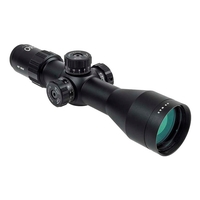
PAO HD MAX 4-16x44 SF FFP Ultra Compact Riflescope
via Uttings
£219.00
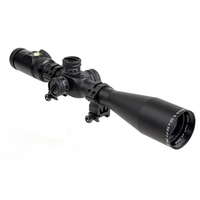
PAO F1 5-20x50 IR SF FFP Rifle Scope
via Uttings
£239.00

Wulf Tornado FFP 6-24x50 W-MIL3 Side Focus Rifle Scope
via BushWear
£249.99
Buying Advice
Start with the numbers. The Yishine AIM101 is marketed as an FFP scope with an MRAD reticle, which means each mil-radian subtension on the reticle corresponds to a real-world measurement at every magnification — 0.1 mil equals 1 cm at 100 metres, regardless of your zoom setting. Compare this with a second-focal-plane (SFP) scope, where those subtensions are only accurate at one magnification, typically the highest. If you plan to use your reticle for holdover or wind corrections (rather than dialling turrets), FFP is a meaningful advantage. However, confirm the AIM101's claimed click values and total elevation travel independently; budget scopes sometimes overstate their adjustment range.
In the UK market, rifle scopes sit in rough budget tiers. Below £100 you find entry-level SFP glass suited to sub-12 ft-lb airguns and rimfire plinking — brands like Hawke and MTC dominate here. From £150 to £350 you enter territory where Athlon, Vortex Crossfire and Diamondback lines, and some lesser-known imports like Yishine compete, often offering FFP reticles, MRAD turrets, and side-focus parallax. Above £400 you reach Vortex Viper and PST, Leupold VX-Freedom, and March entry models with noticeably better glass coatings. Premium spotting scopes and thermal or night-vision optics from Pulsar, HikMicro, and Swarovski occupy a different bracket entirely, often exceeding £1,000.
A common mistake among UK buyers is choosing a scope whose parallax adjustment does not suit their discipline. Airgun scopes need parallax correction down to roughly 10 yards — many centrefire-focused scopes bottom out at 50 yards or even 100 yards, which means the image will never be parallax-free at typical sub-12 ft-lb engagement distances of 25 to 45 yards. The AIM101's minimum parallax setting needs checking against your intended use. Equally, if you shoot a spring-piston air rifle, double recoil — the brutal forward lunge after the rearward kick — will destroy scopes not specifically rated for it. Gas-ram and PCP platforms are far gentler, but do verify any scope's springer compatibility before mounting it on a break-barrel.
UK-specific context matters. In England and Wales, air rifles producing up to 12 ft-lb of muzzle energy (and air pistols up to 6 ft-lb) can be owned without a firearms certificate, though age restrictions and safe-use laws still apply. Above those thresholds, the rifle is FAC-rated and you need a Firearms Certificate issued by your local police force. Scotland requires an Air Weapon Certificate for any air weapon regardless of power. Northern Ireland operates its own licensing framework. For centrefire deer stalking — roe, muntjac, and fallow are the most common UK species — minimum calibre and bullet-energy requirements apply, and close seasons vary by country and species. BASC and your local police firearms licensing department are the authoritative sources for your personal situation.
Match the scope to your actual use case, not aspirations. For HFT and benchrest field target shooting with a sub-12 air rifle, high magnification (10–16×) with fine parallax adjustment and a clean, uncluttered reticle is ideal — an FFP scope may be overkill and a well-specced rimfire SFP model could serve better. For FAC-rated centrefire stalking at variable ranges, a versatile magnification range (say 4–16× or 5–25×) with an illuminated reticle for dawn and dusk shots is more practical. For long-range target work and PRS-style competition, an FFP MRAD scope with exposed, locking turrets and a zero stop is the standard — and this is where the AIM101 theoretically competes. Consider what scope rings or mounts you need too; correct ring height and torque matter as much as the glass itself.
The brand landscape in UK optics is worth understanding. Vortex has built enormous UK market share through aggressive warranty policies and a broad product line from budget to mid-tier. Leupold and Swarovski hold the premium stalking and sporting market. March dominates high-end target and PRS. Thermal and night-vision scopes from Pulsar and HikMicro have transformed UK pest control and fox management over the past few years. Athlon and Weaver offer solid mid-range value. A newcomer like Yishine faces a trust deficit — UK shooters rightly want to know about warranty support, UK-based service, and whether the product will hold zero after 500 rounds. Our forthcoming review will address exactly that.
Frequently Asked Questions
Is the Yishine AIM101 a first-focal-plane or second-focal-plane scope?
The AIM101 is marketed as a first-focal-plane (FFP) scope. In an FFP design, the reticle is placed ahead of the magnification-changing lens group, so it scales proportionally as you adjust zoom. This means your MRAD or MOA subtensions remain dimensionally accurate at every magnification, which is a significant advantage for holdover shooting and range estimation without needing to be on one specific power setting.
Will the Yishine AIM101 survive on a spring-piston air rifle?
This is unconfirmed until we complete our testing. Spring-piston air rifles produce a unique double-recoil impulse — a rearward then violent forward lunge — that destroys many scopes not specifically engineered for it. Unless Yishine explicitly rates the AIM101 for springer use, we would recommend using it only on PCP air rifles, gas-ram guns, or firearms. If in doubt, contact the manufacturer or retailer directly before purchase.
Does the AIM101 have parallax adjustment, and will it work on an airgun at close range?
The AIM101 features a side-focus parallax adjustment dial. However, you must check its minimum parallax distance — many centrefire-oriented FFP scopes bottom out at 10 metres or even 50 yards, which is unsuitable for airgun use at 10–45 yards. For sub-12 ft-lb air rifle shooting, you ideally need parallax correction down to roughly 10 yards. We will test and report the exact minimum in our full review.
MRAD or MOA — which does the AIM101 use, and which should I choose?
The AIM101 uses an MRAD (milliradian) reticle and turret system. MRAD works in metric-friendly increments: 0.1 mil equals 1 cm at 100 metres. MOA (minute of angle) divides differently — 1 MOA is approximately 1.047 inches at 100 yards, or roughly 2.9 cm at 100 metres. Neither is inherently superior; choose whichever matches your training and any ballistic data you already use. In the UK, MRAD has become the more popular choice for PRS and long-range disciplines.
How does the Yishine AIM101 compare to a Vortex Diamondback Tactical?
On paper, both are budget-to-mid-tier FFP scopes with MRAD reticles and side-focus parallax. The Vortex Diamondback Tactical benefits from Vortex's VIP unlimited lifetime warranty, extensive UK dealer network, and a well-proven track record. The AIM101 may undercut it on price, but questions around warranty support, UK service infrastructure, and long-term durability remain unanswered until more field data accumulates. We will directly compare optical clarity, turret feel, and tracking in our review.
What magnification range does the AIM101 offer, and is it enough for UK hunting?
Exact specifications should be confirmed against the latest Yishine product listing, but scopes in this class typically offer a variable zoom range such as 4–16× or 6–24×. For UK hunting — rabbits and corvids with air rifles at sub-50-yard ranges, or deer stalking at 100–250 yards — a range starting around 3–4× and reaching 12–16× covers most practical scenarios. Higher magnification is useful for target shooting but can hinder field of view and low-light performance when stalking at dawn or dusk.
What scope rings or mounts do I need for the AIM101?
You need to match ring diameter to the scope's main tube — likely 30 mm on the AIM101, though verify this before purchasing. Ring height must be sufficient that the objective bell clears the barrel or rail without touching. For Picatinny or Weaver rails, standard tactical rings work; for dovetail-mounted air rifles, you will need dovetail-to-Picatinny adapters or dedicated dovetail rings. Proper torque settings and a secure, level mount are critical for consistent zero.
Is the Yishine AIM101 suitable for UK rimfire target shooting?
A rimfire scope needs to handle relatively close engagement distances — often 25 to 100 yards — and ideally offer parallax adjustment down to at least 25 yards. If the AIM101's parallax range accommodates this, it could work well for rimfire benchrest or informal target sessions. Rimfire .22 LR generates negligible recoil, so scope durability under recoil is rarely an issue. The FFP reticle would be beneficial if you shoot at varied distances without re-zeroing.
Where can I buy the Yishine AIM101 in the UK?
As a newer brand, Yishine products are primarily available through online marketplaces and specialist import retailers rather than established UK optics dealers. This can complicate warranty claims and returns. We recommend purchasing from a seller with a UK returns address and checking whether any UK distributor offers local warranty support. Established alternatives from Vortex, Athlon, or Hawke are stocked widely by UK retailers such as Uttings, John Rothery, and Bushcraft Store, offering easier after-sales service.
Related guides
First look at the Goyojo GRL635 640 thermal scope for UK shooters. We explore its 640-resolution sensor, key specs…
Best FFP Scopes UK: First Focal Plane Scopes ExplainedLooking for the best first focal plane (FFP) scope in the UK? We compare top-rated FFP scopes from Hawke, Vortex, Nightforce…
Pulsar Helion XP38 Thermal Monocular GuideComprehensive UK buyer's guide to the Pulsar Helion XP38 thermal monocular. Covers specs, use cases, budget tiers…
Urban Precision Rifle Optics: UK Buyer's GuideChoosing a scope for urban precision rifle shooting in the UK? Our 2026 guide covers magnification, reticle, turret specs…
Not sure which scope is right for you?
Try our AI-powered scope finder — answer a few questions and get personalised recommendations.
Find My Scope →Get a UK scope tip every day
Follow AiScopes on Facebook for daily buying guides, deals and gear advice.
Follow on Facebook