Vortex Razor HD LHT FFP — What UK Shooters Need to Know
By Peter Makulek · Senior Optics Editor · · Live prices from UK retailers
The Vortex Razor HD LHT line has earned a loyal following among UK stalkers and target shooters who need premium glass without the bulk of a full tactical tube. With the introduction of first-focal-plane variants, Vortex has answered a persistent request from UK long-range and precision rifle shooters: give us the optical quality and featherweight profile of the LHT, but with an FFP reticle whose subtensions remain accurate at every magnification setting. For anyone who has wrestled a heavy 34 mm tactical scope across a Scottish hillside during a hind cull, the appeal is immediately obvious.
FFP scopes are no longer a niche curiosity in the UK. Practical Rifle, F-Class, and NRL-style precision competitions have all driven demand, and the growing popularity of long-range deer management — particularly on open hill ground — means more FAC-rated rifles are being topped with optics that let the shooter range, hold off for wind, and confirm subtension-based drops without needing to dial every time. The Razor HD LHT FFP sits squarely at that crossover between hunting fieldcraft and genuine long-range competence.
Choosing an FFP scope for UK use raises specific questions that a generic American buying guide will not cover. Our typical engagement distances for deer stalking are far shorter than on a Wyoming ranch, so the low-end magnification behaviour of the reticle matters more to us. Our weather is consistently poor, so optical coatings must cope with persistent low light, drizzle, and temperature swings from dawn sits in February to summer fox control at last light. And our legal framework — FAC calibres only for centrefire, with strict conditions on where and how you shoot — means every piece of kit must be chosen with purpose, not just aspiration.
In this guide we examine the Razor HD LHT FFP models in detail: what distinguishes them from the existing SFP LHT variants, how they compare with alternatives from Nightforce, March, Leupold, and Schmidt & Bender, and whether the premium price tag is justified for your specific discipline. We also answer the most common technical questions UK buyers are asking about FFP reticle legibility, parallax adjustment, and MOA versus MRAD selection.
Top Picks — Live UK Prices
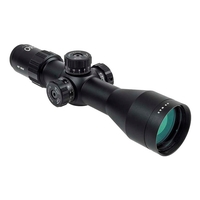
PAO HD MAX 4-16x44 SF FFP Ultra Compact Riflescope
via Uttings
£219.00
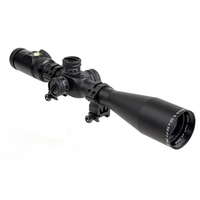
PAO F1 5-20x50 IR SF FFP Rifle Scope
via Uttings
£239.00

Wulf Tornado FFP 6-24x50 W-MIL3 Side Focus Rifle Scope
via BushWear
£249.99
Buying Advice
The headline specification of any FFP scope is that the reticle scales proportionally with the image as you change magnification. In practical terms this means the mil or MOA hash marks on your reticle subtend correctly at every power setting — not just at a single reference magnification as with SFP designs. On the Razor HD LHT FFP, that means you can hold off for a 0.5 mil wind correction at 6× just as accurately as at 18× or 24×, which is extremely useful during a rapid engagement on a fox at an awkward angle. The trade-off is that the reticle appears very fine at low magnification, which can make it harder to acquire in poor light or against cluttered backgrounds. Vortex partially addresses this with etched illumination, but you should always test low-power legibility in person before committing.
In the UK market, the Razor HD LHT FFP models typically sit in the £1,200–£1,800 bracket depending on the specific magnification range and retailer. Below that tier, scopes like the Vortex Viper PST Gen II or Bushnell Match Pro offer FFP capability from roughly £500–£900, but with heavier builds and less refined glass. Above the LHT, you enter the territory of Nightforce NX8 and ATACR models (£1,600–£2,800), March FX series (£1,800–£3,000+), and Schmidt & Bender PM II variants that can exceed £3,000. The LHT FFP occupies a compelling mid-premium position: genuinely high-end APO optical design and HD glass at a weight and price point that undercuts the full tactical flagships.
A common mistake among UK buyers is purchasing an FFP scope with too high a maximum magnification for their actual shooting discipline. If your primary use is roe stalking in woodland at 60–180 yards, a 4.5-22× FFP scope is largely wasted — the reticle at 4.5× will be tiny, and you will rarely if ever use 22×. A 3-15× or 3-18× LHT FFP would be a far better match, offering a more usable reticle at the bottom end and a wider, brighter field of view for snap shots in cover. Another frequent error is assuming FFP is universally superior to SFP. For driven game, walked-up rough shooting, or sub-12 ft-lb airgun work at close range, an SFP scope with a bold duplex reticle is often the better tool. FFP earns its keep specifically when you need to use reticle-based holdovers or rangefinding at variable magnifications.
UK-specific context matters enormously when selecting this class of optic. If you are stalking deer under your FAC conditions, you may be restricted to certain calibres and certain land — your scope choice should reflect the realistic distances and terrain of your permissions, not theoretical 1,000-yard capability. For hill stalking in Scotland, the combination of lightweight build, excellent twilight performance, and reliable subtension at any magnification makes the LHT FFP genuinely practical. For English woodland stalking on roe and muntjac, you might find the standard SFP LHT or even a high-quality Leupold VX-5HD equally capable at a lower outlay. Always buy from an authorised UK dealer — firms like Optics Warehouse, RUAG UK, or your local RFD — to ensure your Vortex VIP warranty is valid and you have UK-based support.
Matching the scope to your use case is ultimately about honesty. If you shoot PRS-style matches, NRL22, or F-Class at 600 yards and beyond, the LHT FFP in MRAD with a Christmas-tree reticle is an outstanding choice that punches well above its weight class. If you are a pure stalker who dials for longer shots but primarily uses a simple hold at moderate range, you might prefer the MOA variant with a less busy reticle, or even the SFP LHT with its bolder low-power presentation. For fox and corvid control at night with a clip-on thermal from Pulsar or HikMicro, ensure the scope's objective bell and eye relief allow the thermal unit to mount cleanly — the LHT's 50 mm objective models generally pair well, but always check compatibility with your specific thermal device before purchase.
The broader brand landscape in this segment is intensely competitive. Vortex's key advantage remains the unconditional VIP lifetime warranty, which is honoured in the UK through their European service centre — a genuine differentiator if you use your scope hard in poor conditions year-round. Nightforce offers arguably the most rugged mechanicals in the business, but at a higher price and usually greater weight. March delivers extraordinary optical clarity and Japanese precision engineering, though UK stock and service can be slower. Leupold's latest Mark 4HD and Mark 5HD FFP models compete closely on weight and American-made cachet. Schmidt & Bender remains the benchmark for European military and professional optics, but at a price that puts it beyond most recreational shooters. Where the Razor HD LHT FFP excels is in offering a genuinely premium optical experience — APO-system glass, excellent mechanical tracking, and class-leading weight — at a price that, while not cheap, is realistic for a serious UK shooter investing in a scope they intend to use for a decade or more.
Frequently Asked Questions
What is the difference between the Vortex Razor HD LHT FFP and the standard SFP version?
The core optical system and mechanical build are very similar, sharing the same APO-system HD glass and lightweight 30 mm tube construction. The key difference is reticle placement: the FFP version places the reticle in the first focal plane so that all subtension markings (mil or MOA hash marks) remain dimensionally accurate at every magnification setting. The SFP version has a reticle that stays the same apparent size regardless of zoom, with subtensions only correct at one reference magnification — typically the highest. This makes the FFP model better suited to shooters who use reticle holdovers at varying power levels.
Is the FFP reticle too fine to see at low magnification?
This is a legitimate concern with all FFP scopes. At the lowest magnification settings, the reticle in an FFP design shrinks proportionally and can become difficult to pick up against dark or cluttered backgrounds. Vortex mitigates this with centre-dot illumination, which helps enormously in low light or against woodland backgrounds. In practice, most UK stalkers report that the illuminated centre is perfectly usable at 3× or 4.5× for close-range snap shots, but the finer subtension markings are only really readable from around 8-10× upward.
Should I choose the MOA or MRAD version for UK use?
Neither system is inherently superior — the choice is primarily about which language you already think in. MRAD (milliradians) is the dominant system in UK precision rifle competition and military use, and most UK ballistic solvers and data cards default to mils. MOA offers finer angular adjustment per click (typically 0.25 MOA versus 0.1 MRAD) but the practical difference is negligible. If you are new to long-range shooting and plan to attend UK PRS or NRL-style events, MRAD is the more common standard and will make sharing data with other shooters easier.
Can I use the Razor HD LHT FFP on a sub-12 ft-lb air rifle?
You could physically mount it, but it would be a poor match for several reasons. Sub-12 ft-lb air rifles are effective to roughly 35-45 yards on quarry like rabbit and grey squirrel, so the long-range subtension markings in the FFP reticle would serve no purpose. More critically, airgun scopes need parallax adjustment down to around 10 yards, whereas the LHT FFP's parallax typically adjusts from 25 or 50 yards to infinity. Additionally, if mounted on a spring-piston air rifle, the bidirectional recoil could damage any scope not specifically rated for springer use. A dedicated airgun scope is a far better investment for that application.
How does the Razor HD LHT FFP compare with the Nightforce NX8 for UK stalking?
Both are excellent lightweight FFP scopes aimed at shooters who want precision capability without excessive bulk. The NX8 uses a compact 30 mm tube and is slightly shorter, making it very popular on shorter-action rifles. Optical clarity is comparable, though many users find the LHT has a slight edge in chromatic aberration control thanks to its APO lens system. The NX8 tends to cost more in the UK — often £200-£400 more depending on the reticle option. The Vortex VIP warranty is arguably more comprehensive. Both are strong choices; the NX8 may suit those who prioritise the most compact possible package.
Is the turret tracking on the LHT FFP reliable enough for dialling at long range?
Independent tracking tests generally show the Razor HD LHT FFP to track very accurately and repeatably through its adjustment range. The turrets offer a clean, positive feel with audible clicks, and the zero-stop mechanism prevents you from dialling below your confirmed zero. For UK long-range disciplines where you might be engaging steel from 300 to 1,000 yards, the tracking is well within the standard expected at this price point. That said, if you are a dedicated F-Class or ELR shooter who demands the absolute last word in mechanical precision, scopes from March or Schmidt & Bender at higher price points may offer marginally tighter tolerances.
What magnification range in the LHT FFP is best for UK deer stalking?
For the majority of UK deer stalking — encompassing roe and muntjac in English woodland through to red and sika on open hill — a 3-15× or 3-18× model is the most versatile choice. The 3× bottom end gives a wide, bright field of view for close encounters in cover or at dawn, while 15-18× is more than sufficient for precise shot placement out to the distances most UK stalkers will realistically engage deer. A 4.5-22× or 5-25× model adds magnification you are unlikely to use in the field and reduces low-end versatility, though it may suit those who also compete at longer ranges.
Does the LHT FFP work well with clip-on thermal imagers for foxing?
The LHT FFP is commonly paired with clip-on thermal devices from Pulsar and HikMicro for night-time fox control under FAC conditions. The 50 mm objective models provide a good optical path for most clip-on units, and the generous eye relief (typically around 95-100 mm) helps maintain a comfortable shooting position with the added length of a thermal device on the objective end. Always verify physical compatibility with your specific thermal unit — mounting adapter diameter, focal alignment, and overall balance on the rifle all matter. Some users find a lightweight scope like the LHT particularly beneficial here, as the clip-on thermal adds significant weight to the front of the rifle.
Where should I buy the Vortex Razor HD LHT FFP in the UK?
Purchase from an authorised Vortex UK dealer to ensure your VIP lifetime warranty is valid. Established UK retailers such as Optics Warehouse, Edgar Brothers stockists, and specialist RFDs who carry the Vortex range are reliable sources. Buying from grey-market or overseas sellers may save a small amount initially but can void your warranty and complicate any future service claims. Prices in the UK typically range from around £1,200 to £1,800 depending on the model, and some dealers offer interest-free credit or part-exchange against your existing optic.
Related guides
Is the Vortex Viper PST Gen I 6–24×50 FFP EBR-1 MOA scope still a smart buy in 2026? UK-focused buying guide covering specs, value, mounts…
Premium PRS Scopes Compared: ATACR vs Razor Gen 3 vs Mark 5HD vs NX6Nightforce ATACR, Vortex Razor HD Gen III, Leupold Mark 5HD and NX6 compared for UK PRS shooters — real trade-offs and honest opinions at the £1,800+…
Element Helix 6-24×50 FFP — Is It Worth It?Element Helix 6-24×50 FFP rifle scope reviewed for UK shooters. We cover FFP reticle benefits, MRAD turrets, parallax setup…
How to Choose Your Next Optic in 2026Expert UK guide to choosing a new rifle optic in 2026. FFP vs SFP, MOA vs MRAD, parallax explained, budget tiers in GBP…
Is MRAD Worth It for UK Shooters?Wondering if MRAD is worth the investment for UK shooting? Our 2026 guide covers mil-rad turrets, reticles, budget tiers in GBP…
Read next
- Vortex Optics UK
Vortex Optics UK: The Complete Vortex Scopes Guide for 2026
Not sure which scope is right for you?
Try our AI-powered scope finder — answer a few questions and get personalised recommendations.
Find My Scope →Get a UK scope tip every day
Follow AiScopes on Facebook for daily buying guides, deals and gear advice.
Follow on Facebook