How to Choose Your Next Optic in 2026
By Peter Makulek · Senior Optics Editor · · Live prices from UK retailers
Choosing a new optic is one of the most consequential decisions a UK shooter can make, yet it is also one of the most bewildering. Whether you are mounting glass on a sub-12 ft-lb springer for rabbit lamping in the hedgerows of Hampshire or fitting a long-range scope to a FAC-rated .308 for Highland stalking, the sheer variety of reticle planes, turret systems, and magnification ranges can paralyse even experienced shooters. This guide cuts through the noise and gives you a structured framework to match an optic to your actual shooting discipline, quarry, and budget — all from a UK-market perspective.
The UK shooting landscape is distinct from almost anywhere else in the world. Our legal framework means many airgunners in England and Wales shoot without a licence at sub-12 ft-lb, producing humane kills on rabbits and grey squirrels out to roughly 35–45 yards at most. Step above that threshold and you need a Firearms Certificate; Scotland requires an Air Weapon Certificate for any air weapon. These realities shape which optics make sense: a sub-12 springer demands a scope that handles brutal double-recoil and focuses down to 10 yards, while a centrefire stalking rifle needs robustness, clarity at dawn, and reliable zero retention across temperature swings.
In 2026 the market has never been broader. First focal plane scopes, once the preserve of military and PRS competitors, have trickled down to accessible price points from brands like Vortex and Bushnell. Meanwhile, March and Nightforce continue to set the benchmark at the premium end, and thermal units from Pulsar and Hikmicro have matured into genuine all-round tools. Schmidt & Bender and Leupold still command fierce loyalty among stalkers and benchrest shooters respectively. Understanding what separates a £150 airgun scope from a £3,000 tactical optic — and whether you actually need the latter — is the core purpose of this guide.
We will walk you through the key technical decisions first: FFP versus SFP, MOA versus MRAD, parallax adjustment, and glass quality. Then we highlight products worth shortlisting across several price tiers, before diving into buying advice that covers common UK mistakes, budget expectations in pounds sterling, and how to match a scope to your specific use case — whether that is HFT competition, lamping, deer management, or long-range target work on MOD ranges.
Top Picks — Live UK Prices
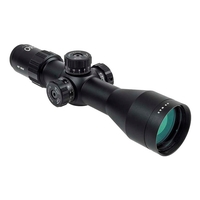
PAO HD MAX 4-16x44 SF FFP Ultra Compact Riflescope
via Uttings
£219.00
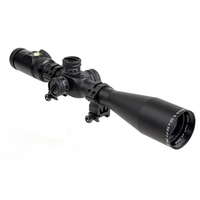
PAO F1 5-20x50 IR SF FFP Rifle Scope
via Uttings
£239.00

Wulf Tornado FFP 6-24x50 W-MIL3 Side Focus Rifle Scope
via BushWear
£249.99
Buying Advice
Understanding the key specifications is the foundation of a good purchase. First focal plane (FFP) reticles scale with magnification, meaning your holdover marks and windage dots remain accurate at every power setting — essential for PRS or any discipline where you dial and hold at varying magnifications. Second focal plane (SFP) reticles stay the same size regardless of zoom and are only dimensionally correct at one magnification (usually the highest), which is perfectly adequate for stalking or HFT where you tend to shoot at a single power. MOA turrets adjust in fractions of an inch at 100 yards (1 MOA ≈ 1.047 inches at 100 yards), while MRAD turrets work in milliradians (0.1 mil = 1 cm at 100 metres). MRAD's metric basis makes it a natural fit for UK shooters who range and calculate in metres, but MOA's finer clicks can appeal to benchrest competitors chasing tiny groups.
Budget tiers in 2026 break down roughly as follows. Below £200 you will find competent SFP scopes suitable for sub-12 ft-lb airguns — brands like Bushnell and entry-level Vortex offerings sit here, often with adjustable objective (AO) parallax down to 10 yards, which is vital for close-range airgun work. Between £200 and £600 the market opens up considerably: expect exposed turrets, FFP reticles, side-focus parallax, and improved glass coatings. From £600 to £1,200 you enter semi-premium territory — Vortex Viper and Leupold Mark 5HD models compete fiercely, delivering excellent tracking, edge-to-edge clarity, and robust warranties. Above £1,200 sit the flagship optics from March, Nightforce, and Schmidt & Bender, where optical performance, mechanical precision, and build quality are genuinely best-in-class.
Common mistakes UK buyers make include over-magnifying for their discipline and ignoring parallax requirements. A 6–24× scope sounds impressive, but on a sub-12 ft-lb air rifle shooting rabbits at 30 yards you rarely need more than 12×, and the extra bulk and weight penalise you in the field. Another frequent error is mounting a non-springer-rated scope on a break-barrel air rifle. Spring-piston guns produce a unique double-recoil — rearward then sharply forward — that destroys conventional scopes designed for centrefire recoil alone. Always confirm the manufacturer rates the scope for spring-piston use, or choose a gas-ram or PCP platform instead. Finally, buying from grey-market imports to save £50 often voids the UK warranty, leaving you with no recourse if the scope fogs or the turrets slip.
UK-specific context matters more than many buyers realise. In England and Wales, air rifles up to 12 ft-lb (and air pistols up to 6 ft-lb) can be held without a licence; above those limits a Firearms Certificate is required. Scotland mandates an Air Weapon Certificate for any air weapon. Northern Ireland operates under a separate regime. If you are unsure which category applies to you, contact your local police firearms licensing department or consult BASC. For centrefire stalkers, the open seasons for roe, muntjac, and fallow deer vary by country and sex — check the Deer Initiative or NatureScot guidance before heading out. Thermal optics from Pulsar and Hikmicro have become popular for foxing and pest control, but be aware that using thermal as a weapon sight (as opposed to a spotter) may carry additional conditions on your FAC.
Matching the optic to your use case is ultimately more important than chasing brand prestige. An HFT or field target competitor benefits from a high-magnification SFP scope with a fine reticle and parallax adjustable down to roughly 8–10 yards — the parallax wheel itself doubles as a rangefinder in competition. A deer stalker needs moderate magnification (perhaps 3–12× or 2.5–10×), a simple reticle with a clear centre dot for low-light dawn shots, and absolute mechanical reliability in Scottish rain. A PRS or NRL competitor in the UK needs an FFP MRAD scope with precise, repeatable turrets, a zero stop, and enough elevation travel for 1,000-yard engagements. Buy for the shooting you actually do, not the shooting you fantasise about.
The brand landscape in 2026 rewards research. Vortex remains the default recommendation for mid-range budgets thanks to its unconditional lifetime warranty, UK-based service, and broad product line spanning airgun-rated Crossfire IIs to the high-end Razor HD Gen III. Leupold offers outstanding American-made glass with a bias toward light weight and clarity — the VX-5HD is a stalking favourite. Nightforce and March dominate the competitive and long-range segments, with the March Genesis and Nightforce ATACR being benchmarks for tracking accuracy and optical quality. Schmidt & Bender occupies a similar tier with a strong European heritage and loyal UK following among professional deer managers. For thermal, Pulsar and Hikmicro lead the UK market, with Pulsar's Thermion 2 line and Hikmicro's Thunder series offering compelling options at different price points. Bushnell rounds out the entry tier with solid, affordable scopes that punch above their weight.
Frequently Asked Questions
What does FFP mean and do I need it?
FFP stands for first focal plane, meaning the reticle scales proportionally as you change magnification. This keeps all holdover marks, mil-dots, and windage references accurate at every zoom level, which is critical for PRS competitors and long-range shooters who hold off at varying magnifications. If you shoot at a fixed magnification — as most stalkers and airgunners do — an SFP (second focal plane) scope is perfectly adequate and often cheaper.
Should I choose MOA or MRAD turrets?
MRAD (milliradian) turrets work in metric-friendly units: 0.1 mil equals 1 cm at 100 metres, making mental arithmetic straightforward for UK shooters who think in metres. MOA (minute of angle) turrets offer finer per-click adjustments — typically ¼ MOA (about 0.7 cm at 100 m) — which can benefit benchrest shooters chasing tiny groups. Neither is objectively superior; choose whichever system you are comfortable calculating with, and ensure your reticle matches your turret unit to avoid confusion.
Why does parallax matter for airgun scopes?
Parallax error occurs when the target image and the reticle are not on the same focal plane, causing apparent reticle shift as you move your eye. At airgun distances — often 10 to 50 yards — this error is magnified because the parallax-free distance on many centrefire scopes is factory-set at 100 yards or more. Airgun-specific scopes allow parallax adjustment down to roughly 8–10 yards, eliminating this error and also serving as a crude rangefinder in HFT competition.
Can I use any scope on a spring-piston air rifle?
No. Spring-piston (springer) air rifles produce a unique double-recoil: the piston slams forward, jolting the rifle rearward, then the compressed air drives it sharply forward. This bidirectional shock destroys scopes designed only for conventional rearward recoil. Always choose a scope explicitly rated for spring-piston or magnum airgun use, or switch to a PCP or gas-ram rifle that produces far less recoil stress on optics.
Do I need a licence to own an air rifle scope in the UK?
A scope on its own is not a regulated item and requires no licence to purchase or own anywhere in the UK. However, the air rifle it is mounted on may require certification. In England and Wales, air rifles producing up to 12 ft-lb (and air pistols up to 6 ft-lb) need no licence; above that they are FAC-rated. Scotland requires an Air Weapon Certificate for any air weapon. Northern Ireland has its own separate regime. Contact your local police firearms licensing department or BASC for guidance specific to your circumstances.
How much should I spend on a rifle scope in 2026?
Budget depends on discipline. For sub-12 ft-lb airgun work, scopes in the £100–£200 bracket from Bushnell or Vortex are genuinely capable. Centrefire stalking and club-level target shooting are well served between £300 and £700, where Leupold, Vortex Viper, and Bushnell Forge models offer strong glass and reliable turrets. Competitive PRS shooters and serious long-range enthusiasts typically invest £1,000–£3,000-plus in optics from March, Nightforce, or Schmidt & Bender. As a rough rule, budget at least as much for your optic as for the rifle itself — you shoot through the scope, not through the barrel.
Is a thermal scope worth the money for UK pest control?
Thermal optics from Pulsar and Hikmicro have transformed foxing and rabbit control at night, allowing positive target identification in total darkness without auxiliary illumination. Prices have fallen significantly, with capable clip-on and dedicated thermal scopes now available from around £1,000 upward. Be aware that using a thermal as a weapon sight (rather than a handheld spotter) may carry specific conditions on your Firearms Certificate, so check with your licensing authority before fitting one to a centrefire rifle.
What magnification range suits UK deer stalking?
Most UK stalkers favour moderate magnification in the 2.5–10× or 3–12× range. High magnification is rarely needed because typical UK stalking shots are taken inside 200 metres — often much closer in woodland. A lower minimum magnification (2× or 3×) provides a wide field of view for close encounters in thick cover and at dawn, while the upper end handles open-hill shots on Scottish roe or Highland red deer. Prioritise optical clarity and light transmission over raw magnification numbers.
What is a zero stop and do I need one?
A zero stop is a mechanical limit built into the elevation turret that prevents you from dialling below your confirmed zero. After ranging a distant target and dialling up, you can rapidly return to zero by spinning the turret back until it stops — no counting clicks, no guessing. It is essential for long-range and PRS competition where fast transitions between distances are common, but less critical for stalkers or airgunners who rarely adjust turrets in the field.
Related guides
Wondering what an optic riser does and whether you need one? Our UK-focused 2026 guide explains heights, compatibility…
Snapped Optic Screw: What to Do Next & How to Prevent ItSnapped a screw on your rifle scope mount? Our 2026 UK guide explains extraction, prevention, correct torque specs, and choosing mounts that last.
Is MRAD Worth It for UK Shooters?Wondering if MRAD is worth the investment for UK shooting? Our 2026 guide covers mil-rad turrets, reticles, budget tiers in GBP…
Infiray TH50 V2 Thermal Scope — Is £1,600 the Sweet Spot?Is the Infiray TH50 V2 thermal scope worth £1,600 for UK night shooting? Our 2026 guide covers specs, detection range, rivals, and where to buy in the UK.
Not sure which scope is right for you?
Try our AI-powered scope finder — answer a few questions and get personalised recommendations.
Find My Scope →Get a UK scope tip every day
Follow AiScopes on Facebook for daily buying guides, deals and gear advice.
Follow on Facebook