Is MRAD Worth It for UK Shooters?
By Peter Makulek · Senior Optics Editor · · Live prices from UK retailers
"Is MRAD worth it?" is one of the most common questions we receive from UK shooters stepping beyond casual plinking or short-range rabbit control and into disciplines where precise, repeatable adjustments matter — whether that is Precision Rifle Series (PRS) competition, long-range deer stalking, or extended-range varminting on FAC-rated platforms. The short answer is that MRAD (milliradian) turrets and reticles offer a mathematically elegant system that pairs beautifully with the metric measurements most UK shooters already think in. But the longer answer depends entirely on your discipline, your budget, and how much time you are willing to invest in learning the system properly.
MRAD — often called "mil" — divides one radian into a thousand parts. At 100 metres, one milliradian subtends exactly 10 centimetres, and most MRAD scopes click in 0.1 mil increments, meaning each click shifts point of impact by 1 cm at 100 m. This clean, decimal-based relationship makes mental arithmetic in the field far simpler than the imperial-rooted MOA system, where 1 MOA equals roughly 1.047 inches at 100 yards and adjustments typically come in ¼ MOA clicks. For UK shooters who habitually range in metres and measure groups in centimetres, MRAD is the more intuitive language.
The relevance of MRAD to your shooting depends heavily on range. If you are running a sub-12 ft-lb air rifle at rabbits inside 40 yards, the difference between MRAD and MOA is largely academic — you will likely zero and leave turrets alone. Where MRAD truly earns its keep is at 300 metres and beyond: stalking with a .308 or 6.5 Creedmoor, competing in NRL/PRS-style matches, or engaging steel at distance with a .338 Lapua Magnum. The ability to quickly hold off for wind and elevation using a first-focal-plane mil reticle, then confirm and dial corrections in the same unit, removes an entire layer of conversion error.
In this guide we examine the MRAD system honestly — its genuine advantages, its limitations, what it costs in real-world GBP terms across budget tiers, and how it fits the UK shooting landscape from Bisley ranges to Highland stalking. We also address common misconceptions, recommend scopes from brands UK shooters trust, and answer the specific questions our readers keep asking. Whether you are upgrading from a bundled scope on your first centrefire rifle or choosing glass for serious competition, this guide will help you decide whether MRAD is worth it for you.
Top Picks — Live UK Prices

Richter Optik Crystal 4x20 Riflescope with Mounts
via BushWear
£9.99

Caldwell Orange Peel Silhouette Target 12x18 5pk
via BushWear
£10.39
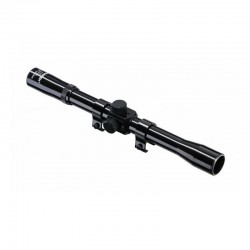
Umarex 4x20 Scope
via DAI Leisure
£19.95
Buying Advice
Understanding the key specifications is essential before committing to MRAD glass. A 0.1 mil click — the standard — moves your point of impact by 1 cm at 100 m, 2 cm at 200 m, and so on. This linear scaling is what makes the system so powerful for holdovers and wind calls. Most quality MRAD scopes feature a first-focal-plane (FFP) reticle, meaning the subtension markings remain accurate at every magnification, not just one reference setting. If a scope is second-focal-plane (SFP) with an MRAD reticle, the hash marks are only true at one stated magnification — usually the highest. For target and tactical use, FFP is strongly preferred. Also check total elevation travel: a scope offering 25 mils of internal adjustment is far more versatile for extreme long range than one with only 15 mils. Zero-stop mechanisms, which prevent you from dialling below your zero, are another feature that becomes genuinely useful once you start adjusting turrets in the field rather than holding with the reticle.
Budget tiers in the UK MRAD market break down roughly as follows. Below £400 you will find entry-level FFP MRAD options from brands like Vortex (Diamondback Tactical line) and some Bushnell models — perfectly serviceable for learning the system and club-level competition. Between £400 and £1,000 the quality jump is significant: better glass clarity, more reliable tracking, and superior turret feel from models in the Vortex Viper PST II class or Leupold Mark 5HD entry configurations. From £1,000 to £2,500 you enter serious competition and professional territory — Nightforce NX8, mid-tier March optics, and Schmidt & Bender Klassik or PM II variants at the upper boundary. Above £2,500, you are looking at flagship Schmidt & Bender PM II configurations, top-end March FX or March Genesis, and Nightforce ATACR — scopes where turret tracking is essentially perfect, glass is as good as physics allows, and build quality will outlast most rifles.
Common mistakes UK buyers make with MRAD scopes include buying MRAD turrets paired with a BDC or MOA-based reticle — always match your reticle and turret unit. Another frequent error is purchasing an MRAD scope for a sub-12 ft-lb air rifle without considering parallax: many tactical MRAD scopes have a minimum parallax setting of 25 or 50 yards, which introduces significant error at the 10–30 yard distances typical of airgun shooting. If you do want MRAD for an airgun, ensure the scope has a side-focus parallax adjustable down to at least 10 yards. Springer shooters face an additional hazard: the reverse recoil impulse of a break-barrel or underlever spring-piston air rifle will destroy scopes not rated for bi-directional recoil. Most tactical MRAD scopes are built for centrefire rifle recoil in one direction only, so check the manufacturer's springer compatibility before mounting one on your HW97 or TX200.
From a UK-specific standpoint, MRAD is overwhelmingly the standard in military and police circles, in NRL/PRS-style competition (which is growing rapidly at UK ranges), and increasingly in deer-stalking optics at the higher end. For legal context, any rifle above 12 ft-lb muzzle energy in England and Wales requires a Firearms Certificate issued by your local police force — Scotland mandates an Air Weapon Certificate for any air weapon at all, and Northern Ireland operates under its own distinct firearms legislation. If you are setting up a centrefire rifle for stalking roe deer, muntjac, or fallow (respecting species-specific close seasons), an MRAD scope paired with a quality ballistic solver like Applied Ballistics or Strelok Pro on your phone can transform your confidence at ethical ranges. Always consult BASC or your local firearms licensing department for current legal requirements before purchasing.
Matching the choice to your use case is the crux of the question. For pure club target shooting at fixed distances under 200 metres, MOA works perfectly well and may even feel more familiar if you grew up with imperial measurements. For PRS/NRL competition, long-range stalking, or any discipline where you make multiple elevation and windage adjustments per session across varying distances, MRAD's decimal simplicity pays real dividends. If you shoot both airguns and centrefire rifles, consider standardising on one angular system across all your optics so that your holdover instincts transfer seamlessly between platforms. The cognitive cost of switching between MOA and MRAD mid-season is real and often underestimated.
The brand landscape for MRAD in the UK is healthy. Vortex offers the broadest range of MRAD scopes at accessible price points and backs them with an outstanding transferable warranty — a genuine benefit when buying second-hand through UK forums or auction sites. Nightforce is the benchmark for turret tracking precision and ruggedness at the premium tier. Schmidt & Bender (S&B) remains the gold standard for European-made precision glass and dominates serious F-Class and military contracts. March, a Japanese manufacturer, produces some of the finest high-magnification competition optics available, with MRAD reticle options throughout their range. Leupold's Mark 5HD line has earned a strong following for its relatively light weight and excellent glass. Bushnell offers solid budget-to-mid-tier MRAD options. Ultimately, the system itself — MRAD — is worth it for any UK shooter who engages targets at varied distances and wants a logical, metric-friendly language for making corrections. The specific scope you choose within that system should be dictated by your budget, your discipline, and the rigours your glass will face in the British field.
Frequently Asked Questions
What does MRAD actually measure and how does it work on a scope?
MRAD stands for milliradian — one thousandth of a radian. On a practical level, 1 mil subtends exactly 10 cm at 100 metres, 20 cm at 200 metres, and so on in a perfectly linear relationship. Most MRAD scopes adjust in 0.1 mil clicks, so each click shifts your point of impact by 1 cm per 100 m of range. This decimal scaling makes range estimation and holdover calculations straightforward, especially if you think in metric units.
Is MRAD better than MOA for UK shooters?
Neither system is inherently more accurate — both divide angular measurement into usable increments. However, MRAD pairs naturally with the metric system: 1 click = 1 cm at 100 m is far easier mental arithmetic than 1 MOA ≈ 1.047 inches at 100 yards. Since most UK shooters range in metres and measure groups in centimetres, MRAD tends to feel more intuitive. MOA does offer slightly finer adjustment per click (roughly 0.7 cm vs 1 cm at 100 m), which some benchrest shooters prefer, but for field and tactical use the difference is negligible.
Do I need an MRAD scope for airgun shooting in the UK?
For sub-12 ft-lb airgun shooting at typical humane-kill ranges of 35–45 yards on quarry such as rabbit or grey squirrel, MRAD offers minimal practical advantage over MOA or simple duplex reticles — you will usually zero and leave your turrets alone. If you do choose an MRAD scope for an airgun, ensure it has a parallax adjustment that goes down to at least 10 yards, and if you shoot a spring-piston rifle, confirm the scope is rated for bi-directional recoil. Many tactical MRAD scopes are not springer-safe.
Should my MRAD scope be first focal plane or second focal plane?
For most shooters investing in MRAD, a first-focal-plane (FFP) scope is the better choice because the reticle subtensions remain accurate at every magnification level. This means you can use the mil hash marks for holdovers and range estimation regardless of your zoom setting. A second-focal-plane (SFP) MRAD scope only reads true at one specific magnification — typically the highest. SFP can be acceptable if you always dial corrections via turrets rather than holding with the reticle, but FFP removes a potential source of error.
How much should I expect to spend on a good MRAD scope in the UK?
Capable entry-level MRAD scopes from brands like Vortex and Bushnell start below £400 and are perfectly adequate for learning the system and club shooting. Between £400 and £1,000 you gain noticeably better glass, more precise turret tracking, and features like zero stops. Premium competition and stalking optics from Nightforce, Leupold, and Schmidt & Bender range from roughly £1,000 to well over £3,000. As with most optics, you are paying for glass clarity, mechanical reliability, and build quality — buy the best you can genuinely afford.
Can I use an MRAD scope for deer stalking in the UK?
Absolutely. MRAD scopes are increasingly popular among UK stalkers, particularly those taking longer shots on open hill ground for species like roe or fallow deer. An MRAD reticle combined with a ballistic calculator allows precise elevation and windage holds at varying distances. Remember that any centrefire rifle used for deer stalking in England and Wales requires a Firearms Certificate with the appropriate conditions, and minimum calibre and muzzle energy requirements apply. Always check current legislation via BASC or your local police firearms licensing department.
What is a zero stop and do I need one on an MRAD scope?
A zero stop is a mechanical feature that prevents the elevation turret from being dialled below your established zero. After zeroing the rifle, you set the stop so the turret physically cannot rotate past that point. This is extremely useful in competition or field shooting where you dial up for a distant target and need to return to zero quickly and confidently — especially under stress or in poor light. For any discipline involving frequent turret adjustments, a zero stop is highly recommended.
Will an MRAD scope survive on a spring-piston air rifle?
Most MRAD scopes are designed for centrefire rifles, which recoil rearward only. Spring-piston air rifles produce a unique double-recoil impulse — rearward then sharply forward — that can shatter internal lenses, strip turret mechanisms, and destroy reticle wires in scopes not specifically rated for it. If you intend to mount any scope on a springer like a Weihrauch HW97 or Air Arms TX200, confirm with the manufacturer that the scope is springer-rated. Some Vortex and Bushnell models carry explicit springer warranties, but many tactical MRAD scopes do not.
Is it worth switching all my scopes to MRAD if I currently use MOA?
There is a strong practical argument for standardising on one angular system across all your optics. Mixing MRAD and MOA means recalibrating your mental holdover instincts every time you switch rifles, which invites mistakes — especially under time pressure in competition or when an ethical shot on quarry presents itself briefly. If you shoot multiple platforms regularly and are already considering MRAD for one, transitioning all optics to MRAD simplifies your shooting life. The main cost is financial, so many shooters transition gradually as they upgrade individual scopes.
Related guides
MOA or MRAD? Our expert guide helps UK shooters pick the right angular measurement system for their discipline…
UK Night Vision & Thermal Law: What Shooters Must KnowUnderstand UK law on night vision and thermal optics for deer stalking, fox control, and lamping. Scotland vs England rules, legal kit…
Weirdly Specific Scope Suggestions You Actually NeedStruggling to find the right scope for your exact UK shooting scenario? Our 2026 guide matches niche requirements to real optics — FFP, SFP, thermal…
Infiray TH50 V2 Thermal Scope — Is £1,600 the Sweet Spot?Is the Infiray TH50 V2 thermal scope worth £1,600 for UK night shooting? Our 2026 guide covers specs, detection range, rivals, and where to buy in the UK.
Thermal & Night Vision Optics: UK Buyer's Guide 2026Expert UK guide to thermal and night vision rifle scopes for 2026. FFP vs SFP, MOA vs MRAD, legal considerations, budget tiers in GBP…
Not sure which scope is right for you?
Try our AI-powered scope finder — answer a few questions and get personalised recommendations.
Find My Scope →Get a UK scope tip every day
Follow AiScopes on Facebook for daily buying guides, deals and gear advice.
Follow on Facebook