UK Night Vision & Thermal Law: What Shooters Must Know
By Peter Makulek · Senior Optics Editor · · Live prices from UK retailers
Night vision and thermal optics have become dramatically more accessible to UK shooters over the past few years, with units from Pulsar, and increasingly from Burris and other mainstream brands, offering genuine field capability at price points that would have been unthinkable a decade ago. Yet the legal framework around using these devices for shooting in England, Wales, Scotland, and Northern Ireland remains one of the most misunderstood areas in UK fieldsports. This guide breaks down what the law actually says, where the differences lie between the home nations, and what kit is worth considering for lawful night shooting in 2026.
The core confusion stems from the fact that owning night vision or thermal equipment is not itself illegal anywhere in the UK. There is no restriction on purchasing a thermal monocular, a clip-on night vision device, or a dedicated thermal riflescope. The legal questions arise around when and how you may use these devices in conjunction with a firearm, and critically, what quarry you are shooting and under what authority. The Deer Act 1991 (England and Wales) and the Deer (Scotland) Act 1996 treat the use of artificial light and night-sighting devices very differently from the general firearms and pest control frameworks.
For fox control and other pest species, the picture is considerably more permissive. Shooting foxes at night with a rifle and lamp or thermal scope is widely practised across England and Wales, provided you have the landowner's permission and the appropriate firearms certificate conditions. Thermal scopes from manufacturers like Pulsar and dedicated clip-on units have become the tool of choice for many professional pest controllers, largely replacing traditional lamp-and-scope setups because they eliminate the need to illuminate the quarry and give far superior detection capability in hedgerows and cover.
This guide covers the legal position as it stands in 2026, the practical differences between night vision and thermal technology for UK fieldwork, the key optical and technical specifications you need to understand before buying, and some product considerations across different budget tiers. We are not solicitors, and none of this constitutes legal advice — always confirm your position with your local police firearms licensing department or an organisation such as BASC or the British Deer Society before heading out.
Top Picks — Live UK Prices

Richter Optik Crystal 4x20 Riflescope with Mounts
via BushWear
£9.99

Caldwell Orange Peel Silhouette Target 12x18 5pk
via BushWear
£10.39
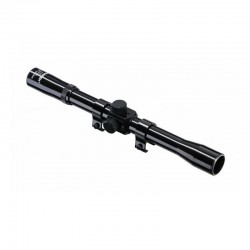
Umarex 4x20 Scope
via DAI Leisure
£19.95
Buying Advice
The fundamental technical choice is between image-intensifier night vision (which amplifies available ambient light) and thermal imaging (which detects heat signatures). For UK conditions, thermal has become dominant among serious shooters for several reasons. Britain's weather means cloud cover, fog, and rain are common at night, all of which severely degrade intensifier-based NV performance. Thermal is unaffected by darkness levels and cuts through light fog, making it far more reliable for detecting foxes in pasture, rabbits on arable land, or deer at woodland edges. Image-intensifier NV still has a role — it gives a more natural image that aids target identification at closer ranges — but for most UK night-shooting applications in 2026, thermal is the stronger choice.
Budget tiers in the UK thermal market break down roughly as follows. Entry-level thermal monoculars (handheld spotters, not weapon-mounted) start from around £800–£1,200 and include units from Pulsar's Axion range and competitors. Dedicated thermal riflescopes suitable for centrefire use begin at approximately £2,000–£3,000 for capable units with adequate resolution and refresh rates, with mid-range options from Pulsar's Thermion series sitting around £3,000–£4,500. Top-tier units with higher-resolution sensors (640×480 and above), superior NETD sensitivity, and built-in recording push past £5,000 and can reach £8,000 or more. Clip-on thermal units, which mount ahead of your existing day scope, typically sit in the £2,500–£5,000 bracket and offer versatility if you already own a quality day optic.
A common mistake UK buyers make is focusing solely on sensor resolution and ignoring NETD (Noise Equivalent Temperature Difference), which measures how small a temperature difference the sensor can detect. A unit with a 640×480 sensor but a poor NETD of 60mK will produce a noisier, less detailed image than a well-engineered 384×288 sensor with a NETD below 25mK, particularly in mild UK summers when the temperature differential between a fox and the surrounding ground is small. Refresh rate also matters: anything below 25Hz will produce noticeable lag when tracking moving quarry, and 50Hz units give a markedly smoother image for shooting off sticks or a bipod.
For deer stalking specifically, the legal restrictions on night shooting and artificial sighting aids mean that most UK stalkers will use thermal monoculars purely for observation, detection, and carcass recovery rather than as weapon-mounted sights. This is an entirely lawful and increasingly common practice — scanning a field margin with a thermal spotter before a dawn stalk is enormously effective for locating roe or muntjac without disturbing them. Several stalkers now carry a compact Pulsar Axion or similar unit as standard kit alongside their day scope. For fox and pest control under lawful authority, a weapon-mounted thermal riflescope or clip-on is the practical choice and has largely replaced lamp-based setups among professional controllers.
When matching optics to your rifle, consider the reticle and zeroing system carefully. Most thermal riflescopes use an electronic reticle overlaid on the display, which behaves differently from a traditional glass-etched reticle. There is no FFP/SFP distinction in the conventional sense — the reticle and image are both digital — but you should check whether the unit offers multiple zero profiles (essential if you use it across different rifles or calibres) and whether the ballistic calculator, if present, is genuinely useful for your cartridge. MOA or MRAD click adjustments on thermal scopes can feel less precise than on a quality Nightforce or March mechanical turret, so verify the unit's real-world tracking before relying on it at longer ranges.
In the brand landscape for 2026, Pulsar remains the dominant thermal optics brand in the UK market by volume, with strong dealer networks and a wide product range from entry-level spotters to flagship riflescopes. Their Thermion 2 and Merger LRF lines are widely stocked by UK retailers. At the premium end, brands like InfiRay and Liemke are gaining ground among professional stalkers and pest controllers who want higher sensor specifications. For traditional image-intensifier night vision, Photonis tubes (a European manufacturer) remain the benchmark for Gen 2+ and Gen 3 equivalent performance. Vortex does not currently compete in the thermal weapon-sight space but their conventional day optics pair well with clip-on thermal units. Always buy from an authorised UK dealer for warranty support and ensure any unit you purchase meets your specific legal requirements.
Frequently Asked Questions
Is it legal to own night vision or thermal optics in the UK?
Yes. There is no law in England, Wales, Scotland, or Northern Ireland that prohibits the purchase, ownership, or carrying of night vision or thermal imaging devices. The legal restrictions relate to how and when these devices may be used in conjunction with firearms for shooting specific quarry. Always check the specific legislation for your quarry species and jurisdiction before using any sighting device while shooting.
Can I use a thermal scope to shoot foxes at night in England?
Shooting foxes at night with a rifle is widely practised in England and Wales and is not prohibited by the Wildlife and Countryside Act 1981, provided you have the landowner's permission and your firearms certificate conditions permit it. Using a thermal or night-vision scope for this purpose is lawful. However, you should always verify your FAC conditions and consult BASC or your local police firearms licensing team if you are uncertain about your specific permissions.
Is it legal to shoot deer at night using night vision or thermal scopes?
Under the Deer Act 1991 (England and Wales), it is generally an offence to shoot deer during the night — defined as the period between one hour after sunset and one hour before sunrise. There are limited exceptions under specific licences issued by Natural England or Natural Resources Wales, typically for crop damage prevention. In Scotland, the Deer (Scotland) Act 1996 has its own provisions, and authorisation from NatureScot may be required. Using night-sighting devices on deer without lawful authority is an offence — contact the British Deer Society or BASC for current guidance.
Are the rules on night vision and shooting different in Scotland?
Yes, several important differences exist. Scotland requires an Air Weapon Certificate for any air weapon, unlike England and Wales where sub-12 ft-lb air rifles need no licence. For deer, the Deer (Scotland) Act 1996 has different close seasons and different provisions for night shooting and out-of-season shooting authorisations issued by NatureScot. The legal framework for pest species also differs in some respects under Scottish legislation. Always check the specific Scottish legislation or consult BASC Scotland before shooting in Scotland.
What is the difference between a thermal clip-on and a dedicated thermal riflescope?
A thermal clip-on mounts ahead of your existing day scope and projects a thermal image through it, allowing you to use your familiar reticle and turrets. A dedicated thermal riflescope replaces your day scope entirely and has its own electronic reticle, display, and controls. Clip-ons offer versatility if you already own a quality day scope from Nightforce, Leupold, or similar, but they add length and weight to the rifle. Dedicated units are generally lighter as a complete system and often offer higher image quality, but you lose your day-scope setup.
Do I need a firearms certificate to buy a thermal scope in the UK?
No. Thermal and night-vision optics are not firearms, ammunition, or component parts of a firearm under UK law, and no licence is required to purchase them. You can buy a thermal monocular or riflescope from any UK retailer without any form of licence. However, you will of course need the appropriate firearms certificate or shotgun certificate to own the firearm you intend to mount the optic on, and your FAC conditions must cover the shooting activity you plan to undertake.
Can I use a thermal spotter for deer stalking without breaking the law?
Using a handheld thermal monocular or spotter to observe and locate deer is not shooting deer and does not fall foul of the Deer Act provisions on night shooting or sighting devices. Many stalkers now routinely use thermal spotters for pre-dawn scanning, assessing deer numbers, and recovering shot deer. This is considered best practice by many professional stalkers and deer management organisations. The legal restrictions specifically concern the use of sighting devices mounted on or used in conjunction with a firearm to take deer at night.
What NETD and resolution should I look for in a thermal scope for UK fox shooting?
For reliable fox identification and shooting in UK conditions, look for a sensor with NETD of 25mK or lower and a minimum resolution of 384×288 pixels, though 640×480 is noticeably better for positive identification at range. A 50Hz refresh rate is strongly recommended for weapon-mounted use. UK summer nights can produce low thermal contrast between foxes and warm ground, so a sensitive sensor with low NETD is more important in British conditions than in colder climates. Budget accordingly — skimping on sensor quality often means struggling with identification in marginal conditions.
Where should I buy thermal and night-vision optics in the UK?
Purchase from authorised UK dealers to ensure full manufacturer warranty and after-sales support. Established UK retailers specialising in shooting optics stock Pulsar, InfiRay, and other major brands. Avoid grey imports from non-UK sources, as warranty support can be difficult to obtain and specifications may differ between regional models. BASC and the Countryside Alliance can point you towards reputable dealers, and many UK gun shops with an online presence now carry a solid range of thermal optics alongside traditional day scopes from Vortex, Leupold, and Nightforce.
Related guides
Expert UK guide to thermal and night vision rifle scopes for 2026. FFP vs SFP, MOA vs MRAD, legal considerations, budget tiers in GBP…
Trading a PVS-14 for Thermal & LPVO: Is It Worth It?Should you swap a used PVS-14 for a thermal scope and LPVO? We break down the trade-offs, UK legalities, top picks and budget tiers for night vision…
Best PARD Night Vision Scopes for UK ShootersDefinitive UK buyer's guide to PARD digital night vision scopes for foxing, deer stalking and vermin control.
Best Night Vision Clip-Ons & Add-Ons for UK Shooters in 2026Our 2026 buyer's guide to the best night vision clip-on scopes for UK foxing and pest control. Covers budget to premium add-ons, PARD models…
Not sure which scope is right for you?
Try our AI-powered scope finder — answer a few questions and get personalised recommendations.
Find My Scope →Get a UK scope tip every day
Follow AiScopes on Facebook for daily buying guides, deals and gear advice.
Follow on Facebook