Optic Risers: The Beginner's Guide
By Peter Makulek · Senior Optics Editor · · Live prices from UK retailers
If you have ever mounted a new rifle scope only to find you cannot get a comfortable cheek weld, or your eye sits too low to see a full, clear image through the optic, you have bumped into the exact problem an optic riser is designed to solve. A riser — sometimes called a scope riser mount or riser rail — is a simple spacer that sits between your rifle's receiver or Picatinny rail and the scope rings or mount, lifting the optic higher above the bore. It sounds trivial, but the effect on eye relief, neck strain, and shot-to-shot consistency can be dramatic, especially on air rifles or rimfire setups where the stock geometry was not designed with a large-objective scope in mind.
UK shooters encounter this issue more often than you might expect. Sub-12 ft-lb air rifles — which in England and Wales require no licence below that power threshold — frequently ship with low-profile dovetail rails. Fit a scope with a 50 mm objective bell and you may find it physically contacts the barrel or the top of the breech block. A riser of 10–20 mm can provide the clearance you need without resorting to ultra-high rings that may themselves be too tall for a comfortable head position. The same logic applies to FAC-rated centrefire rifles when fitting large-objective or night-vision clip-on units that demand extra rail height.
Choosing the right riser height is not guesswork: it depends on the objective diameter of your scope, the height of your rings, the diameter of the scope tube (typically 30 mm or 34 mm in modern optics), and the geometry of your stock's comb. Getting this wrong leads to either a still-obstructed view or, worse, a head position so high that felt recoil drives the rim of the eyepiece into your brow — an unpleasant experience sometimes called 'scope eye'. This guide walks you through the decision, the specifications that matter, and the mistakes to avoid.
We also address the broader optics context: whether you are shopping for your first air-rifle scope for rabbiting at 30 yards, upgrading to a long-range FFP optic for deer stalking, or adding a thermal or night-vision device that needs additional clearance. Throughout, all prices are in pounds sterling, all legal references are to UK law, and all recommendations reflect the quarry, ranges, and conditions you will actually encounter on these islands.
Top Picks — Live UK Prices
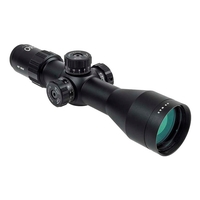
PAO HD MAX 4-16x44 SF FFP Ultra Compact Riflescope
via Uttings
£219.00
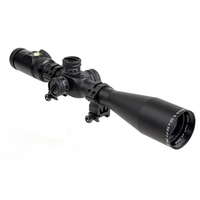
PAO F1 5-20x50 IR SF FFP Rifle Scope
via Uttings
£239.00

Wulf Tornado FFP 6-24x50 W-MIL3 Side Focus Rifle Scope
via BushWear
£249.99
Buying Advice
Understanding the key specifications of an optic riser starts with height, measured in millimetres. Common riser heights run from 10 mm to 25 mm, though some tactical or PRS-style risers go higher. The height you need is determined by a simple calculation: the scope's objective bell radius plus a small clearance gap (at least 2–3 mm) minus the distance from the rail centreline to the top of the barrel or any obstruction. If your 50 mm objective scope has a 25 mm radius, and your rings already provide 20 mm of lift from rail to tube centre, but your barrel sits only 18 mm below the rail, the bell will foul. A 10 mm riser solves this neatly. Risers also come in Picatinny (MIL-STD-1913) and dovetail (11 mm) variants — confirm which rail your rifle uses before ordering, as fitting the wrong profile will result in a loose, unsafe mount.
Budget tiers in the UK break down roughly as follows. Entry-level aluminium risers from brands like Hawke, Sportsmatch, or no-name imports typically cost £10–£30 and are perfectly adequate for sub-12 ft-lb air rifles and rimfire platforms where recoil is negligible. Mid-range risers in the £30–£80 bracket, from manufacturers such as UTG or Warne, tend to offer tighter machining tolerances, integral recoil lugs, and harder anodised finishes. At the upper end, £80–£150 and above, you find precision-machined steel or 7075-T6 aluminium risers from brands like Spuhr or Tier One — these suit FAC centrefire rifles where repeatable zero retention under heavy recoil is essential. Night-vision and thermal bridge mounts, which effectively function as risers with integrated attachment points, can run above £200.
The most common mistake UK buyers make is purchasing a riser without first checking whether higher rings would solve the same problem more simply and with less added weight. A pair of 'extra-high' rings from Sportsmatch or Hawke often provides the same lift without introducing an additional joint between scope and rifle — every joint is a potential source of looseness and zero shift. The second frequent error is ignoring the recoil profile of their rifle. Spring-piston air rifles generate a unique double-recoil impulse — rearward then sharply forward — that can shear cheap pot-metal risers or, worse, destroy the internals of a scope not rated for springer use. If you shoot a break-barrel springer, ensure both the riser and the scope are springer-rated; Vortex and Hawke both specify this clearly in their product lines.
UK-specific context matters here. For air-rifle shooters in England and Wales operating below the 12 ft-lb threshold (6 ft-lb for air pistols), no firearms licence is required, but in Scotland an Air Weapon Certificate is mandatory for any air weapon. Northern Ireland operates under a separate regime entirely. If you are fitting optics to an FAC-rated rifle — whether air or centrefire — for deer stalking, remember that specific calibre and bullet-energy minima apply by species and by country within the UK. The Deer Act 1991 (England and Wales) and the Deer (Scotland) Act 1996 set these out. Always check with your local police firearms licensing department or BASC for current guidance. Buying optics and mounts from UK retailers such as Uttings, Sportsmanguncentre, or Optics Warehouse ensures you receive items compatible with UK rail standards and can return easily if sizing is wrong.
Matching the riser to your use case is straightforward once you have the numbers. Pest control with a sub-12 air rifle — rabbits, grey squirrels, corvids, and pigeons at realistic distances of 25–40 yards — rarely demands more than a 10–15 mm dovetail riser, because the scopes used (typically 3-9×40 or 4-12×40 with an AO or side-focus parallax adjustable down to 10 yards) have modest objective bells. Deer stalkers running a 30 mm or 34 mm tube scope with a 56 mm objective on a bolt-action centrefire may need a 20 mm Picatinny riser plus high rings, especially if using a clip-on night-vision or thermal device in front of the day scope. For long-range target shooting, where an FFP MRAD scope from brands like Vortex, Athlon, or March might sit atop a chassis rifle with a fully adjustable cheekpiece, a riser becomes less about clearance and more about achieving the optimal head position for reading the reticle at high magnification.
On the brand landscape, the risers themselves are often unbranded or produced by mounting specialists like Sportsmatch (a UK company), Tier One, Spuhr, or Warne. When it comes to the optics you are lifting, the UK market in 2026 offers strong options across every budget. Vortex and Bushnell dominate the value tier for rifle scopes, with Leupold and Zeiss holding the premium ground for stalking and long-range work. March remains a favourite among F-Class and PRS competitors for its optical clarity and precise turret tracking. For thermal and night-vision scopes — where risers and bridge mounts are particularly relevant — Pulsar and HikMicro lead UK sales, offering clip-on and standalone units that often require specific mounting heights. Always confirm the manufacturer's recommended mounting height before selecting a riser.
Frequently Asked Questions
What exactly does an optic riser do?
An optic riser is a machined block or rail segment that sits between your rifle's receiver rail and the scope rings or mount, lifting the entire optic higher above the bore. This provides clearance for large-objective scope bells, improves cheek weld geometry, and can accommodate clip-on night-vision or thermal devices. It does not change the optical properties of the scope itself — it simply repositions it vertically.
How do I know what height riser I need?
Measure the radius of your scope's objective bell (half the objective diameter), add 2–3 mm for barrel clearance, then subtract the lift your rings already provide from the rail to the centre of the tube. If the result is positive, that is roughly the riser height you need. Many UK retailers list ring and riser heights in millimetres, making the maths straightforward. When in doubt, a 15 mm riser is a sensible middle-ground for most air-rifle setups with 40–50 mm objectives.
Can I use a riser on a spring-piston air rifle?
Yes, but you must ensure the riser is robust enough to withstand the double-recoil impulse that spring-piston (springer) air rifles produce. Cheap pot-metal risers can crack or shear under this stress. Look for risers machined from solid aluminium or steel with a positive recoil-stop pin or lug. Equally important is ensuring the scope itself is springer-rated — many gas-ram and spring-piston manufacturers, and optics brands like Vortex, explicitly state springer compatibility.
Is a riser better than just buying higher scope rings?
Not always. Higher rings achieve the same vertical lift with fewer components and fewer potential points of looseness. A riser becomes the better choice when suitably high rings are not available for your rail type, when you need to maintain a specific ring height for a clip-on device, or when the riser incorporates additional features such as a cant indicator or integral Picatinny rail on a dovetail rifle. For simplicity and rigidity, higher rings are usually preferable if they exist in the height you need.
Do I need a Picatinny or dovetail riser?
This depends entirely on the rail machined into or fitted to your rifle. Most centrefire bolt-actions and tactical-style rifles use Picatinny (MIL-STD-1913) rails with a 20 mm slot width and specific cross-slot spacing. Many air rifles, rimfires, and older sporting rifles use 11 mm dovetail rails. Fitting the wrong type results in a loose, dangerous mount. Check your rifle's manual or measure the rail width with a calliper before purchasing.
Will adding a riser affect my zero?
Yes — raising the scope increases the height-over-bore, which changes the trajectory relationship between your line of sight and the bullet or pellet path. You will need to re-zero after fitting a riser. At short airgun ranges (25–40 yards) the effect is modest but measurable. At longer centrefire distances the hold-over or dial-up at range will also change slightly, so update any ballistic calculator or turret tape with the new sight height.
Are risers useful for thermal or night-vision scopes?
Absolutely. Clip-on night-vision or thermal devices from brands like Pulsar and HikMicro mount ahead of the day scope's objective and often require additional vertical clearance to sit on-axis. A riser — or a dedicated bridge mount — lifts the entire optical train to the correct height. Some thermal scope units are standalone and bulkier than conventional optics, again benefiting from a riser for comfortable head position. Always check the device manufacturer's recommended mounting height.
Does a riser change parallax adjustment on my scope?
No. Parallax is an internal optical phenomenon relating to the focal plane alignment inside the scope, adjusted via the AO ring or side-focus turret. A riser changes only the external physical position of the scope. However, if the riser alters your eye position relative to the eyepiece, you may notice parallax error more or less depending on how centred your eye now sits behind the ocular lens. Proper cheek weld and eye alignment remain essential regardless of riser height.
What is the difference between MOA and MRAD, and does a riser affect which I should choose?
MOA (minute of angle) and MRAD (milliradian) are angular measurement systems used in scope turrets and reticles. One MOA subtends roughly 2.9 cm at 100 metres; one MRAD subtends 10 cm at 100 metres (so 0.1 MRAD = 1 cm at 100 m). A riser has no bearing on which system to choose — that decision rests on personal preference and whether your shooting community and ballistic data use metric (favouring MRAD) or imperial units. In the UK, MRAD is increasingly popular for long-range and tactical disciplines.
Related guides
Expert UK guide to choosing a new rifle optic in 2026. FFP vs SFP, MOA vs MRAD, parallax explained, budget tiers in GBP…
Snapped Optic Screw: What to Do Next & How to Prevent ItSnapped a screw on your rifle scope mount? Our 2026 UK guide explains extraction, prevention, correct torque specs, and choosing mounts that last.
Hawke Airmax 3-12×44 SR6 – Is This the Best All-Round Airgun Scope?Hawke Airmax 3-12×44 with SR6 BDC reticle reviewed for UK shooters. Covers parallax, springer suitability, sub-12 ft-lb ballistics and how it compares…
Area 419 20 MOA Remington 700 Short Action Scope RailExpert UK guide to the Area 419 20 MOA improved Picatinny rail for Remington 700 short actions. Scope mounting advice, budget tiers in GBP…
Not sure which scope is right for you?
Try our AI-powered scope finder — answer a few questions and get personalised recommendations.
Find My Scope →Get a UK scope tip every day
Follow AiScopes on Facebook for daily buying guides, deals and gear advice.
Follow on Facebook