Scope Upgrade Ideas & Recommendations 2026
By Peter Makulek · Senior Optics Editor · · Live prices from UK retailers
Whether you are pushing a sub-12 ft-lb springer out to its humane limits on rabbit or running a stalking rifle on roe at first light, the scope sitting on top is the single component that dictates whether you shoot with confidence or frustration. Yet upgrading optics is one of the most confusing decisions UK shooters face: first-focal-plane or second, MOA or MRAD, 10-yard parallax or 50? This guide cuts through the noise, giving you practical upgrade paths grounded in the realities of UK quarry, UK law, and UK terrain — not American hunting shows or US-centric forums.
The UK market has changed dramatically over the past two seasons. Thermal scopes from Pulsar and HikMicro have gone from exotica to everyday pest-control tools, while traditional glass from Vortex, Leupold, March, Nightforce, and Schmidt & Bender now ships through a growing number of UK retailers and online platforms. At the same time, the choice between a £120 rimfire scope and a £2,000-plus stalking optic has never been wider, and getting the wrong one wastes money or — worse — leads to a botched shot on live quarry.
Before you spend a penny, you need to understand what your current scope is failing to do. Is parallax error making groups wander at close range on an air rifle? Is the reticle too thick for precise holdover on corvids at 40 yards? Are you losing light in the last twenty minutes of a December evening stalk? Each of these problems has a different solution, and the most expensive scope is rarely the right answer for everyone. We will walk you through the decision matrix before and after our curated product picks.
This guide is written exclusively for UK-based shooters. All prices are in pounds sterling, all legal references relate to England, Wales, Scotland, and Northern Ireland (each of which has its own firearms framework), and all range estimates are grounded in realistic UK shooting distances. We reference real brands with genuine UK availability and never invent test data. For specific legal questions about licensing — particularly around FAC-rated air rifles or deer-legal calibres — always consult your local police force firearms department or BASC.
Top Picks — Live UK Prices
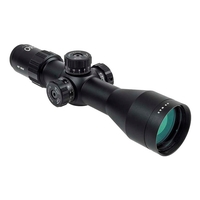
PAO HD MAX 4-16x44 SF FFP Ultra Compact Riflescope
via Uttings
£219.00
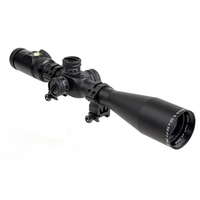
PAO F1 5-20x50 IR SF FFP Rifle Scope
via Uttings
£239.00

Wulf Tornado FFP 6-24x50 W-MIL3 Side Focus Rifle Scope
via BushWear
£249.99
Buying Advice
Understanding key specifications is essential before parting with cash. FFP (first focal plane) reticles scale with magnification, meaning your holdover marks and windage dots remain accurate at every power setting — invaluable for variable-range pest control or long-range target work. SFP (second focal plane) reticles stay the same apparent size regardless of zoom, which many stalkers prefer for a clean sight picture at low power. MOA adjustments move the point of impact roughly 1.047 inches per click at 100 yards, while MRAD (milliradians) work in metric: 0.1 mil equals 1 cm at 100 metres. Neither system is inherently superior, but MRAD's decimal maths tends to suit metric-thinking UK shooters and pairs naturally with metric range cards.
Budget tiers in the UK break down roughly as follows. Below £150, you will find solid rimfire and airgun scopes from brands like Vortex (Crossfire II line) and Hawke, which are perfectly adequate for sub-12 ft-lb pest control at realistic distances. Between £300 and £700 sits a competitive mid-range tier — here you can expect fully multi-coated glass, reliable tracking, and features like illuminated reticles and side-focus parallax adjustment. Stepping above £800 into the £1,000–£2,000 bracket brings premium stalking and target scopes from Leupold, Nightforce, and Burris, with superior light transmission and build quality. Beyond £2,000, March and Schmidt & Bender offer competition and professional-grade optics with razor-sharp glass and bombproof mechanics.
Common mistakes UK buyers make are worth flagging. First, mounting a non-springer-rated scope on a break-barrel air rifle: spring-piston guns generate a vicious double recoil — rearward then forward — that can destroy scopes designed only for centrefire recoil in one direction. Always confirm a scope is springer-rated or choose a gas-ram or PCP platform. Second, ignoring parallax range: a scope with parallax fixed at 100 yards will introduce significant aiming error at the 25–40-yard distances typical of airgun shooting. Look for adjustable parallax that goes down to 10 yards. Third, over-magnifying: a 6–24× scope on a sub-12 ft-lb rifle is largely pointless when your maximum humane-kill range on rabbit is roughly 35–45 yards.
UK-specific context matters more than many guides acknowledge. Sub-12 ft-lb air rifles (and sub-6 ft-lb air pistols) require no licence in England and Wales but do require an Air Weapon Certificate in Scotland; Northern Ireland has its own separate regime. FAC-rated air rifles and all firearms require a Firearms Certificate. For deer stalking, calibre and bullet-energy minimums are set in law and vary by species. Close seasons apply to most deer species — roe bucks, for example, have a close season in England and Wales from 1 November to 31 March. Never shoot deer out of season, and always verify current regulations through BASC or the Deer Initiative. For purchasing optics, established UK dealers include Uttings, John Rothery, Sporting Saint, and numerous BASC-affiliated retailers.
Matching the scope to your use case is the single most important step. For sub-12 ft-lb airgun pest control on rabbit, grey squirrel, and corvids, a 3–12× or 4–16× scope with adjustable parallax down to 10 yards, a fine reticle (duplex or mil-dot), and springer-safe construction (if applicable) is the sweet spot. For rimfire target shooting at 25–100 metres, an FFP scope with MRAD turrets and a detailed Christmas-tree reticle pays dividends. Stalkers wanting a scope for roe or muntjac at dawn and dusk should prioritise a large objective (50 mm+), generous eye relief, and an illuminated centre dot over raw magnification. For thermal, Pulsar and HikMicro dominate the UK market, and a clip-on thermal monocular can upgrade your existing day scope without re-zeroing.
The brand landscape in the UK is healthier than ever. Vortex offers exceptional value across every tier and backs everything with a transferable no-fault warranty — a genuine differentiator in the second-hand market. Leupold remains the benchmark for lightweight stalking glass. March is the connoisseur's choice for benchrest and ELR, with Japanese-made optics that compete at the very top. Nightforce and Schmidt & Bender dominate professional and military circles and are increasingly seen on UK sporting rifles. Burris offers rugged mid-range options, while Pulsar and HikMicro continue to push thermal-scope technology forward at prices that have dropped significantly year on year. For spotting scopes used on the range or for deer counting, Vortex Razor and Leupold Gold Ring lines are well represented by UK stockists.
Frequently Asked Questions
What is the difference between FFP and SFP scopes, and which is better for UK shooting?
In an FFP (first focal plane) scope the reticle scales with the magnification, so holdover marks and subtension values remain accurate at every zoom level. In an SFP (second focal plane) scope the reticle stays the same visual size regardless of zoom, meaning subtension marks are only accurate at one specific magnification (usually the highest). FFP suits variable-distance pest control and target work where you dial magnification frequently; SFP is often preferred by stalkers who value a clean sight picture at low power.
Do I need a special scope for a spring-piston air rifle?
Yes. Spring-piston (springer) air rifles generate a unique double-recoil impulse — rearward and then sharply forward — that can crack lenses, strip turret mechanisms, and shift zero on scopes designed only for centrefire recoil. Always choose a scope explicitly rated for springer or bi-directional recoil. PCP and CO2 air rifles produce negligible recoil and can use virtually any scope without damage.
Why does parallax matter so much on an airgun scope?
Parallax error occurs when the target image and the reticle are not on the same focal plane, causing the point of aim to shift as your eye moves behind the scope. At the close ranges typical of sub-12 ft-lb airgun shooting (10–45 yards), a scope with parallax fixed at 100 yards can introduce enough error to miss a rabbit-sized kill zone. Look for an adjustable parallax (AO or side-focus) that goes down to 10 yards for airgun use.
Should I choose MOA or MRAD turrets?
Neither is inherently more accurate. MOA (minute of angle) works in imperial-friendly increments — roughly 1.047 inches at 100 yards per MOA. MRAD (milliradians) uses a decimal metric system — 0.1 mil equals 1 cm at 100 metres. Many UK shooters find MRAD more intuitive because ranges are commonly measured in metres. The critical thing is to match your turret system to your reticle: an MRAD turret with an MOA reticle creates confusion.
What magnification range do I actually need for UK airgun pest control?
For sub-12 ft-lb airgun shooting on rabbit, grey squirrel, and corvids, a 3–12× or 4–16× scope covers every realistic scenario. You will rarely engage quarry beyond 35–45 yards with a sub-12 gun, so extremely high magnification adds weight and narrows your field of view without practical benefit. A moderate top-end magnification also helps with mirage management on warmer days.
Are thermal scopes legal for UK pest control?
Thermal scopes and clip-on thermal devices are legal to own and use in England and Wales and are widely employed for night-time pest control on rabbit, fox, and corvids under the relevant General Licences. Scotland and Northern Ireland have their own regulations, and you should verify local rules before using thermal at night. Pulsar and HikMicro are the dominant brands in the UK thermal market, with prices ranging from roughly £500 for entry-level monoculars to several thousand pounds for weapon-mounted scopes.
How important are scope rings, and what should I look for?
Scope rings are the mechanical link between your scope and your rifle, and cheap or poorly matched rings can undo every advantage of premium glass. Ensure the ring diameter matches your scope tube (typically 1 inch or 30 mm in the UK market) and the height allows adequate clearance above the barrel or action without raising the scope so high that you lose a natural cheek weld. For springer air rifles, choose one-piece mounts with an arrestor pin or recoil stop to prevent the scope creeping forward under recoil.
What scope upgrades make the biggest difference for deer stalking in the UK?
Light transmission is the single most impactful upgrade for stalkers. Dawn and dusk are prime activity windows for roe, muntjac, and fallow, and a scope with high-quality multi-coated glass and a large objective lens (50 mm or 56 mm) can give you an extra ten to fifteen minutes of usable shooting light. An illuminated centre dot reticle also helps in low-contrast woodland settings. Beyond that, generous and consistent eye relief (90 mm+) matters greatly for quick, safe shots at varying angles.
Can I use a spotting scope instead of upgrading my rifle scope?
A spotting scope is a complement, not a replacement. On a range, a good 20–60× spotting scope lets you read shot fall and assess groups without walking downrange, which can inform what rifle-scope adjustments you need. For deer counting and reconnaissance, a spotting scope is invaluable. However, it does not improve your aiming system — if your rifle scope lacks the reticle precision, turret tracking, or light-gathering ability you need, only a rifle-scope upgrade will solve that.
Related guides
Struggling to find the right scope for your exact UK shooting scenario? Our 2026 guide matches niche requirements to real optics — FFP, SFP, thermal…
Rimfire Scope vs Regular Scope: The Real Differences ExplainedWhat is the actual difference between a rimfire scope and a regular centrefire scope? We cover parallax, turrets…
Burris vs Vortex: The UK Shooter's VerdictBurris or Vortex — which scope brand suits UK shooters best? We compare FFP/SFP reticles, MOA vs MRAD turrets, warranties and UK availability to help you…
Is a Vortex Crossfire 3-9×40 on a .30-06 Enough for Serious Hunting?We assess whether a Vortex Crossfire II 3-9×40 on a Savage 334 .30-06 is up to demanding hunts. UK-focused buying guide with scope tiers…
Snapped Optic Screw: What to Do Next & How to Prevent ItSnapped a screw on your rifle scope mount? Our 2026 UK guide explains extraction, prevention, correct torque specs, and choosing mounts that last.
Not sure which scope is right for you?
Try our AI-powered scope finder — answer a few questions and get personalised recommendations.
Find My Scope →Get a UK scope tip every day
Follow AiScopes on Facebook for daily buying guides, deals and gear advice.
Follow on Facebook