Night Vision Add-Ons and Scope Adapters: What Fits Your Day Scope
By Peter Makulek · Senior Optics Editor · · Live prices from UK retailers
A night vision add-on is a separate unit that works with the day scope you already own. You keep your reticle, your turrets and, if the fitting is sound, your zero. The searches that bring people here ask the same thing in different words: which add-on, which adapter, and will it fit my scope? Everything turns on one question. Does the unit go on the front of the scope or on the back?
A front add-on clamps over the objective bell and sends its image into the day scope, so you keep looking through your own eyepiece with your own reticle over the picture. Thermal clip-ons are normally built this way. A rear add-on clamps over the eyepiece instead. A camera inside the unit looks through the scope the way your eye would, and you watch the result on the unit's own display. Pard, for example, lists its NV007SP2 4K as a rear clip-on with a 3840x2160 sensor and a 1600x1200 OLED display: the camera takes the picture from your scope, and the screen replaces the view your eye would have had.
This guide is about fit and choice, not a ranked list. It covers what decides whether an add-on will work on your scope, the checks to make before you pay, and what UK law says about using one on a rifle at night. For named models compared side by side, use the related guides further down the page.
Top Picks — Live UK Prices
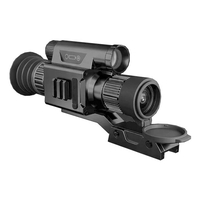
Fuego DS-X7 4K Day & Night Vision Rifle Scope
via Uttings
£299.99
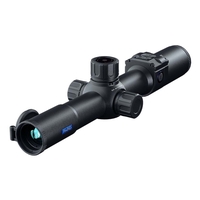
Pard Night Stalker Mini Night Vision Riflescope - 35mm
via Uttings
£339.00
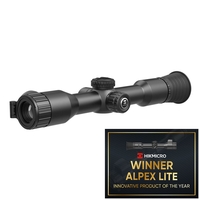
HIKMicro Alpex 4K Lite Digital Day/Night Riflescope
via Uttings
£399.00
Buying Advice
Rear unit: measure the eyepiece. A rear unit grips the eyepiece housing with a clamp or adapter ring, so the outside diameter of your eyepiece decides what you can use. Measure it with digital callipers at the point where the clamp will sit, not at the widest part of the ocular bell and not from the spec sheet of a different scope in the same range. Adapters are sold in size bands. Pard's accessory range, for instance, lists its NV007SP quick-release adapter in three bands: 32-42 mm, 40-48 mm and 44-54 mm. An eyepiece measuring 38 mm falls in one band, one measuring 46 mm falls in two, and one measuring 56 mm falls in none. Ribbed, tapered or rubber-armoured eyepieces and built-in power rings need particular care, because a clamp wants a plain cylinder.
Front unit: measure the objective bell, then check the magnification. A front unit clamps over the objective bell, so you need its outside diameter, and any sunshade or flip-up cover has to come off first. Check the maker's stated range of bell diameters and the day-scope magnification it recommends. Thermal makers publish that magnification range because a thermal sensor has a fixed number of pixels: zoom the day scope well past the range and you are enlarging individual pixels, not detail.
Rear unit: eye relief, exit pupil and magnification. The camera in a rear unit sees only what leaves the eyepiece. Exit pupil in millimetres is the objective diameter divided by the magnification, so a 4-16x50 has a 12.5 mm exit pupil at 4x and 3.1 mm at 16x, and a 3-9x40 has 13.3 mm at 3x and 4.4 mm at 9x. A large exit pupil is forgiving of small alignment errors; a small one is not, and the picture can darken towards the edges. That is why rear units are normally run at the low to middle of the zoom range at night. The unit also sits where your eye would, so the scope needs enough eye relief for the camera body to seat flush against the eyepiece. Check the maker's recommended magnification range for your scope before buying.
Digital night vision or thermal. Digital night vision add-ons use a CMOS sensor and depend on whatever light there is plus an infrared illuminator. Thermal add-ons read heat and need no light, but they build the picture from far fewer pixels. Infrared illuminators come in 850 nm and 940 nm. Pard sells the NV007SP2 4K in both. The 850 nm version usually gives a brighter picture but shows a faint red glow at the lens; 940 nm is invisible to the eye and usually gives a dimmer picture. Pard quotes 350 m of irradiation distance for the NV007SP2 4K. That figure is how far the infrared light reaches. It is not how far you can identify a fox, and it is not how far a rifle should shoot.
Weight, battery and recoil. A rear unit hangs its weight off the back of the scope. Pard lists the NV007SP2 4K at 397 g with battery and up to 6 hours of use from a removable 18650 cell. Carry a charged spare, because cold nights shorten runtime. Weight and recoil are also why you should check the maker's stated recoil limit against your rifle before fitting anything. Spring-piston air rifles recoil forwards as well as back, which is hard on any accessory hung off a scope. If the limit does not cover your rifle in writing, ask the maker or the dealer first.
Zero. Fitting an add-on should not move your zero, but treat it as unconfirmed until you have checked. A loose clamp, a sideways load on the scope tube or a unit that shifts under recoil can all move the point of impact. Shoot a group with the day scope on its own, fit the add-on and shoot another, then remove it and shoot a third. If the groups do not land together, the fit is wrong, not the rifle.
Air rifles. An add-on changes what you can see, not what the rifle can do. Sub-12 ft/lb air rifles, springers included, are effective only to about 50-75 yards on small quarry such as rats and rabbits. Seeing a rabbit at 150 yards through a good unit does not make a 150-yard shot acceptable. The same applies to identifying your target and what is behind it: a bright picture is not a backstop.
Which to choose. If you want digital night vision and your scope has a plain round eyepiece that falls inside a single adapter band, a rear unit is the simpler route. If you want thermal, or you want to keep looking through your own eyepiece, you are looking at a front unit, and the objective bell size and recommended magnification are your checks. If neither measurement works with your scope, or you plan to change the day scope soon, a dedicated day-and-night scope may be less trouble than adapting around the problem.
UK law, checked 5 November 2026. Buying an add-on does not need a firearm or shotgun certificate. The Home Office licensing guide lists the component parts of a firearm that fall under certificate control as a barrel, chamber or cylinder; a frame, body or receiver; and a breech block, bolt or similar mechanism that holds the pressure of discharge at the rear of a chamber. Optics are not on that list. What you may shoot with an add-on fitted is a separate question, and the answer depends on the quarry.
Deer. In England and Wales, section 3 of the Deer Act 1991 makes it an offence to take or intentionally kill a deer between the end of the first hour after sunset and the start of the last hour before sunrise, subject to the exceptions in the Act, such as a licence from Natural England or Natural Resources Wales. In Scotland, section 18 of the Deer (Scotland) Act 1996 makes night shooting an offence unless NatureScot has authorised it. An add-on changes neither rule. Scotland also regulates by Order the sights and equipment that may be used on deer, so check that Order before fitting an add-on to a deer rifle there.
Rabbits and hares. In England and Wales, the Ground Game Act 1880 prohibits using firearms to kill ground game, meaning hares and rabbits, between the end of the first hour after sunset and the start of the last hour before sunrise. The Wildlife and Countryside Act 1981 exempts an occupier of the land, or one other person the occupier authorises, where the occupier holds the written authority of a person entitled to kill or take ground game on that land. Scotland has its own provisions under the Agriculture (Scotland) Act 1948. Foxes are not ground game and are not covered by those provisions, but your certificate conditions and the landowner's permission still apply.
Wild birds. Section 5 of the Wildlife and Countryside Act 1981 makes it an offence to use "any device for illuminating a target or any sighting device for night shooting" to kill or take a wild bird, subject to the exceptions and licences in the Act. If you shoot pigeons or corvids, check the exact terms of any licence you rely on and ask BASC before putting a night sight on a rifle for birds. Northern Ireland has separate legislation and is not covered here. None of this is legal advice: for your own case, ask BASC or your force's firearms licensing department.
Frequently Asked Questions
Do I need a firearms certificate to buy a night vision add-on in the UK?
No. The component parts of a firearm that need certificate control are a barrel, chamber or cylinder; a frame, body or receiver; and a breech block, bolt or similar mechanism at the rear of the chamber. Optics are not on that list. What you can lawfully shoot with the add-on fitted depends on the quarry and the time of day, so read the law section above. Position checked 5 November 2026.
Will a night vision add-on change my zero?
It should not, because the day scope stays on the rifle as before. A loose clamp, a sideways load on the scope or a unit that shifts under recoil can move the point of impact, so shoot a group with and without the add-on fitted before you rely on it.
Can I fit a night vision add-on to any day scope?
No. A rear unit needs an eyepiece whose outside diameter falls inside the unit's adapter bands and a scope with enough eye relief to seat it. A front unit needs a compatible objective bell diameter and a day scope that runs within the maker's recommended magnification range. Measure with callipers before you buy.
Do I need an infrared illuminator?
For digital night vision in real darkness, yes: the sensor needs light, and the illuminator supplies it, whether built into the unit or fitted separately. Thermal add-ons read heat and need no illuminator. An 850 nm illuminator usually gives a brighter picture but a faint red glow; 940 nm is invisible to the eye and usually gives a dimmer picture.
Related guides
Best night vision clip-on scopes for UK foxing and pest control in 2026: budget to premium add-ons, including PARD models.
Best Day Scopes to Pair with a Rear-Mounted Night-Vision Add-OnChoosing a day scope for a Pard NV007SP or Sytong HT-66 rear add-on? Our UK guide covers eyepiece fit and eye relief for 2026.
NV Clip-On vs Thermal Clip-On: Which Suits Your Stalking?Digital night vision or thermal clip-on for UK deer stalking? Our 2026 guide compares detection, identification and legal use.
IR Illuminator Wavelengths Explained: 850nm vs 940nm850nm or 940nm IR illuminator for UK night shooting? We explain the differences in range, visibility and stealth so you pick the right one.
Thermal Spotting Scopes: What to Buy and What the Law SaysChoosing a thermal spotting scope in the UK: sensor, lens and field of view, battery, detection versus identification, and what the law says about owning one.
Not sure which scope is right for you?
Try our AI-powered scope finder — answer a few questions and get personalised recommendations.
Find My Scope →Get a UK scope tip every day
Follow AiScopes on Facebook for daily buying guides, deals and gear advice.
Follow on Facebook