Matching Turrets, Reticles & BDC to Your Calibre
By Peter Makulek · Senior Optics Editor · · Live prices from UK retailers
Buying the best scope for long range UK rifle shooting in 2026 is no longer just about magnification and glass clarity. The critical question today is whether your scope's turret travel, reticle design and ballistic drop compensation actually align with the cartridge you are firing and the distances you intend to engage. Get this wrong and you will either run out of elevation before your bullet reaches the target, or find that a BDC reticle calibrated for one muzzle velocity is wildly inaccurate with another. This guide exists to help UK shooters make that match correctly the first time.
Ballistics — the science of how a projectile behaves in flight — governs every decision you make at the scope-selection stage. A .308 Winchester zeroed at 100 metres drops roughly 6.5 MRAD (about 22 MOA) at 600 metres, whereas a 6.5 Creedmoor with a higher ballistic coefficient bullet may drop only 5.2 MRAD at the same range. Those numbers directly determine how much internal adjustment your scope needs, whether a BDC reticle's subtensions will be accurate, and how fine your turret clicks must be to resolve the difference between a hit and a miss.
For UK shooters the context is specific. Most centrefire deer-legal calibres start at .243 Winchester and climb through .308, 6.5 Creedmoor, and .300 Winchester Magnum. Shooting distances on open Scottish hill ground or English downland can stretch to 300 metres for stalking, while target and PRS disciplines regularly push past 800 metres. The scope that works brilliantly for close woodland stalking may lack the turret range or reticle granularity to perform at longer distances, and vice versa. Understanding your own operational envelope is the first step.
In the sections that follow we review the scopes that excel at marrying ballistic capability with practical field use, then provide detailed buying advice covering MOA versus MRAD turrets, BDC reticle compatibility, magnification requirements, budget tiers, and common mistakes UK buyers make. Whether you are a deer stalker looking for the best scope for long range hunting on open ground or a target shooter building a precision rig, this is the definitive resource for 2026.
Top Picks — Live UK Prices

Nikko Stirling Diamond Long Range 30mm Tactical 4-16x50 IR Rifle Scope
via Uttings
£199.00

Hawke Endurance 30 WA 1-4x24 IR (Tactical Dot 4x) Telescopic Sights
via BushWear
£251.10
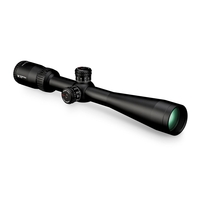
Vortex Diamondback Tactical 4-12x40 Riflescope - VMR-1 Reticle (MOA)
via Uttings
£299.00
Buying Advice
Start with the key specifications that determine ballistic compatibility. Total elevation travel is listed in MOA or MRAD and tells you how much drop you can dial before the turret runs out of adjustment. A scope with 25 MRAD (roughly 86 MOA) of total elevation is typical for a tactical or PRS optic; after zeroing at 100 metres you might have 15–18 MRAD of remaining up-travel, which is enough to reach 1,000 metres with most 6.5 Creedmoor loads. For a .308 Winchester, which drops faster, you may need a 20 MOA canted rail to recover extra travel. Always check usable elevation above zero, not just the headline figure. Turret click value matters too: 0.1 MRAD clicks move the point of impact 1 cm at 100 metres, while ¼ MOA clicks move it roughly 0.7 cm at the same distance — both are fine-grained enough for long-range shooting.
Budget tiers in the UK break down clearly. Entry-level scopes under £400 from brands such as Athlon or primary-market own-brands offer exposed turrets and mil-dot reticles, but glass quality and tracking reliability may limit you beyond 500 metres. Mid-range optics between £400 and £1,000 — the popular scope under 1000 bracket — deliver dramatically better turret repeatability, first-focal-plane reticles, zero-stop mechanisms and coatings that matter at dawn and dusk. This is where most UK PRS competitors and serious stalkers land. Premium optics above £1,000, from makers like Vortex Razor, Nightforce, Schmidt & Bender and Kahles, add features like locking turrets, tool-less zero resets, and ED glass that resolves mirage and trace at extreme distance.
The most common mistake UK buyers make is purchasing a BDC reticle without verifying it matches their specific load. A BDC reticle is calibrated for a particular bullet weight, muzzle velocity, and ballistic coefficient. If your .243 Win fires a 100-grain bullet at 2,960 fps but the reticle was designed around a .308 at 2,650 fps, the hold-over marks will be wrong at every distance beyond zero. Unless the manufacturer provides a ballistic calculator that lets you input your exact load data, a generic Christmas-tree or mil-hash reticle with known subtensions is far more versatile. Another frequent error is choosing SFP (second focal plane) for a scope intended for dialling and holding at multiple distances; SFP reticle subtensions are only accurate at one magnification, so FFP (first focal plane) is strongly preferred for long-range shooting where you use the reticle for range estimation or wind holds.
UK-specific context shapes the decision. Deer-legal calibres must produce a minimum muzzle energy of 1,700 ft/lbs for most species in England and Wales (2,440 ft/lbs for red and sika deer in Scotland with a .270-class minimum). These cartridges all have significant bullet drop beyond 200 metres, making ballistic turrets or a well-matched reticle essential for ethical shot placement at longer ranges. UK firearms certificate conditions and club rules may specify disciplines; PRS and NRL-style competitions are booming in the UK and demand scopes with reliable tracking, tall turrets and FFP mil reticles. Purchasing from UK retailers such as RUAG, Optics Warehouse, or specialists stocking brands like PARD ensures warranty support and correct import duty status.
Matching the scope to your specific use case requires honesty about distance. A stalker who rarely shoots beyond 200 metres on woodland permissions may be best served by a lightweight SFP scope with a simple duplex reticle and capped turrets — ballistic complexity adds weight and cost for no real benefit. Conversely, a shooter who regularly dials to 800 metres on open hill ground or at Diggle, Bisley, or Orion MPC needs a scope with at least 12 MRAD of usable elevation above zero, a detailed FFP reticle for wind holds, and turrets that track accurately over repeated revolutions. For long-range shooting disciplines the MOA MRAD debate is largely settled in favour of MRAD in the UK: the metric system aligns naturally with milliradians, most UK PRS shooters use MRAD, and sharing data with spotters or squad-mates is simpler when everyone speaks the same language.
The brand landscape in 2026 is competitive. Vortex continues to dominate the mid-range with aggressive warranty support and UK distribution. Nightforce and Kahles own the premium PRS tier. Hawke and Nikko Stirling serve the budget-conscious UK hunter well. PARD, traditionally known for digital night-vision and thermal add-ons, has expanded into smart-scope territory with ballistic overlays that calculate hold-overs in real time — an interesting option for tech-forward shooters. Schmidt & Bender remains the prestige choice for European driven-hunt and precision work. Whatever brand you choose, prioritise verified turret tracking (a box test at 100 metres is easy and essential), glass clarity at the magnification you will actually use, and a reticle whose subtensions you have cross-referenced against your own ballistic solver output.
Frequently Asked Questions
What is a BDC reticle and which UK calibres does it actually work for?
A BDC (Bullet Drop Compensation) reticle has aiming points or hash marks spaced to correspond with bullet drop at specific distances for a particular cartridge and load. It works accurately only when your bullet's muzzle velocity and ballistic coefficient closely match the profile the reticle was designed for — typically something like a .308 Win 168-grain HPBT at 2,650 fps. If you shoot a significantly different calibre or load, the hold-over marks will not correspond to real-world drop. For UK stalkers using .243 Win, .308, or 6.5 Creedmoor, check whether the manufacturer provides a ballistic match chart or app; if not, a generic mil or MOA hash reticle used with a ballistic solver is more versatile.
How do I match my scope's turret adjustment range to my calibre's bullet drop at 800 metres?
First, use a ballistic calculator (Applied Ballistics, Strelok, or Hornady 4DOF) to determine total bullet drop in MRAD or MOA from your zero distance to 800 metres with your specific load. For example, a .308 Win 175-grain SMK at 2,600 fps drops approximately 8.4 MRAD from a 100-metre zero to 800 metres. Your scope must have at least that much usable elevation above zero — not total travel, but the portion remaining after you set your 100-metre zero. If it falls short, a 20 MOA (roughly 6 MRAD) canted scope base effectively shifts more of the scope's internal range above zero, recovering the travel you need.
Should I use MOA or MRAD turrets for dialling corrections on a centrefire hunting rifle in the UK?
Either system is mechanically capable, but MRAD has become the dominant standard for UK long-range shooting because milliradians align naturally with the metric system used on Ordnance Survey maps and range cards. One click of 0.1 MRAD moves the point of impact exactly 1 cm at 100 metres, making mental arithmetic straightforward. MOA remains popular in the US and among some UK hunters who learned on imperial measurements. The most important rule is to ensure your turrets and reticle use the same unit — mixing an MOA reticle with MRAD turrets forces unnecessary conversions under time pressure.
What magnification do I need to see impacts and make wind corrections at long range?
For observing bullet trace and splash beyond 600 metres, most UK PRS shooters use 18× to 25× magnification. Below about 15× it becomes difficult to spot impacts on steel or read mirage for wind estimation. However, higher magnification narrows your field of view, amplifies mirage distortion on hot days, and makes it harder to find targets quickly. A variable scope in the 5-25× or 4-16× range covers both close-range target acquisition and long-range precision. For dedicated long-range shooting, scopes topping out at 25× are the current sweet spot in the UK.
How does muzzle velocity affect which scope turret range I need for deer stalking on open ground?
Muzzle velocity directly determines how much a bullet drops over a given distance, which in turn dictates how much elevation you need to dial. A faster cartridge like a .270 Win at 3,060 fps drops considerably less than a .308 Win at 2,620 fps at the same distance, requiring fewer clicks of elevation correction. For open-ground stalking in Scotland where shots may reach 250–300 metres, even modest differences in velocity change the required turret adjustment by 1–2 MRAD. Always calculate your specific load's trajectory rather than relying on generic tables, because even the same cartridge loaded with different bullet weights will perform differently.
What is the difference between FFP and SFP, and which is better for ballistic work?
In a first-focal-plane (FFP) scope, the reticle scales with magnification so the subtension values — the distance each hash mark represents — remain accurate at every power setting. In a second-focal-plane (SFP) scope the reticle stays the same apparent size, meaning its subtensions are only correct at one specific magnification (usually the maximum). For any form of ballistic hold-over, range estimation, or wind correction using the reticle, FFP is strongly preferred because it removes the need to be on a particular magnification setting before taking the shot.
Do I need a zero-stop mechanism on a ballistic scope?
A zero-stop is a mechanical hard stop set at your confirmed zero that prevents you from dialling below it. After engaging targets at long range and dialling back down, the zero-stop guarantees you return precisely to your base zero without counting clicks in the dark or under pressure. For any scope used with ballistic turrets at varying distances it is considered essential by most UK precision shooters. Nearly all mid-range and premium tactical scopes now include a zero-stop or at least a re-settable revolution indicator.
Can I use a ballistic scope on a sub-12 ft/lb air rifle for long-range shooting?
No. A sub-12 ft/lb air rifle — the legal limit for unlicensed air rifles in England and Wales — fires a pellet at relatively low velocity (typically 550–800 fps with a .177 pellet). Effective range is realistically 40–50 yards, with ethical pest-control accuracy limited to about 50–75 yards at the extreme. The massive trajectory arc and rapid energy loss make long-range ballistic turrets and BDC reticles designed for centrefire cartridges entirely irrelevant. A simple duplex or mil-dot reticle on a modest 3-12× scope with close parallax adjustment is far more appropriate for these rifles.
Is it worth spending over £1,000 on a rifle scope for UK long-range shooting?
It depends on your discipline and frequency of use. Above £1,000 you gain demonstrably better optical clarity in low light, more reliable turret tracking over thousands of clicks, superior mechanical build quality, and features like locking turrets and integrated level indicators. For competitive PRS or NRL shooters in the UK, these attributes directly affect scores and consistency. For an occasional stalker who rarely shoots beyond 200 metres, a well-chosen scope under 1000 will perform admirably. The best approach is to define your maximum realistic engagement distance, test turret tracking with a box test, and invest at the level your shooting demands.
Related guides
Master bullet drop, wind drift and velocity for your UK rifle scope setup in 2026. Learn BDC vs MOA vs MRAD, elevation turrets…
Best Long-Range Scopes 2026: BDC Reticles vs Exposed TurretsDefinitive UK buyer's guide to the best scopes for long-range shooting in 2026. Compare BDC reticles vs exposed turrets for 300–1,000 yard shots…
Christmas Tree vs Simple Reticles: Which PRS Reticle Is Right for You?Christmas tree reticle or clean holdover design for PRS? Our 2026 UK guide compares Tremor3, EBR-7C, PR2 and more to help you pick the right precision…
Best Scopes for Ballistics-Matched Long-Range Shooting in 2026Our 2026 UK buyer's guide to the best long-range scopes with BDC reticles, ballistic turrets and calibre pairing for accurate shooting from 300 to 1,000…
Pulsar vs Hikmicro: Which Thermal Scope Suits UK Shooters?Pulsar or Hikmicro thermal scope for UK shooting in 2026? Our in-depth comparison covers specs, budget tiers, deer stalking…
Best Long-Range Rifle Scopes 2026: Match Your Optic to Your CalibreOur 2026 UK guide to the best scopes for long range shooting. Learn how to match reticle, turrets and magnification to your calibre's ballistic profile…
Not sure which scope is right for you?
Try our AI-powered scope finder — answer a few questions and get personalised recommendations.
Find My Scope →Get a UK scope tip every day
Follow AiScopes on Facebook for daily buying guides, deals and gear advice.
Follow on Facebook