Ballistics Basics: Bullet Drop, Wind Drift & Your Scope Setup
By Peter Makulek · Senior Optics Editor · · Live prices from UK retailers
Understanding ballistics is the single most important step between buying a long range rifle scope in the UK and actually hitting targets at distance. Bullet drop, wind drift and muzzle velocity are not abstract physics concepts — they directly dictate which reticle style you need, how your turrets should be graduated, what magnification range is practical, and how you zero your optic. In 2026, UK shooters have access to better glass, better turrets and better ballistic solvers than ever, but the fundamentals of exterior ballistics remain unchanged. This guide exists to bridge the gap between the theory and your scope setup.
For UK centrefire shooters — whether you are foxing with a .223 Remington, stalking with a .308 Winchester, or competing in PRS or F-Class with a 6.5 Creedmoor — the distances involved expose the practical consequences of bullet drop and wind drift in ways that short-range zeroing never does. A .308 Winchester firing a 168-grain HPBT at 2,650 fps drops roughly 36 inches at 400 yards when zeroed at 100 yards. That is three feet of vertical correction your scope must deliver precisely and repeatably. If your turrets, reticle or understanding cannot account for that, you will miss.
Wind drift is the other critical variable and, at typical UK hunting and foxing distances of 100 to 300 yards, it often causes more misses than bullet drop does. A modest 10 mph crosswind — entirely normal on open British moorland or coastal farmland — will push that same .308 bullet roughly 7 inches off course at 300 yards. Your scope cannot correct for wind automatically, but understanding MRAD or MOA wind holds in your reticle makes rapid, accurate corrections possible without touching your turrets at all.
This guide covers the core ballistic principles every UK rifle shooter should understand, explains how they translate into practical scope choices — BDC reticles, MOA turrets, MRAD systems, first and second focal plane — and then recommends the best scope for long range UK rifle use across several budget tiers and disciplines. Whether you are a long range shooting UK beginner or an experienced benchrest competitor refining your setup, the information here is designed to be the most thorough, practically useful resource available.
Top Picks — Live UK Prices

Nikko Stirling Diamond Long Range 30mm Tactical 4-16x50 IR Rifle Scope
via Uttings
£199.00

Hawke Endurance 30 WA 1-4x24 IR (Tactical Dot 4x) Telescopic Sights
via BushWear
£251.10
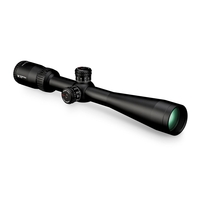
Vortex Diamondback Tactical 4-12x40 Riflescope - VMR-1 Reticle (MOA)
via Uttings
£299.00
Buying Advice
The key specifications to examine when choosing a ballistics scope in the UK in 2026 centre on adjustment range, adjustment granularity and optical plane. Elevation adjustment range determines how much bullet drop you can physically dial out: a scope with 60 MOA (roughly 17.5 MRAD) of total elevation travel is adequate for most UK centrefire calibres to 600 yards, but PRS and long-range target shooters engaging at 1,000 yards or beyond need 80–120 MOA or 25+ MRAD of total travel, often achieved with a 20 MOA canted rail. Adjustment granularity matters too: 0.25 MOA clicks give roughly 7mm movement per click at 100 yards, while 0.1 MRAD clicks give exactly 1 cm at 100 metres. First focal plane (FFP) scopes keep the reticle subtensions accurate at every magnification — essential for holdover shooting — while second focal plane (SFP) reticles are only accurate at one specified magnification, usually the highest.
Budget tiers in the UK market break down clearly. Entry-level scopes from around £200 to £500 — such as solid offerings from Athlon, Hawke and some MTC models — deliver reliable tracking and adequate glass for foxing and range work to 300 yards. Mid-range optics between £500 and £1,200, from manufacturers like Vortex, Bushnell and certain Pard models, provide noticeably better glass clarity, more precise turret tracking, FFP reticle options and features like zero-stop turrets that prevent you from losing your 100-yard zero when dialling back. Premium scopes from £1,200 upward — Nightforce, Kahles, Schmidt & Bender, Zeiss and top-tier Vortex — offer the optical clarity, turret repeatability and build quality that competitive PRS, F-Class and benchrest shooters demand. For the best scope for benchrest in the UK, budget for the mid-range tier at minimum.
Common mistakes UK buyers make include mismatching their reticle system with their turret adjustments — mounting a mil-dot reticle on a scope with MOA turrets forces awkward conversions in the field and invites errors. Always match: MRAD reticle with MRAD turrets, or MOA reticle with MOA turrets. Another frequent error is buying more magnification than needed while sacrificing field of view and exit pupil. For foxing at 100–250 yards in low light, a 4-16× scope with a 50mm objective often outperforms a 6-24× in practical terms because the wider field of view helps you acquire moving quarry and the larger exit pupil gathers more light at lower powers. Finally, many shooters neglect parallax adjustment: at long range, parallax error can introduce several MOA of apparent reticle shift if the scope is set to a fixed 100-yard parallax. Adjustable parallax (AO or side-focus) is essential for any serious long-range work.
UK-specific context matters significantly. All centrefire rifles require a firearms certificate (FAC) with conditions specifying calibre and purpose, and your choice of scope should reflect the distances and quarry your FAC conditions cover. Deer stalking in Scotland frequently involves shots from 80 to 200 yards in variable light, favouring scopes with generous light transmission and a simple, uncluttered reticle — a BDC or standard duplex at 3-12× or 4-16×. PRS competition, growing rapidly across UK ranges like Orion, Bisley and Diggle, rewards FFP MRAD scopes with exposed locking turrets in the 5-25× range. For sub-12 ft/lb air rifles, which are legal without a licence in England and Wales, effective range is realistically 30 to 50 yards — a scope with a fixed parallax at 25–30 yards and modest 3-9× magnification is entirely appropriate, and long-range ballistic features are unnecessary. UK retailers including Optics Warehouse, RSPB-independent dealers, and specialist online stores typically stock the full range.
Matching a scope to your specific use case begins with your calibre's ballistic profile. Use a free solver like Strelok or Applied Ballistics to generate a drop chart for your exact load — inputting your bullet weight, ballistic coefficient (BC), muzzle velocity and zero range. This chart tells you how many MOA or MRAD of elevation you need at each distance. For example, a 6.5 Creedmoor firing a 140-grain ELD Match at 2,710 fps, zeroed at 100 yards, requires roughly 7.5 MRAD (approximately 25.8 MOA) of elevation to reach 800 yards. Ensure your scope can physically deliver that adjustment from its mechanical zero, factoring in any canted base. For wind, use the same solver to generate drift values at your expected wind speeds — 5, 10, 15 mph — and practise reading holds in your reticle at those values.
The brand landscape for a ballistics scope in the UK in 2026 is competitive and increasingly accessible. Vortex dominates the mid-range PRS and tactical segment with strong UK distribution and an unconditional warranty. Nightforce and Kahles lead at the premium tier for competitive shooters. Hawke and MTC remain popular for UK hunting and foxing at sensible price points with solid UK-based support. Pard, increasingly visible in the UK market, offers digital and thermal optics alongside conventional scopes and is worth considering if you want day-night versatility on a single rifle. Schmidt & Bender and Zeiss carry the heritage premium and are favoured by serious stalkers and military-specification users. Across all brands, the advice is consistent: buy the best glass and turret tracking you can afford for your intended distances, match your reticle system to your turrets, and learn your ballistic data before you ever dial or hold.
Frequently Asked Questions
How does bullet drop affect which scope magnification and reticle I need for long-range shooting in the UK?
Bullet drop increases exponentially with distance, so at ranges beyond 300 yards you need a reticle with enough subtension marks (mil-dots or MOA hashmarks) to hold over accurately, or turrets with sufficient elevation travel to dial the correction. Higher magnification — typically 16× to 25× — helps you resolve targets at distance and use fine reticle graduations precisely. For a long range rifle scope in the UK, an FFP reticle is ideal because its holdover markings remain accurate at any magnification, letting you engage at varied distances without switching to a specific power setting.
What is the difference between a BDC reticle and a mil/MOA turret for compensating for drop at 500 metres?
A BDC (Bullet Drop Compensator) reticle has pre-set aiming points calibrated to specific distances for a particular calibre and load — you simply place the correct circle or hashmark on target. This is fast but inflexible: if your load differs from the manufacturer's reference, the BDC points will be inaccurate. A mil or MOA turret system lets you dial precise elevation corrections based on your actual ballistic data, making it universally adaptable to any calibre. For 500 metres, a BDC reticle vs MOA turret choice comes down to speed versus precision — turret dialling is more accurate, while BDC is faster for known-distance scenarios.
How do I use my scope's elevation turret to correct for bullet drop when zeroed at 100 yards?
First, generate a ballistic drop chart for your specific load using a solver like Strelok or Applied Ballistics, entering your bullet weight, BC, muzzle velocity and atmospheric conditions. The chart tells you how many MOA or MRAD of elevation correction is needed at each distance. For scope elevation adjustment in the UK, simply dial up the required number of clicks — for example, if your .308 drops 10.5 MOA at 400 yards and your turret has 0.25 MOA clicks, you dial up 42 clicks. A zero-stop turret lets you return to your 100-yard zero instantly by dialling back until the turret stops, preventing you from going past zero.
Does wind drift matter more than bullet drop at typical UK hunting and foxing distances?
At typical UK foxing distances of 100 to 250 yards, wind drift is often the primary cause of missed shots rather than bullet drop. A .223 Remington zeroed at 100 yards drops only about 5 inches at 200 yards, which is manageable, but a 10 mph full-value crosswind pushes the same bullet roughly 4 inches laterally at that range — enough to miss a fox's kill zone entirely. Drop is predictable and can be dialled precisely; wind drift for a rifle scope requires real-time judgment of wind speed and direction, making it the harder variable to master and, in practice, the more consequential one.
How do I match my scope's MOA or MRAD adjustments to my calibre's ballistic data for benchrest and long-range shooting?
Begin by choosing one system — MRAD or MOA — and ensure both your reticle and turrets use the same unit. Then run your exact handload or factory ammunition through a ballistic calculator, inputting precise muzzle velocity (ideally confirmed by chronograph), bullet BC (G1 or G7), zero range, altitude and temperature. The solver outputs a drop table in your chosen unit. Print or programme this into a ballistic app. For the best scope for benchrest in the UK, MRAD is increasingly popular because 0.1 MRAD clicks equate to exactly 1 cm at 100 metres, making metric range calculations intuitive.
Should I choose a first focal plane (FFP) or second focal plane (SFP) scope for ballistic holdover shooting?
For any shooting where you use reticle subtensions to hold over or hold off — rather than dialling turrets — FFP is strongly preferred. In an FFP scope, the reticle scales with magnification, so a 1 MRAD gap between hashmarks always corresponds to 1 MRAD on target regardless of the zoom level. In an SFP scope, the reticle subtensions are only accurate at one specific magnification (usually the highest). If you use SFP at half magnification, your holdovers will be half the actual value, causing misses. For a scope for long range shooting in the UK where holdovers are common, FFP eliminates this source of error entirely.
What ballistic coefficient (BC) means and why it matters when choosing a scope setup?
Ballistic coefficient describes a bullet's ability to overcome air resistance in flight. A higher BC means the bullet retains velocity better, drops less and drifts less in wind at any given range. This matters for scope setup because a high-BC bullet — like a 6.5mm 140-grain ELD Match (G1 BC ~0.610) — requires significantly less elevation correction at long range than a lower-BC bullet of the same calibre. In practical terms, a high-BC load needs fewer turret clicks or holdover marks to reach a given distance, meaning scopes with moderate elevation travel remain viable for longer ranges.
Is a 20 MOA canted rail necessary for long-range scope setups in the UK?
A 20 MOA canted rail tilts your scope's optical axis downward, effectively giving you an extra 20 MOA of upward elevation adjustment without moving the erector tube to its mechanical limit. For UK shooters engaging targets beyond 500–600 yards — common in PRS matches and long-range target disciplines — this additional travel is often essential, especially with calibres that drop heavily like .308 Winchester. If you only shoot to 300 yards for stalking or foxing, a standard 0 MOA mount is perfectly adequate and simpler to set up.
How does air density and UK weather affect bullet drop and my scope corrections?
Air density directly affects drag on the bullet: cold, damp, low-altitude conditions — extremely common across the UK — produce denser air, increasing drag and causing slightly more drop and drift than standard ICAO atmospheric models predict. A .308 Winchester at sea level on a 5°C winter morning in the Scottish Highlands may drop 2–3 inches more at 600 yards than the same load on a warm summer day. Modern ballistic solvers account for temperature, pressure, humidity and altitude. Inputting accurate local conditions before a shoot ensures your scope elevation adjustment matches reality rather than a textbook average.
Related guides
Expert UK guide to choosing the best scope for long range ballistics in 2026. Learn how to match BDC reticles, MOA or MRAD turrets and magnification…
Best Scopes for Ballistics-Matched Long-Range Shooting in 2026Our 2026 UK buyer's guide to the best long-range scopes with BDC reticles, ballistic turrets and calibre pairing for accurate shooting from 300 to 1,000…
MOA vs MRAD: Which Should UK Shooters Choose?MOA or MRAD? Our expert guide helps UK shooters pick the right angular measurement system for their discipline…
Best Long-Range Rifle Scopes 2026: Match Your Optic to Your CalibreOur 2026 UK guide to the best scopes for long range shooting. Learn how to match reticle, turrets and magnification to your calibre's ballistic profile…
Best PARD Night Vision Scopes for UK ShootersDefinitive UK buyer's guide to PARD digital night vision scopes for foxing, deer stalking and vermin control.
First Focal Plane Reticles: The Long-Range Shooter's GuideUnderstand how first focal plane reticles work for long-range shooting. Expert UK guide covering FFP vs SFP, MRAD holdovers…
Not sure which scope is right for you?
Try our AI-powered scope finder — answer a few questions and get personalised recommendations.
Find My Scope →Get a UK scope tip every day
Follow AiScopes on Facebook for daily buying guides, deals and gear advice.
Follow on Facebook