Best Clip-On Thermal Imagers 2026
By Peter Makulek · Senior Optics Editor · · Live prices from UK retailers
If you already own a day scope you trust — one that's properly zeroed on your deer rifle, your AR-platform coyote gun, or your bolt-action predator rig — a clip-on thermal imager lets you convert that setup into a thermal-capable system without losing your zero or buying a second rifle. The concept is simple but the execution is genuinely impressive: a self-contained thermal unit mounts directly in front of your day scope's objective lens, projecting a thermal image through your existing optic so you see warm targets rendered against a cooled background, all while looking through your familiar reticle and glass. For US hunters chasing hogs in Texas brush country, calling coyotes across Oklahoma pastures at night, or managing predators on western ranches, the best clip-on thermal imager can turn a single rifle into a legitimate day-and-night platform.
The US market for clip-on thermals has matured significantly heading into 2026. Where a few years ago the category was dominated by a handful of extremely expensive military-derived units, today there are realistic options starting around the $2,000 mark and scaling up past $7,000 for premium long-range systems. Brands like Pulsar, IRay, AGM, Bering Optics, and InfiRay now compete alongside legacy defense contractors, which means more sensor choices, better refresh rates, and genuinely usable detection ranges at prices that — while still serious money — are within reach for dedicated hunters rather than exclusively military or law-enforcement budgets.
This guide is built specifically for US buyers trying to navigate the real confusion around clip-on thermals. We drew on current community discussion — including active threads on r/NightVision asking exactly which clip-on options are worth it today — and combined that with hands-on knowledge of how these units perform on common US rifle platforms like the Remington 700, Tikka T3x, Ruger American, and AR-15/AR-10 builds. We cover what a clip-on actually is (mechanically, not marketing), who genuinely benefits from one versus a dedicated thermal riflescope, and what detection and identification ranges you should realistically expect at each price tier.
Before diving into specific recommendations, it's worth being honest about the core tradeoff: clip-on thermals almost always cost more than a dedicated thermal scope with a comparable sensor, because you're paying for the additional optical engineering required to couple the thermal unit cleanly to another optic without degrading either image. That premium buys you something genuinely valuable — the ability to run one rifle, one zero, day and night — but it is a premium. If you only ever shoot at night and don't mind maintaining a separate zero on a dedicated thermal scope, a clip-on may not be the most cost-effective path. For everyone else, particularly hunters who want maximum flexibility from a single zeroed rig, it's one of the smartest investments in the thermal category.
Top Picks — Live UK Prices

ATN X-Celsior-NV 3-9x Day/Night Hunting Riflescope
via Uttings
£499.00

ATN X-Celsior-NV 5-15x Day/Night Hunting Riflescope
via Uttings
£549.00
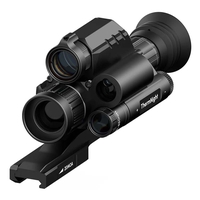
DNT Optics Thermnight Thermal (256x192) & Night Vision Multispectral Riflescope - 25mm with LRF
via Uttings
£999.99
Buying Advice
Understanding what a clip-on thermal actually is — and how it differs from a dedicated thermal riflescope — is essential before spending several thousand dollars. A clip-on thermal imager is a self-contained thermal imaging unit that mounts in front of your existing day scope's objective lens, ahead of the bell, using a quick-detach adapter. It does not replace your scope; it projects a thermal image through your scope's existing glass and reticle. You look through your day optic exactly as you normally would, but instead of seeing a daylight or starlight scene, you see the thermal unit's processed heat signature image. Because the clip-on sits ahead of the day scope and the day scope itself never moves, your rifle's existing zero is preserved — attach the clip-on for night work, remove it for daytime hunting, and your point of impact stays the same. A dedicated thermal riflescope, by contrast, replaces your day optic entirely and requires its own separate zero, meaning swapping between day and thermal shooting involves re-zeroing or maintaining two rifles.
Clip-on thermals are for shooters and hunters who want dual-use capability from a single rifle without the hassle of re-zeroing. The most common US use case is the hunter who runs a quality day scope on a bolt-action or AR-platform rifle for daytime predator or big-game hunting and wants to add thermal capability for night hog control, coyote calling after dark, or predator management on ranch land — all without pulling the day scope or losing a confirmed zero. They're also popular with competitive and recreational shooters who want to experiment with thermal without dedicating a separate rifle. If you hunt multiple states with different night-hunting regulations — legal for hogs in Texas, legal for coyotes in many plains states, restricted elsewhere — a clip-on lets you add or remove thermal capability as the legal situation demands, keeping one versatile rifle in the truck rather than two.
For the best overall clip-on thermal imager in 2026, the smart money lands in the $2,500–$4,000 mainstream tier, where you get a 12-micron sensor (typically 384×288 or 640×512 resolution), a 50 Hz refresh rate for smooth target tracking, and realistic detection ranges of 500–800 yards on a deer-sized target under good atmospheric conditions. Units in this range from manufacturers like InfiRay, Pulsar, and IRay offer mature software with multiple color palettes, built-in video recording, and wireless connectivity for phone-based setup. This is the tier where most serious US hunters will find the best balance of cost, capability, and reliability — enough sensor resolution to positively identify targets at realistic engagement distances (typically inside 200–400 yards for identification versus raw detection), paired with quick-detach mounts that fit the most common day scope objective bell sizes (40–56mm). If you're running a standard 3-15×50 or 4-16×44 hunting scope on a .308 Win, 6.5 Creedmoor, or .223 Rem predator rifle, a clip-on in this tier should pair cleanly.
For the best budget clip-on thermal under $2,500, expect to make meaningful but manageable compromises. Entry-level clip-ons in the $2,000–$2,500 range typically use a 12-micron 256×192 or 384×288 sensor with a smaller objective lens (around 25–35mm), which limits both detection and identification range. Realistic detection on a human or deer-sized target drops to roughly 300–500 yards, and positive identification — confirming whether that heat blob is a coyote, a dog, or a rock still radiating daytime warmth — may be limited to 150–250 yards. Refresh rates at this tier are sometimes 30 Hz rather than 50 Hz, which means moving targets can appear slightly choppy. These units absolutely work for close-to-mid-range hog hunting in thick East Texas brush or calling coyotes inside 200 yards in the Midwest, but they're not the right tool for scanning open western rangeland at 600-plus yards. AGM and some InfiRay-based units compete aggressively in this tier, and availability on Amazon.com or through retailers like OpticsPlanet has improved substantially.
For the best premium clip-on thermal imager, the $4,000–$7,000-plus tier delivers genuinely impressive capability: 640×512 (or higher) resolution sensors, larger objective lenses (50mm+), 50–60 Hz refresh rates, and detection ranges that push 1,000 yards or beyond on a large warm target under favorable conditions. Units from Pulsar's Thermion line (their dedicated clip-on variants), IRay's RICO series clip-on configurations, and military-heritage brands occupy this space. At this level, identification range — the distance at which you can confirm target species with confidence — extends meaningfully to 400–600 yards, which opens up longer-range predator work on open terrain common in western states like Montana, Wyoming, and the Texas Panhandle. Premium clip-ons also tend to have superior battery life, more robust quick-detach mechanisms with finer alignment adjustability, and better resistance to heavy recoil from magnum cartridges like .300 Win Mag or .338 Lapua. This tier is a genuine investment, but for a serious predator hunter or ranch manager covering large acreage at night, the capability gap over budget units is real and meaningful.
Mounting, detection range, and realistic price-to-performance expectations deserve careful attention before buying any clip-on thermal. Most clip-ons attach via a quick-detach adapter that clamps around or indexes to your day scope's objective bell — correct sizing is critical. A clip-on designed for a 50mm bell won't align properly on a 44mm or 56mm objective without the correct adapter ring, and a poorly aligned clip-on will cause vignetting: a dark ring or shadow around the edges of your image that reduces your effective field of view. Always verify the clip-on manufacturer's compatibility chart against your specific day scope model and objective diameter before purchasing. On detection range, remember that manufacturer specs are typically stated for ideal conditions against a standardized target — real-world performance drops with humidity, rain, fog, and temperature differentials between the target and background. Finally, be realistic: a $2,200 clip-on will not match a $6,000 unit's sensor clarity or range, and no clip-on will make a mediocre day scope suddenly excellent. The clip-on projects its image through your day optic's glass, so a sharp, well-coated day scope with good light transmission will yield a noticeably better thermal image than a budget scope with soft glass. When the clip-on is removed, your day scope performs exactly as it always did — the clip-on adds nothing permanent and alters nothing in the day optic's optical path.
Frequently Asked Questions
Do I need to re-zero my rifle after adding a clip-on thermal?
Generally, no — and this is the single biggest practical advantage of a clip-on thermal over a dedicated thermal riflescope. Because the clip-on mounts in front of your day scope's objective lens and the day scope itself never moves, your existing zero is preserved. You attach the clip-on for thermal use and remove it for daytime shooting without changing your point of impact. That said, a very poorly aligned or incorrectly sized clip-on adapter could theoretically shift the perceived image enough to cause minor point-of-impact concerns, so always verify zero after your first installation and confirm your specific mount indexes repeatably.
Does a clip-on thermal work with any day scope, or only specific ones?
Most clip-on thermals are designed to work with a wide range of day scopes, but compatibility depends on matching the clip-on's adapter to your day scope's objective bell diameter. Common objective sizes like 40mm, 44mm, 50mm, and 56mm are well-supported by most manufacturers' adapter ring systems. However, scopes with unusually shaped objective bells, very large sunshade threads, or non-standard housing geometry may require a custom adapter or may not be compatible. Always check the clip-on manufacturer's compatibility list for your specific scope model and measure your objective bell diameter carefully before purchasing.
What detection range should I expect from a clip-on thermal?
Detection range — the distance at which you can spot a warm target like a deer or human-sized heat signature — varies significantly by sensor resolution, lens size, and atmospheric conditions. Budget clip-ons in the $2,000–$2,500 range typically detect at roughly 300–500 yards, mainstream units in the $2,500–$4,000 tier reach 500–800 yards, and premium clip-ons above $4,000 can push 1,000 yards or more under ideal conditions. Critically, identification range (confirming what you're seeing, not just that something warm is there) is meaningfully shorter than raw detection range — often 40–60% of the stated detection figure. Humidity, rain, and minimal temperature contrast between target and background all reduce effective range.
Is a clip-on thermal better than buying a dedicated thermal riflescope?
It depends on your priorities. A clip-on thermal's main advantage is preserving your day scope's zero so you can switch between day and thermal use on one rifle without re-zeroing — that's genuinely valuable for hunters who shoot both day and night. However, clip-ons typically cost more than a dedicated thermal scope with a similar sensor, because you're paying for the additional optical engineering of coupling to another optic. A dedicated thermal riflescope is often simpler (one unit, no adapter), may offer a wider field of view, and can be less expensive at equivalent sensor specs. If you only shoot at night or are willing to dedicate a rifle to thermal use, a standalone thermal scope may be more cost-effective.
Does a clip-on thermal reduce the image quality of my day optic when it's not in use?
No. A clip-on thermal only affects your view when it is physically attached in front of your day scope. Once removed, your day scope performs exactly as it did before — the clip-on doesn't alter, coat, or modify any of your day optic's internal glass or coatings. There is nothing permanent about the installation. Your day scope's clarity, light transmission, and reticle function remain completely unchanged when the clip-on is detached.
How does sensor resolution affect clip-on thermal performance?
Sensor resolution is one of the most important specs in a clip-on thermal. A 640×512 sensor captures significantly more thermal detail than a 384×288 or 256×192 sensor, which translates directly to better target identification at longer distances and a clearer overall image. Higher-resolution sensors let you distinguish between a coyote and a domestic dog at greater range, or pick out individual hogs in a sounder more easily. However, higher resolution also means higher cost, so matching your sensor choice to your realistic engagement distances is key — a 384×288 sensor is perfectly adequate for most sub-400-yard hog and predator hunting scenarios.
Can I use a clip-on thermal on an AR-15 or AR-10 platform?
Absolutely. Clip-on thermals mount to the day scope's objective bell, not to the rifle's rail or receiver, so they're platform-agnostic in that sense. AR-15 builds in .223 Rem or .300 Blackout and AR-10 builds in .308 Win or 6.5 Creedmoor are among the most popular US platforms for clip-on thermal use, especially for night predator and hog hunting. Just ensure your day scope's objective diameter is compatible with the clip-on's adapter, and verify that the added weight and length of the clip-on in front of your scope doesn't create a balance or clearance issue with your specific handguard or rail setup.
What refresh rate do I need in a clip-on thermal for hunting?
For hunting moving targets like running hogs or trotting coyotes, a 50 Hz refresh rate provides noticeably smoother motion than 30 Hz. At 30 Hz, fast-moving targets can appear slightly choppy or laggy, which can make shot timing more difficult. Most mainstream and premium clip-ons in 2026 offer 50 Hz, while some budget units are limited to 30 Hz. If your primary use case involves stationary or slow-moving targets at close range, 30 Hz is workable. For tracking moving targets, calling coyotes on the run, or scanning large areas quickly, 50 Hz is a meaningful upgrade worth prioritizing.
How much does a clip-on thermal imager weigh, and does it affect rifle handling?
Most clip-on thermals weigh between 14 and 28 ounces depending on sensor size, lens diameter, and housing material. Adding that weight forward of the scope's objective does shift the rifle's balance point forward, which can make the rifle feel nose-heavy — particularly on lightweight bolt-action hunting rifles or light-profile AR builds. For bench or bipod shooting this is rarely an issue, but for offhand or standing shots on a called-in coyote, the added weight is noticeable. Heavier premium units with large objective lenses (50mm+) have the most impact on handling. Consider your shooting position and style when choosing between a compact, lighter clip-on and a larger, longer-range unit.
Related guides
Digital night vision or thermal clip-on for UK deer stalking? Our 2026 guide compares detection, ID, legal use, and value to help you choose the right unit.
How to Zero a Thermal Scope: The Hand-Warmer Method ExplainedLearn the thermal scope hand warmer zeroing method step by step. Fix weak heat contrast, choose the right distance, and get a reliable zero for night hunting in 2026.
Thermal vs Night Vision: Which Should You Buy First?Thermal vs night vision — which to buy first in 2026? Our US-focused decision guide breaks down detection vs identification, real price tiers, and the best pick for your use case.
Pulsar vs Hikmicro: Which Thermal Scope Suits UK Shooters?Pulsar or Hikmicro thermal scope for UK shooting in 2026? Our in-depth comparison covers specs, budget tiers, deer stalking, fox control and rabbit shooting to help you choose the best thermal rifle scope.
Best Budget Thermal Scopes for Fox & Deer Shooting in the UKOur 2026 UK buyer's guide to the best thermal scopes under £500 for foxing and deer stalking. Compare PARD, Hikmicro and more — specs, legality and real-world advice.
Best Scopes for AR-10 & .308 Win Under $2,000Expert-picked best scopes for AR-10 and .308 Win under $2,000 in 2026. FFP vs SFP, magnification, mounts, and 5 real picks from $700 to $1,900 for US precision shooters.
Best Night Vision Clip-Ons & Add-Ons for UK Shooters in 2026Our 2026 buyer's guide to the best night vision clip-on scopes for UK foxing and pest control. Covers budget to premium add-ons, PARD models, IR illuminators, law and mounting tips.
Not sure which scope is right for you?
Try our AI-powered scope finder — answer a few questions and get personalised recommendations.
Find My Scope →Get a UK scope tip every day
Follow AiScopes on Facebook for daily buying guides, deals and gear advice.
Follow on Facebook