Your First Thermal Scope for Hunting: UK Guide
By Peter Makulek · Senior Optics Editor · · Live prices from UK retailers
Thermal imaging has moved from the exclusive preserve of military operators and professional pest controllers into the hands of everyday UK hunters and deer stalkers. Prices have fallen dramatically in recent years, and the technology has matured to the point where a first-time buyer can pick up a genuinely capable thermal rifle scope without remortgaging the house. Whether you are managing foxes on farmland at night, controlling deer populations during the close season with the appropriate permissions, or lamping for rabbits, a thermal scope can transform your effectiveness and — critically — your ability to make humane, well-placed shots in low-light conditions.
For UK hunters specifically, thermal optics occupy an interesting legal and practical niche. Unlike image-intensifier night vision, thermal imaging is not currently restricted under firearms legislation in England, Wales, or Scotland, though it is always your responsibility to confirm the legality of any equipment and method with your local police firearms licensing department or an organisation such as BASC before heading afield. Many stalkers now mount thermal clip-on units ahead of their existing day scope, while others prefer a dedicated thermal rifle scope for a cleaner setup. Both approaches have merit, and your choice will depend heavily on budget, quarry, and how many rifles you intend to use the unit on.
The UK hunting landscape presents specific challenges that make thermal scopes particularly valuable. Short winter days, dense hedgerows, undulating farmland, and woodland edges all conspire to limit visibility at the times when quarry is most active. A good thermal scope lets you detect and identify animals by their heat signature through light mist, at dusk and dawn, and in complete darkness, giving you a decisive advantage when identifying your target — and what is beyond it — before taking a shot. For fox control and deer management alike, positive identification is not just good practice; it is an ethical and often legal obligation.
This guide is aimed squarely at the UK buyer picking up their first thermal scope for a centrefire hunting rifle. We will walk you through the specifications that actually matter, explain the difference between detector resolutions and refresh rates in plain English, set out realistic budget tiers in pounds sterling, and highlight some of the brands and models that have earned strong reputations among British stalkers and pest controllers. We will also address common questions from hunters who may be more familiar with conventional glass optics from brands like Vortex, Leupold, Zeiss, or Nightforce, and who are stepping into the thermal world for the first time.
Top Picks — Live UK Prices
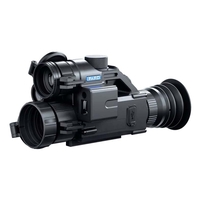
Pard Landsat 256 Mini Mulit-Spectral LRF Thermal/Night Vision Scope
via Uttings
£599.00
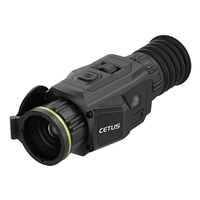
Pixfra Cetus C225 Thermal (256x192) Rifle Scope
via Uttings
£679.95
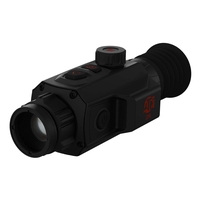
ATN Thor 6 Mini 215 (2-16x) Compact Thermal (256x192) Rifle Scope
via Uttings
£699.00
Buying Advice
The single most important specification on a thermal scope is detector resolution, expressed as a pixel count such as 384×288, 640×480, or 640×512. Higher resolution means more thermal detail, sharper animal outlines, and better identification at range. A 384-resolution sensor is perfectly adequate for fox-sized quarry inside 150 metres and represents the sweet spot for budget-conscious UK buyers, but if you regularly need to identify deer species at longer distances or work across open moorland, a 640 sensor is a worthwhile investment. Pixel pitch — typically 12µm or 17µm — also matters: a smaller pitch packs more pixels onto a smaller detector, often yielding a sharper image. Refresh rate, usually 50Hz in European-market scopes, ensures smooth tracking of moving animals without the stuttery lag that cheaper 25Hz units can exhibit.
Budget tiers for thermal rifle scopes in the UK market break down roughly as follows. Entry-level units from brands like Hikmicro start from around £1,500 to £2,500 and typically offer 384-resolution detectors, adequate magnification ranges, and reliable zero-holding for centrefire recoil. Mid-range scopes from Hikmicro and Pulsar sit between £2,500 and £4,500, stepping up to 640-resolution sensors, better lenses, onboard recording, and improved battery life. Premium units from Pulsar's Thermion 2 LRF line and comparable models push above £4,500, adding integrated laser rangefinders, ballistic calculators, and the finest image processing available. Each tier represents a genuine step up in capability, but even entry-level thermals from reputable manufacturers are transformative compared to hunting with conventional optics in poor light.
Common mistakes UK buyers make when purchasing their first thermal scope include overvaluing magnification and undervaluing base optical magnification. A scope advertising 2.5-10× may sound modest compared to a 4-16× day scope, but thermal scopes use digital zoom beyond their optical base, which degrades image quality. Always check the native (optical) magnification first. Another frequent error is buying a scope that cannot withstand your rifle's recoil: ensure the unit is rated for centrefire calibres such as .308 Winchester, .30-06, or .243. Mounting is also critical — most thermal scopes use 30mm tubes or proprietary mounts, and a quality set of rings or a Picatinny adapter from a reputable source is not the place to economise. Finally, do not overlook battery life: a scope that dies after two hours on a cold February night on the hill is a liability.
UK-specific context is essential when choosing a thermal scope. If you hold a Firearms Certificate and are using the scope on a centrefire rifle for deer stalking, you must comply with all relevant legislation including the Deer Act 1991 (England and Wales) or the Deer (Scotland) Act 1996, which govern permitted calibres, seasons, and methods. Night shooting of deer is heavily restricted and generally requires a specific authorisation; do not assume that owning a thermal scope entitles you to stalk after dark. For fox control, landowner permission and adherence to the conditions on your FAC are paramount. Scotland's Air Weapon Certificate regime applies separately if you are considering thermal for an air rifle, though sub-12 ft-lb airguns combined with thermal are primarily used for close-range rat control rather than longer-range hunting. Always consult BASC, the Deer Initiative, or your local police firearms licensing team for definitive guidance.
Matching the scope to your use case is where many first-time buyers go wrong. A dedicated fox and rabbit controller working farmland at ranges under 200 metres will be well served by a 384-sensor scope with a moderate 35mm or 50mm objective lens — compact, lightweight, and sufficient for the task. A deer stalker who also manages foxes across larger estates may prefer a 640-sensor unit with a larger objective lens for the additional detection range and identification clarity needed when confirming species and sex at distance. If you shoot multiple rifles, consider whether a clip-on thermal unit ahead of your existing day scope — from makers such as Pulsar or Hikmicro — might offer better versatility than a dedicated scope locked to one platform. Each approach involves trade-offs in weight, image quality, and zero reliability.
The brand landscape for thermal scopes in the UK is dominated by Pulsar and Hikmicro, both of which have earned strong reputations for reliability, image quality, and after-sales support through UK distributors. Pulsar's Thermion series and Hikmicro's Thunder and Panther lines appear on stalking forums constantly, with real-world feedback from British users in British conditions. Beyond these two, brands like InfiRay and Guide Sensmart are gaining traction at competitive price points. Traditional optics giants such as Zeiss, Leupold, and Vortex have been slower to enter the thermal rifle scope market in a meaningful way, though Vortex has made moves in adjacent categories. For your first thermal scope, buying a well-supported brand with a UK service centre and readily available accessories is arguably more important than chasing marginal spec-sheet advantages from a lesser-known manufacturer.
Frequently Asked Questions
What is the best thermal scope for deer stalking in the UK?
For UK deer stalking, Pulsar's Thermion 2 series and Hikmicro's Panther range are consistently recommended by British stalkers. A 640-resolution sensor is ideal for positively identifying deer species at typical UK stalking ranges of 100–250 metres. Ensure any scope you choose is rated for the recoil of your stalking calibre, whether that is .243, .308 Winchester, or .30-06. Always confirm that your intended use — particularly any night shooting — is lawful under the Deer Act and your FAC conditions.
Can I use a thermal scope on my .308 or .30-06 deer rifle?
Yes, most thermal rifle scopes from reputable manufacturers such as Pulsar and Hikmicro are rated for centrefire recoil, including .308 Winchester and .30-06 Springfield. Always check the manufacturer's stated recoil rating before purchasing, as some budget units are designed only for rimfire or air rifle use. Proper mounting with quality rings or a base is essential — a loose mount will lose zero quickly under centrefire recoil, and an improperly secured thermal scope is both expensive and dangerous.
Is it legal to hunt with a thermal scope in the UK?
Thermal imaging devices are not themselves restricted items under current firearms legislation in England, Wales, or Scotland. However, the legality of using one while hunting depends entirely on your quarry, the time of day, your permissions, and your FAC conditions. Night shooting of deer is subject to strict controls and generally requires specific authorisation. We strongly recommend consulting BASC or your local police firearms licensing department before using thermal optics in the field, as the rules differ across the UK's jurisdictions.
What detector resolution do I need for hunting?
A 384×288 detector is adequate for fox-sized quarry at ranges inside 150–200 metres and represents the most affordable entry point. For deer stalking, where positive species and sex identification at longer ranges is critical, a 640×480 or 640×512 detector provides significantly more detail and is well worth the additional cost. Pixel pitch matters too: a 12µm pitch generally yields sharper images than 17µm at equivalent resolutions.
Should I buy a dedicated thermal scope or a clip-on unit?
A clip-on thermal unit mounts ahead of your existing day scope, letting you use one thermal device across multiple rifles without re-zeroing each time. This offers excellent versatility and preserves your investment in quality conventional glass. A dedicated thermal rifle scope, however, is typically lighter, faster to deploy, and often provides a better image because the thermal sensor feeds directly to the eyepiece without an intermediary optic. If you shoot only one rifle, a dedicated scope is usually the simpler and more elegant solution.
How much should I budget for a first thermal hunting scope?
Entry-level thermal rifle scopes from brands like Hikmicro start at roughly £1,500 to £2,500 in the UK market. Mid-range options with 640-resolution sensors and better features sit between £2,500 and £4,500. Premium models with integrated laser rangefinders and top-tier image processing can exceed £5,000. For a first thermal scope that will handle fox control and general stalking duties reliably, the £2,000–£3,500 bracket offers the best balance of capability and value.
Can I use a thermal scope on a sub-12 ft-lb air rifle?
Technically, some thermal scopes can be mounted on air rifles, and a few models are specifically designed for lighter recoil platforms. However, sub-12 ft-lb airguns are humane-kill effective only to roughly 35–45 yards on quarry such as rats, so you would be paying a premium for technology that offers limited advantage at such short distances. Spring-powered air rifles also produce a unique double-recoil that destroys optics not specifically designed for it, so ensure any scope is springer-rated if applicable. In Scotland, remember that any air weapon requires an Air Weapon Certificate.
What brands are most popular for thermal scopes among UK hunters?
Pulsar and Hikmicro dominate the UK thermal scope market, with both brands offering well-supported product lines and accessible UK service centres. Pulsar's Thermion and Talion ranges and Hikmicro's Thunder, Panther, and Stellar series are the most commonly discussed on British stalking forums. InfiRay is also gaining ground at competitive prices. Traditional scope makers like Vortex, Leupold, Zeiss, and Nightforce are primarily known for conventional day optics in the UK, though some are beginning to explore thermal and digital categories.
How does a thermal scope differ from a night vision scope?
A thermal scope detects infrared radiation — heat — emitted by objects, creating an image based on temperature differences. It works in complete darkness, through light fog, and does not require any ambient light. An image-intensifier night vision scope amplifies existing light (starlight, moonlight) and requires at least some ambient illumination to function. Thermal is generally superior for detecting and identifying live quarry, while traditional night vision can provide a more natural-looking image. Digital night vision scopes, which use a sensor and IR illuminator, occupy a middle ground but still require their illuminator to see in total darkness.
Related guides
Our expert-tested guide to the best thermal spotter monoculars under £1,000 for UK deer stalking and foxing.
HIKMICRO Stellar 3.0 Price Reductions ExplainedHIKMICRO Stellar 3.0 thermal scope prices have dropped across UK dealers. Our 2026 guide covers what you get, how it compares…
GOYOJO GRL335 Thermal Scope – Initial UK ThoughtsFirst impressions of the GOYOJO GRL335 thermal scope for UK shooters. We cover specs, image quality, build, value for money…
Infiray TH50 V2 Thermal Scope — Is £1,600 the Sweet Spot?Is the Infiray TH50 V2 thermal scope worth £1,600 for UK night shooting? Our 2026 guide covers specs, detection range, rivals, and where to buy in the UK.
New Scope Day – Getting It Right First TimeExcited for new scope day? Our 2026 UK guide covers fitting, FFP vs SFP, MOA vs MRAD, parallax, and the best rifle scopes for every discipline and budget…
.25 PCP for Crows at 50–70 m: £500 Budget GuideNeed a .25 PCP air rifle and scope for corvid control at 50–70 metres on a £500 budget? Our UK guide covers FAC power, scope choice…
Not sure which scope is right for you?
Try our AI-powered scope finder — answer a few questions and get personalised recommendations.
Find My Scope →Get a UK scope tip every day
Follow AiScopes on Facebook for daily buying guides, deals and gear advice.
Follow on Facebook