New Scope Day – Getting It Right First Time
By Peter Makulek · Senior Optics Editor · · Live prices from UK retailers
There are few feelings in the shooting world quite like new scope day. Whether you have just unwrapped a compact rimfire optic for pest control on the permission or a premium long-range glass for open-hill stalking, the moment you slide it from the box is when anticipation peaks. But that excitement can turn to frustration remarkably quickly if the scope is wrong for the rifle, the discipline, or the legal class it sits on. In this guide we cut through the marketing noise and help UK shooters — from sub-12 ft-lb airgunners to FAC-rated centrefire stalkers — choose and fit the right scope with confidence.
The UK scope market in 2026 is broader than it has ever been. Established names such as Vortex, Leupold, Zeiss, and Bushnell sit alongside rapidly growing challengers like Athlon, March, and Arken, while the thermal and night-vision segment — dominated by Pulsar and HikMicro — continues to evolve at pace. For the buyer standing in a UK gun shop or browsing online, the sheer variety of reticle types, focal-plane choices, and magnification ranges can be paralysing. Understanding a handful of core concepts transforms that confusion into a clear shortlist.
Context matters enormously in the UK. A sub-12 ft-lb air rifle used for rabbiting at 30 yards faces completely different optical demands from a .308 stalking rifle engaging muntjac at 200 metres in forestry, or a .223 foxing rig reaching across open farmland at night. Parallax settings, magnification range, turret precision, and even physical length and weight all shift depending on the task. Legal requirements differ too: in England and Wales, sub-12 ft-lb air rifles need no licence, while anything above is FAC-rated; Scotland requires an Air Weapon Certificate for any air weapon. Always check with your local police force or BASC for current guidance.
Throughout this guide we examine the decision factors that actually matter on new scope day: focal plane (FFP vs SFP), angular measurement system (MOA vs MRAD), parallax adjustment, reticle design, and how to match magnification to your quarry and range. We also discuss mounting — a step many shooters rush and later regret — and flag the common mistakes that lead to returned optics and wasted money. Whether you are budgeting under £150 or stretching past £1,000, the principles are the same: buy once, buy right, and enjoy the moment you thread those ring screws tight.
Top Picks — Live UK Prices

Element Optics Iris 3-9x40 SFP Riflescope
via Uttings
£119.00
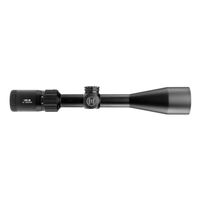
Element Optics Iris 4-12x44 SFP Riflescope
via Uttings
£129.99

Element Optics Iris 3-9x40 Sfp Duplex MOA
via BushWear
£135.99
Buying Advice
Start with the key specs and what the numbers actually mean. A scope labelled 4-16×44 offers 4× to 16× magnification through a 44 mm objective lens. Higher magnification is not always better: on a sub-12 ft-lb air rifle shooting rabbits at 25-40 yards, 3-9× or 4-12× is more than enough, and excessive magnification amplifies wobble without adding practical precision. The "×44" or "×50" figure determines light-gathering potential, but exit-pupil diameter (objective ÷ magnification) is what your eye actually uses — around 5 mm suits most UK dawn-and-dusk shooting. Understanding these relationships stops you over-spending on a huge objective you cannot exploit.
Budget tiers in the UK follow a fairly predictable pattern. Below £150 you find competent starter scopes — perfectly adequate for plinking and casual pest control — from brands like Bushnell and some Vortex Crossfire models. Between £150 and £400 the quality leap is significant: better glass coatings, more reliable tracking, and features such as side-focus parallax and illuminated reticles appear from Athlon, Vortex Diamondback Tactical, and Arken. From £400 to £800 you enter serious hunting and target territory with excellent edge-to-edge clarity from March, Vortex Viper, and Leupold VX-Freedom. Above £800, premium Zeiss, March, and Leupold offerings deliver the optical and mechanical precision demanded by PRS competition and professional stalking.
Common mistakes UK buyers make are surprisingly consistent. First, fitting a non-springer-rated scope to a spring-piston air rifle: the unique double-recoil impulse of a springer hammers internals that conventional centrefire scopes are not designed for, cracking lenses and stripping turret teeth. Always confirm a scope is springer-rated or choose a gas-ram or PCP platform. Second, ignoring parallax: most centrefire scopes ship with parallax factory-set at 100 yards or even 150 metres, which introduces significant aiming error at the 10-45 yard distances common in UK airgun shooting. Look for adjustable parallax down to around 10 yards on any airgun optic. Third, buying more magnification than conditions allow — mirage, wind disturbance, and the UK's typically overcast light make a crystal-clear 10× image far more useful than a murky 24× one.
UK-specific context shapes the decision in ways that overseas guides miss. Sub-12 ft-lb airguns are effective for humane kills on rabbits and grey squirrels to roughly 35-45 yards in still conditions; do not let a high-magnification scope tempt you into unethical long shots. FAC-rated air rifles extend practical range but are subject to Firearms Certificate conditions. For centrefire stalking — roe, muntjac, fallow — most UK shots are taken inside 200 metres in woodland or at field edges, so a moderate 3-12× or 4-16× scope with a simple duplex or BDC reticle is ideal. For foxing or long-range target work you may want more magnification and an MRAD-matched reticle with a zero-stop turret. Thermal clip-ons and dedicated thermal scopes from Pulsar and HikMicro have become enormously popular for UK night-time fox and pest control; ensure any use complies with your FAC conditions and landowner permissions.
Matching the scope to your use case is the single most important decision. A dedicated rimfire scope for .22 LR plinking at 50-100 metres wants different parallax, magnification, and turret travel from a spotting-distance range scope on a .338 Lapua. If you shoot multiple disciplines, consider whether one versatile optic — such as a quality 3-15× or 4-16× — can serve double duty, or whether two purpose-built scopes are more honest. Think about the mount too: a quality one-piece Picatinny or dovetail mount, torqued to manufacturer specifications with a decent inch-pound wrench, protects your investment and ensures zero holds. Cheap mounts and poor fitting are the number-one cause of "new scope, bad groups" frustration.
The brand landscape in the UK is healthy and competitive. Vortex has built enormous loyalty through its unconditional lifetime warranty and broad product range from entry-level Crossfire to premium Razor. Leupold's reputation for lightweight, ultra-clear hunting glass remains strong among stalkers. Zeiss commands a premium but delivers optical performance that justifies it for dawn-and-dusk roe stalking. March, a Japanese manufacturer, has quietly become the go-to for UK benchrest and field-target competitors who demand exceptional tracking. Athlon offers remarkable value in the mid-range, while Arken has generated significant grassroots interest with well-specified SFP and FFP models at aggressive price points. Bushnell remains a solid budget gateway. Ultimately, buy the best glass you can afford — you shoot through the scope every single time you pull the trigger.
Frequently Asked Questions
What is the difference between FFP and SFP, and which should I choose?
In a first focal plane (FFP) scope the reticle scales with magnification, so holdover marks and windage references remain accurate at every power setting. In a second focal plane (SFP) scope the reticle stays the same size regardless of zoom, meaning subtension values on the reticle are only correct at one magnification (usually maximum). FFP is preferred for long-range and tactical shooting where you may dial magnification frequently; SFP is perfectly fine — and often cheaper — for hunting and airgun use where you typically shoot at one set magnification.
MOA or MRAD — which angular system suits UK shooting?
MRAD (milliradians) works in metric-friendly increments: 0.1 mil equals 1 cm at 100 metres, which meshes neatly with UK range measurements. MOA (minutes of angle) is approximately 1.047 inches at 100 yards and is still widely used, particularly among stalkers and traditional shooters. Neither system is inherently more accurate; the key is matching your turrets to your reticle so adjustments are intuitive. If you are starting fresh and think in metric, MRAD is the simpler mental arithmetic.
Why does parallax matter so much for airgun scopes?
Parallax error occurs when the target image and the reticle are not focused on the same optical plane, causing the point of aim to shift as your eye moves behind the scope. Most centrefire scopes have parallax factory-set at 100 yards or more, which introduces substantial error at the 10-45 yard distances typical of sub-12 ft-lb airgun shooting. An airgun scope or a scope with adjustable objective (AO) or side-focus parallax down to approximately 10 yards lets you eliminate this error and hold consistent aim on small quarry like rabbits and grey squirrels.
Can I use any rifle scope on a spring-piston air rifle?
No. Spring-piston (springer) air rifles produce a unique double-recoil impulse — first rearward then sharply forward — that is far more destructive to scope internals than conventional firearm recoil. Standard centrefire scopes are not designed for this and can suffer cracked lenses, stripped turret mechanisms, and shifting zero. Always choose a scope explicitly rated for springer or bi-directional recoil, or use a PCP or gas-ram rifle which produces minimal recoil and is compatible with virtually any scope.
Is the new Arken 2-12 SFP worth considering for UK use?
The Arken 2-12 SFP has generated considerable buzz among UK shooters looking for a versatile mid-range optic at a competitive price point. Its 2-12× magnification range covers everything from close-range pest control to moderate-distance hunting and target work. As an SFP design, the reticle subtensions are accurate at maximum magnification, which suits shooters who set and forget rather than constantly adjusting zoom. Check that parallax adjustment range suits your intended discipline and confirm UK availability and warranty support before committing.
What magnification range do I actually need for UK hunting?
For sub-12 ft-lb airgun pest control on rabbits and squirrels at 25-45 yards, 3-9× or 4-12× is ample; higher magnification just amplifies wobble and narrows your field of view. For centrefire stalking of roe or muntjac in typical UK woodland and field-edge situations inside 200 metres, 3-12× or 4-16× covers the vast majority of scenarios. Only long-range foxing or target disciplines regularly benefit from 5-25× or higher. More magnification is not automatically better — it must be matched to the realistic engagement distances of your quarry and terrain.
Do I need a thermal or night-vision scope for UK shooting?
Thermal and night-vision optics from manufacturers like Pulsar and HikMicro have become extremely popular for UK night-time fox control and pest management. Thermals detect heat signatures regardless of light conditions and work through light foliage, making them superb for scanning and engaging quarry after dark. However, they are substantial investments, often starting above £1,000 for a capable unit. Any night shooting must comply with your firearms certificate conditions and landowner permissions. Dedicated thermal scopes, clip-on units, and handheld spotting monoculars each serve different roles — consider which combination suits your workflow.
How important is the scope mount, and what should I look for?
The mount is arguably as important as the scope itself. A poorly fitted or cheap mount allows the scope to shift under recoil, destroying zero and potentially damaging the scope tube. Match the mount to your rifle's rail type — dovetail for most airguns, Picatinny or Weaver for centrefire rifles — and ensure ring diameter matches the scope tube (typically 30 mm or 1 inch). Use a torque wrench set to the manufacturer's specification rather than guessing by feel. Quality one-piece mounts from reputable brands offer rigidity and consistent return-to-zero if removed and refitted.
Where should I buy a scope in the UK?
Specialist UK retailers — both high-street gun shops and established online dealers — offer the advantage of local warranty support, knowledgeable staff, and compliance with UK firearms legislation where applicable. Buying from overseas can save money but may complicate warranty claims and occasionally attracts import duty. For higher-value optics it is worth visiting a retailer who will let you handle and compare models in person. Check that the scope ships with the correct documentation and that any warranty is honoured in the UK through an authorised distributor.
Related guides
Choosing a day scope that works perfectly with a Pard NV007SP or Sytong HT-66 rear add-on? Our UK guide covers eyepiece fit, eye relief…
New to Stalking? Rifle & Scope Advice for UK BeginnersStarting deer stalking in the UK? Our 2026 guide covers rifle calibres, scope choices, budget tiers in GBP, and legal essentials to help new stalkers…
.25 PCP for Crows at 50–70 m: £500 Budget GuideNeed a .25 PCP air rifle and scope for corvid control at 50–70 metres on a £500 budget? Our UK guide covers FAC power, scope choice…
CZ 457 MTR Scope Rail: Pairing the Match Pro ED in an ARC M-BraceWhich scope rail suits a CZ 457 MTR running a Match Pro ED in an ARC M-Brace chassis? UK-focused 2026 guide covering rail options, heights…
Not sure which scope is right for you?
Try our AI-powered scope finder — answer a few questions and get personalised recommendations.
Find My Scope →Get a UK scope tip every day
Follow AiScopes on Facebook for daily buying guides, deals and gear advice.
Follow on Facebook