New to Stalking? Rifle & Scope Advice for UK Beginners
By Peter Makulek · Senior Optics Editor · · Live prices from UK retailers
Choosing your first stalking rifle and scope is one of the most exciting — and potentially overwhelming — decisions a new deer stalker in the UK will face. With dozens of calibre options, action types, and a bewildering range of riflescopes from budget to premium, it is easy to spend months trawling forums without getting any closer to a decision. This guide is written specifically for the UK market, covering the calibres legally permitted for deer in England, Wales, and Scotland, the scope specifications that actually matter on a UK stalk, and realistic budget expectations in pounds sterling for 2026.
In England and Wales, the Deer Act 1991 sets minimum calibre and bullet energy requirements for deer species: broadly, rifles of not less than .240 calibre with a minimum muzzle energy of 1,700 ft-lbs and a minimum bullet weight of 100 grains are required for all deer species. For the smaller species — muntjac and Chinese water deer — a lower threshold applies: .220 calibre minimum, 1,000 ft-lbs muzzle energy, and 50-grain bullet minimum. Scotland has its own requirements under the Deer (Scotland) Act 1996, and Northern Ireland has separate legislation. Always confirm current legal requirements with BASC, the BDS, or your local police firearms licensing department before purchasing.
The UK stalking landscape is distinctive. Most shots on roe deer are taken between 80 and 150 metres in woodland or on field edges, with the occasional longer opportunity across open hill ground for red or sika. This means you do not need an extreme long-range setup; you need a rifle and scope combination that is accurate, reliable, and well-suited to dawn and dusk light conditions when deer are most active. A good scope with generous light transmission matters far more in British conditions than maximum magnification.
Your Firearms Certificate (FAC) application will require you to specify the calibre and, in many constabularies, the intended quarry. It is therefore sensible to decide on calibre before applying, and your local Deer Management Qualification (DSC1) course is an excellent place to get hands-on experience with common stalking calibres. This guide will help you narrow the field so you arrive at your RFD with confidence rather than confusion.
Top Picks — Live UK Prices

Richter Optik Crystal 4x20 Riflescope with Mounts
via BushWear
£9.99

Caldwell Orange Peel Silhouette Target 12x18 5pk
via BushWear
£10.39
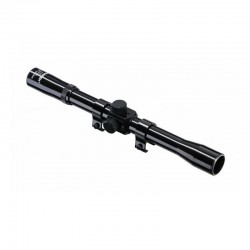
Umarex 4x20 Scope
via DAI Leisure
£19.95
Buying Advice
When evaluating a stalking scope, understand the key specifications. Objective lens diameter (e.g., 42 mm or 50 mm) determines how much light can enter: a 50 mm lens gathers more light for dawn and dusk, but adds weight and requires higher mounts. Magnification range matters less than optical quality at typical UK ranges — a 3-12×50 or 2.5-10×50 is ideal for most woodland and open-ground stalking. Exit pupil (objective ÷ magnification) should be around 5–7 mm at low power for effective use in poor light. SFP (second focal plane) scopes are the UK stalking standard, with the reticle remaining a constant size throughout the zoom range — adequate when you are using holdover rather than dialling for long-range precision.
Budget tiers in the UK stalking scope market break roughly into three bands. Entry-level scopes in the £200–£450 range from brands such as Hawke, Nikko Stirling, and some Meopta models offer serviceable glass and reliable turrets for a new stalker. Mid-range options between £500 and £1,000 — including certain Leupold, Vortex, and Meopta models — deliver noticeably better coatings, edge-to-edge sharpness, and twilight performance. Premium glass from Swarovski, Zeiss, Schmidt & Bender, and Kahles typically starts above £1,200 and can exceed £2,500, offering exceptional low-light capability, bombproof build quality, and outstanding colour fidelity. For a first rifle and scope package, many new stalkers find the mid-range tier offers the best value.
Common mistakes UK buyers make include over-magnifying (a 6-24× scope is overkill and unwieldy for woodland roe stalking), ignoring the importance of quality mounts and rings (cheap mounts cause more zero-shift problems than cheap scopes), and buying a calibre based on online enthusiasm rather than practical UK use. The .308 Winchester and .243 Winchester remain the two most popular UK stalking calibres for good reason: widely available ammunition, manageable recoil, and proven performance on all UK deer species (the .243 for all species in England and Wales, and for roe and smaller in Scotland; the .308 is legal everywhere for all species). The 6.5 Creedmoor and 6.5×55 Swedish have gained popularity but check ammunition availability from your local RFD before committing.
UK-specific context is vital. Your rifle must be stored in a police-approved gun cabinet bolted to a structural wall, and ammunition must be stored separately or in a separate locked compartment. Sound moderators (suppressors) are widely used and encouraged in UK stalking — they reduce noise disturbance and recoil, and most RFDs can advise on suitable moderators. Factor a moderator into your budget (typically £200–£500) as it will affect barrel length, overall balance, and scope mounting height. Ensure your FAC conditioned slot covers the moderator. Stalking insurance and landowner permission are also essentials before you go afield.
Match your choice to your actual use case. If you will primarily stalk roe and muntjac in southern English woodland at ranges under 150 metres, a lightweight bolt-action in .243 Win or 6.5 Creedmoor with a compact 3-9×42 or 2.5-10×50 scope is ideal. If you plan to pursue red deer on open Scottish hill ground where 200-metre-plus shots are realistic, consider a .308 Win or .270 Win with a 3-12×50 or 4-16×50 scope offering a finer reticle and perhaps exposed turrets. For an all-rounder covering both scenarios, the .308 paired with a quality 3-12×50 scope and a good moderator is exceptionally hard to beat as a first UK stalking setup.
The brand landscape for stalking rifles in the UK centres on several proven manufacturers. Tikka (particularly the T3x range), CZ (the 557 and 600 series), Sako, Howa, and Blaser are all widely stocked by UK RFDs and well-supported for parts and aftermarket accessories. Remington and Ruger have a following but availability can fluctuate. Synthetic stocks are increasingly popular for UK conditions — they shrug off rain, mud, and temperature swings that can swell or warp walnut. Try before you buy wherever possible: attend a game fair, visit a well-stocked RFD, or ask your DSC1 provider if you can handle different rifles. Fit, balance, and trigger feel are deeply personal, and no amount of online research replaces shouldering the rifle yourself.
Frequently Asked Questions
What is the best first calibre for UK deer stalking?
The .243 Winchester and .308 Winchester are the two most commonly recommended first calibres for UK stalkers, and both are legal for all deer species in England and Wales. The .243 offers lighter recoil and is pleasant to shoot, making it excellent for new stalkers. The .308 is heavier-hitting with broader versatility if you plan to pursue larger species such as red or fallow on open ground. Ammunition for both is widely available from UK dealers.
How much should I budget for a first stalking rifle and scope in the UK?
A realistic total budget for a serviceable first setup — rifle, scope, mounts, moderator, and a basic soft case — starts at around £1,200–£1,500 for entry-level combinations. A mid-range package with better glass and a well-regarded rifle typically falls between £2,000 and £3,000. It is generally better to allocate proportionally more towards the scope, as optical quality directly affects shot placement in the low-light conditions typical of UK stalking.
What magnification range do I need for a UK stalking scope?
For the majority of UK stalking scenarios — woodland roe, field-edge muntjac, and even open hill red deer — a variable scope in the 3-9× to 3-12× range is ideal. Higher magnifications (e.g., 4-16× or 6-24×) are rarely needed and can be a hindrance in dense cover where a wide field of view at low power is essential for target acquisition. Prioritise optical clarity and light transmission over maximum magnification.
Do I need illuminated reticle for deer stalking?
An illuminated reticle is a genuinely useful feature for UK stalking, where legal shooting light at dawn and dusk often means aiming against a dark woodland background. A subtle red-dot illumination at the reticle centre helps place the aiming point precisely without obscuring the target. It is not strictly essential on a first scope, but if your budget allows, it is a worthwhile upgrade. Ensure the illumination has low-intensity settings so it does not bloom in dim conditions.
Is a sound moderator worth fitting from the start?
Absolutely. Sound moderators are widely used in UK stalking and are considered best practice. They significantly reduce felt recoil and muzzle blast, making the rifle more pleasant to shoot and improving accuracy. They also reduce noise disturbance to livestock, neighbours, and other stalkers. Most UK constabularies will readily grant a moderator on your FAC. Factor the moderator into your rifle purchase so your RFD can ensure scope, mounts, and moderator all work together as a balanced system.
Should I choose MOA or MRAD turrets for a stalking scope?
For a first stalking scope, this distinction is far less critical than it is in target or long-range shooting. Most UK stalkers zero their rifle at 100 metres and rarely dial turrets in the field, relying instead on holdover for the few shots needed at extended range. MOA turrets are more traditional in the UK, where 1 MOA equates to roughly 1.047 inches at 100 yards (approximately 3 cm at 100 m). MRAD turrets work in metric-friendly 0.1 mil clicks (1 cm at 100 m). Choose whichever system you find more intuitive.
Can I use a .22 LR or a .17 HMR for deer in the UK?
No. Rimfire calibres such as .22 LR and .17 HMR are not legal for any deer species anywhere in the UK. The minimum legal requirements specify centrefire rifles of defined calibre, bullet weight, and muzzle energy. Rimfire rifles are popular for fox control and vermin, but they must never be used on deer. Full details of minimum calibre requirements are available from BASC and the British Deer Society.
What objective lens size is best for a UK stalking scope?
A 50 mm objective is the most popular choice for UK stalking scopes, offering excellent light-gathering for dawn and dusk use when deer are most active. A 42 mm objective saves weight and allows lower mounting but sacrifices some low-light performance. If you stalk exclusively in woodland where shots are close and fast, a compact 42 mm scope may suffice. For versatility across woodland and open hill, 50 mm is the safer choice, particularly paired with quality multi-coated glass.
Where should I buy my first stalking rifle and scope in the UK?
Purchase from a registered firearms dealer (RFD) who can advise on your specific FAC conditions, fit the scope and mounts correctly, and zero the rifle on a range. Many UK RFDs offer package deals combining rifle, scope, mounts, and moderator at a discounted price. Reputable online retailers such as Sporting Saint, Edgar Brothers dealers, and Highland Outdoors also stock a wide range. Avoid private sales for your first purchase, as you lose warranty support and professional fitting advice.
Related guides
Expert UK guide to choosing a new rifle optic in 2026. FFP vs SFP, MOA vs MRAD, parallax explained, budget tiers in GBP…
New Scope Day – Getting It Right First TimeExcited for new scope day? Our 2026 UK guide covers fitting, FFP vs SFP, MOA vs MRAD, parallax, and the best rifle scopes for every discipline and budget…
Vortex Razor HD LHT FFP — What UK Shooters Need to KnowComprehensive UK guide to the Vortex Razor HD LHT FFP range. We cover reticle subtension, weight savings, MOA vs MRAD choices…
Not sure which scope is right for you?
Try our AI-powered scope finder — answer a few questions and get personalised recommendations.
Find My Scope →Get a UK scope tip every day
Follow AiScopes on Facebook for daily buying guides, deals and gear advice.
Follow on Facebook