Best Thermal Scopes for Wild Boar Hunting in the UK
By Peter Makulek · Senior Optics Editor · · Live prices from UK retailers
Feral wild boar are established in the Forest of Dean, on the Kent and East Sussex border, in Dorset, in parts of South Wales, and in a growing number of areas of Scotland. Almost all boar activity in the UK happens at night or in the half-light of dawn and dusk, and boar spend the day bedded down in thick bramble, bracken and dense woodland cover — exactly the conditions where a thermal riflescope earns its cost. Thermal imaging detects the animal's own body heat through foliage and darkness that would defeat both the naked eye and a conventional lamp, which is why boar hunting is one of the strongest genuine use cases for thermal optics on this site.
Wild boar are not classed as deer under the Deer Act, so none of the Deer Act's calibre minimums or close seasons apply to them. There is no statutory close season for wild boar, and no restriction on shooting them at night. In practice, most UK shooting organisations recommend a minimum of .270 calibre with a 130-grain bullet and 2,600 ft lb of muzzle energy, with larger calibres such as .308, .30-06 or 9.3x62 preferred for a certain, humane kill on a genuinely large animal. Your Firearms Certificate needs to authorise boar specifically, or carry an "any lawful quarry" condition — check with your local police firearms licensing team before heading out, and always confirm you have the landowner's shooting rights: on Forestry England's own land in the Forest of Dean, only its employed rangers may shoot the boar population, though private landowners with shooting rights on adjacent or other land can and do manage boar themselves.
What actually matters in a thermal scope for boar work is different from a fox or rabbit setup. A 384x288 sensor is a realistic minimum — boar are large animals, but picking out a clear, unambiguous outline through a screen of bramble or bracken at 40-120 yards genuinely benefits from the extra detail a 384-class or 640-class sensor resolves over a cheaper 256-class unit. A useful magnification range with digital zoom matters more than a very high optical ceiling, since most UK boar cover forces engagement at closer range than open-field fox work. Given boar can be dangerous if wounded and not finished cleanly, a scope that lets you confirm a genuinely clean, certain shot before you take it — rather than one that merely detects a heat blob at long range — is the right priority.
None of this changes the underlying safety framework. A wounded, cornered boar is a genuinely dangerous animal, so a certain, well-placed shot from an adequately powerful rifle and a safe, confirmed backstop matter more here than on almost any other UK quarry covered on this site. Landowner permission and the correct FAC condition are non-negotiable, and night shooting demands the same discipline as daylight shooting — confirm the target and what lies beyond it before you fire, regardless of how clearly thermal shows you a heat signature.
Top Picks — Live UK Prices
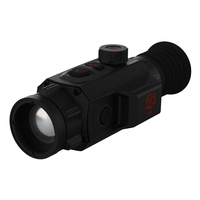
ATN Thor 6 Mini 325 (2.5-20x) Compact Thermal (384x288) Rifle Scope
via Uttings
£1199.00
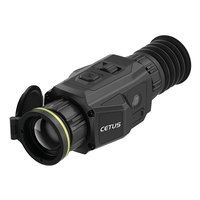
Pixfra Cetus C635 Thermal (640x512) Rifle Scope
via Uttings
£1389.95
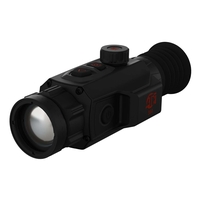
ATN Thor 6 Mini 335 (3.5-28x) Compact Thermal (384x288) Rifle Scope
via Uttings
£1399.00
Buying Advice
At a genuinely useful entry point for boar work, the PARD Pantera 384 Mini with LRF, at £1,399.00, pairs a 384x288 sensor with an integrated laser rangefinder — useful in thick cover where judging distance to a partially obscured animal by eye alone is unreliable. Its narrow, near-fixed 2.4x-3.4x magnification window suits closer-range work through cover well, though it trades away the flexibility of a variable zoom for a lighter, more compact body.
The Pulsar Thermion 2 LRF XQ50 Pro, at £2,659.95, is a strong step up: a 384x288 sensor at sub-25mK NETD, a built-in 800m laser rangefinder, and Pulsar's established UK dealer and repair network, which matters on a scope that will see hard use in wet, thorny cover. Its 2.5-10x variable magnification gives genuine flexibility between a close woodland shot and a longer field-edge one, which suits the mixed engagement distances boar hunting actually produces.
For the clearest possible image through genuinely thick cover, the PARD Pantera EX 640, at £2,499.99, steps up to a 640x512 sensor with a ≤14mK NETD rating — meaningfully more resolution than a 384-class unit, which translates directly into confidently distinguishing a boar's outline from background clutter rather than guessing at a vague heat shape. At a similar price to the Thermion 2 LRF XQ50 Pro, the choice between the two comes down to whether you prioritise PARD's higher raw sensor resolution or Pulsar's integrated rangefinder and longer-established UK support network.
Match the scope to your rifle's recoil and your realistic engagement distance, not to the highest headline detection-range figure on a spec sheet. Boar-legal calibres — .270 upward, with .308, .30-06 and 9.3x62 all common UK choices — produce meaningfully more recoil than a .223 fox rifle, so mounting hardware and ring torque deserve the same care as the scope choice itself. Because most UK boar cover is thick woodland rather than open ground, realistic shots are very often inside 100 yards; a scope bought purely for its longest-range detection claim, at the expense of image clarity and quick target acquisition through foliage at closer range, is solving the wrong problem for this quarry.
Budget for a quick-release or dedicated thermal mount rather than assuming your existing day-scope rings will fit — thermal riflescopes from PARD and Pulsar use their own mounting standards, and getting this wrong is one of the most common costly mistakes for a first-time thermal buyer. Both brands are stocked with consistent UK-warrantied pricing across the main UK thermal retailers, which is a reasonable proxy for a settled, serviceable market rather than a short-lived import.
Frequently Asked Questions
What is the minimum calibre for shooting wild boar in the UK?
Wild boar are not deer, so no statutory Deer Act minimum applies. UK shooting organisations commonly recommend a minimum of .270 calibre with a 130-grain bullet and 2,600 ft lb of muzzle energy, with larger calibres such as .308, .30-06 or 9.3x62 preferred for a certain, humane kill given the animal's size.
Do I need a special Firearms Certificate condition to shoot boar?
Yes — your FAC needs to specifically authorise boar, or carry an "any lawful quarry" condition that covers them. Check the exact wording of your certificate with your local police firearms licensing team before shooting boar, since this differs from the deer-specific conditions covering red, fallow, roe, sika and muntjac.
Is there a close season for wild boar in the UK?
No — wild boar are not classed as deer under the Deer Act, so none of the Deer Act's close seasons apply to them, and there is no restriction on shooting them at night. Landowner permission and the correct FAC condition are still required regardless of season or time of day.
Why use thermal rather than conventional night vision for boar?
Boar spend the day bedded down in thick bramble, bracken and dense woodland cover, and are typically active at night or in low light. Thermal imaging detects the animal's body heat directly through that foliage and darkness, where a conventional lamp or light-amplifying night vision device struggles to resolve a clear, unambiguous outline through the same cover.
What sensor resolution do I need for boar hunting in thick cover?
A 384x288 sensor is a realistic minimum for confidently picking out a boar's outline through bramble or bracken at typical UK engagement distances of 40-120 yards. A 640x512 sensor, such as the PARD Pantera EX 640, resolves noticeably more detail and is worth the extra cost if you regularly hunt genuinely thick cover.
Where are wild boar found in the UK?
Established feral populations exist in the Forest of Dean, on the Kent and East Sussex border, in Dorset, in parts of South Wales, and in a growing number of areas of Scotland. On Forestry England's own land in the Forest of Dean, only its employed rangers may shoot the resident boar population; private landowners with shooting rights manage boar on their own land separately.
Related guides
Choosing your first thermal hunting scope? Our 2026 UK guide covers key specs, budget tiers in GBP, legal context, and top picks from Pulsar…
Best Thermal Monoculars Under £1,000 for UK Stalking & FoxingOur expert-tested guide to the best thermal spotter monoculars under £1,000 for UK deer stalking and foxing.
HIKMICRO Stellar 3.0 Price Reductions ExplainedHIKMICRO Stellar 3.0 thermal scope prices have dropped across UK dealers. Our 2026 guide covers what you get, how it compares…
GOYOJO GRL335 Thermal Scope – Initial UK ThoughtsFirst impressions of the GOYOJO GRL335 thermal scope for UK shooters. We cover specs, image quality, build, value for money…
Best Scopes for Bullpup Air Rifles in the UKChoosing a scope for a bullpup PCP air rifle like the FX Impact or Brocock Compatto? Compare compact optics with real 2026 UK prices and mounting advice.
Best Air-Rifle Ballistic Apps & Building Reticle Aim PointsChairgun is gone — discover the best air-rifle ballistic apps for UK shooters in 2026, plus how to build accurate reticle aim points for sub-12 and FAC…
Not sure which scope is right for you?
Try our AI-powered scope finder — answer a few questions and get personalised recommendations.
Find My Scope →Get a UK scope tip every day
Follow AiScopes on Facebook for daily buying guides, deals and gear advice.
Follow on Facebook