Best Long-Range Rifle Scopes 2026: UK Buyer's Guide
By Peter Makulek · Senior Optics Editor · · Live prices from UK retailers
Choosing the best scope for long range shooting in the UK has never been more nuanced. Whether you are engaging steel at 1,000 metres on a PRS-style competition range, making an ethical 300-metre deer-stalking shot in the Scottish Highlands, or controlling foxes at extended distances across open farmland, your optic must translate ballistic data into reliable, repeatable hits. In 2026 the market offers more genuinely capable long-range rifle scopes at every price point than ever before, but that abundance makes the buying decision harder, not easier. This guide exists to cut through the marketing noise and help UK shooters make an informed choice based on real-world ballistic requirements.
The core decision for any long-range scope buyer centres on how you will compensate for bullet drop and wind drift. Broadly, you have two paths: dialling corrections on exposed ballistic turrets, or holding off using subtensions built into a BDC reticle. Each approach has passionate advocates, and each suits different shooting disciplines. A dedicated PRS competitor may prefer tall turrets with a zero-stop and a clean mil-dot reticle for precise dialling, while a UK deer stalker who needs to take a rapid second shot at a different distance may favour a BDC reticle scope that lets them hold and shoot without lifting a hand from the stock.
Matching the scope to your calibre and load is equally critical and often overlooked. A BDC reticle designed around the trajectory of a .308 Winchester 168-grain match load will be significantly inaccurate if mounted on a .243 firing 80-grain varmint bullets — the subtension spacing simply will not correspond to the correct drop values. Ballistic turrets calibrated to a specific cartridge face the same constraint. Understanding ballistic coefficient (BC), muzzle velocity, and the relationship between your chosen unit of adjustment — MOA or MRAD — and real-world displacement at distance is the foundation of an effective long-range setup.
This guide is written squarely for the UK market. We address the calibres most commonly used here — .308 Win, 6.5 Creedmoor, .243 Win, and .223 Rem among them — the legal framework around firearms certificates and quarry-specific conditions, and the practical realities of British weather, terrain, and available shooting distances. We reference brands with genuine UK distribution and aftermarket support, from heritage European glass houses to technology-forward manufacturers like Pard, whose digital and thermal optics are increasingly appearing on UK long-range setups. Read on for our curated product picks, in-depth buying advice, and a comprehensive FAQ section answering the exact questions UK shooters are asking right now.
Top Picks — Live UK Prices

WULF Hurricane Lite 4.5-18x50 SFP Non Illuminated Half Mildot SF Tactical 0.1 MRAD 30mm Rifle Scope
via Optics Warehouse
£94.95
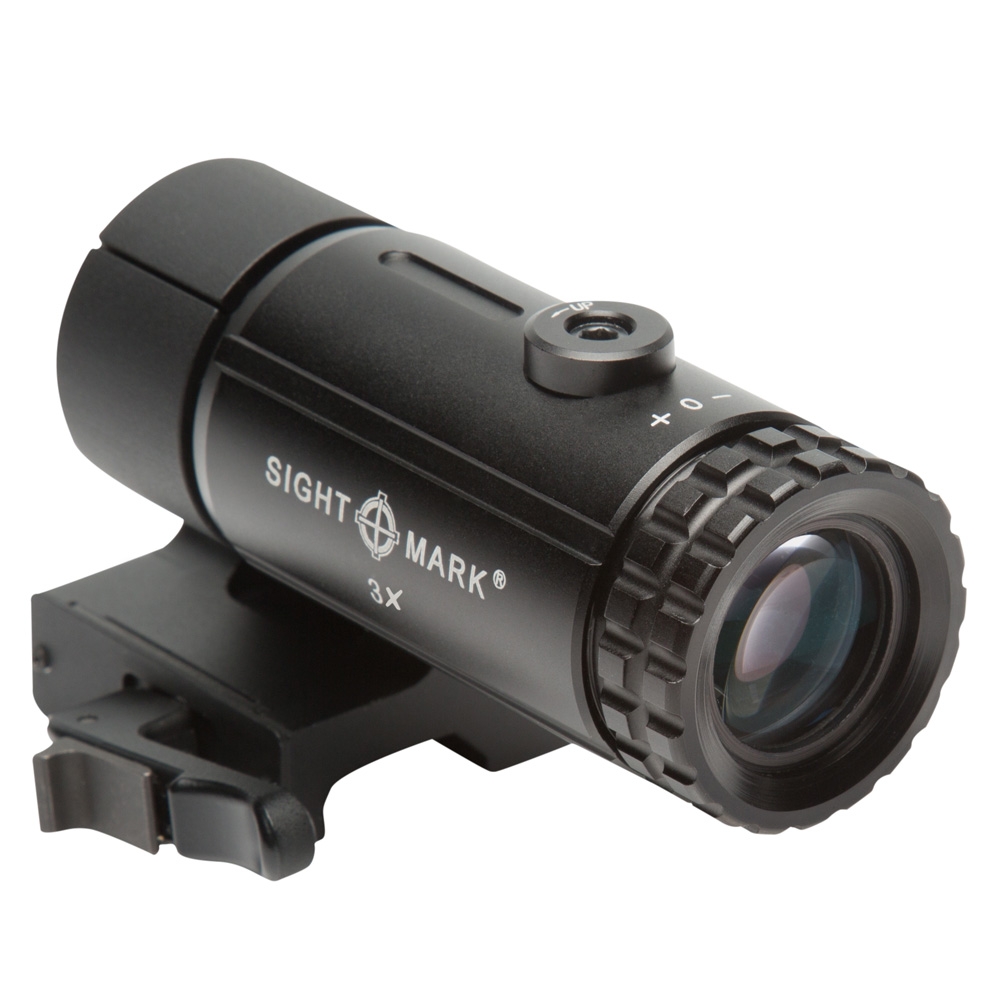
Sightmark T-3 3x Tactical Magnifier
via Livens
£119.00

Vector Optics Victoptics S6 1-6x24 LPVO SFP IR VI-CTSIX MIL 30mm Rifle Scope
via Optics Warehouse
£124.99
Buying Advice
Start with the key specifications. Magnification range matters less than optical clarity at the top end; a 5-25×56 is the sweet spot for most UK long-range disciplines, offering enough low-end field of view for woodland stalking and sufficient magnification for reading mirage and spotting trace at distance. Look for a 34 mm main tube if you need maximum internal elevation travel — typically 28-35 MRAD (roughly 96-120 MOA) in quality scopes — because running out of travel before you reach your target distance is a showstopper. Check the per-click adjustment value: 0.1 MRAD (1 cm at 100 m) or ¼ MOA (roughly 0.7 cm at 100 m / 0.26 inches at 100 yards). Confirm the reticle plane: a first focal plane (FFP) reticle scales with magnification so subtensions remain accurate at every power setting, which is essential if you use the reticle for ranging or holdover. Second focal plane (SFP) reticles are only accurate for subtension-based work at one specific magnification, usually the maximum.
Budget tiers in the UK market break down roughly as follows. Entry-level long-range scopes — think quality models from brands offering capable glass under £500 — will get you repeatable turrets, reasonable optical clarity, and often an MRAD or MOA reticle with usable subtensions; they suit club-level target shooting and stalking out to moderate distances. Mid-range scopes between approximately £800 and £1,500 bring noticeably better glass coatings, tighter turret tolerances, locking or zero-stop turrets, illuminated reticles, and more robust weatherproofing for Scottish or Welsh hill conditions. Premium optics above £1,500 deliver elite-level light transmission, near-perfect click repeatability verified over thousands of rounds, tool-less turret customisation, and the kind of edge-to-edge sharpness that matters when you are trying to read wind through mirage at 800 m. Decide honestly how far and how often you shoot before spending.
Common mistakes abound when buying a long-range rifle scope. The most frequent is mismatching turret or reticle units: buying an MOA turret scope with an MRAD reticle (or vice versa) forces constant mental conversion under pressure. Stick to a matched system — MRAD/MRAD or MOA/MOA. Another error is neglecting parallax adjustment; any scope intended for use beyond 200 metres should have a side-focus or adjustable objective parallax knob so you can eliminate apparent target shift at your actual shooting distance. Buyers also over-prioritise magnification at the expense of objective lens diameter and coating quality, ending up with a dim, narrow image at high power. Finally, ignoring total elevation travel requirements means a shooter zeroed at 100 m may lack enough remaining up-travel to dial to 800 m, especially with lower-velocity cartridges like subsonic .308 loads.
UK-specific context shapes the long-range scope decision in several ways. Your Firearms Certificate (FAC) conditions may restrict you to specific quarry species and land parcels, meaning your maximum practical engagement distance is often dictated by the geography of your permission rather than the cartridge's theoretical capability. For deer stalking, the Deer Act 1991 (England & Wales) and the Deer (Scotland) Act 1996 impose minimum calibre and muzzle energy requirements — for example, .240 calibre and 1,700 ft-lbs for most Scottish deer species — which in turn defines the trajectory curve your scope must accommodate. UK weather is another factor: frequent low light, rain, and mist make high light transmission and quality lens coatings more important here than in drier climates. Purchase from established UK retailers who offer proper warranty support and can advise on mounting and zeroing — this is especially important for higher-end optics where turret calibration and reticle selection may be customised at point of sale.
Matching the scope to your use case requires honest self-assessment. If you shoot PRS or NRL-style matches, prioritise an FFP MRAD reticle with a Christmas-tree holdover pattern, tall exposed turrets with a zero-stop, and at least 26 MRAD of total elevation travel. If you are primarily a deer stalker who occasionally takes longer shots, a BDC reticle scope calibrated to your specific load — or a simpler turret system with a clear, uncluttered reticle — may serve you better; the best scope for deer stalking in the UK is often the one that lets you make an ethical shot quickly and confidently without fumbling with turrets in fading light. Fox and vermin controllers working at night may benefit from pairing a conventional day scope with a Pard digital night-vision clip-on, leveraging the day scope's ballistic reticle or turrets while gaining IR illumination for nocturnal work. Varmint and target shooters using .223 Rem should note the relatively steep trajectory beyond 400 m and ensure their chosen optic has sufficient internal elevation.
The brand landscape for long-range scopes in the UK is broad. European manufacturers dominate the premium tier and carry strong reputations for optical quality and mechanical reliability, backed by robust UK service networks. Japanese-made optics offer exceptional value in the mid-range, with outstanding glass quality relative to price. Several American brands have strengthened their UK distribution in recent years, bringing competition-proven turret designs and reticle options. Meanwhile, Pard has carved out a distinctive niche with its digital and thermal optics, which increasingly complement or integrate with traditional long-range setups — their clip-on night-vision devices, for example, allow a stalker to retain their ballistic turret zero while switching to thermal detection after dark. Whichever brand you choose, verify that UK-specification models are available (some reticle or turret options are region-specific) and that spare parts, turret caps, and custom turret rings can be sourced domestically.
Frequently Asked Questions
What is a BDC reticle and how does it compare to dialling turrets for long-range shooting in the UK?
A BDC (Bullet Drop Compensator) reticle has aiming points or hash marks spaced to correspond to the bullet's drop at predetermined distances — for example, marks at 200, 300, 400 metres and beyond. Instead of adjusting your turrets, you simply place the appropriate mark on the target and fire. The advantage is speed: you never move the turret, so your zero is always intact, which suits UK deer stalking where a quick follow-up at a different range may be needed. The downside is that the subtensions are only accurate for one specific cartridge and load at one specific muzzle velocity, and in SFP scopes only at one magnification. Dialling turrets, by contrast, lets you input the exact correction for any distance and any load, offering greater precision — the preferred method in PRS competition — but requires more time and discipline to execute correctly in the field.
How do I match a scope's ballistic turret or reticle to my specific calibre and load?
You need the precise ballistic profile of your ammunition: muzzle velocity (chrono-verified, not box data), ballistic coefficient (G1 or G7), bullet weight, and your zero distance. Feed these into a ballistic solver — Applied Ballistics, Strelok Pro, or the manufacturer's own app — and it will generate a drop table in MOA or MRAD. For a BDC reticle, compare this table against the reticle's subtension spacing to see how closely it matches your load's trajectory; a close match means the hold points will be accurate. Some manufacturers offer calibre-specific custom turret dials: you send them your ballistic data and they engrave a turret cap marked in metres or yards rather than clicks. This is an excellent option for UK stalkers who shoot one consistent load.
Do I need a ballistic calculator app to get the most from a long-range scope?
In practical terms, yes. A ballistic calculator app — such as Applied Ballistics Elite, Strelok Pro, or Hornady 4DOF — converts environmental data (temperature, pressure, humidity, altitude, wind speed) and your ammunition's profile into precise elevation and windage corrections for any distance. Without one, you are relying on generic drop charts or memorised data that may not account for the conditions on the day. For UK shooters, where temperature can swing 15°C between dawn and midday in spring, and air density varies significantly with altitude in highland terrain, a solver running on your phone is the single most cost-effective accuracy upgrade you can make beyond the scope itself.
What ballistic features should UK hunters look for in a scope for 300–800 metre deer and fox shots?
For ethical shots at these distances on live quarry, you need an optic with precise, repeatable turret adjustments — ideally with a zero-stop so you can return to your confirmed zero without counting clicks in poor light. An FFP reticle ensures holdover marks remain accurate regardless of your magnification setting, which is important when you may zoom in to confirm the animal and then hold without adjusting power. Sufficient total elevation travel is essential: a .308 Win shooting 168-grain match ammunition drops roughly 12-13 MRAD (about 42 MOA) at 800 m from a 100 m zero, so you need well in excess of that in available up-travel. Good low-light performance, a side-focus parallax knob adjustable down to at least 50 metres, and reliable weatherproofing are all non-negotiable for UK hill conditions.
MOA or MRAD turrets for long-range ballistic corrections: which system is easier to use in the field?
Both systems work equally well if you learn them properly; the difference is ergonomic, not mathematical. MRAD (milliradians) is the dominant system in UK and European long-range circles because the metric relationship is intuitive: 0.1 MRAD equals exactly 1 cm at 100 m, 2 cm at 200 m, and so on. MOA is slightly finer per click (¼ MOA ≈ 0.7 cm at 100 m vs 1 cm for 0.1 MRAD), which some benchrest shooters prefer, but the imperial maths (1 MOA ≈ 1.047 inches at 100 yards) is less convenient if you think in metric. Most UK PRS competitors and professional deer managers have standardised on MRAD. The critical rule is to match your turret and reticle unit — never mix MOA turrets with an MRAD reticle.
Is a first focal plane (FFP) scope essential for long-range shooting, or will second focal plane (SFP) work?
FFP is strongly preferred for long-range shooting because the reticle subtensions remain proportionally correct at every magnification — if a hash mark represents 1 MRAD, it represents 1 MRAD whether you are on 5× or 25×. This means you can hold over, range targets, or measure wind corrections at any power setting without error. An SFP reticle is only dimensionally accurate at one magnification (usually the maximum). SFP can still work perfectly well if you always dial your turrets and only use the reticle's centre crosshair, or if you discipline yourself to confirm you are on the correct magnification before using holdover marks. For UK deer stalking where speed matters, FFP eliminates one potential source of error.
Can I use a long-range rifle scope on a sub-12 ft-lb air rifle?
Technically you can mount one, but it would be entirely inappropriate and misleading. A sub-12 ft-lb air rifle — the legal limit in England and Wales without an FAC — shoots pellets at roughly 550-800 fps depending on calibre, and effective accuracy is limited to approximately 50-75 yards at best. The ballistic turrets, BDC reticles, and elevation travel of a long-range centrefire scope are designed for engagements from 300 to well over 1,000 metres. Additionally, spring-powered air rifles generate a unique bi-directional recoil that can damage optics not rated for it. For airgun work, choose a scope specifically designed for air-rifle recoil profiles and short-range engagement distances.
How does UK weather affect long-range scope performance and what features help?
British conditions — low sun angles, frequent overcast skies, rain, mist, and rapid temperature changes — test optics harder than many shooters realise. Low light transmission makes dawn and dusk stalking difficult, so prioritise scopes with high-quality multi-coated lenses and larger objective diameters (50-56 mm) for maximum light gathering. Fogging is a real concern on the hill: ensure the scope is nitrogen or argon purged and O-ring sealed to an IPX7 standard or better. Rain on the objective lens can scatter light and reduce contrast; hydrophobic lens coatings and quality flip-up covers help enormously. Temperature shifts also subtly alter air density, which changes your bullet's trajectory — another reason to use a ballistic calculator app that accepts real-time weather inputs.
What role do Pard and other digital or thermal optics play in UK long-range shooting?
Pard has become a well-recognised name among UK shooters, particularly for night-vision and thermal clip-on devices that mount in front of a conventional day scope. For long-range fox control after dark — a common requirement on UK farmland — a Pard thermal clip-on allows you to detect and identify quarry at several hundred metres while retaining your day scope's ballistic turret settings and zero. Dedicated digital scopes from Pard and similar manufacturers also offer on-board ballistic calculators, video recording, and rangefinding. While traditional glass still dominates daytime long-range competition and stalking for optical purity and reliability, digital and thermal technology is an increasingly important part of the UK long-range toolkit, especially where night shooting permissions apply.
Related guides
Our 2026 UK guide to the best scopes for long range shooting. Learn how to match reticle, turrets and magnification to your calibre's ballistic profile for precision results.
Best Budget Long-Range Scopes Under £500 (2026 UK Guide)Find the best scope for long range shooting under £500 in the UK for 2026. We cover MRAD vs MOA, elevation travel, BDC reticles, and top picks for reaching 1,000 yards on a budget.
Best Scopes for Extreme Long-Range Shooting Beyond 1,000 YardsExpert UK guide to the best scopes for long range shooting beyond 1,000 yards in 2026. Compare FFP optics, turret systems, reticles and budget tiers for precision rifle work.
Best Long-Range Benchrest Scopes: UK Buyer's Guide 2026Definitive UK guide to the best scopes for benchrest shooting at 200–1,000 yards in 2026. Expert advice on magnification, turrets, reticles, FFP vs SFP and top picks for every budget.
Best Long-Range Scopes Under £1,000 for UK ShootersOur 2026 UK buyer's guide to the best scopes for long-range shooting under £1,000. Expert picks, specs explained, and FAQs for reaching 1,000 yards on a budget.
Not sure which scope is right for you?
Try our AI-powered scope finder — answer a few questions and get personalised recommendations.
Find My Scope →Get a UK scope tip every day
Follow AiScopes on Facebook for daily buying guides, deals and gear advice.
Follow on Facebook