Best Long-Range Benchrest Scopes: UK Buyer's Guide 2026
By Peter Makulek · Senior Optics Editor · · Live prices from UK retailers
Benchrest shooting at long range demands more from a riflescope than almost any other discipline. When your entire game is measured in fractions of an inch at 600 yards or beyond, optical clarity, repeatable turret tracking, and a reticle that lets you read conditions precisely are not luxuries—they are essentials. This guide is written specifically for UK shooters competing or practising at distances from 200 to 1,000 yards, covering every decision point from benchrest scope magnification to focal-plane choice, so you can invest with confidence.
The UK benchrest scene has grown significantly in recent years, with clubs from Diggle to Blair Atholl hosting competitions out to 1,000 yards. Disciplines such as F-Class Open, F-Class TR, and group benchrest each place slightly different demands on optics, but the common thread is the need for a scope that tracks accurately, resolves mirage and bullet trace, and lets you make precise holdover or dial-up corrections without losing your zero. Understanding what separates a competent scope from a truly outstanding one is the first step toward tighter groups.
Choosing the best scope for bench rest shooting in the UK also means navigating a market that can feel overwhelming. Options range from proven Japanese-made glass at sensible money through to flagship European and American designs costing several thousand pounds. We will help you understand which specifications genuinely matter for long-range benchrest optics, which are marketing fluff, and how to match a scope to your rifle, calibre, and the distances you actually shoot. Whether you are loading 6mm BR for 300-yard groups or pushing .284 Winchester to 1,000 yards, the right optic makes a measurable difference.
Throughout this guide we reference real-world UK availability, pricing in sterling, and the practical realities of shooting on British ranges—variable light, frequent wind, and the need for an optic that performs in overcast conditions as well as bright summer sunshine. We also address the MOA-versus-MRAD debate, front-focal-plane versus second-focal-plane design, and the objective-lens and magnification considerations that genuinely affect your ability to shoot small groups at extreme distance.
Top Picks — Live UK Prices

WULF Hurricane Lite 4.5-18x50 SFP Non Illuminated Half Mildot SF Tactical 0.1 MRAD 30mm Rifle Scope
via Optics Warehouse
£94.95

Vector Optics Victoptics S6 1-6x24 LPVO SFP IR VI-CTSIX MIL 30mm Rifle Scope
via Optics Warehouse
£112.49
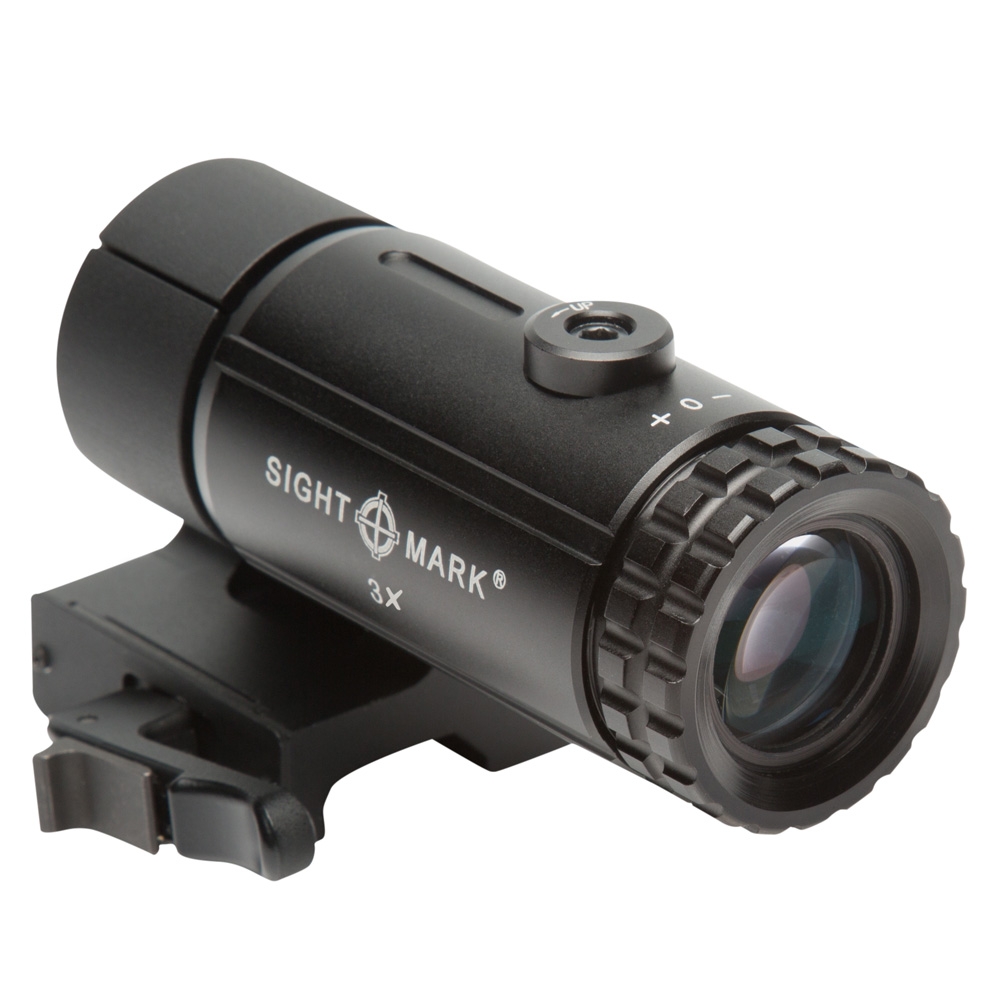
Sightmark T-3 3x Tactical Magnifier
via Livens
£119.00
Buying Advice
Start with the specifications that matter most for benchrest. Magnification range is critical: for 200–600 yard work, 20–25× is usually sufficient, but extending to 1,000 yards typically demands 30× or more to resolve mirage, read wind flags through the scope, and clearly identify bullet holes in targets. Objective lenses of 50–56 mm strike the best balance between light-gathering ability and manageable weight on a benchrest front rest. Parallax adjustment must go below 50 yards ideally and up to at least 1,000 yards; a side-focus parallax wheel is standard on any serious benchrest scope and allows you to eliminate parallax error without shifting your cheek weld. Exit pupil at high magnification will be small—around 1.5–1.8 mm at 30×—so glass quality and coatings become even more important for brightness and contrast.
Budget tiers in the UK market break down roughly as follows. Under £500 you can find scopes from brands like Athlon and MTC that offer surprisingly good tracking and adequate glass for 200–600 yard benchrest; they will get you started but may lack the coating sophistication or mechanical precision for consistent 1,000-yard work. The mid-range tier, roughly £500–£1,500, is where the best value sits for serious benchrest competitors—Japanese-made optics from Bushnell, Vortex, Athlon Ares, and similar lines offer excellent turret repeatability, ED glass, and robust zero-stop mechanisms. Above £1,500 you enter premium territory with marques such as Nightforce, Kahles, Schmidt & Bender, March, and Sightron, where turret tracking is virtually flawless and optical resolution lets you split bullet holes at extreme range. For most UK benchrest shooters, the mid tier delivers 90% of the performance at 40% of the cost.
Common mistakes UK benchrest buyers make include over-prioritising magnification at the expense of optical quality. A 40× scope with mediocre glass will show you a blurry, washed-out image at distance, while a 25× scope with premium ED elements will let you read mirage and spot impacts far more clearly. Another frequent error is ignoring turret tracking accuracy—cheap scopes may advertise MOA or MRAD turrets but fail to move the reticle precisely or repeatably, which is disastrous for benchrest load development where you need to trust that a 0.5 MOA adjustment is genuinely half a minute. Always check independent tracking-test data before buying. Finally, many shooters buy a scope with insufficient internal elevation adjustment for their cartridge and distance combination, then resort to canted bases that introduce their own complications.
UK-specific context matters. Benchrest rifles in this country commonly chamber 6mm BR, 6.5×47 Lapua, .308 Winchester, and .284 Winchester, all of which are legal on an FAC with appropriate conditions. Scopes can be purchased from specialist UK retailers such as RUAG Ammotec dealers, Optics Warehouse, Uttings, and others; buying from EU or US retailers post-Brexit may incur VAT and import duty, typically adding around 20% plus handling fees, so factor that into any apparent bargain. Thermal and digital optics from brands like Pard are increasingly popular for night shooting and foxing in the UK, but benchrest remains a discipline where traditional optical glass scopes reign supreme due to their superior resolution, zero latency, and the rules of most UK benchrest competitions which mandate conventional optics.
Matching the scope to your specific use case means honestly assessing the distances you shoot most often. If your club maxes out at 600 yards, a high-quality 5-25× or 6-24× with a 50 mm objective and proven tracking will serve you better—and cost less—than an exotic 8-48× behemoth designed for ELR. Conversely, if you regularly compete at 1,000 yards at places like Diggle or the FCSA nationals, investing in 30×-plus magnification with a reticle featuring fine windage references is worthwhile. Consider your reticle preference carefully: a fine-crosshair dot reticle is traditional in group benchrest because it obscures minimal target, while a tree-style or Horus-type reticle with wind dots is preferred by F-Class and score shooters who need holdover references. Always ensure the scope's total elevation travel covers your cartridge's drop at maximum distance with room to spare.
The brand landscape for long-range benchrest optics in the UK is competitive. March, a Japanese manufacturer, dominates the top end of group benchrest worldwide with ultra-high-magnification models offering 10-60× or 8-80× ranges and remarkably fine adjustments. Nightforce and Kahles are favourites among F-Class shooters for their bombproof mechanics and crystal-clear glass. Sightron offers outstanding value with its SIII and S6 lines, both well-regarded for tracking accuracy. Vortex has made significant inroads in the UK with aggressive warranty support and models like the Razor HD Gen III. At the more accessible end, Athlon's Ares and Helos lines punch well above their price point. Whichever brand you choose, prioritise verified tracking data, UK dealer support, and a warranty that can be serviced without shipping the scope overseas.
Frequently Asked Questions
What magnification and objective lens size do I need for benchrest shooting at 600 yards and beyond?
For 600-yard benchrest, 20–25× magnification paired with a 50–56 mm objective lens is generally ideal, providing enough resolution to read mirage and spot impacts without excessive weight or a tiny exit pupil. At 1,000 yards, many top competitors use 30× or higher to resolve fine detail and bullet trace. An objective of 56 mm helps maintain usable brightness at these extreme magnifications, though glass quality and coating technology matter more than raw objective size for image clarity.
How do I choose between MOA and MRAD turrets for benchrest load development and group analysis?
MOA has traditionally been the benchrest standard, partly because targets and group measurements in the UK and US are often quoted in inches, and 1 MOA equates to roughly 1.047 inches at 100 yards, making mental arithmetic straightforward. MRAD (where 0.1 mil equals 1 cm at 100 metres) is increasingly popular, especially among younger shooters and those who also compete in PRS-style events. For pure benchrest, either system works perfectly well provided the turret clicks are fine enough—typically 0.125 MOA or 0.05 mil—and track repeatably. Choose whichever system you think in naturally.
Which reticles are best for reading wind and making precise holdover corrections at long-range benchrest distances?
For group benchrest, a fine-crosshair or dot reticle is preferred because it obscures the least target area and allows you to aim at a precise point. For F-Class and score benchrest, reticles with graduated windage marks—such as the Nightforce MOAR-T, March FMA-3, or Horus TReMoR—allow you to hold off for wind without dialling the windage turret, which saves time in variable conditions. The key is choosing a reticle fine enough not to cover the target at your magnification setting, yet with enough references to read wind displacement confidently.
Do I need a front-focal-plane scope for long-range benchrest or is second focal plane good enough?
In benchrest shooting you almost always shoot at maximum or near-maximum magnification, which means the reticle subtensions are accurate whether the scope is FFP or SFP. SFP scopes are therefore perfectly suitable and are actually preferred by many benchrest shooters because the reticle remains a consistent, fine size regardless of zoom, avoiding the issue of a thick-appearing reticle at high power that some FFP designs can present. FFP is more advantageous in dynamic disciplines like PRS where magnification changes frequently and holdovers must remain valid at any zoom setting.
What are the best UK-available benchrest scopes under £1,500 that track accurately for 200–1,000 yard shooting?
Several scopes in this bracket have proven themselves among UK benchrest and F-Class shooters. The Sightron SIII 8-32×56 is widely respected for tracking accuracy and glass quality at its price point. The Athlon Ares ETR 4.5-30×56 and Vortex Viper PST Gen II 5-25×50 both offer excellent turret repeatability, zero-stop mechanisms, and ED glass. Bushnell's XRS3 6-36×56 has also earned a strong following for its clarity and reliable adjustments. All are available through UK dealers, and each represents a genuine best scope for benchrest shooting without entering premium pricing.
How much internal elevation adjustment do I need in a benchrest scope for 1,000-yard shooting?
This depends on your cartridge and its ballistic coefficient, but as a rule of thumb, a .308 Winchester with a 175-grain SMK needs approximately 36–40 MOA of elevation from a 100-yard zero to reach 1,000 yards. A 6.5×47 Lapua with a high-BC bullet might need 28–32 MOA. Your scope should offer enough total elevation travel to cover this with margin to spare, ideally without relying on a canted rail. Look for scopes with at least 80–100 MOA (or 25–30 mils) of total travel; some dedicated benchrest and tactical models offer 120 MOA or more.
Is it worth spending over £2,000 on a benchrest scope if I only shoot to 600 yards?
At 600 yards, the optical and mechanical advantages of ultra-premium scopes are real but less critical than at 1,000 yards, because bullet drop and wind deflection are more modest and tracking demands are lower. A well-chosen rifle scope under £1,500 with good glass and verified turret tracking will serve most 600-yard benchrest shooters extremely well. Where premium optics justify their cost is in superior mirage resolution, edge-to-edge sharpness, and bombproof repeatability over tens of thousands of clicks—advantages that compound when you push to longer distances or shoot in poor UK light.
Can I use a scope designed for PRS or tactical shooting on a benchrest rifle?
Absolutely, and many UK shooters do exactly this. Tactical and PRS scopes in the 5-25× to 7-35× range are built for precise turret tracking, durable mechanics, and feature-rich reticles—all qualities that translate directly to benchrest. The main consideration is reticle choice: tactical reticles with thick lines or busy holdover trees may obscure small benchrest targets, so look for models offering a fine-crosshair or dot option. Scopes marketed as tactical also tend to be heavier and longer, which is rarely an issue on a benchrest rest but matters if you also shoot F-Class off a bipod.
How do parallax and focus adjustments affect precision in long-range benchrest shooting?
Parallax error causes the reticle to shift relative to the target when your eye moves off the optical axis—a critical issue in benchrest where fractions of an inch matter. A properly adjusted side-focus parallax knob eliminates this by ensuring the target image and the reticle sit on the same focal plane. At benchrest distances, you should set the parallax dial to match your target distance and then confirm by gently moving your head behind the scope: if the crosshair shifts against the target, parallax is not fully corrected. High-quality scopes offer finer parallax resolution and more accurate yardage markings on the dial.
Related guides
Our 2026 UK buyer's guide to the best scopes for long-range shooting under £1,000. Expert picks, specs explained, and FAQs for reaching 1,000 yards on a budget.
Best Long-Range Scopes Beyond 800 Metres (2026)Expert UK buyer's guide to the best long-range rifle scopes for shooting beyond 800 metres in 2026. Covers magnification, reticles, turrets, and top brands like Vortex, Zeiss and Swarovski.
Best Long-Range Hunting Scopes for UK Stalkers in 2026Our expert UK guide to the best scopes for long range hunting in 2026. We cover magnification, reticles, FFP vs SFP, budget tiers and what actually matters beyond 500 metres.
Best Scopes for Getting Started in Long-Range ShootingDiscover the best beginner long-range scope UK shooters can buy in 2026. We cover magnification, FFP vs SFP, reticle choice, and top picks from Vortex, Burris and more.
Best .22LR Long-Range Scopes for UK Shooters in 2026Our UK expert guide to the best scopes for .22LR long-range shooting beyond 100 yards in 2026. FFP vs SFP, MOA vs MRAD, reticles, budget tiers and top picks reviewed.
Not sure which scope is right for you?
Try our AI-powered scope finder — answer a few questions and get personalised recommendations.
Find My Scope →Get a UK scope tip every day
Follow AiScopes on Facebook for daily buying guides, deals and gear advice.
Follow on Facebook