Best Long-Range Scopes Beyond 800 Metres (2026)
By Peter Makulek · Senior Optics Editor · · Live prices from UK retailers
Shooting beyond 800 metres demands optics that most general-purpose scopes simply cannot deliver. At extreme long range, bullet drop measured in tens of metres, wind drift counted in full milliradians, and mirage shimmer that eats your sight picture all conspire against you. Choosing the right long range scope in the UK means understanding not just magnification but the entire optical and mechanical package — from the reticle subtension system to the internal erector travel, turret repeatability, and parallax adjustment range. This precision rifle scope buying guide is written specifically for UK shooters stepping up to 800 m and beyond in 2026, whether for NRA-sanctioned competition at Bisley, club-level ELR events, or serious target practice on permitted ranges.
It is worth noting up front that this guide covers centrefire rifle optics for disciplines such as F-Class, PRS, and extreme long range target shooting. Sub-12 ft/lb air rifles and spring-powered airguns are effective only to around 50–75 yards and have no place in long-range shooting discussions. Similarly, thermal and night-vision devices from brands like Pard, HikMicro and Yukon are invaluable for pest control and deer management, but they are not substitutes for a dedicated daylight precision scope when your target is a steel plate at 1,000 yards or more. With that cleared up, let us look at what genuinely matters when choosing extreme long range optics for UK use.
The UK long-range community has grown considerably over the past few years, driven by access to ranges offering firing points out to 1,200 yards and beyond, and by the rising quality of factory ammunition in calibres like 6.5 Creedmoor, .300 Win Mag, and .338 Lapua Magnum. That growth means more scope options than ever — but also more opportunity to spend badly. Our aim here is to help you invest wisely, matching real-world performance to your shooting discipline and budget.
Top Picks — Live UK Prices

WULF Hurricane Lite 4.5-18x50 SFP Non Illuminated Half Mildot SF Tactical 0.1 MRAD 30mm Rifle Scope
via Optics Warehouse
£94.95

Vector Optics Victoptics S6 1-6x24 LPVO SFP IR VI-CTSIX MIL 30mm Rifle Scope
via Optics Warehouse
£112.49
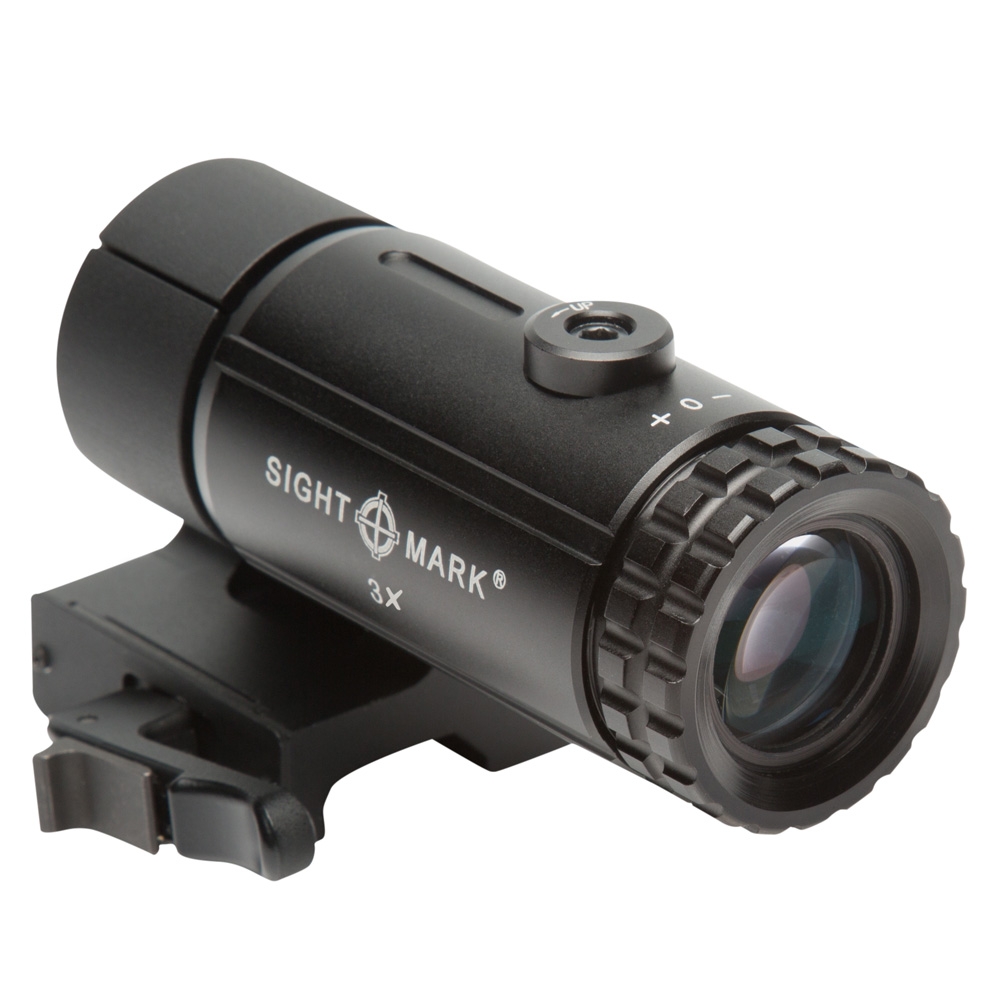
Sightmark T-3 3x Tactical Magnifier
via Livens
£119.00
Buying Advice
When shortlisting a scope for 800 metre shooting and beyond, start with the turret and reticle system. For ELR work, MRAD (milliradian) is the dominant language in UK competition circles: 0.1 mil clicks correspond to exactly 1 cm of shift at 100 metres, making range-card calculations clean and intuitive. First focal plane (FFP) reticles are strongly preferred because the subtensions remain accurate at every magnification, letting you range, hold off, or dial without switching to a specific power setting. Look for a reticle with a detailed Christmas-tree or hash-mark holdover pattern — Vortex's EBR-7C MRAD and Zeiss's ZF-MRi are both excellent examples. Ensure the scope offers enough total internal elevation adjustment; shooting at 1,000 yards with a typical .308 Win load requires roughly 35–40 MOA (around 10–12 MRAD) of come-up from a 100 m zero, and larger calibres at longer distances demand even more. A quality zero-stop mechanism prevents you from losing your baseline after dialling back down.
Optical quality matters enormously when mirage, light conditions and tiny aiming points conspire against you. A 50 mm or 56 mm objective lens paired with high-end ED or fluorite glass gives you the resolution and light transmission to read wind flags and spot trace at distance. Swarovski's long range scope UK offerings, such as the X5i line, and the Zeiss LRP S5 are renowned for glass clarity, while Vortex's Razor HD Gen III offers competitive performance at a lower price point — making the vortex vs zeiss long range debate a genuine one rather than a foregone conclusion. Burris also deserves mention: their XTR III series punches above its weight for UK shooters on a tighter budget. Whichever brand you choose, insist on a side-parallax adjustment dial calibrated down to at least 45 metres, capped turrets or locking turrets if the scope will also travel in a slip, and a tube diameter of 34 mm or 35 mm for maximum internal adjustment range.
Finally, consider the total system weight. A scope for 1000 yard shooting with rings, level, and sunshade can easily weigh 1–1.2 kg, and when mounted on a heavy-barrelled rifle the combined package may exceed 7 kg. For prone F-Class or bench shooting this is a non-issue — indeed, weight aids stability. But if you shoot positional PRS stages or need to carry the rifle any distance, every gram matters. Budget-wise, a genuinely capable long range rifle scope in 2026 starts at roughly £800–£1,000 for optics like the Vortex Viper PST Gen II 5-25×50 or Burris XTR III, while top-tier glass from Swarovski, Zeiss, or the Vortex Razor HD Gen III sits in the £1,800–£3,200 bracket. Factor in quality mounts (£100–£250) and a bubble level, and a first time long range scope setup can be had for well under £1,500 — while a no-compromise competition rig may approach £3,500 all-in.
Frequently Asked Questions
What magnification and objective lens size do I need for shooting beyond 800 metres?
For long range shooting UK competitors typically use scopes in the 5-25× or 7-35× range. At 800 metres and beyond, you will usually shoot at or near maximum magnification, so 25× is a practical minimum; 30× or 35× helps with spotting trace and reading mirage. A 50 mm or 56 mm objective lens provides the light-gathering ability to maintain a bright, high-contrast image at these higher powers, especially in the overcast conditions common across Britain.
Which reticle and turret features matter most for extreme long-range precision?
A first focal plane (FFP) MRAD reticle with detailed holdover markings — often called a Christmas-tree or hash-pattern reticle — is considered essential for extreme long range optics. FFP ensures subtension values stay accurate regardless of zoom level, which matters when you need to hold wind quickly. On the turret side, look for 0.1 MRAD clicks with a tactile, positive feel, a reliable zero-stop so you can return to your confirmed zero without counting revolutions, and enough total elevation travel to cover the drop of your chosen cartridge at your maximum intended distance.
How do Vortex, Zeiss and Swarovski compare for UK long-range competition and target shooting?
All three brands field strong long range scope options. Swarovski's X5i offers arguably the finest glass clarity and colour fidelity, making it popular in F-Class, but commands a premium price. The Zeiss LRP S5 series combines superb optics with excellent turret mechanics and competitive pricing, making it a growing favourite on UK ranges. Vortex's Razor HD Gen III delivers comparable mechanical precision and very good glass at a noticeably lower cost, backed by the brand's transferable no-fault warranty — a significant factor for UK buyers considering resale value.
Does gun weight and scope weight really affect accuracy at extended ranges?
In prone or bench-rest disciplines, a heavier rifle-and-scope combination actually helps by damping recoil and reducing shooter-induced movement. A scope for 1000 yard shooting commonly weighs 850 g to 1.1 kg, and this weight is a net positive when the rifle is fully supported. However, in PRS-style matches that include positional and barricade stages, excess weight causes fatigue and slower transitions. The key is to match system weight to your discipline rather than assuming lighter is always better.
What budget should a UK shooter expect for a capable 800 m+ scope setup?
A first time long range scope setup capable of consistent accuracy beyond 800 metres can be assembled from around £1,000 to £1,500 including scope, quality rings, and a spirit level. At this price point, the Vortex Viper PST Gen II 5-25×50 and Burris XTR III are strong contenders. Stepping up to premium glass from Zeiss or Swarovski, or the Vortex Razor HD Gen III, pushes the optic alone into the £1,800–£3,200 range, with total setup costs of £2,000–£3,500 once you include a 34 mm mount and accessories.
Do I need MOA or MRAD turrets for long-range shooting in the UK?
MRAD (milliradian) is the predominant system among UK long-range and ELR shooters, largely because the metric relationship — 0.1 mil equals 1 cm at 100 metres — integrates cleanly with metric range cards and ballistic solvers. MOA works perfectly well mathematically (1 MOA ≈ 1.047 inches at 100 yards, or roughly 2.9 cm at 100 metres), and some F-Class shooters prefer its finer click resolution at ¼ MOA. Either system is accurate; what matters is that your reticle and turrets are matched — never pair an MRAD reticle with MOA turrets or vice versa.
Related guides
Our UK expert guide to the best scopes for .22LR long-range shooting beyond 100 yards in 2026. FFP vs SFP, MOA vs MRAD, reticles, budget tiers and top picks reviewed.
Best Long-Range Scopes Under £1,000 for UK ShootersOur 2026 UK buyer's guide to the best scopes for long-range shooting under £1,000. Expert picks, specs explained, and FAQs for reaching 1,000 yards on a budget.
Best Long-Range Hunting Scopes for UK Stalkers in 2026Our expert UK guide to the best scopes for long range hunting in 2026. We cover magnification, reticles, FFP vs SFP, budget tiers and what actually matters beyond 500 metres.
Best Scopes for Getting Started in Long-Range ShootingDiscover the best beginner long-range scope UK shooters can buy in 2026. We cover magnification, FFP vs SFP, reticle choice, and top picks from Vortex, Burris and more.
First Focal Plane Reticles: The Long-Range Shooter's GuideUnderstand how first focal plane reticles work for long-range shooting. Expert UK guide covering FFP vs SFP, MRAD holdovers, magnification behaviour and what to look for in 2026.
Not sure which scope is right for you?
Try our AI-powered scope finder — answer a few questions and get personalised recommendations.
Find My Scope →Get a UK scope tip every day
Follow AiScopes on Facebook for daily buying guides, deals and gear advice.
Follow on Facebook