Best Scopes for Extreme Long-Range Shooting Beyond 1,000 Yards
By Peter Makulek · Senior Optics Editor · · Live prices from UK retailers
Shooting beyond 1,000 yards is no longer the preserve of military snipers or wealthy hobbyists. In the UK, the disciplines of Precision Rifle Series (PRS), Extreme Long Range (ELR) competition, and ambitious varminting have driven huge demand for optics that can reliably track, hold, and correct at distances where a bullet may be in flight for well over two seconds. For UK shooters running calibres such as .338 Lapua Magnum, .300 Win Mag, or the increasingly popular 6.5 PRC and 6.5 Creedmoor, the rifle scope is arguably the single most important component after the barrel itself. Getting it wrong means wasted ammunition, missed targets, and genuine frustration on ranges like Diggle, Bisley, or the Scottish Highlands.
This guide exists because choosing the best scope for long range shooting at this level involves navigating a dense thicket of specifications — magnification, objective diameter, focal plane, turret graduation, total elevation travel, reticle design, parallax adjustment, and glass quality — all of which interact in ways that are not always intuitive. A scope that performs superbly at 600 yards may run out of internal elevation at 1,200, or its reticle may lack the subtension range needed for meaningful holdover in a crosswind. We have distilled the genuine decision points into a single, thorough resource aimed squarely at UK buyers.
The UK context matters more than many guides acknowledge. Our firearms licensing regime means most shooters are working with bolt-action rifles on Firearm Certificates (FAC), and the calibres available — while powerful — still demand every fraction of an arc-minute of mechanical accuracy from the scope. Our climate is another factor: rain, fog, and rapidly shifting wind conditions across open moorland or coastal ranges put a premium on fog-proof construction, quality multi-coatings, and turrets you can manipulate cleanly with cold or gloved hands. Where you buy matters too, with UK retailers like Optics Warehouse, UKSN sponsors, and specialist dealers offering warranty support that grey imports simply cannot match.
Below, you will find our curated product picks filtered for tactical and PRS-grade optics with maximum magnification of 16× or higher — the realistic minimum for precision work at extreme distance. After the picks, we provide a detailed buying-advice section covering specifications, budget tiers, common mistakes, UK-specific considerations, and how to match your optic to your specific use case. Whether you are stepping up from 600-yard club shooting or building a dedicated ELR rig, this is the definitive long range scope UK resource for 2026.
Top Picks — Live UK Prices

WULF Hurricane Lite 4.5-18x50 SFP Non Illuminated Half Mildot SF Tactical 0.1 MRAD 30mm Rifle Scope
via Optics Warehouse
£94.95

Vector Optics Victoptics S6 1-6x24 LPVO SFP IR VI-CTSIX MIL 30mm Rifle Scope
via Optics Warehouse
£112.49
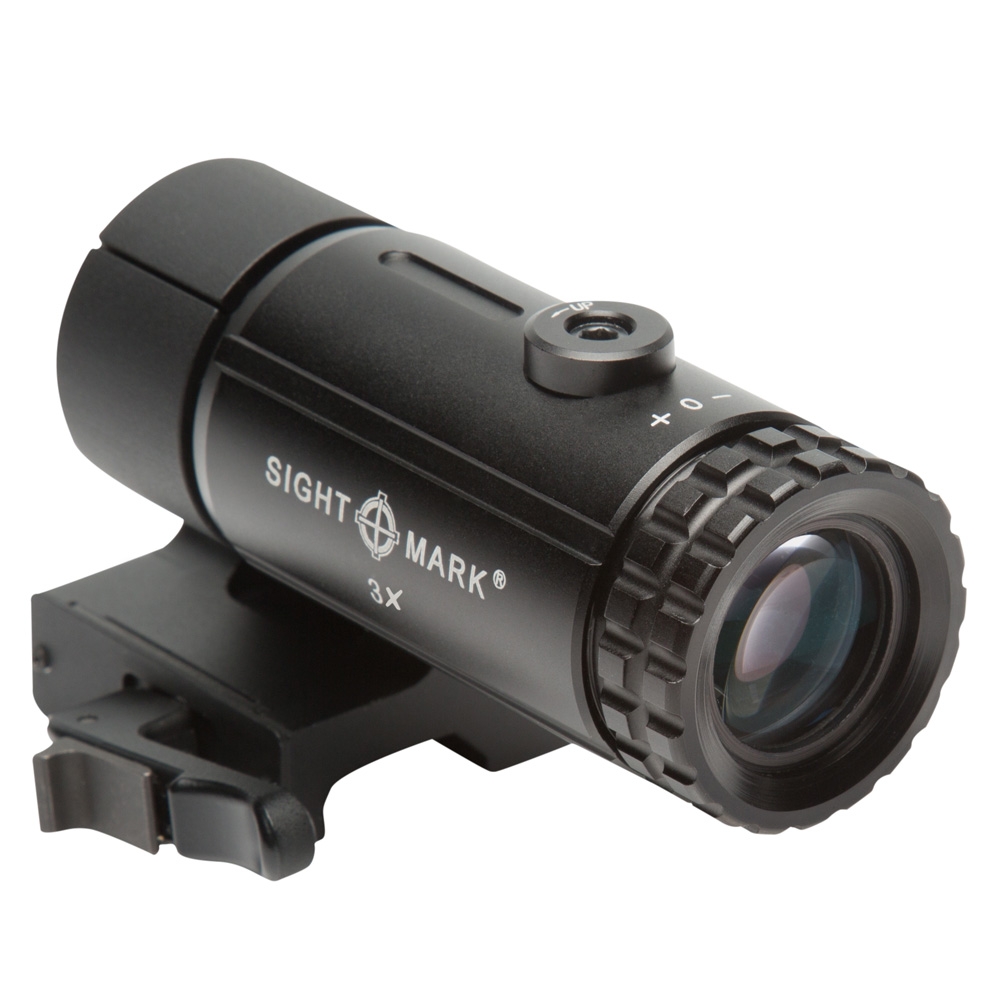
Sightmark T-3 3x Tactical Magnifier
via Livens
£119.00
Buying Advice
Start with the numbers that genuinely matter for shooting beyond 1,000 yards. Total internal elevation adjustment is critical: at 1,200 yards a .308 Win may require 35-plus MRAD (over 120 MOA) of come-up from a 100-metre zero, and even flatter-shooting rounds like 6.5 Creedmoor still need upwards of 25 MRAD. Always check total travel in the manufacturer's spec sheet and subtract a few MRAD for zero-stop overhead. Turret graduation determines your click resolution — 0.1 MRAD moves the point of impact 1 cm at 100 m; 1 MOA moves it approximately 1.047 inches at 100 yards (roughly 0.29 MRAD). MRAD users find mil-based reticles and turrets faster for wind holds because the maths is metric-friendly, which suits UK range markers almost universally given in metres. Meanwhile, objective lens diameter — typically 50 mm or 56 mm on a serious long range scope — governs light transmission and exit pupil size, both important for dawn-and-dusk shooting on Scottish stalking ground or dimly lit range bays.
Budget tiers break down roughly as follows for UK buyers in 2026. Entry-level long-range scopes in the £500–£900 bracket — think brands entering the tactical segment — can deliver adequate glass clarity and MRAD turrets, but often compromise on turret repeatability, coating consistency, or total elevation travel. The mid-tier sweet spot sits around £900–£2,000, where you find proven performers with excellent zero-stop mechanisms, locking turrets, fully multi-coated ED glass, and turret tracking that is genuinely reliable over thousands of clicks. Premium optics above £2,000 and up to £3,500-plus add the finest optical coatings, ultra-precise erector systems, broader fields of view at high magnification, and sometimes integrated electronic features. At every tier the rule of thumb holds: spend at least as much on glass as you do on the rifle if you are serious about 1,000-yard-plus precision.
Common mistakes UK shooters make when selecting a best scope for 1000 yards include over-prioritising magnification and under-prioritising turret quality. A 30× scope with mushy, imprecise clicks will lose to a 25× optic with a crisp 0.1 MRAD turret every time at distance. Another frequent error is choosing a second focal plane (SFP) scope and then attempting to use the reticle for holdover at variable magnifications — SFP reticles are only dimensionally accurate at one specific magnification setting, which in a high-stress competition stage is easy to forget. Failing to account for mounting height and rail cant is also surprisingly common: a 20 MOA canted base is almost mandatory for extreme-distance work, and not budgeting for quality rings or a one-piece mount can undermine an otherwise excellent optic.
UK-specific context is essential. Under Home Office guidance and individual police force policies, the calibres most commonly approved on FAC for long-range target shooting are .308 Win, 6.5 Creedmoor, 6.5 PRC, .300 Win Mag, and .338 Lapua Magnum, with larger ELR cartridges like .375 CheyTac available in some force areas with appropriate justification. Clubs affiliated with the NRA at Bisley, the FCSA, or regional associations often run long-range comps at measured distances in metres, reinforcing the practical advantage of MRAD-graduated optics. When purchasing, buying from an established UK dealer — whether a high-street shop or a reputable online retailer — ensures you receive a UK-valid warranty and avoid import duty surprises. Brands like Pard, known primarily for digital night-vision and thermal add-ons, are increasingly visible in the UK optics market; while their thermal clip-ons can complement a day scope for legal night shooting under a specific condition on your FAC, they do not replace a dedicated precision day optic for extreme-range target work.
Matching the scope to your use case is the final and arguably most important step. A dedicated ELR competition shooter who never fires below 800 yards can optimise for maximum magnification, maximum elevation travel, and a busy, subtension-rich reticle without worrying about field-of-view at low power. A UK deer stalker who occasionally stretches to long range but also needs a versatile optic for woodland work will want a broader zoom ratio, a cleaner reticle at lower magnifications, and a lighter, more compact package — here, a 5-25×56 with an illuminated MRAD Christmas-tree reticle represents a practical compromise. PRS competitors, meanwhile, prioritise fast turret manipulation, generous eye relief for awkward positional stages, and a forgiving eyebox. There is no single best scope for long range that fits every shooter — but by understanding the specifications, your discipline, and your budget, you can find the scope that turns your rifle into a genuine 1,000-yard-plus precision system.
The brand landscape in 2026 is broad and competitive. European manufacturers continue to dominate the premium segment, while several Japanese and Filipino-made optics offer remarkable mid-tier value. American tactical brands remain strong in PRS circles. In the UK market specifically, dealer availability and after-sales service should weigh heavily in your decision; a scope with a five-year transferable warranty supported by a UK distributor is worth more than a marginally sharper optic that must be shipped overseas for repair. Digital and smart-scope technology — including integrated ballistic solvers and rangefinding reticles — is maturing rapidly, and brands such as Pard are pushing thermal and digital fusion concepts, though for pure daylight precision at extreme range, traditional optical scopes with high-quality glass and mechanical turrets remain the gold standard heading into 2026 and beyond.
Frequently Asked Questions
What magnification and objective lens size do you need for shooting beyond 1,000 yards in the UK?
For consistent target identification and precise aiming beyond 1,000 yards, a minimum top-end magnification of around 20× is recommended, with 25× to 34× being the practical sweet spot for most UK ELR and PRS shooters. Objective lens diameter of 50 mm or 56 mm provides the light-gathering ability needed for clear images at high magnification, particularly in the lower-light conditions common across British ranges. A 5-25×56 or 7-35×56 configuration covers both close-range positional stages and extreme-distance precision, making it the most versatile choice for UK long-range shooting disciplines.
MRAD or MOA: which turret system is better for extreme long-range UK shooting?
MRAD (milliradian) turrets have become the dominant choice for UK extreme-distance shooting, and for good reason. One click of 0.1 MRAD moves the point of impact exactly 1 cm at 100 metres, making mental arithmetic straightforward when UK ranges are marked in metric distances. MRAD also pairs naturally with mil-based reticles for fast holdover and wind corrections without dialling. MOA turrets — where 1 MOA equals approximately 1.047 inches at 100 yards — remain popular in some American-influenced disciplines, but the metric simplicity of MRAD gives it a clear practical edge on British ranges.
How much should UK shooters expect to spend on a scope built for 1,000+ yard precision?
Realistically, a rifle scope capable of reliable performance beyond 1,000 yards will cost UK buyers from around £900 at the entry point of the mid-tier up to £3,500 or more for premium glass. Below £900 you can find functional optics, but turret tracking repeatability and coating quality often suffer — both of which are critical at extreme distance. The mid-range sweet spot of roughly £1,200–£2,000 delivers excellent value, with proven zero-stop turrets, ED glass, and the internal elevation travel needed for ELR work. Budget for quality mounts and a canted rail on top of the scope price.
Which reticle features matter most for holdover and wind correction at extreme distance?
At distances beyond 1,000 yards, a Christmas-tree or hash-marked reticle with clearly graduated subtensions in MRAD is invaluable. These reticles provide holdover dots or lines below the centre crosshair and wind-hold marks to the sides, allowing you to apply corrections visually without dialling the turrets — essential when conditions change rapidly. Look for reticles with subtension marks extending to at least 20 MRAD below centre and 5 MRAD either side. Illumination of the centre dot aids target acquisition against dark backgrounds but should not wash out the finer hash marks.
Do you need a first focal plane scope for shooting beyond 1,000 yards?
For extreme-distance precision, a first focal plane (FFP) scope is strongly recommended because the reticle subtensions remain accurate at every magnification setting. This means you can use the reticle for holdover, range estimation, and wind correction regardless of your zoom level — a major advantage when you need to adjust magnification quickly during a PRS stage or as mirage conditions change. Second focal plane (SFP) scopes are only dimensionally correct at one specific magnification, which introduces a significant margin for error under pressure. For dedicated 1,000-yard-plus work, FFP is the safer and more versatile choice.
How much total elevation travel does a scope need for shooting beyond 1,000 yards?
The total elevation adjustment required depends on your cartridge and zero distance, but as a rule of thumb, you should look for at least 25 MRAD (approximately 86 MOA) of total internal elevation. A .308 Win zeroed at 100 metres may need 35 MRAD or more to reach 1,200 yards, while a 6.5 Creedmoor requires roughly 25 MRAD for the same distance. Using a 20 MOA (roughly 6 MRAD) canted scope base effectively adds to your usable come-up, which is why such bases are almost universal in the UK ELR community.
What role does parallax adjustment play at extreme long range?
Parallax error occurs when the target image and the reticle are not on the same focal plane, causing apparent reticle movement as your eye shifts position behind the scope. At 1,000 yards and beyond, even small parallax errors translate into significant point-of-impact shifts. A side-focus or adjustable-objective parallax knob that ranges to at least 1,000 yards — and ideally to infinity — is essential. Always fine-tune the parallax dial until the reticle appears completely stationary against the target when you move your head slightly, before committing to the shot.
Can I use a long-range rifle scope on a sub-12 ft/lb air rifle for extended-range shooting?
No. Sub-12 ft/lb air rifles — whether spring-powered or PCP — are ballistically effective only to approximately 50–75 yards due to their low muzzle energy and the rapid velocity decay of lightweight pellets. Mounting a high-magnification tactical scope on such a rifle will not extend its effective range; it will simply magnify the target without providing the energy or trajectory consistency needed for precision beyond those distances. Long-range optics discussed in this guide are designed for centrefire rifles on FAC, firing cartridges with the energy and ballistic coefficient to remain supersonic well past 1,000 yards.
Are digital or thermal scopes like those from Pard suitable for extreme long-range precision?
Thermal and digital optics from brands such as Pard serve a different primary purpose — they excel at target detection in low light or darkness and are popular among UK shooters for legal night-time pest control under the appropriate FAC conditions. However, current-generation digital and thermal scopes generally lack the optical resolution, turret precision, and reticle subtension accuracy required for cold-bore hits at 1,000 yards and beyond. For dedicated extreme-distance precision in daylight, a high-quality traditional optical rifle scope remains the best tool. That said, a Pard thermal clip-on mounted ahead of your day scope can add significant night capability to an ELR rig without sacrificing daytime performance.
Related guides
Our UK expert guide to the best scopes for .22LR long-range shooting beyond 100 yards in 2026. FFP vs SFP, MOA vs MRAD, reticles, budget tiers and top picks reviewed.
Best Long-Range Scopes Under £1,000 for UK ShootersOur 2026 UK buyer's guide to the best scopes for long-range shooting under £1,000. Expert picks, specs explained, and FAQs for reaching 1,000 yards on a budget.
Best Long-Range Scopes Beyond 800 Metres (2026)Expert UK buyer's guide to the best long-range rifle scopes for shooting beyond 800 metres in 2026. Covers magnification, reticles, turrets, and top brands like Vortex, Zeiss and Swarovski.
Best Long-Range Benchrest Scopes: UK Buyer's Guide 2026Definitive UK guide to the best scopes for benchrest shooting at 200–1,000 yards in 2026. Expert advice on magnification, turrets, reticles, FFP vs SFP and top picks for every budget.
Best Long-Range Hunting Scopes for UK Stalkers in 2026Our expert UK guide to the best scopes for long range hunting in 2026. We cover magnification, reticles, FFP vs SFP, budget tiers and what actually matters beyond 500 metres.
Not sure which scope is right for you?
Try our AI-powered scope finder — answer a few questions and get personalised recommendations.
Find My Scope →Get a UK scope tip every day
Follow AiScopes on Facebook for daily buying guides, deals and gear advice.
Follow on Facebook