Best Scopes for Long-Range Hunting in the UK (2026)
By Peter Makulek · Senior Optics Editor · · Live prices from UK retailers
Choosing the best scope for long-range hunting demands a different mindset from picking glass for woodland stalking at a hundred metres. When you extend your engagement envelope to 300, 500, or even 800 metres across open Scottish hillsides or Welsh uplands, your optic must deliver repeatable elevation adjustment, a reticle that aids holdover or dialling, and enough magnification to place a shot inside the vital zone of a red hind or a fox. This guide exists because UK shooters increasingly pursue ethical long-range capability, yet most buying guides lump all hunting scopes together without addressing the specific ballistic and optical demands of extended-range fieldwork.
The UK context matters enormously. Our legal framework for deer stalking specifies minimum calibres and bullet energies—.243 Win for most English and Welsh deer species, .240 calibre and 1,700 ft/lbs muzzle energy for Scottish red and sika—and the choice of cartridge directly affects how much bullet drop and wind drift your scope must compensate for at range. Fox shooting, often conducted at night with thermal or night-vision clip-ons, adds further requirements around eye relief, mounting height, and compatibility with devices from brands like PARD. Understanding these constraints before spending money on glass is the difference between a confident system and an expensive disappointment.
We will walk you through the critical decision points: first focal plane versus second focal plane, MRAD versus MOA adjustments, magnification range, objective lens diameter, turret quality, and parallax adjustment. Each of these specifications has a measurable effect on your ability to hit a deer's heart-lung zone—roughly a 20cm circle—at distances where bullet drop may exceed two metres. We test and compare scopes that UK stockists actually carry, at price points from serious entry-level around £400 to premium optics above £2,000.
Below the product picks you will find our in-depth buying advice, covering budget tiers, common mistakes, UK law, and how to match a scope to your specific discipline—whether that is hill stalking roe and red deer across Highland glens, lamping foxes on arable land in East Anglia, or precision target work that crosses over into field shooting. Our FAQ section answers the exact questions UK shooters are asking in forums and Facebook groups right now. This is designed to be the most thorough single-page resource on choosing a long-range scope for British hunting in 2026.
Top Picks — Live UK Prices

WULF Hurricane Lite 4.5-18x50 SFP Non Illuminated Half Mildot SF Tactical 0.1 MRAD 30mm Rifle Scope
via Optics Warehouse
£94.95

Vector Optics Victoptics S6 1-6x24 LPVO SFP IR VI-CTSIX MIL 30mm Rifle Scope
via Optics Warehouse
£112.49
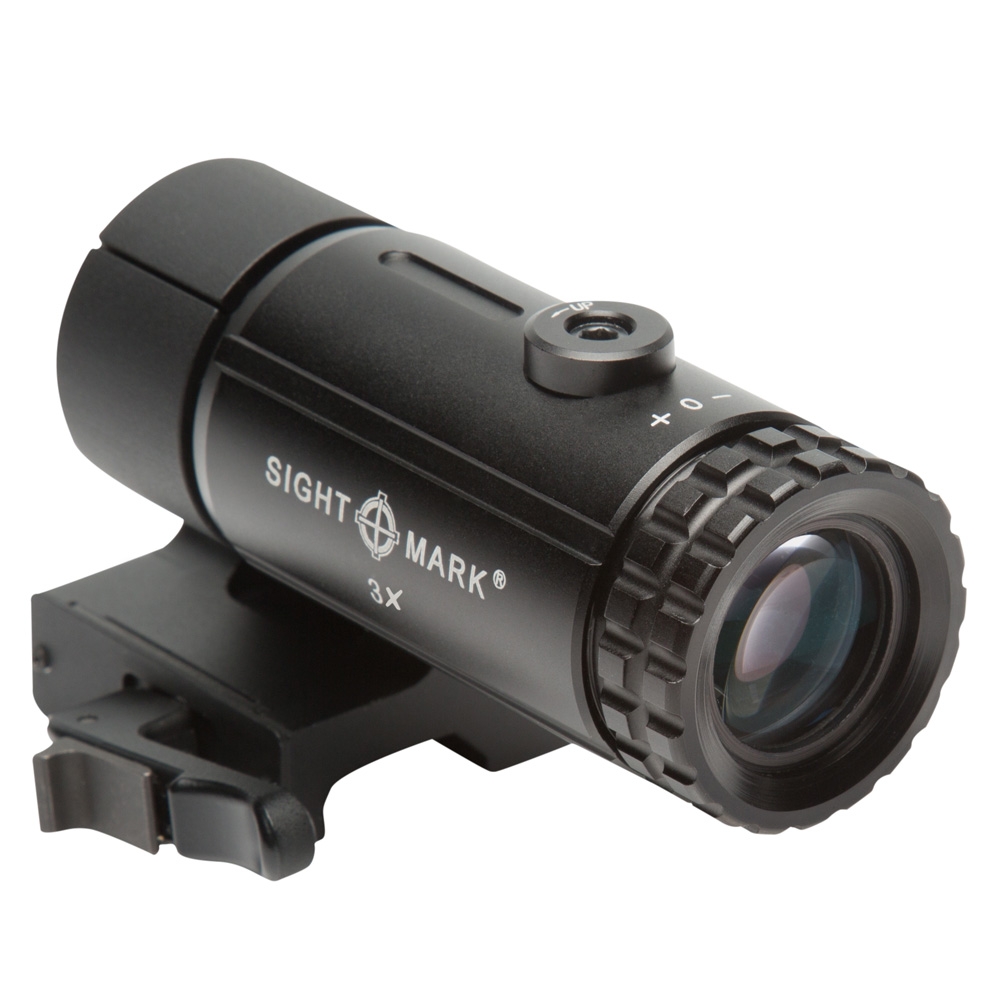
Sightmark T-3 3x Tactical Magnifier
via Livens
£119.00
Buying Advice
Start with the key specifications. Magnification range dictates both field of view (critical for target acquisition at closer distances) and the ability to resolve fine detail at 600 metres and beyond. A 5-25× or 4-20× scope hits the sweet spot for most long-range hunting in the UK; you retain a usable 5× or 4× low end for driven or walked-up shots, yet can dial up to positively identify a beast and place your crosshair precisely. Objective lens diameter—typically 50mm or 56mm on long-range scopes—determines light transmission; a 56mm objective gathers noticeably more light in the last thirty minutes of legal shooting time, but adds weight and demands taller rings. Parallax adjustment, usually a side-focus knob, must be present and precise: at 400 metres, even a small parallax error shifts the apparent point of aim off the true optical axis, which can mean a miss or, worse, a wounding shot.
Budget tiers in the UK market break down roughly as follows. Entry-level long-range hunting scopes (£400–£800) offer exposed turrets with acceptable repeatability, second focal plane reticles, and adequate glass quality—brands in this bracket are perfectly functional for shots to 500 metres if you verify tracking on a tall target. Mid-range optics (£800–£1,500) typically introduce first focal plane reticles, locking turrets, zero-stop mechanisms, ED or HD glass for sharper contrast, and tighter machining tolerances on the erector system. Premium scopes (£1,500–£3,000+) deliver the highest optical resolution, the most reliable turret tracking over thousands of clicks, illuminated reticles with daylight-visible settings, and build quality that withstands years of Highland weather. Your budget should also account for quality rings or a one-piece mount; a £1,500 scope in cheap rings is a wasted investment.
Common mistakes are worth cataloguing because they cost real money and, in a hunting context, risk animal welfare. First, buying excessive magnification (e.g., 10-50×) on a hunting rifle—above about 25× in field conditions, mirage and natural body movement make the image unusable. Second, choosing MOA turrets with an MRAD reticle, or vice versa; your adjustment system and reticle graduation must match so that you can read a correction in the glass and dial it without mental conversion. Third, neglecting to confirm turret tracking: not every scope tracks perfectly, and a scope that dials 0.1 MRAD per click but actually moves 0.08 MRAD will put you off target by 16cm at 800 metres over a 20-MRAD dial-up. Fourth, ignoring total elevation travel—a 6.5 Creedmoor drops roughly 12 MRAD (about 41 MOA) at 800 metres, so your scope needs that much usable up-travel above a 100-metre zero after accounting for the mount's built-in cant.
UK-specific context is essential. Deer stalking in England and Wales is governed by the Deer Act 1991 and its amendments; in Scotland, the Deer (Scotland) Act 1996 applies, with specific close seasons for each species and sex. Your firearm certificate conditions will specify calibre and expanding ammunition. For long-range deer work, popular UK calibres include .243 Win, 6.5 Creedmoor, 6.5 PRC, .270 Win, 7mm Rem Mag, and .308 Win—each with different ballistic profiles that affect how much scope elevation you need. Fox shooting at night often uses .223 Rem or .22-250, and the scope must pair with a clip-on thermal such as a PARD unit without vignetting at low magnification. It is worth noting that none of this applies to air rifles: sub-12 ft/lb air rifles, which do not require an FAC, are effective only to roughly 50–75 yards and are wholly unsuitable for the ranges discussed here. Purchase scopes from reputable UK dealers—online retailers, specialist gun shops, and country shows all offer good options, and buying UK-stocked products ensures warranty support.
Matching the scope to your use case requires honest self-assessment. If you primarily stalk roe in southern English woodland but occasionally take a 400-metre shot across a stubble field, a versatile 3-18×50 SFP scope with a simple BDC or MRAD Christmas-tree reticle and capped turrets may be ideal—it keeps the rifle compact and snag-free in cover. If you are a Highland stalker regularly engaging red deer across open corries at 300–600 metres, a 5-25×56 FFP scope with exposed locking turrets, a zero-stop, and an MRAD reticle gives you the precision and adjustability you need. For dedicated fox control at night, eye relief of 90mm or more prevents scope-eye under recoil, and a 30mm or 34mm main tube paired with a large objective lets in maximum light before you attach a clip-on. Think about total system weight too—carrying a rifle with a heavy 56mm scope and bipod across a Scottish hill for eight hours is a real consideration.
The brand landscape for long-range scopes in the UK is broad. European makers dominate the premium tier, offering superb glass and mechanical reliability. Japanese-made optics provide excellent value in the mid-range, often with class-leading turret feel and optical clarity. Filipino- and Chinese-manufactured scopes have improved markedly and populate the entry-level bracket with genuine capability. PARD, primarily known for thermal and digital night-vision devices, is relevant because many UK fox shooters build a system around a day scope paired with a PARD clip-on thermal, so compatibility with your chosen scope's objective diameter matters. Ultimately, the best scope for long-range UK rifle use is the one whose turret travel, reticle design, optical quality, and weight match your cartridge, your terrain, and your discipline—not simply the most expensive model on the shelf.
Frequently Asked Questions
What ballistic reticle or turret system is best for long-range deer stalking in the UK?
For dedicated long-range deer stalking, an MRAD (milliradian) first focal plane reticle combined with matched 0.1-MRAD click-value turrets is the most versatile system. This allows you to read wind corrections directly in the reticle and dial precise elevation, with each 0.1 MRAD click moving the point of impact 1 cm at 100 metres, scaling linearly to 5 cm at 500 metres. Locking, zero-stop turrets prevent accidental adjustment during a stalk. MOA-based systems work equally well provided your reticle and turrets are both in MOA—the key is consistency, not which angular unit you choose.
How does bullet drop compensation work on a hunting scope, and do I need a BDC reticle or dial turrets?
A BDC (bullet drop compensation) reticle has subtension marks or hash lines below the central crosshair that correspond to specific ranges for a given cartridge's trajectory. You hold the appropriate mark on the target instead of dialling the turret. This is fast but less precise, because the BDC marks are calibrated for one specific load and velocity—any deviation means the marks are approximate. Dialling turrets gives you exact compensation for any load, provided you have a reliable drop chart or ballistic calculator. For serious long-range work beyond 400 metres, most UK stalkers prefer dialling turrets with an MRAD or MOA reticle as a backup holdover reference.
Which magnification range and objective lens size balances field of view with long-range precision for UK hill stalking?
A 5-25×56 or 4-20×50 scope covers the vast majority of UK hill stalking scenarios. At 5× or 4× you retain a wide field of view—typically 7–8 metres at 100 metres—which helps you locate and track a moving deer at closer distances. At 20× or 25× you have enough magnification to precisely place a shot on a roe deer's heart-lung zone at 500–600 metres. The 56mm objective gathers significantly more light than a 44mm in dawn and dusk conditions, which is when most stalking occurs, though it adds around 100–150 grams of weight. For predominantly daytime fox shooting, a 50mm objective is usually sufficient.
Can I use a ballistic calculator app with my scope turrets for foxing and deer at extended range?
Absolutely, and it is highly recommended. Apps such as Applied Ballistics, Strelok Pro, and the free Hornady 4DOF calculator let you input your bullet's ballistic coefficient, muzzle velocity, zero range, and environmental conditions (temperature, pressure, humidity, altitude) to generate precise elevation and windage corrections in MRAD or MOA. You then dial these values on your turrets or use them as holdover references. For UK fox shooting at night, pre-calculated drop cards taped to the rifle stock are a practical backup when you cannot easily check a phone. Always verify app outputs against actual impacts on a range before relying on them in the field.
What is the practical maximum ethical range for deer and fox in the UK, and how does scope choice affect it?
There is no single legal maximum range, but ethical range is determined by your ability to consistently hit the vital zone—roughly a 20 cm circle on most UK deer species and 8–10 cm on a fox—under field conditions, accounting for wind, your shooting position, and the animal's potential movement. For many competent stalkers with a well-set-up rifle and quality long-range scope, 400–600 metres on deer is the practical limit; beyond that, wind reading and environmental variables dominate. Scope choice affects ethical range by determining how precisely you can dial corrections, how clearly you can resolve the target, and how confidently you can read wind through the reticle. A scope with poor tracking or inadequate magnification effectively shortens your ethical range.
Should I choose a first focal plane or second focal plane scope for long-range hunting?
First focal plane (FFP) scopes keep the reticle subtensions accurate at every magnification, so your MRAD or MOA holdover marks are always correct—this is a significant advantage when you may need to take a quick shot without dialling up to maximum power. Second focal plane (SFP) reticles are only accurate at one specific magnification (usually maximum), but they appear finer and less obstructive at high power, which some hunters prefer for precise shot placement. For long-range hunting where you routinely use reticle holdovers at varying zoom levels, FFP is generally the better choice. If you always dial turrets and shoot at maximum magnification, SFP remains perfectly viable.
How much total elevation travel do I need in a scope for 800-metre shots?
This depends on your cartridge and zero distance. As a guide, a .308 Win (175 gr at 2,600 fps) drops approximately 18 MRAD (roughly 62 MOA) at 800 metres from a 100-metre zero; a 6.5 Creedmoor (140 gr at 2,710 fps) drops around 12 MRAD (41 MOA). You need this much usable up-elevation above your zero, not just total travel. A 20-mil scope with a 20 MOA (approximately 6 MRAD) canted rail gives you significantly more usable up-travel. Always check the manufacturer's stated elevation range and verify it on a tall target board to ensure you have enough adjustment to reach your intended maximum distance.
Do I need a zero-stop on a long-range hunting scope?
A zero-stop is not strictly necessary, but it is extremely valuable for field use. It provides a mechanical reference point on the elevation turret that prevents you from dialling below your confirmed zero. After taking a long-range shot—say dialling up 8 MRAD for a 600-metre deer—you can spin the turret back to the stop and know you are precisely at your 100-metre zero without counting clicks or checking a revolution indicator. In the field, especially in cold or wet conditions where fine motor control is reduced, this reliability is worth the modest cost premium.
What mounts and rings should I use for a long-range hunting scope in the UK?
Quality mounts are as important as the scope itself. For bolt-action rifles common in UK stalking, a Picatinny rail with matched 34mm or 30mm rings (depending on tube diameter) is standard. If you need extra elevation travel, a 20 MOA or 30 MOA canted rail tilts the scope downward, giving you more usable up-elevation for extreme range. One-piece cantilever mounts are popular for their rigidity and ease of levelling. Ensure the rings are torqued to the manufacturer's specification with a calibrated wrench, and use a scope-levelling kit to eliminate cant—even 2 degrees of cant introduces meaningful horizontal error at 600 metres and beyond.
Related guides
Our expert UK guide to the best scopes for long range hunting in 2026. We cover magnification, reticles, FFP vs SFP, budget tiers and what actually matters beyond 500 metres.
Best Budget Long-Range Scopes Under £500 (2026 UK Guide)Find the best scope for long range shooting under £500 in the UK for 2026. We cover MRAD vs MOA, elevation travel, BDC reticles, and top picks for reaching 1,000 yards on a budget.
Best Scopes for Extreme Long-Range Shooting Beyond 1,000 YardsExpert UK guide to the best scopes for long range shooting beyond 1,000 yards in 2026. Compare FFP optics, turret systems, reticles and budget tiers for precision rifle work.
Best Long-Range Benchrest Scopes: UK Buyer's Guide 2026Definitive UK guide to the best scopes for benchrest shooting at 200–1,000 yards in 2026. Expert advice on magnification, turrets, reticles, FFP vs SFP and top picks for every budget.
Best Long-Range Scopes Under £1,000 for UK ShootersOur 2026 UK buyer's guide to the best scopes for long-range shooting under £1,000. Expert picks, specs explained, and FAQs for reaching 1,000 yards on a budget.
Not sure which scope is right for you?
Try our AI-powered scope finder — answer a few questions and get personalised recommendations.
Find My Scope →Get a UK scope tip every day
Follow AiScopes on Facebook for daily buying guides, deals and gear advice.
Follow on Facebook