Best Scopes for Bench Rest Shooting in 2026
By Peter Makulek · Senior Optics Editor · · Live prices from UK retailers
Bench rest shooting is the ultimate proving ground for a rifle scope. When you are chasing single-hole groups at 100, 200, or even 1,000 yards, every fraction of an angular minute matters, and the optic on top of your rifle is frequently the limiting factor before the barrel or the ammunition. Choosing the best scope for bench rest shooting in the UK requires a clear understanding of optical quality, tracking precision, and the specific conditions of British ranges — from the close confines of a 100-yard gallery to exposed moorland at 600 yards and beyond. This guide exists to help you make that choice with confidence.
The UK bench rest community is thriving, with disciplines ranging from UKBRA short-range benchrest at 100 and 200 yards through to F-Class Open and TR at Bisley and regional ranges. Each discipline places slightly different demands on your optic, but the core requirements are remarkably consistent: high magnification, a crisp and distortion-free image, repeatable and precise turret adjustments, and excellent parallax control. Whether you shoot a 6mm PPC at 100 yards or a .284 Winchester at 1,000 yards, these fundamentals do not change.
What has changed in 2026 is the breadth of quality available at every price tier. Precision rifle scope technology that was once confined to scopes costing well over £2,000 has trickled down into the mid-range and even budget segments. Japanese and Filipino glass houses now supply superb ED lens assemblies to a wide range of brands, meaning a benchrest rifle scope under £500 can genuinely hold its own in repeatable tracking and image clarity against models that cost twice as much just a few years ago.
In this guide we cover the critical specifications, explain the real-world trade-offs between FFP and SFP, MOA and MRAD, and lay out a clear budget framework in GBP. We then let our Algolia-powered product picker show you the top-rated scopes currently in stock from UK retailers. If you are after the best scope for benchrest UK shooters can buy right now, read on.
Top Picks — Live UK Prices

WULF Hurricane Lite 4.5-18x50 SFP Non Illuminated Half Mildot SF Tactical 0.1 MRAD 30mm Rifle Scope
via Optics Warehouse
£94.95

Vector Optics Victoptics S6 1-6x24 LPVO SFP IR VI-CTSIX MIL 30mm Rifle Scope
via Optics Warehouse
£112.49
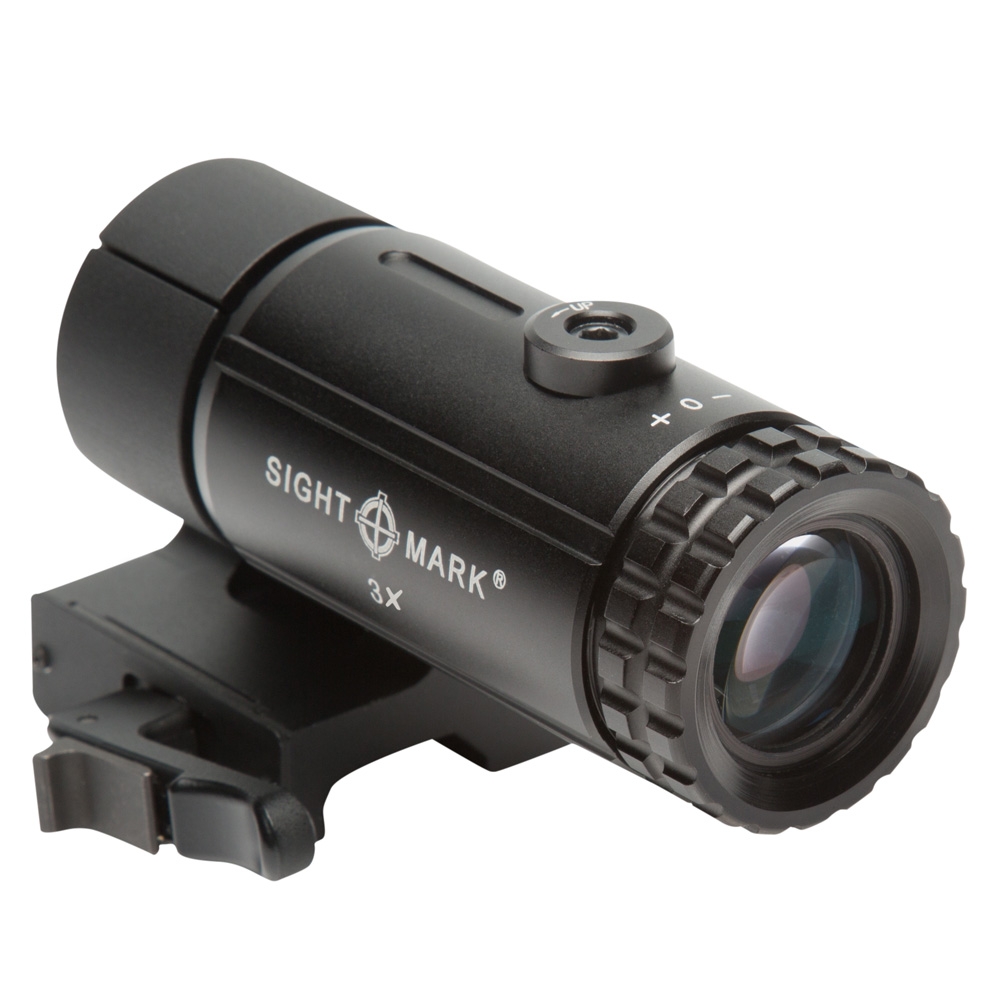
Sightmark T-3 3x Tactical Magnifier
via Livens
£119.00
Buying Advice
Start with the key specifications. Magnification of 20× or above is considered the minimum for serious bench rest work; many competitive shooters prefer 40× to 60× for short-range benchrest, while long-range F-Class shooters often settle around 25–40×. Objective lens diameter matters because it governs the exit pupil at high magnification — a 50 mm objective at 40× gives an exit pupil of only 1.25 mm, which can feel dim on an overcast British afternoon. Moving to a 56 mm objective improves this, and a handful of premium models now offer 60 mm bells. Parallax adjustment is critical: look for a side-focus knob calibrated from at least 10 yards (if you also shoot rimfire benchrest) up to infinity, and verify that the image snaps to a clean, stable focus at your most-used distances. Tube diameter — 30 mm or 34 mm — affects internal adjustment range but also mounting options; a 34 mm tube gives more elevation travel for scope long range work beyond 600 yards.
Budget tiers in the UK benchrest market break down roughly as follows. Entry-level (under £500) includes scopes from brands such as Athlon, Element Optics, and MTC Optics — these can be a good bench rest scope under £500 for UK shooters entering the sport, offering reliable tracking and acceptable glass, though chromatic aberration and edge sharpness may lag behind pricier models. Mid-range (£500–£1,200) is where many club-level competitors land, with scopes from Hawke, Bushnell, and Vortex offering ED glass, locking turrets, and solid zero-stop mechanisms. Premium (£1,200–£3,000+) covers March, Nightforce, Sightron, and Schmidt & Bender — the glass is exceptional, the turret repeatability is sub-click accurate, and the build quality survives decades of hard use. Determine your competition ambitions before your budget, and buy the best glass you can justify.
Common mistakes are surprisingly consistent among UK buyers. The first is over-prioritising magnification at the expense of optical quality — a blurry 60× image is less useful than a razor-sharp 36× one. The second is ignoring turret repeatability: some budget scopes advertise fine click values but drift or fail to return to zero reliably over a box test. Always verify tracking claims with independent reviews or, ideally, your own box test at the range. Third, many shooters buy a scope with insufficient elevation travel for their discipline and then resort to a canted rail or shims, introducing unnecessary complexity. Finally, do not overlook the reticle: a fine dot or thin crosshair is generally preferred for group benchrest, while a Christmas-tree or grid reticle suits long-range score shooting where holdover references are valuable.
UK-specific context matters. All centrefire rifles used in benchrest require a valid Firearms Certificate (FAC), and your scope choice has no separate legal restriction — but retailers will need to see your FAC or RFD status before shipping a complete rifle. Popular UK benchrest calibres include 6mm PPC, 6mm BR Norma, 6.5 Creedmoor, .308 Winchester, and .284 Winchester for long range. Retailers such as RUAG, Optics Warehouse, Uttings, and specialist RFDs are the primary sources for buying a precision rifle scope in the UK; always compare prices including VAT and check warranty terms — some US-origin scopes offer a VIP no-fault warranty that transfers easily, others do not cover UK-purchased units to the same degree. Bisley, Diggle, Blair Atholl, and Doveridge are among the most commonly used ranges for bench rest competition, each with different prevailing wind patterns that influence how much you will rely on turret adjustment versus wind-reading skill.
Match the scope to your use case. If you exclusively shoot 100-yard group benchrest, an SFP scope at 36–50× with a fine dot reticle, MOA turrets, and a 40–50 mm objective is hard to beat — you will seldom adjust from your zeroed magnification, so FFP offers no meaningful advantage. If you split time between benchrest and PRS-style positional stages, an FFP scope in the 5–25× or 7–35× range with MRAD turrets becomes more versatile; this is arguably the best scope for PRS crossover use. For dedicated 1,000-yard F-Class, look for 25–40× with a 56 mm objective, generous elevation travel (at least 25 MRAD or 80 MOA), and a zero stop so you can dial confidently and return to your 100-yard zero without miscounting clicks.
The brand landscape in the UK is broad. March (from Japan) and Nightforce (USA) dominate the top of competitive benchrest. Sightron, also Japanese, offers remarkable value in its SIII and S6 lines. Vortex and Athlon provide aggressive mid-range competition. Hawke, a UK-headquartered brand, continues to improve its Frontier and Sidewinder lines for precision use. At the technology-forward end, Pard is gaining UK mindshare with digital and thermal optics; while these are not traditional benchrest scopes, their digital day-optics line is worth watching as sensor resolution improves. Schmidt & Bender remains the gold standard for many European F-Class shooters, with the PM II 5–25×56 a perennial favourite. Do your homework, handle the scope if possible at a dealer day, and never underestimate the value of solid UK after-sales support.
Frequently Asked Questions
What magnification and objective lens size do you need for bench rest shooting?
For short-range benchrest at 100–200 yards, most competitors use 36× to 50× magnification with a 40–56 mm objective lens. At 1,000-yard benchrest or F-Class, 25–40× with a 56 mm objective is more common because the larger exit pupil helps in variable British light. A bigger objective gathers more light but adds weight and requires higher mounts, so balance this against your rest setup and rifle weight limits.
Should you choose FFP or SFP for bench rest competition in the UK?
For pure benchrest group shooting where you fire at a single fixed magnification, SFP (second focal plane) is perfectly adequate and often preferred because the reticle stays fine and unobtrusive at maximum power. FFP (first focal plane) becomes more useful if you also compete in PRS or F-Class disciplines where you adjust magnification between stages and need the reticle subtensions to remain accurate. In short, SFP for dedicated benchrest, FFP for multi-discipline versatility.
MOA or MRAD turrets: which is better for benchrest zeroing?
Neither is inherently superior — both are angular measurement systems. MOA clicks (typically 1/8 MOA per click, roughly 0.36 mm at 100 yards) offer slightly finer resolution than standard 0.1 MRAD clicks (1 cm at 100 metres). Many traditional benchrest shooters prefer MOA because UK and US benchrest targets are scored in imperial units. MRAD is dominant in PRS and military precision shooting, so if you cross disciplines, MRAD may simplify your workflow. Choose whichever system you are comfortable calculating with and stick with it.
What is a good bench rest scope under £500 for UK shooters?
Several scopes offer genuine benchrest capability below £500 in the UK market. The Athlon Ares ETR and Element Optics Titan are frequently recommended for their reliable tracking, side parallax adjustment, and decent glass quality at this price. MTC Optics Viper Pro also deserves a look as a UK-designed brand with local support. At this budget tier, expect honest turret tracking and good image clarity at moderate magnification, though you may notice some chromatic fringing at the highest powers compared to premium glass.
Do you need a zero stop turret for bench rest shooting?
A zero stop is not strictly necessary for short-range benchrest, where you typically dial to a single zero and leave the turret alone for an entire match. However, it becomes very valuable for long-range benchrest and F-Class, where you dial significant elevation between distances and need a reliable mechanical reference to return to your 100-yard zero. Even for short-range use, a zero stop acts as an insurance policy against accidentally dialling past your zero when handling the rifle.
How important is parallax adjustment for bench rest accuracy?
Parallax adjustment is critical. At benchrest distances, even a small parallax error — where the reticle shifts against the target as your eye moves slightly off-axis — can open a group by a quarter-MOA or more. Look for a scope with a side-focus parallax knob calibrated from 10 yards (useful for rimfire benchrest) to infinity. When setting up, always adjust parallax so the target image is sharpest and the reticle does not shift when you move your head slightly behind the eyepiece.
Can I use a best budget scope intended for hunting on a benchrest rifle?
You can, but you will likely hit limitations quickly. Budget hunting scopes often lack side-parallax adjustment, have coarser turret clicks (1/4 MOA rather than 1/8 MOA), and may not track reliably over repeated adjustments. Their optical quality at high magnification also tends to fall short. If you are simply trying benchrest for the first time, a decent hunting scope will let you participate, but upgrading to a dedicated precision rifle scope will yield a meaningful improvement in group sizes.
What tube diameter should I choose for a benchrest rifle scope?
The two main options are 30 mm and 34 mm. A 34 mm tube provides more internal space for the erector assembly, which translates to greater total elevation and windage adjustment range — important if you shoot at long range and need to dial significant corrections. For short-range 100-yard benchrest, a 30 mm tube typically offers more than enough adjustment. Bear in mind that 34 mm rings and mounts are slightly more expensive and heavier, so match the tube size to your actual adjustment needs.
Are digital or smart scopes from brands like Pard suitable for bench rest?
Digital optics from Pard and similar manufacturers are advancing rapidly and are popular for night-vision hunting in the UK. For traditional daylight benchrest competition, optical scopes still offer superior resolution, zero latency, and the fine image quality needed to judge mirage and wind. However, Pard's day-optic digital scopes are improving each year, and features such as automatic shot logging and on-screen ballistic data could eventually appeal to long-range benchrest shooters. For now, conventional glass remains the standard for competition benchrest.
Related guides
Our expert 2026 guide to the best scope for bench rest shooting UK. Compare precision optics under £500 with the magnification, turrets and parallax features that matter for group shooting.
Best Budget PRS Scopes Under £500 (UK 2026)Find the best scope for PRS and precision rifle competition under £500 in the UK. Our 2026 guide covers FFP vs SFP, MRAD turrets, top brands and real buying advice.
Best Long-Range Scopes Under £1,000 for UK ShootersOur 2026 UK buyer's guide to the best scopes for long-range shooting under £1,000. Expert picks, specs explained, and FAQs for reaching 1,000 yards on a budget.
Best Long-Range Scopes Beyond 800 Metres (2026)Expert UK buyer's guide to the best long-range rifle scopes for shooting beyond 800 metres in 2026. Covers magnification, reticles, turrets, and top brands like Vortex, Zeiss and Swarovski.
First Focal Plane Reticles: The Long-Range Shooter's GuideUnderstand how first focal plane reticles work for long-range shooting. Expert UK guide covering FFP vs SFP, MRAD holdovers, magnification behaviour and what to look for in 2026.
Not sure which scope is right for you?
Try our AI-powered scope finder — answer a few questions and get personalised recommendations.
Find My Scope →Get a UK scope tip every day
Follow AiScopes on Facebook for daily buying guides, deals and gear advice.
Follow on Facebook