Best Scopes for .22-250 Remington in 2026
By Peter Makulek · Senior Optics Editor · · Live prices from US retailers
The .22-250 Remington has been a varmint-shooting institution in the US for decades, and in 2026 it is enjoying a genuine renaissance. Faster twist rates — 1:8 and even 1:7 barrels from Savage, Ruger, Bergara, and custom shops — now stabilize heavy-for-caliber 75- to 80-grain bullets that were previously the exclusive province of the .224 Valkyrie and 22 Creedmoor. The result is a cartridge that can push high-BC projectiles past 3,400 fps, delivering prairie-dog accuracy at 400 yards and coyote-killing authority well beyond that. Choosing a scope for this revitalized round means understanding how bullet selection, barrel twist, and reticle subtension interact at the distances US varmint hunters actually shoot.
For most American shooters, the .22-250 lives on bolt actions — the Remington 700 platform, the Savage 110 Predator, the Ruger Hawkeye Varmint, and Howa 1500 variants. These rifles are typically topped with medium- to high-magnification optics and shot from bipods, bags, or portable benches in open terrain: the wheat stubble of Kansas, the sagebrush flats of Wyoming, or the ranch pastures of west Texas. Engagement distances routinely stretch from 100 to 500 yards on prairie dogs and ground squirrels, while coyote callers often need to make fast shots inside 300 yards under low light at dawn and dusk. The scope you pick must serve both roles or you need to be honest about which one dominates your season.
The key decision factors are magnification range, reticle design and subtension accuracy, parallax adjustment range, and optical clarity in marginal light. A 6-24x50 has been the default varmint configuration for years, but 5-25x and 4-20x options increasingly compete on versatility. First focal plane reticles matter more than ever if you are dialing or holding with heavy bullets that drift differently than the 55-grain pills the .22-250 was historically paired with. Second focal plane still makes perfect sense for fixed-magnification shooters who zero and hold at one power setting. We will break all of this down and explain exactly how fast-twist barrel bullet choices change reticle math.
This guide is written for US buyers. All prices are in US dollars, and we reference retailers like Amazon.com and OpticsPlanet where these optics are widely stocked. Our editorial picks span entry-level glass in the $250–$400 range through mid-tier options from $500–$900 and into premium optics above $1,000 from brands like Nightforce, Kahles, and March. Whether you are a first-time predator caller in the Midwest or a seasoned prairie-dog shooter heading to South Dakota, this is the most complete breakdown of scope selection for the .22-250 Remington you will find anywhere online in 2026.
Top Picks — Live US Prices
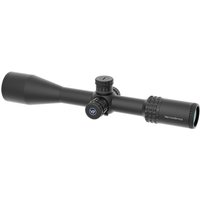
Vector Optics Sentinel 6-24x50 30mm Tube Rifle Scope, First Focal Plane, VSE-4 MOA Reticle, Black, SCFF-57
via OpticsPlanet
$174.30
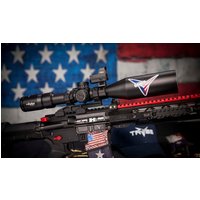
TRYBE Optics HIPO Rifle Scope, 4-16x44mm, 30 mm Tube, FFP, PLR-25 MOA Reticle, Black, TRORS4-16x44FFP-BL
via OpticsPlanet
$186.29
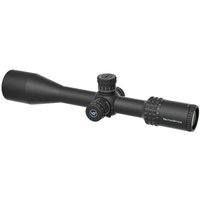
Vector Optics Sentinel 5-25x50mm 30mm Tube HD Rifle Scope, First Focal Plane, VSE-5 MOA Reticle, Black, SCFF-58
via OpticsPlanet
$187.90
Buying Advice
Start with the specifications that actually matter for a .22-250 varmint rig. Magnification range is straightforward: you want at least 16x on the top end for positive ID and precise aim on small targets past 300 yards, and enough bottom-end versatility — 4x to 6x — for scanning terrain or fast coyote shots inside 150 yards. Objective lens diameter of 44mm to 56mm directly affects exit pupil at high magnification; a 50mm objective at 25x yields a 2mm exit pupil, which is tight in low light. Parallax adjustment should go down to at least 25 yards, ideally 10 yards, because the .22-250's flat trajectory tempts you into close pest work. Eye relief of 3.5 inches or more matters because even the relatively mild recoil of a .22-250 can punish a careless cheek weld over hundreds of rounds in a prairie-dog session. Finally, verify total elevation travel: a 55-grain V-Max at 3,700 fps drops roughly 35 inches at 500 yards, but an 80-grain ELD Match at 3,200 fps drops about 52 inches at the same distance — you need enough internal adjustment to cover the heavier bullet's arc if you plan to dial rather than hold.
Budget tiers look very different in 2026 than they did even three years ago. In the $250–$400 entry tier, Vortex Diamondback Tactical and Hawke Vantage SF lines deliver surprisingly clear glass, exposed turrets with tool-less zero reset, and side-focus parallax. They lack true zero-stop mechanisms and premium lens coatings, so edge-to-edge sharpness and chromatic correction suffer compared to more expensive glass. The $500–$900 mid tier is the sweet spot for most dedicated varmint shooters: Vortex Viper PST Gen II, Leupold VX-3HD or Mark 5HD in certain configurations, and Hawke Frontier SF all live here, offering repeatable turrets, quality multi-coated glass, and first-focal-plane reticle options. Above $1,000, Nightforce NX8 and SHV, Kahles K525i, March FX series, and Swarovski Z8i deliver the optical clarity, mechanical precision, and build quality that justify the cost for shooters who put thousands of rounds downrange every season.
The most common mistake buyers make when scoping a .22-250 is treating the cartridge like it is still a 55-grain-only proposition. If your rifle has a 1:12 or 1:14 twist, that assumption is correct and a standard duplex or BDC reticle calibrated for lightweight .224 bullets is perfectly adequate. But if you have moved to a 1:8 or 1:7 fast-twist barrel to shoot 75- or 80-grain high-BC bullets, your wind drift drops off significantly while your trajectory actually gets steeper, not flatter, because you gave up roughly 500 fps of muzzle velocity to get that bullet weight — and the holdover values on a BDC reticle designed for 55-grain loads will be wildly wrong past 300 yards. In that scenario, you need either a mil or MOA hash-mark reticle with known subtensions so you can calculate your own holds, or a turret system you trust enough to dial precise corrections. Another common error is buying too much magnification and not enough field of view. A 10-50x benchrest scope sounds impressive, but at 50x the mirage off a Kansas wheat field in July will make your target dance like a mirage spirit. For most real-world varmint shooting, 20x to 25x is the practical ceiling.
For US buyers, the most convenient sources are Amazon.com, which stocks the full Vortex, Leupold, Hawke, and much of the Nightforce lineup with Prime shipping in most states, and OpticsPlanet, which often carries deeper inventory of March, Kahles, and Swarovski models along with mounting hardware. State sales tax applies per your jurisdiction; there are no federal restrictions on purchasing rifle scopes, so this is a straightforward online transaction anywhere in the US. If you want to handle glass before buying, use our dealer locator at aiscopes.co.uk — we list authorized retailers across all 50 states. One practical note: if you are mounting a heavy 56mm-objective scope on a Remington 700, verify that your base and ring height clears the barrel and bolt handle. A 30mm or 34mm tube in medium-high or high rings is the typical solution; Leupold, Vortex, and Nightforce all sell matched ring sets.
Matching the scope to your specific use case is the final step. If you are primarily a predator caller who shoots coyotes under 300 yards, lean toward a lower-magnification range like 4-16x or 3-18x with a wide field of view, an illuminated reticle for dawn and dusk work, and forgiving eye relief. The Leupold VX-6HD 3-18x50 and Vortex Viper PST Gen II 3-15x44 both excel here. If your primary mission is prairie-dog or ground-squirrel shoots at 300 to 600 yards, prioritize high magnification (6-24x or 5-25x), fine MOA or mil reticle graduations, and a smooth, precise side-focus parallax knob. The Nightforce SHV 4-14x56 or NX8 4-32x50, Kahles K525i 5-25x56, and March 5-42x56 are top contenders in this space. Dual-purpose shooters who split time between calling and long-range varminting should look at the 5-25x class with an FFP reticle — the Vortex Viper PST Gen II 5-25x50 remains one of the best all-around values in the US market.
The brand landscape in 2026 rewards informed buyers. Vortex dominates the entry and mid tiers with an unconditional lifetime warranty that no competitor matches at the price point; their customer service is US-based and genuinely excellent. Leupold carries deep credibility with American hunters and manufactures in Beaverton, Oregon — a genuine "Made in USA" claim that matters to many buyers. Nightforce, based in Lavallette, Idaho, builds some of the most mechanically precise turrets on the market and is the default choice for competitive PRS shooters moving into varmint work. Kahles, the Austrian optics house owned by Swarovski, offers superb glass with a lower profile than its parent brand. March, a Japanese manufacturer, produces extreme-magnification models with remarkably fine reticle detail that prairie-dog specialists swear by. Hawke and Weaver fill important niches at the value end, and Swarovski remains the gold standard in raw optical clarity if budget is no object. Every one of these brands has models well suited to the .22-250; the question is what you are willing to spend and how many rounds a year you intend to fire through your rig.
Frequently Asked Questions
What magnification range is best for a .22-250 varmint scope?
For most US varmint and predator hunters, a 5-25x or 6-24x scope covers the full envelope. The lower end gives you enough field of view for scanning terrain and making fast coyote shots inside 200 yards, while the top end provides the precision needed to place shots on prairie dogs at 400-plus yards. Avoid going above 30x unless you shoot exclusively from a solid bench, because atmospheric mirage usually becomes the limiting factor before your optic does.
Does a fast-twist .22-250 barrel change which scope reticle I should choose?
Yes, meaningfully. A fast-twist barrel (1:8 or 1:7) stabilizes heavy 75- to 80-grain high-BC bullets that have a significantly different trajectory and wind-drift profile compared to traditional 55-grain loads. Any BDC reticle calibrated for lightweight .224 bullets will give incorrect holdover values past 200-300 yards with these heavier projectiles. Choose a mil or MOA hash-mark reticle with known, consistent subtensions so you can calculate your own holds, or plan to dial your turrets for each shot.
Should I choose a first focal plane (FFP) or second focal plane (SFP) scope for .22-250?
If you use reticle holdovers at varying magnification levels — common when alternating between close coyote shots and distant prairie-dog work — FFP is the better choice because the reticle subtensions remain accurate at every power setting. If you always shoot at one magnification (typically max power for varmint benchrest), SFP is perfectly fine and often delivers a finer, cleaner reticle image at that setting. SFP scopes are also generally less expensive at equivalent optical quality.
How much elevation adjustment do I need in a .22-250 scope?
It depends on your load. A 55-grain V-Max at approximately 3,700 fps drops about 35 inches at 500 yards, requiring roughly 7 MOA of adjustment from a 100-yard zero. An 80-grain ELD Match at 3,200 fps drops closer to 52 inches at 500 yards, needing about 10 MOA. Most quality scopes offer 60 to 90+ MOA of total elevation travel, so this is rarely a limitation — but verify that your mounting setup (rail cant, ring height) keeps enough usable travel above your zero.
Is MOA or MRAD (mil) better for varmint shooting with a .22-250?
Neither system is inherently superior; both work perfectly well. MOA (minute of angle) clicks in 1/4-MOA increments (roughly 0.26 inches per click at 100 yards) are intuitive for shooters who think in inches and yards. MRAD (milliradian) clicks in 0.1-mil increments (1 centimeter at 100 meters, or roughly 0.36 inches at 100 yards) are preferred by many competitive and tactical shooters. Choose whichever system matches your ballistic calculator output and your comfort level with the math.
What parallax setting should I look for on a .22-250 scope?
Look for a side-focus parallax knob that adjusts down to at least 25 yards, and preferably 10 yards. The .22-250 is often used for close pest work as well as long-range varminting, and parallax error at close range on high magnification can shift your point of impact noticeably. Nearly all varmint-grade scopes in the $400-and-up range include side-focus parallax; avoid models with fixed parallax set at 150 or 200 yards, as they will introduce error at both close and extended distances.
Can I use the same scope for both coyote calling and long-range prairie-dog shooting?
Absolutely, but you need to choose wisely. A 5-25x50 FFP scope with an illuminated reticle covers both roles: low magnification and the illuminated center dot help in the dim light of a dawn coyote stand, while high magnification and precise hash marks serve prairie-dog work at 400-plus yards. The compromise is weight and size — a 50mm or 56mm objective on a varmint bolt rifle adds bulk. If weight matters, a 4-16x44 or 3-18x44 is a lighter alternative that sacrifices some top-end magnification.
Where can I buy these scopes in the US?
Amazon.com carries the full Vortex, Leupold, and Hawke lineups, along with many Nightforce models, and typically offers free Prime shipping. OpticsPlanet is another strong option with deeper inventory of premium European and Japanese brands like Kahles, March, and Swarovski. For hands-on evaluation before purchase, use the AIScopes dealer locator at aiscopes.co.uk, which covers all 50 US states. All rifle scopes are legal to purchase online in every state with no federal restrictions.
How much should I expect to spend on a quality .22-250 varmint scope?
Capable entry-level scopes from Vortex and Hawke start in the $250–$400 range and offer clear glass, side-focus parallax, and usable turrets. The mid-tier sweet spot of $500–$900 gets you repeatable turrets, premium multi-coated lenses, and first-focal-plane reticle options from Vortex, Leupold, and Hawke. Premium optics from Nightforce, Kahles, March, and Swarovski run from $1,000 to well over $3,000 and deliver the mechanical precision and optical clarity that high-volume varmint shooters demand.
Related guides
Discover proven solutions for locking your rifle scope elevation turret in 2026. We compare CRS, cap-lock, and zero-stop systems across top US brands and budgets.
Best Varmint Scopes for 2026Find the best varmint hunting scopes for 2026. We cover magnification, parallax, reticle subtension, and mirage management so you can hammer prairie dogs and groundhogs all summer.
Zero Stop Turrets Explained for US ShootersHow zero-stop turrets work, which US-market systems (Leupold CDS-ZL, Vortex CRS, Nightforce ZeroStop, Bushnell RevLimiter) to buy, and how to choose by budget and discipline in 2026.
How to Sight In a Rifle Scope: Step-by-Step First-Time GuideFirst time sighting in a rifle scope? Our 2026 step-by-step US guide walks you through mounting, bore-sighting, and dialing in your zero at 25 and 100 yards.
Best Scopes for .30-06 Springfield (2026)Find the best scope for your .30-06 Springfield in 2026. Recoil-proof construction, ideal magnification for 400-yard shots, and zero advice for 150–180 gr loads.
Why Isn't My Scope Hitting Where I Aim? A Troubleshooting ChecklistScope not hitting where you aim? Work through this proven troubleshooting checklist — mounts, zero, parallax, ammo — cheapest and most likely causes first. US shooters, all platforms.
Not sure which scope is right for you?
Try our AI-powered scope finder — answer a few questions and get personalised recommendations.
Find My Scope →Get a UK scope tip every day
Follow AiScopes on Facebook for daily buying guides, deals and gear advice.
Follow on Facebook