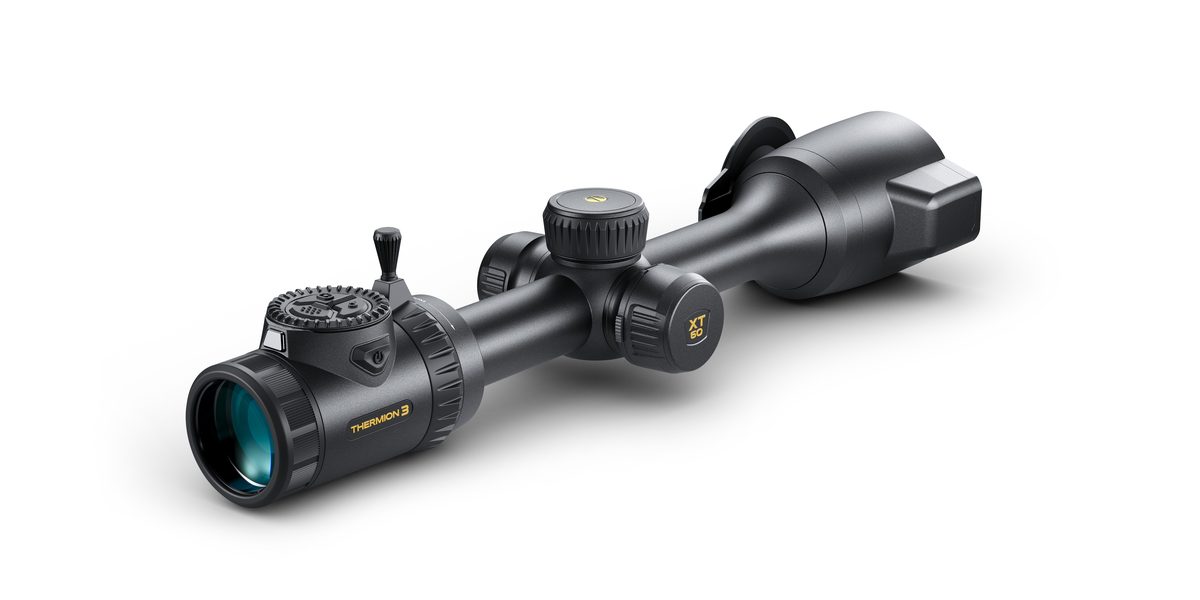
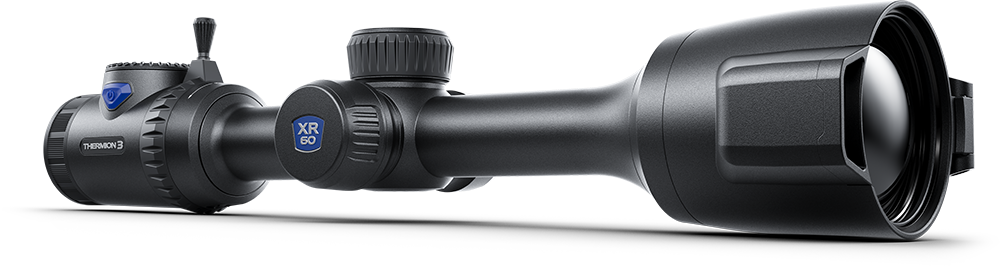
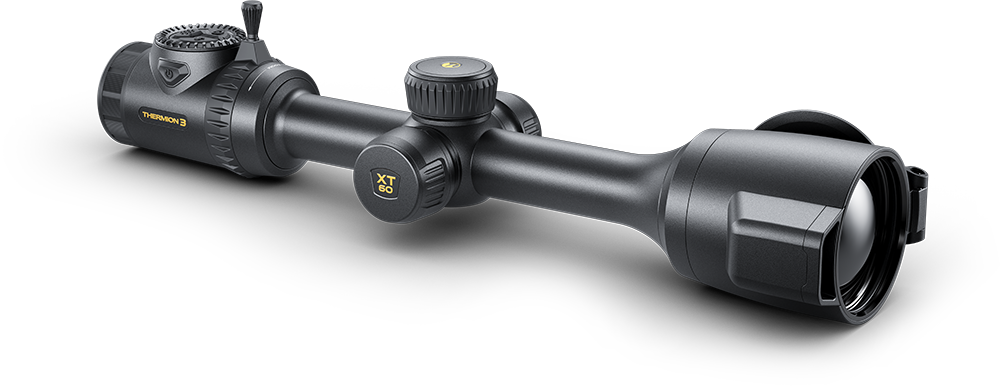
Two models, two priorities. Pulsar does not present the XR60 and XT60 as the same product at two price points. Its brief describes the XR60 as built for long-range precision and the XT60 as built for versatile awareness, from low to long range. Both share the same 60 mm F1.0 lens, the same rangefinder figures and the same 65 mm eye relief, so the choice comes down to sensor resolution and magnification range. The XT60's SRP is £2,000 higher than the XR60's (our arithmetic from the SRPs checked 11 November 2026), so the question to ask is whether you would use what the extra money buys.
Sensor and field of view. Pulsar quotes a 640 x 480 sensor for the XR60. For the XT60 it quotes a 1280 x 1024 sensor. Both have a 12 micron pixel pitch. A higher-resolution sensor has more image data to work with, which Pulsar says gives the XT60 greater image detail. For thermal sensitivity (NETD, where a lower figure means smaller temperature differences can be shown), Pulsar's manuals give a system NETD of under 18 mK for the XR60 and under 20 mK for the XT60, and a sensor NETD of under 30 mK and under 40 mK respectively. Pulsar has published footage recorded through the XT60, which is the second video on this page. Pulsar does not currently have equivalent XR60 footage available, so we cannot show you the two images side by side. Pulsar also quotes a 7.3 degree field of view for the XR60 (12.8 m wide at 100 m) and 14.6 degrees for the XT60 (25.7 m wide at 100 m). By our arithmetic from those figures, the XT60 view is about twice as wide, which helps when you are sweeping a field or a woodland edge and want to see more of it before you zoom in. A narrower view is a trade-off you accept for the higher magnification. Neither figure tells us how the image looks in the field, because we have not looked through one.
Magnification and distance. The XR60 covers 4-40x and the XT60 covers 2-24x. Both use what Pulsar's manuals call Smooth Digital Zoom: you change the magnification smoothly by turning the zoom ring. If most of your shots are at long range from a fixed position, the XR60 range is the one Pulsar points you towards. If you also shoot closer in, or move through cover, a lower starting magnification and a wider view may suit you better. We have no same-distance comparison of the two to offer.
Detection range versus identification. Pulsar quotes a detection range of 2,950 m for both models. Its manual gives that figure for a deer-type object, and actual performance varies with conditions and target. Detection means seeing that something warm is there. Recognising what it is, and whether it is safe to shoot, needs a much shorter distance with any thermal device. Treat 2,950 m as a ceiling on what the sensor and lens can pick up, and judge the models on how much detail they give you at the distances you really shoot.
Rangefinder. Pulsar says the built-in laser rangefinder measures up to 1,200 m with an accuracy of 1 m, using a 905 nm laser, on both models. Actual performance varies with conditions and target. Pulsar's creator brief says the unit supports single, scanning and True Horizontal Distance modes, and has a ballistic calculator that shows corrections and a Suggested Point of Aiming for the measured range. Check how that works with your own rifle, ammunition and zero before counting it as a reason to buy.
Battery. Both models run on two APS5 battery packs used together, one removable and one built in. Pulsar's manuals give an operating time of up to 14 hours for the XR60 and up to 8.5 hours for the XT60, with both packs, at an ambient temperature of 22 C. The manuals add that actual time depends on how much you use Wi-Fi, the video recorder, Bluetooth and the rangefinder. You may see 8.5 hours quoted for the XR60 elsewhere; Pulsar has confirmed to us that the manual figure of 14 hours is the correct one. Pulsar's manuals recommend that the built-in battery is replaced by a qualified professional or an authorised service centre, so do not plan on changing that one yourself. A British winter night is colder than 22 C, so plan on spare power for long sessions.
Build and handling. Pulsar gives 65 mm eye relief, which its brief describes as designed to stay safe with high calibres, a 6,000 J shock resistance rating, IP67 protection and an operating range of -25 to +50 C. Its manuals give the same size and weight for both models: 391 x 96 x 76 mm, which Pulsar told us is measured without the eyecup, and 1.3 kg with the removable battery. Pulsar lists a classic riflescope-style zoom lever and a central focus turret that can be used from either side. Those are claims about handling, and handling is exactly what a spec sheet cannot show. Mount it, shoulder it and see how it sits on your rifle before you commit if you can.
Zeroing, reticles and recording. Pulsar lists three zeroing methods (one-shot, zoom and freeze), 10 preloaded electronic reticles and 9 colour palettes. Its manuals give a reticle adjustment range of 2,000 mm horizontal and vertical at 100 m for the XR60, and 4,000 mm for the XT60. The value of one click changes with magnification and gets smaller as you zoom in: at the lowest magnification it is 10 mm at 100 m on the XR60 (at 4x) and 20 mm at 100 m on the XT60 (at 2x). It also lists a built-in recorder with 128 GB of memory, saving video and photos at 1440 x 1080, plus Wi-Fi and Bluetooth. Its brief says the Stream Vision 2 app handles file access, streaming and firmware updates, and Stream Vision Ballistics handles ballistic profiles. Check that the apps work with your phone before you buy.
What to check before you buy. First, confirm the exact model and SKU: the XR60 is 76589 and the XT60 is 76590 (Blackwood Outdoors shows them as PUL-76589 and PUL-76590; BushWear uses its own codes, S198840 and S198841). Dealer product names vary, and Scott Country's titles drop 'LRF'. Second, check the price, stock and delivery on the dealer page on the day. Third, ask for warranty and returns terms in writing, since we have not verified them. Fourth, check the law and the conditions of your firearms certificate before using any thermal sight, because we are not giving legal advice. Finally, handle one if you can. At these prices, time with the unit tells you more than any spec sheet.
Where to buy. Pulsar named three UK & ROI dealers for this guide: Scott Country, Blackwood Outdoors and BushWear. UK & ROI Distributor Recommended Retail Price (SRP), checked 11 November 2026: £3,599.95 for the XR60 and £5,599.95 for the XT60. SRP supplied by Thomas Jacks, Pulsar's UK & ROI distributor. Dealers set their own prices, which may differ from the SRP; use the dealer buttons to see each dealer's current price. The order of the dealers is not a ranking. Choose on delivery, support and who you already trust. If you would rather buy locally, Thomas Jacks, Pulsar's exclusive UK & ROI distributor, publishes a dealer locator on its own site and on Pulsar UK & ROI (run by Thomas Jacks); the product listing links to both. The dealer links are sponsored.