Best Rifle Scopes Under £100 for UK Shooters (2026)
By Peter Makulek · Senior Optics Editor · · Live prices from UK retailers
Spending under £100 on a rifle scope in 2026 no longer means settling for a toy. Advances in multi-coated lens technology, improved turret machining and intense competition among Far-Eastern manufacturers have pushed optical quality at this price point to a level that would have been unthinkable a decade ago. Whether you are fitting out a spring-powered air rifle for plinking and pest control in the garden, mounting glass on a .22 LR for rabbit lamping, or adding a basic optic to a .223 for foxing on a budget, there are genuinely competent scopes available without breaking the bank. This guide cuts through the marketing noise and tells you exactly what to look for.
The UK market has its own quirks that generic American buying guides ignore entirely. Our most popular discipline at this price bracket is sub-12 ft/lb air-rifle shooting, where ranges rarely exceed 50 yards and recoil from a spring or gas-ram powerplant is uniquely punishing on optics — the harsh bi-directional jolt kills scopes that survive centrefire recoil perfectly well. Then there is the legal landscape: you need to hold a valid firearms certificate for anything above air-rifle power, and many UK shooters start with an air rifle before moving up. Understanding these factors is crucial to choosing the right scope.
Within the sub-£100 bracket you will find scopes ranging from 3–9×40 variables suited to air-rifle hunters, through compact 4×32 fixed-power models ideal for rimfire, to surprisingly capable 3–12×40 or 4–16×44 designs that can sit on a centrefire rifle for medium-range work. The key decision factors are magnification range, objective lens size, reticle type (mil-dot, duplex, or BDC), turret style, and whether the scope uses a first focal plane (FFP) or second focal plane (SFP) reticle — each of which we explain in depth below.
We have evaluated the current UK market — including stock from retailers like Uttings, Pellpax, John Rothery, and the major online dealers — to identify the scopes that deliver the best combination of optical clarity, mechanical reliability and value. Below you will find our curated picks, followed by detailed buying advice that covers every specification you need to understand, common pitfalls to avoid, and how to match a scope to your specific shooting discipline. Whether you are a newcomer buying your first optic or a seasoned shooter fitting a budget spare, this is the definitive resource.
Top Picks — Live UK Prices

Richter Optik Crystal 4x20 Riflescope with Mounts
via BushWear
£9.99

Caldwell Orange Peel Silhouette Target 12x18 5pk
via BushWear
£10.39
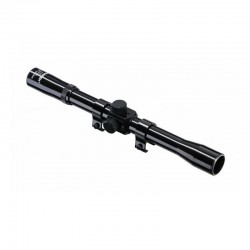
Umarex 4x20 Scope
via DAI Leisure
£19.95
Buying Advice
Start with the specifications that actually matter at this price. Magnification is often over-prioritised: for sub-12 ft/lb air rifles effective to around 50 yards, 3–9× is more than enough, and a fixed 4× or 6× keeps things simple and robust. Objective lens diameter determines light-gathering ability — a 40mm objective is the sweet spot under £100, offering a good exit pupil at moderate magnifications without being excessively heavy or requiring ultra-high mounts. Pay close attention to eye relief: anything under 70mm is uncomfortable on a springer and potentially dangerous on a centrefire rifle. Fully multi-coated lenses (all air-to-glass surfaces coated) will noticeably outperform merely 'coated' optics in low light, which is critical for UK dawn and dusk shooting.
At the budget end — roughly £25 to £50 — you will find simple 4×32 or 3–9×40 scopes with wire-erector reticles and basic coatings. These are perfectly serviceable for casual plinking and garden-range air-rifle use to 30 yards, but expect some chromatic aberration, softer edge clarity, and turrets that may not track with perfect repeatability. In the £50 to £75 mid tier, optical quality jumps noticeably: expect fully multi-coated lenses, crisper reticles (often glass-etched), and more reliable turret adjustments — usually ¼ MOA per click, where 1 MOA equates to approximately 1.047 inches at 100 yards or roughly 3cm at 100 metres. At the £75 to £100 premium-budget tier, you start to see features like adjustable parallax (sometimes called an AO or side-focus), illuminated reticles, and occasionally even mil-based turrets offering 0.1 MRAD clicks, where each click moves the point of impact 1cm at 100 metres.
The most common mistake UK buyers make at this price is choosing too much magnification. A 6–24×50 scope for £60 sounds impressive on paper, but the optical compromises required to hit that price — poor lens coatings, imprecise erector systems, narrow eye boxes — make it worse in practice than a well-made 3–9×40 at the same money. Another frequent error is mounting a standard scope on a spring-powered air rifle without checking it is rated for the reverse recoil impulse. Springers and gas-ram guns recoil backwards then snap forwards, and this double-shuffle destroys scopes designed only for rearward recoil. Always confirm the manufacturer rates the scope as spring-piston safe, or budget for a separate damper mount. Finally, do not ignore mount height: UK air rifles with dovetail rails often need medium or high mounts to clear the breech or loading port, and getting this wrong leads to an inability to achieve a comfortable cheek weld.
UK-specific context matters enormously. For sub-12 ft/lb air rifles — which require no licence in England, Wales, and Scotland (though Scotland mandates an air weapon certificate) — effective hunting range is realistically 40 to 50 yards maximum, and a scope's holdover marks beyond that distance are largely irrelevant. For .22 LR rimfire, which requires a firearms certificate, shots on quarry rarely exceed 100 yards, making a basic 3–9×40 with a duplex reticle more than adequate. If you are putting a budget optic on a centrefire rifle such as a .223 Remington or .243 Winchester for foxing, be realistic about limitations: a sub-£100 scope will work at moderate ranges, but turret tracking, repeatability and optical resolution will not match a £300-plus optic for precision work. Buy from established UK retailers who offer returns and warranty support — high-street and reputable online dealers typically stock Hawke, MTC, Nikko Stirling, BSA, and Discovery, all of which have UK service centres or distributors.
Matching the scope to your use case is the single most important step. For HFT (Hunter Field Target) competition with an air rifle, you want an adjustable-parallax scope — parallax error at short distances can shift your point of impact by several millimetres, which matters in a discipline scored on small kill zones. For ratting with a rimfire at close range in poor light, prioritise a wide exit pupil and fully multi-coated glass over high magnification. For a centrefire foxing rifle on a tight budget, look for a scope with an exposed or at least finger-adjustable elevation turret so you can make field corrections without a coin or screwdriver. If you intend to use night-vision add-ons such as those from Pard, ensure the scope's eyepiece dimensions and eye relief are compatible with a clip-on device — some budget scopes have unusually small or recessed eyepieces that make this impractical.
The brand landscape under £100 in the UK is dominated by a handful of names. Hawke is arguably the most trusted, with their Vantage and Airmax lines sitting at or just above the £100 mark and occasionally dipping below on promotion. MTC Optics, a British-designed brand, offers the Viper and Mamba series with strong reputations for springer-safe construction. Nikko Stirling remains popular for entry-level scopes with a wide dealer network. BSA has a long heritage in the UK air-rifle market, and Discovery Optics has gained ground by offering FFP reticles and side-focus parallax at aggressive prices. Pard, primarily known for night-vision and thermal devices, is increasingly relevant if you are building a day-and-night capable setup on a budget — pairing a competent budget scope with a Pard NV clip-on is a cost-effective route to legal night shooting.
Frequently Asked Questions
Can I use a sub-£100 scope on a spring-powered air rifle?
Yes, but only if the scope is specifically rated for spring-piston or gas-ram recoil. Unlike firearms, which recoil rearwards only, springers produce a harsh forward-then-backward jolt that can shatter lenses and strip turret internals in scopes not designed for it. Look for explicit manufacturer confirmation of springer compatibility. Brands like MTC, Hawke, and BSA typically indicate this clearly in their specifications.
What magnification do I need for air-rifle shooting at up to 50 yards?
A 3–9× variable or a fixed 6× is ideal for most sub-12 ft/lb air-rifle work out to 50 yards. Higher magnification sounds appealing but narrows your field of view, reduces the exit pupil, and amplifies any wobble in your hold. For HFT competition where precise rangefinding via parallax is important, a scope with a wider magnification range such as 4–12× and adjustable parallax is beneficial, but keep expectations realistic about optical quality at this budget.
What is the difference between FFP and SFP reticles, and which is better under £100?
In a first focal plane (FFP) scope, the reticle scales with magnification, so holdover marks and mil-dot subtensions remain accurate at every power setting. In a second focal plane (SFP) scope, the reticle stays the same size and subtensions are only correct at one specific magnification, usually the highest. Most scopes under £100 are SFP, which is perfectly fine provided you remember to use the correct magnification setting when using holdover marks. A few Discovery Optics models offer FFP at this price, which is worth considering if you vary magnification frequently.
Should I choose MOA or MRAD turrets on a budget scope?
At this price point, most scopes use MOA (minute of angle) turrets with ¼ MOA clicks — each click moves the point of impact approximately 0.7cm at 100 metres or about 0.26 inches at 100 yards. MRAD (milliradian) turrets, typically in 0.1 mil clicks, move the point of impact exactly 1cm at 100 metres, which many shooters find easier to calculate in metric. Choose whichever system matches your reticle — a mil-dot reticle paired with MRAD turrets is the most intuitive combination, as is a MOA reticle with MOA turrets. Mixing systems creates unnecessary confusion in the field.
Do I need adjustable parallax on a budget scope?
It depends on your discipline. Parallax is the apparent shift of the reticle against the target when you move your eye behind the scope. Most fixed-parallax budget scopes are set at either 100 yards (for rimfire and centrefire) or 50 yards (for air-rifle models). If you shoot at distances significantly different from the factory setting — especially at shorter ranges where parallax error is more pronounced — an adjustable objective (AO) or side-focus model lets you eliminate this error. For HFT and close-range air-rifle hunting, adjustable parallax is strongly recommended.
Is it worth buying a budget scope for a centrefire rifle like a .223 or .243?
For moderate-range work — foxing inside 200 yards, for example — a well-chosen sub-£100 scope can be perfectly adequate. Prioritise a scope with reliable, repeatable turrets, fully multi-coated lenses, and sufficient eye relief (at least 80mm for centrefire). However, if you plan to shoot at longer ranges, engage small targets, or dial elevation frequently, you will quickly outgrow a budget optic. In that case, consider saving for a mid-range scope in the £150 to £300 bracket rather than buying twice.
Can I attach a Pard night-vision clip-on to a budget scope?
In many cases, yes. Pard NV clip-on devices attach to the eyepiece of your day scope and effectively digitise the image. The key compatibility factors are the outer diameter of your scope's eyepiece housing (Pard adapters accommodate a range of sizes) and sufficient eye relief so the device can focus correctly. Check your scope's eyepiece diameter against Pard's adapter specifications before purchasing. This setup is a popular and cost-effective route to legal night shooting for foxing on UK farms.
What mounts do I need, and are they included with budget scopes?
Some budget scopes include mounts, but they are often low-quality and may not suit your rifle. Air rifles typically use 11mm dovetail rails, while firearms use Picatinny (Weaver-style) rails — ensure you buy the correct mount type. Medium-height mounts suit most setups, but spring-powered break-barrels often need high mounts to clear the breech. Budget an extra £10 to £20 for a decent set of mounts from a brand like Sportsmatch or BKL — it is a small investment that makes a significant difference to reliability and consistency.
How long can I expect a sub-£100 scope to last?
On a rimfire or centrefire rifle, a decent budget scope can last many years with proper care, since conventional rearward recoil is relatively gentle on optics. On a spring-powered air rifle, longevity depends heavily on the scope's construction quality — poorly built models may lose zero or develop internal faults within a few hundred shots. Buying from a UK retailer who honours warranty claims and choosing a springer-rated model from a reputable brand significantly improves your chances of long service life.
Related guides
Our expert guide to the best budget thermal scopes under £1,000 for UK fox and vermin shooting in 2026.
Best Budget Air Rifle Target Scopes Under £100 (2026)Our expert guide to the best scopes for air rifle target shooting under £100 in the UK for 2026. Covers HFT, FT and plinking — magnification, parallax…
Best Budget Air Rifle Scopes Under £100 (2026 UK Guide)Our UK experts pick the best air rifle scopes under £100 for springer and PCP shooting in 2026. Covers magnification, recoil resistance, parallax and more.
Best Budget Scopes Under £200 UK 2026The best rifle scopes under £200 in the UK — reliable, clear glass for air rifles, rimfire, and centre-fire use.
Best Budget Night Vision Scopes Under £500 for UK ShootersOur 2026 buyer's guide to the best budget night vision scopes under £500 for UK hunters. Covers digital vs Gen 1, how cheap is too cheap, clip-ons…
Best LPVO Scopes for Driven Shooting in 2026Our expert UK buyer's guide to the best LPVO scopes for driven shooting in 2026. Compare 1-6x and 1-8x low power variable optics for fast-moving game…
Driven hunt rifle scopes: the best optics for UK driven shooting in 2026Driven hunt rifle scopes compared for 2026. UK buyer's guide to magnification, reticles, red dots and budget picks for fast shots on driven deer and boar.
Not sure which scope is right for you?
Try our AI-powered scope finder — answer a few questions and get personalised recommendations.
Find My Scope →Get a UK scope tip every day
Follow AiScopes on Facebook for daily buying guides, deals and gear advice.
Follow on Facebook