Best PRS Scopes for UK Precision Rifle Competitors in 2026
By Peter Makulek · Senior Optics Editor · · Live prices from UK retailers
Precision Rifle Series competition has exploded in the UK over the past few years, with clubs from Scotland to the south coast now hosting regular matches that test shooters from 100 metres out to 1,000 and beyond. Whether you are stepping up to your first UK PRS match or looking to upgrade your glass for the 2026 season, the scope sitting on top of your rifle is arguably the single most important equipment decision you will make. A poor choice of reticle, unreliable tracking or inadequate magnification range can cost you points on every single stage, no matter how good your rifle and handloads are.
This guide is written specifically for the UK market, where the discipline landscape, legal framework and available retailers differ meaningfully from the US scene that dominates most online advice. In the UK, PRS-style matches often take place on MOD ranges or private estates, frequently at shorter average distances than American two-day nationals, but wind conditions — especially in Scotland and Wales — can be brutally challenging. That shifts the balance of what matters in a precision rifle scope: glass clarity for mirage reading and a fast, intuitive reticle become at least as important as raw top-end magnification.
Choosing the best scope for PRS means balancing several interconnected decisions: first focal plane versus second, MRAD versus MOA turret systems, the style and subtension density of the reticle, objective lens size, tube diameter and overall weight. Each of these factors interacts with the others and with your rifle platform, so a scope that is perfect for a lightweight 6.5 Creedmoor gas gun may be entirely wrong for a heavy bolt-action in .308 Winchester. We will walk you through every decision point before and after the product picks below.
Below the curated product selection you will find our in-depth buying advice covering budget tiers in GBP, common mistakes first-time PRS competitors make when buying precision rifle competition optics, and a detailed FAQ section that answers the exact questions UK shooters are asking right now. Our aim is to make this page the single most useful long range scope resource for anyone competing — or about to compete — in UK precision rifle disciplines in 2026.
Top Picks — Live UK Prices

WULF Hurricane Lite 4.5-18x50 SFP Non Illuminated Half Mildot SF Tactical 0.1 MRAD 30mm Rifle Scope
via Optics Warehouse
£94.95

Vector Optics Victoptics S6 1-6x24i Fibre LPVO SFP IR VIS-F1 MIL 30mm Rifle Scope
via Optics Warehouse
£94.99
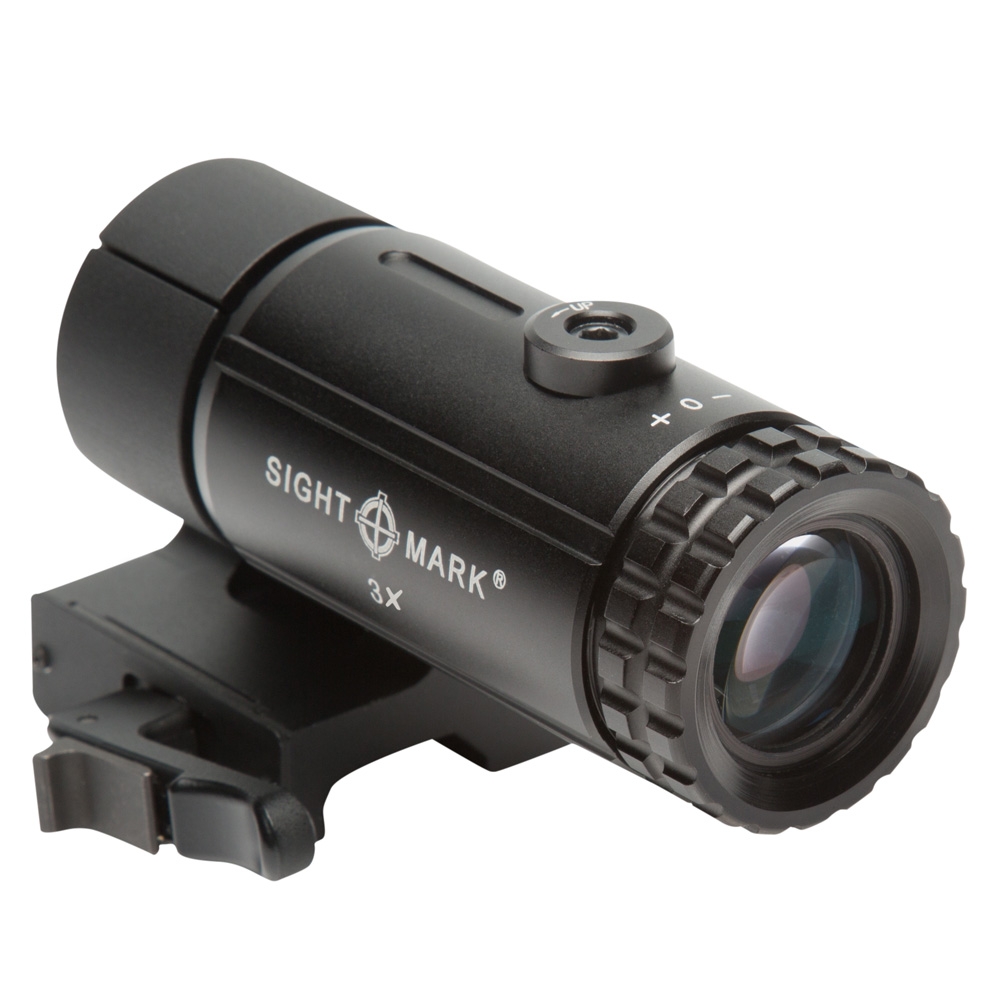
Sightmark T-3 3x Tactical Magnifier
via Livens
£119.00
Buying Advice
When evaluating any PRS scope, start with the specification sheet and know what the numbers actually mean. A 5-25×56 FFP scope with 0.1 MRAD clicks means each click moves point of impact 1 cm at 100 metres (or 0.5 cm at 50 m, scaling linearly). If you see an MOA turret, each 0.25 MOA click moves impact roughly 0.26 inches — effectively a quarter inch — at 100 yards. Total elevation travel matters for long-range stages: you typically want at least 25 MRAD (roughly 86 MOA) of total internal adjustment, and ideally 16+ MRAD of usable up-travel from a 100-metre zero for UK courses that reach out to 1,000 m or slightly beyond. Tube diameter affects this directly — 34 mm tubes offer more adjustment range than 30 mm — so most serious precision rifle scopes are now built on 34 mm tubes.
Budget tiers in the UK PRS scene break down fairly neatly. At the entry level, expect to spend roughly £700–£1,200 on a capable FFP scope with exposed tactical turrets, adequate glass and a Christmas-tree-style reticle — brands like Athlon, Element Optics and some Bushnell models sit here and are perfectly competitive at club-level matches. The mid tier, from around £1,200–£2,500, is where you find scopes with noticeably better glass coatings, tighter click tolerances and more refined turret feel; this is the sweet spot many UK competitors settle on as the best budget PRS scope category that does not compromise on tracking reliability. Premium glass from the likes of Nightforce, Vortex Razor, Kahles, Schmidt & Bender and Zero Compromise Optics occupies the £2,500–£4,000-plus bracket and delivers the finest optical clarity, most repeatable mechanics and best warranty support — important if your rifle is a serious competitive tool.
The most common mistake new UK PRS shooters make is over-magnifying. Running 25× on every stage sounds logical until you realise that higher magnification narrows your field of view, amplifies mirage distortion and slows target acquisition on positional stages where you have seconds to find and engage. Experienced competitors frequently dial back to 12×–18× even at 600 m and above, using reticle hold-offs rather than turret dialling for wind. Another frequent error is buying a second focal plane scope because it was cheaper, then discovering that the reticle subtensions are only accurate at one specific magnification — a serious handicap when you need to hold for wind at variable power. An FFP scope for PRS is overwhelmingly the correct choice for competition use.
UK-specific context matters. You need a valid Firearm Certificate to own the centrefire rifles used in PRS — typically bolt actions in 6.5 Creedmoor, 6 mm Creedmoor, .308 Winchester or .223 Remington — and your scope must be mounted on a rifle that is listed on your FAC. Retailers such as RUAG, Optics Warehouse, Scott Country International and specialist dealers like Runcible Sports carry the major PRS-oriented brands. Import duty and VAT on scopes bought from outside the UK can add 20%+ to the sticker price, so buying from a UK stockist often makes more economic sense. Also bear in mind that UK ranges frequently mandate specific calibres or muzzle-energy limits, and some clubs set maximum magnification rules for certain divisions — check before you buy.
Matching the scope to your use case is the final step. If you shoot exclusively PRS-style matches on known-distance ranges, prioritise turret repeatability, zero stop, a dense mil-based reticle and enough elevation travel for your calibre's drop at maximum range. If your rifle doubles as a deer-stalking tool — perfectly common in the UK — you may lean towards a scope with a slightly lower minimum magnification (3× or 4×) for woodland shots, accepting a modest compromise at the PRS end. Likewise, weight matters if you carry the rifle any distance; a 5-25×56 scope can weigh over 1 kg, so factor in mount weight too. Brands like Pard are known primarily for their thermal and digital optics rather than traditional PRS glass, but their growing UK presence in the night-vision and observation market means they may be worth watching as the technology landscape evolves. For pure optical competition scopes, however, stick to brands with a proven mechanical track record at the distances and round counts PRS demands.
Frequently Asked Questions
What magnification range and reticle style do UK PRS competitors actually use in matches?
The overwhelming majority of UK PRS competitors use scopes in the 5-25× magnification range, with 4-24× and 5-34× also seen. Dense Christmas-tree or grid-style mil reticles — such as the Tremor3, SKMR3, MSR2 or similar designs — are favoured because they allow fast wind holds without dialling the turret. In practice, most shooters rarely exceed 18–20× during stages, dialling magnification down to manage mirage and widen the field of view on positional or movers stages.
MOA or MRAD for PRS: which turret system do most UK precision rifle shooters prefer and why?
MRAD (milliradian) is the dominant system in UK PRS by a wide margin. The metric-friendly nature of MRAD — where 0.1 mil equals exactly 1 cm at 100 metres — aligns naturally with the metric range distances used on UK courses. Communication between spotters and shooters is also faster in mils. While MOA is slightly finer per click (0.25 MOA ≈ 0.72 cm at 100 m versus 1 cm for 0.1 mil), most competitors find the simplicity and commonality of MRAD more valuable than the marginally finer adjustment.
Do you need a first focal plane scope for PRS competition or can second focal plane work?
A first focal plane (FFP) scope is strongly recommended for PRS. In an FFP scope the reticle scales with magnification, meaning your hold-off subtensions are accurate at any power setting. A second focal plane (SFP) reticle is only dimensionally correct at one specific magnification (usually the highest), so if you adjust power mid-stage — which is common — your hold-offs become inaccurate. Virtually every competitive PRS shooter in the UK uses an FFP scope, and we would advise the same for anyone entering the discipline.
What is the minimum scope spec to be competitive at UK PRS matches without overspending?
To be genuinely competitive without overspending, look for a 34 mm tube FFP scope with at least 5-25× magnification, 0.1 MRAD clicks, a zero stop, at least 25 MRAD total elevation travel, and a tree-style or grid reticle. Glass quality should be good enough to read mirage confidently at 15–20×. In the UK market this specification starts at roughly £700–£900 for entry-tier brands and around £1,200–£1,500 for mid-tier options with better coatings and turret feel — either range can get you through club-level PRS matches respectably.
How important is zero stop and rev-counter turret tracking for PRS stage shooting?
A zero stop is virtually essential for PRS. It gives you a positive mechanical reference that prevents you from dialling below your confirmed zero, which is critical when you are adjusting elevation rapidly between stages and cannot afford to lose track of your turret position. A revolution counter or rev indicator is equally valuable on scopes with more than one full revolution of elevation travel, as it tells you at a glance whether you are on your first or second turn — eliminating the risk of being an entire revolution off, which would mean missing the target by several metres.
How much elevation travel do I need in a PRS scope for UK match distances?
UK PRS stages commonly run from 100 m to around 900–1,000 m, occasionally further. A typical 6.5 Creedmoor load with a 140-grain bullet at 2,700 fps requires roughly 9–10 MRAD of elevation from a 100 m zero to reach 1,000 m. You want comfortable headroom above that, plus some travel below zero for close-range offset or incline shots. A minimum of 14–16 MRAD of usable up-travel from zero is a sensible benchmark; most 34 mm PRS scopes exceed this comfortably.
Does objective lens size matter much for UK PRS — 50 mm versus 56 mm?
A 56 mm objective is the most popular choice among UK PRS competitors because it provides a brighter image at higher magnifications, which helps in low-light conditions common on British ranges — early-morning starts and overcast winter days are the norm. A 50 mm objective can work and saves a little weight and mounting height, but the difference in exit pupil at 25× (2.24 mm versus 2 mm) is noticeable when you need to spot trace or read mirage. For dedicated PRS use, 56 mm is the safer choice.
Can I use the same scope for PRS competition and deer stalking in the UK?
You can, though there are trade-offs. A 5-25×56 PRS scope at 5× gives a usable field of view for woodland stalking, but it will be heavier and bulkier than a dedicated hunting optic. The exposed tactical turrets common on PRS scopes can also snag on clothing or vegetation. Many UK shooters who compete and stalk own two rifles with purpose-matched optics. If budget forces a single scope, a lighter 4-24×50 with locking turrets offers a reasonable compromise for both roles.
Are there any UK legal considerations when buying a precision rifle scope?
Scopes themselves are not controlled items under UK firearms law — you can buy one without any licence. However, the rifle it sits on must be held on a valid Firearm Certificate (FAC) with an appropriate condition for target shooting or the relevant quarry species. Some ranges and PRS match organisers have specific equipment rules regarding maximum magnification in certain divisions, so check the match rules before investing. Importing scopes from outside the UK may attract customs duty and 20% VAT, making UK-based retailers the more straightforward purchasing route.
Related guides
Find the best scope for PRS and precision rifle competition under £500 in the UK. Our 2026 guide covers FFP vs SFP, MRAD turrets, top brands and real buying advice.
Best PRS & Precision Rifle Scopes for UK Competitors in 2026Our expert UK guide to the best scopes for PRS and precision rifle competition in 2026. Covers FFP vs SFP, MRAD turrets, budget tiers, and what UK shooters actually need.
Best PRS Scopes UK 2026Top-rated scopes for PRS and practical precision rifle shooting in the UK. Compare FFP, MRAD, and zero-stop options from Nightforce, Vortex, Kahles, and more.
Best PRS Competition Scopes: A UK Beginner's Guide for 2026Choosing your first precision rifle scope for PRS in the UK? Our 2026 guide covers reticles, turrets, magnification and budget tiers to get you match-ready with confidence.
Best Long-Range Rifle Scopes 2026: Match Your Optic to Your CalibreOur 2026 UK guide to the best scopes for long range shooting. Learn how to match reticle, turrets and magnification to your calibre's ballistic profile for precision results.
Not sure which scope is right for you?
Try our AI-powered scope finder — answer a few questions and get personalised recommendations.
Find My Scope →Get a UK scope tip every day
Follow AiScopes on Facebook for daily buying guides, deals and gear advice.
Follow on Facebook