Elevation Up, Reticle Down — Why Your Scope Isn't Broken
Shopping in the US? This page is on our US site: aiscopes.us →
By Peter Makulek · Senior Optics Editor · · Live prices from US retailers
It is genuinely one of the most common questions in shooting forums, and it is not stupid at all: when you click your elevation turret in the "UP" direction, you expect the reticle to move up inside the tube. Instead, it moves down. Your first instinct is that the scope is broken, backwards, or that you mounted it wrong. It is none of those things. Understanding why this happens is the single most important conceptual step toward accurate shooting at any distance, whether you are zeroing a rimfire at 25 yards or dialing for a coyote at 400.
Here is the short answer: the "UP" arrow on your turret tells the bullet's point of impact to move up on the target, not the reticle. Inside the scope, the erector tube tilts so the reticle actually shifts downward relative to the optical axis. This forces you to raise the muzzle slightly to bring the reticle back onto the target, which in turn sends the bullet higher. It is counterintuitive until you think of the reticle as a lever — push one end down inside the tube, and the barrel end points up. Every modern rifle scope from Vortex to Leupold to Kahles works this way.
This concept matters far beyond the initial zero. If you shoot long range — whether PRS matches, western mule deer hunts, or predator calling across open prairie — you will dial elevation constantly. Misunderstanding which direction to turn costs rounds, time, and sometimes a harvest. It also matters when choosing between first focal plane and second focal plane scopes, because the reticle behavior at different magnifications changes how you perceive that internal movement. FFP reticles scale with magnification; SFP reticles stay the same size regardless of zoom.
This guide covers the optics physics behind the phenomenon, walks through MOA versus MRAD turret systems, explains parallax and how it interacts with reticle position, and then recommends scopes across several real-world US shooting disciplines — from air rifle plinking to thermal coyote hunting at night. We also address night vision and thermal scope options where reticle behavior works differently because the image is electronically generated. Every recommendation is available to US buyers through retailers like Amazon.com and OpticsPlanet.
Top Picks — Live US Prices
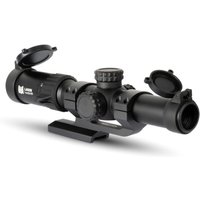
Monstrum Ladon 1-6x24mm LPVO 30mm Tube Rifle Scope, First Focal Plane, CM7 Reticle, Black, FFL16X-CM7
via OpticsPlanet
$134.99
Monstrum Ladon 1-6x24mm LPVO 30mm Tube Rifle Scope, First Focal Plane, CM3 Reticle, Black, FFL16X-CM3
via OpticsPlanet
$134.99
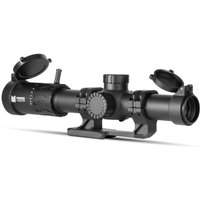
Monstrum Panzer ED 1-6x24mm LPVO 30mm Rifle Scope, First Focal Plane, CM3 Reticle, Black, FFZ16X-B
via OpticsPlanet
$149.99
Buying Advice
Start with the key specifications that directly relate to turret and reticle behavior. Elevation and windage adjustments are measured in either MOA (minutes of angle) or MRAD (milliradians). One MOA click is typically 1/4 MOA, which moves point of impact roughly 0.26 inches at 100 yards. One MRAD click is typically 0.1 mil, which moves impact 1 centimeter at 100 meters — or about 0.36 inches at 100 yards. Neither system is inherently superior; MOA is more traditional in the US hunting market, while MRAD dominates PRS and military circles because the math scales cleanly in metric. The critical rule: match your turret units to your reticle units. A scope with an MOA turret and an MRAD reticle is a recipe for field math errors.
Budget tiers in rifle scopes are fairly well defined in 2026. Entry-level scopes in the $150–$350 range — think Vortex Crossfire II or Bushnell Banner 2 — offer capped turrets, SFP reticles, and fixed parallax or side-focus down to 50 yards. They are perfectly adequate for most whitetail hunters shooting under 150 yards from a stand. Mid-range scopes from $400–$900 — such as the Vortex Viper PST Gen II, Meopta Optika6, or Leupold VX-3HD — deliver exposed locking turrets, zero stops, FFP reticle options, and better glass coatings. Premium scopes above $1,000, including the Kahles K525i and March FX series, offer top-tier mechanical repeatability and optical clarity for competitive long-range shooting.
The most common mistake buyers make is choosing a scope based solely on magnification range without considering turret total travel and mechanical quality. A scope advertised as having 80 MOA of elevation travel might lose 20 MOA to mounting geometry, leaving you short on dial for long shots. Another frequent error is buying exposed tactical turrets for a hunting rifle that will ride in a truck scabbard — bumping a turret off zero in the field is a real problem. Capped turrets or locking turrets like the Leupold CDS-ZL system exist specifically to prevent this. Also, never assume parallax does not matter: at ranges beyond 200 yards, even moderate parallax error shifts the apparent reticle position and compounds the confusion about which way the reticle "should" move.
For US-specific context, consider your discipline. Eastern whitetail hunters rarely need more than a 3-9x or 4-12x SFP scope with a simple duplex or BDC reticle — MOA turrets are the norm, and shots are typically under 150 yards. Western hunters pursuing mule deer, pronghorn, or elk across open terrain benefit from a 4-16x or 5-25x FFP scope with MRAD turrets, a zero stop, and a side-focus parallax knob. Predator hunters calling coyotes at night increasingly pair a clip-on night vision device or a dedicated thermal scope — Pulsar and Hikmicro dominate the US thermal market — with a daylight optic already zeroed. Air rifle shooters need scopes rated for springer recoil (which is bidirectional and destroys scopes not built for it), and should remember that even the best sub-12 ft-lb air rifles are realistically effective only to about 50–75 yards.
Matching the scope to your use case means being honest about your actual shooting distances and conditions. A $2,000 FFP scope with 35 MRAD of elevation travel is wasted on a .30-30 lever gun used inside 100 yards. Conversely, trying to stretch a budget SFP scope with imprecise turrets to 800 yards on a 6.5 Creedmoor PRS rifle will frustrate you quickly. Thermal scopes from Pulsar or Hikmicro are transformative for nighttime predator and hog hunting — legal in most US states — but their digitally generated reticles behave differently from traditional glass optics. The reticle in a thermal scope is overlaid on a sensor image, so turret adjustments move it in the intuitive direction on-screen, which can actually retrain your brain in an unhelpful way when you switch back to a conventional scope.
The brand landscape for US buyers in 2026 is competitive and healthy. Vortex remains the dominant value-to-performance brand with an unconditional lifetime warranty and massive dealer network. Leupold offers American-assembled quality and the Custom Dial System for hunters who want a turret engraved to their specific load's ballistics. Kahles and March serve the premium segment with outstanding mechanical precision. Bushnell covers the entry tier reliably. Meopta is an underrated option with excellent European glass at mid-range prices. For thermal and night vision, Pulsar's Thermion 2 line and Hikmicro's Thunder series are the strongest US sellers. All are widely available on Amazon.com and OpticsPlanet, and AIScopes maintains a 50-state dealer locator at aiscopes.co.uk for additional sourcing.
Frequently Asked Questions
Why does the reticle move down when I turn the elevation turret to "UP"?
The "UP" label refers to bullet impact moving up on the target, not the reticle moving up inside the scope. Internally, the erector tube tilts the reticle downward, which forces you to raise the barrel to realign the crosshair with your aiming point. This barrel rise sends the bullet higher. Every conventional rifle scope — from Vortex to Kahles — works this way.
Is my scope reticle broken if it seems to move the wrong way?
Almost certainly not. The apparent "wrong way" movement is normal optical behavior. If you watch the reticle while turning the turret, it should move smoothly and consistently in the direction opposite the labeled arrow. If it moves erratically, sticks, or does not move at all, then you may have a mechanical problem and should contact the manufacturer's warranty department.
Does this work the same way on FFP and SFP scopes?
Yes. In both first focal plane and second focal plane scopes, dialing "UP" moves the reticle down inside the tube and raises bullet impact. The difference between FFP and SFP is how the reticle scales with magnification — FFP reticles grow and shrink as you zoom, keeping subtension values accurate at every power, while SFP reticles remain a fixed size and are only subtension-accurate at one specific magnification, usually the highest.
Which is better for long-range shooting, MOA or MRAD?
Neither is inherently more accurate. MRAD is slightly easier for on-the-fly math because 0.1 mil adjustments correspond to 1 cm at 100 meters, making corrections in round numbers. MOA is deeply rooted in US shooting culture and pairs naturally with yards and inches (1 MOA equals approximately 1.047 inches at 100 yards). The critical rule is to match your turret unit to your reticle unit so holdovers and dial-ups use the same measurement system.
Do thermal scopes and night vision scopes have the same reticle direction issue?
Generally no. Thermal scopes from brands like Pulsar and Hikmicro use digitally generated reticles overlaid on a sensor image. When you adjust the zero, the software moves the reticle in the intuitive direction on the display. This is actually the opposite of how a traditional glass scope works and can cause confusion if you switch between thermal and conventional optics frequently.
What is the best scope for coyote hunting at night?
For dedicated nighttime predator hunting, a thermal scope like the Pulsar Thermion 2 or Hikmicro Thunder TQ50 is hard to beat — they detect body heat regardless of darkness or vegetation. If you prefer to keep your daylight scope zeroed and add night capability, a clip-on night vision or thermal device mounted ahead of your existing optic is a versatile option. Check your state's regulations, as a few states restrict electronic sighting devices for hunting.
Can I use a regular rifle scope on a spring-piston air rifle?
Not any scope. Spring-piston air rifles produce a unique bidirectional recoil that destroys scopes not designed for it. Brands like Bushnell and Vortex make models rated for airgun use. Also, remember that sub-12 ft-lb springers are realistically effective only to about 50–75 yards, so you do not need extreme magnification or long-range turret travel. A 3-9x or 4-12x scope with an airgun-rated build is ideal.
What does parallax have to do with reticle position?
Parallax error means the reticle and the target image are not on the same focal plane, so moving your eye slightly behind the scope shifts the apparent reticle position on the target. This can make you think your turret adjustments moved the reticle the wrong amount or in the wrong direction. Most scopes with a side-focus parallax knob let you eliminate this error at any distance, which is essential for precise shooting beyond 200 yards.
How do I know how much elevation travel I actually need?
It depends on your caliber, barrel length, muzzle velocity, and maximum intended range. A flat-shooting 6.5 Creedmoor at 2,700 fps needs roughly 12 MRAD (about 41 MOA) of come-up to reach 1,000 yards from a 100-yard zero. A .308 Winchester at similar velocity needs more. Use a ballistic calculator with your exact load data, then confirm your scope has enough remaining travel after zeroing. Mounting the scope in a 20-MOA canted base buys extra upward travel for long-range work.
Related guides
Wondering whether the PA GLX 2.5-10×44 with Raptor M2 reticle beats the Griffin Mil version? Our 2026 US buyer's guide breaks down holdovers, subtensions…
MOA vs MRAD: Which Reticle System Should You Choose?MOA vs MRAD explained for US shooters. Learn what each system means, which suits hunting or long-range PRS, how to convert between them…
Why Isn't My Scope Hitting Where I Aim? A Troubleshooting ChecklistScope not hitting where you aim? Work through this proven troubleshooting checklist — mounts, zero, parallax, ammo — cheapest and most likely causes first.
How to Spot Fake Scopes on eBay & Protect Your InvestmentLearn how to identify counterfeit rifle scopes, thermal optics, and night vision devices sold on eBay.
Best Long Range Scopes Under $1,000Find the best long range scope under $1,000 for PRS, hunting, and precision shooting. Expert-tested picks, buying advice, and FAQs for US shooters in 2026.
Not sure which scope is right for you?
Try our AI-powered scope finder — answer a few questions and get personalised recommendations.
Find My Scope →Get a UK scope tip every day
Follow AiScopes on Facebook for daily buying guides, deals and gear advice.
Follow on Facebook