MPVO vs LPVO: Which Variable Scope Belongs on Your AR-15 or Hunting Rifle?
Shopping in the US? This page is on our US site: aiscopes.us →
By Peter Makulek · Senior Optics Editor · · Live prices from US retailers
Quick answer: an MPVO (medium-power variable optic) in the 2-10x, 2-12x, or 3-15x range gives you the close-range speed of a low-power variable at the bottom end, plus enough magnification at the top to make precise shots to 500–600 yards on steel or game — eliminating the need to choose between an LPVO and a dedicated mid-range scope. Pair it with a top-mounted micro red dot for true 1x CQB work, and you have a setup that genuinely does it all.
The LPVO — typically a 1-6x, 1-8x, or 1-10x — has dominated the AR-15 market for a decade. Its appeal is simple: a true 1x bottom end for both-eyes-open shooting at room-clearing distances, with enough top-end magnification for 300-yard engagements. The problem is that optical quality at 1x always involves compromises. Designing an erector system that performs from 1x to 8x or 10x forces manufacturers into tradeoffs in edge sharpness, light transmission, and eye box forgiveness at the higher settings. And even a premium 1-10x maxes out where many Western hunters and PRS-style competitors need their scope to begin working hard.
Enter the MPVO. By surrendering true 1x — starting instead at 2x or 3x — scope engineers reclaim significant optical headroom. The erector assembly operates over a narrower ratio (a 3-15x is a 5:1 zoom; a 1-10x is 10:1), which translates directly into sharper images, wider fields of view at mid-range, more forgiving eye boxes, and better edge-to-edge clarity at higher magnifications. For a hunter sitting a box blind in South Texas glassing for hogs at 200 yards, a competition shooter engaging targets from 50 to 600 yards, or a patrol-rifle user who supplements with a piggyback dot, the MPVO offers a measurably better optical experience across the magnification range that actually matters.
This guide explains the MPVO concept from the ground up, compares the three most common power ranges head to head, walks through how a top-mounted red dot solves the close-range gap, and recommends specific optics across budget tiers for AR-15 platforms and bolt-action hunting rifles used across the US. Whether you are building a do-everything 5.56 carbine, setting up a 6.5 Creedmoor for Western mule deer, or looking for a .308 recce build that works from the treestand to the open prairie, this is the resource to bookmark.
Top Picks — Live US Prices
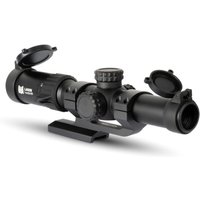
Monstrum Ladon 1-6x24mm LPVO 30mm Tube Rifle Scope, First Focal Plane, CM7 Reticle, Black, FFL16X-CM7
via OpticsPlanet
$134.99
Monstrum Ladon 1-6x24mm LPVO 30mm Tube Rifle Scope, First Focal Plane, CM3 Reticle, Black, FFL16X-CM3
via OpticsPlanet
$134.99
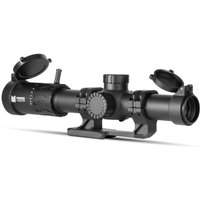
Monstrum Panzer ED 1-6x24mm LPVO 30mm Rifle Scope, First Focal Plane, CM3 Reticle, Black, FFZ16X-B
via OpticsPlanet
$149.99
Buying Advice
Start with the specs that actually differentiate MPVOs from one another. Zoom ratio is the ratio of maximum to minimum magnification — a 2-10x is 5:1, a 2-12x is 6:1, and a 3-15x is also 5:1. Lower zoom ratios generally allow better optical performance at each setting. Objective lens diameter (40 mm, 44 mm, 50 mm) controls light-gathering at dusk; for most hunting and tactical work 40–44 mm is the sweet spot of brightness versus compactness. Tube diameter matters: a 30 mm tube is standard and compatible with the widest range of mounts, while 34 mm tubes offer more internal adjustment range — important if you plan to dial past 400 yards. Check total elevation travel in MOA or MRAD: you want at least 60 MOA (or roughly 17 MRAD) of total travel for a .308 AR-10 shooting to 600 yards, and more like 80 MOA for a 6.5 Creedmoor reaching to 1,000. FFP (first focal plane) reticles scale with magnification, meaning your subtension-based holdovers are accurate at every power — critical for fast engagements at varying distances. SFP scopes are simpler and sometimes sharper at one magnification but require you to be on a specific power setting for holdovers to work. Parallax adjustment — either a side knob or an adjustable objective — matters once you shoot past 150 yards; most MPVOs include a side-focus parallax knob adjustable from 25 or 50 yards to infinity.
Budget tiers in the MPVO category break down predictably. Entry-level ($250–$450) includes models from Athlon (Midas and Argos lines), Bushnell (Match Pro), and Primary Arms. You get solid glass clarity, reliable tracking, and decent reticles, but expect heavier weight, narrower eye boxes, and coatings that lose a step at dawn and dusk. Mid-tier ($500–$900) is where the value proposition peaks: Vortex Viper PST Gen II, Leupold Mark 5HD in lighter configurations, and Athlon Ares ETR models deliver excellent glass, locking turrets, zero stops, and well-designed illuminated reticles. Premium ($1,000–$2,500+) brings Nightforce NX8, Swarovski Z8i, and Leupold Mark 5HD 3.6-18x into play — scopes with exceptional edge clarity, bombproof turret mechanisms, sub-MOA tracking verified over dozens of revolutions, and world-class low-light performance. For most US shooters building a practical rifle, the mid-tier sweet spot gives you 90% of premium performance.
Common mistakes in this category: first, buying more magnification than you need and ending up with a heavier, bulkier scope. A 3-15x on a lightweight mountain rifle in .270 Win is plenty for any ethical shot on elk to 500 yards; you do not need a 5-25x unless you are also doing paper-punching at 1,000. Second, ignoring weight and balance — mounting a 30-ounce scope on a 6.5-pound AR-15 carbine shifts the center of gravity forward and makes the rifle unwieldy offhand. Third, pairing an FFP reticle with a scope you only ever use at max power; in that case SFP saves money and gives you a cleaner reticle at low magnification. Fourth, skimping on the mount when you invest in the optic — a quality one-piece cantilever mount (Scalarworks LEAP, Badger Ordnance C1, or Vortex Precision) is essential on an AR-15 to maintain zero under recoil and provide proper eye relief with the receiver's non-reciprocating charging handle geometry.
US-specific context matters here. East of the Mississippi, most whitetail deer are taken inside 150 yards from elevated stands; a 2-10x or 2-12x with a 40 mm objective handles that perfectly while also being enough scope for a 350-yard shot across a soybean field. West of the Rockies, mule deer, pronghorn, and elk hunters regularly engage at 300–500 yards across open basins — a 3-15x gives you the top-end magnification to read wind on mirage and place shots precisely at those distances. For AR-15 owners who shoot 3-gun, run carbine courses, or build a general-purpose 5.56 recce rifle, the 2-10x paired with a piggyback red dot is arguably the most versatile optics package available in 2026. You can buy any of these scopes on Amazon.com (our site uses the aiscopeus-20 Associates tag to help fund reviews) or through OpticsPlanet, which often stocks exclusive SKUs and offers military/LEO pricing. Use the dealer locator at aiscopes.us to find local shops where you can put hands on glass before buying.
Matching the MPVO to your use case comes down to three questions. First: what is your realistic maximum engagement distance? If it is 400 yards or less, a 2-10x is all you need. If it extends to 600, the 2-12x or 3-15x gives you meaningful advantages in target identification and precise holdover. Second: do you need true 1x close-range speed? If yes, either choose an LPVO and accept its optical tradeoffs, or mount a quality micro red dot (Aimpoint Acro, Trijicon RMR, or Holosun 509T) on a 45-degree offset or piggyback plate atop your MPVO — the latter is increasingly the preferred answer among competitive and tactical shooters because it gives you a genuine zero-distortion 1x dot while keeping the superior mid-to-long-range glass of the MPVO. Third: what platform is the scope going on? A heavy-recoiling .300 Win Mag bolt gun demands a scope with generous eye relief (3.5–4 inches minimum) and robust internal construction; a 5.56 AR-15 is gentler and prioritizes light weight and a compact footprint. For hog hunting from a helicopter or UTV — common in Texas and the Southeast — a 2-10x FFP at moderate magnification with an illuminated reticle is hard to beat.
The brand landscape for MPVOs is competitive and healthy in 2026. Vortex essentially popularized the MPVO concept in the mainstream market with the Razor HD Gen III 1-10x and later the Razor HD LHT 3-15x for hunters, backing everything with their transferable no-fault warranty. Leupold counters with American-assembled options like the VX-6HD 2-12x and Mark 5HD 3.6-18x, offering CDS-ZL turrets that are intuitive for hunters. Nightforce's NX8 2.5-20x and ATACR 4-16x are benchmark tactical choices with impeccable tracking and extreme durability. Swarovski's Z8i 2-16x is the low-light king, ideal for Western big-game hunters who glass at dawn and dusk. Athlon and Bushnell provide excellent entry points for budget-conscious shooters. All of these brands have strong US distribution, and many offer scopes assembled or serviced domestically. The MPVO category will only grow as shooters realize they can get better glass, lighter weight, and broader real-world utility by giving up the 1x bottom end they rarely use anyway.
Frequently Asked Questions
What does MPVO stand for and how is it different from an LPVO?
MPVO stands for medium-power variable optic, a term describing scopes with a low-end magnification of 2x–3x and a top end of 10x–18x. An LPVO (low-power variable optic) starts at 1x for both-eyes-open close-range use and typically tops out at 6x, 8x, or 10x. The key tradeoff is that an MPVO sacrifices true 1x in exchange for better optical quality, wider eye box, and superior image clarity across its entire zoom range, especially at mid-to-high magnifications.
Can I use an MPVO on an AR-15 for home defense or CQB?
On its own, no — a 2x or 3x bottom end is too much magnification for room-clearing distances. However, many shooters pair an MPVO with a piggyback-mounted micro red dot (like an Aimpoint Acro or Holosun 509T) sitting on top of the scope in a Badger Ordnance J-ARM or similar plate. This gives you a genuine 1x, zero-distortion dot for CQB work and the full power of the MPVO for longer engagements. It is the most versatile setup available for a do-everything carbine.
Is FFP or SFP better for an MPVO?
For shooters who dial or hold over at varying magnification levels — such as in competition, tactical use, or hunting where shot distances change quickly — FFP is the clear choice because the reticle subtensions are accurate at every power setting. SFP is perfectly fine if you typically shoot at one magnification (for instance, always cranked to max for precise shots) and prefer a cleaner, finer reticle at low power for scanning. SFP scopes are also often less expensive within the same product line.
How much elevation adjustment do I need in an MPVO for a 6.5 Creedmoor?
A 6.5 Creedmoor 140-grain load with a muzzle velocity around 2,700 ft/s drops approximately 36 MOA (about 10.5 MRAD) at 1,000 yards. After accounting for a 100-yard zero, you will need roughly 40–45 MOA of usable up-elevation to dial to 1,000 yards, depending on your mount's built-in cant. A scope with at least 80 MOA total elevation travel (or 25+ MRAD) in a 20-MOA canted base will cover most 6.5 Creedmoor applications to 1,000 yards comfortably.
What magnification range should I choose: 2-10x, 2-12x, or 3-15x?
Choose 2-10x for a lightweight, compact setup on an AR-15 or a brush-country hunting rifle where shots rarely exceed 400 yards. Go with 2-12x for a slightly broader envelope — ideal for mixed terrain where you might take a 100-yard shot through timber and a 500-yard shot across a clearing on the same hunt. Pick 3-15x if you regularly shoot to 600 yards or beyond, such as Western big-game hunting or carbine matches with longer-range stages. The 3x bottom end is still plenty fast for shots inside 100 yards when paired with a piggyback dot.
Does a top-mounted red dot add too much height over bore on an AR-15?
A piggyback dot on an MPVO does raise the total height over bore, typically adding about 0.5 to 0.7 inches above the scope's centerline. On an AR-15, your scope centerline is already 2.5–2.8 inches above bore, so the dot sits roughly 3.2–3.5 inches high. This is manageable — you simply need to confirm your dot's zero at a practical distance (usually 25 or 50 yards) and understand the offset at close range. Most shooters find the benefit of having a true 1x aiming point far outweighs the slight height-over-bore increase.
Are MPVOs suitable for hog hunting at night with thermal clip-ons?
Yes, and this is actually one of the MPVO's strengths. Thermal clip-on devices from Pulsar and Hikmicro mount in front of the objective lens and project a thermal image through your existing scope. An MPVO's moderate magnification range (especially 2-10x or 3-15x) pairs well with clip-ons because you get enough zoom to identify hogs at 200–400 yards without over-magnifying the thermal sensor's resolution. The 2x or 3x bottom end also keeps the field of view wide enough for scanning large pastures, which is critical in the fast-paced Texas and Southeast hog-hunting environment.
What mount should I use for an MPVO on a flat-top AR-15?
A one-piece cantilever mount is the standard choice for AR-15 platforms. It positions the scope forward for proper eye relief (typically 3.5–4 inches) and provides a rigid, repeatable clamping surface. Quality options include the Scalarworks LEAP, Badger Ordnance Condition One, and Vortex Precision Extended Cantilever. If you plan to add a piggyback dot, choose a mount with a top-rail section or compatible accessory plate. Make sure the ring diameter matches your scope tube — most MPVOs use a 30 mm tube, but some premium models use 34 mm.
How does parallax adjustment work, and do I need it on an MPVO?
Parallax is the apparent shift of the reticle against the target when you move your eye off-center behind the scope. At higher magnifications, even small parallax error can shift your point of impact by an inch or more at 300 yards. Most MPVOs include a side-focus parallax knob adjustable from 25 or 50 yards to infinity. You should always adjust parallax to match your target distance before shooting. If a scope lacks parallax adjustment (factory-set at a single distance like 100 or 150 yards), it will be accurate at that range but may introduce error at significantly shorter or longer distances.
Related guides
Learn the optimal zero distance for your LPVO rifle scope in 2026. Covers 50 vs 100-yard zero, BDC reticles, FFP vs SFP…
3-15x Scopes: Versatile Enough or a Compromise?Is a 3-15x rifle scope truly versatile for hunting and long range shooting in 2026? We break down magnification, FFP vs SFP…
How to Spot Fake Scopes on eBay & Protect Your InvestmentLearn how to identify counterfeit rifle scopes, thermal optics, and night vision devices sold on eBay.
Match the Right Scope to Your Rifle in 2026Stop wasting money on mismatched optics. Our 2026 guide helps US shooters pair the right rifle scope to every platform—from rimfire and air rifle…
Tall-Target, Box Test & Return-to-Zero: Test Your Scope RightLearn how to test any rifle scope yourself with the tall-target test, box test, and return-to-zero check.
Red Dot + Magnifier vs LPVO vs Prism: Which AR-15 Optic Setup Wins?Red dot with magnifier, LPVO, or prism scope for your AR-15? Our 2026 US buying guide compares weight, eye relief, speed…
Not sure which scope is right for you?
Try our AI-powered scope finder — answer a few questions and get personalised recommendations.
Find My Scope →Get a UK scope tip every day
Follow AiScopes on Facebook for daily buying guides, deals and gear advice.
Follow on Facebook