Tall-Target, Box Test & Return-to-Zero: Test Your Scope Right
Shopping in the US? This page is on our US site: aiscopes.us →
By Peter Makulek · Senior Optics Editor · · Live prices from US retailers
Quick answer: the three essential DIY scope tests are the tall-target test (confirms your turret moves the reticle exactly 1 MOA per click or 0.1 mil per click at a measured distance), the box test (dials a square pattern and checks that the point of impact returns to start, proving internal repeatability), and the return-to-zero test (runs the turret out and back to confirm it lands on its original zero). If your scope passes all three, you can trust it in the field.
Every serious shooter in the US eventually asks the same question: is my scope actually doing what the turret numbers say? Whether you are dialing for a 600-yard steel target at a PRS match or adjusting two clicks for a 200-yard whitetail shot from a Midwestern treestand, inaccurate tracking turns good marksmanship into mystery misses. The good news is that you do not need a laboratory or a $10,000 collimator to get answers. A tape measure, a plumb line, a solid rest, and about 40 rounds of consistent ammunition will tell you almost everything you need to know about your optic's mechanical integrity.
These tests matter more than ever because US shooters are buying scopes across a huge price range — from $200 entry-level hunting optics from Bushnell or Burris up through $2,500-plus tactical glass from Nightforce, Schmidt & Bender, and March. Even premium optics can leave the factory with an occasional lemon, and budget scopes may have erector spring tension that degrades over time. Testing is the only way to verify what you actually received, not what the spec sheet promises. It is also the single best investment of range time you can make before hunting season or a competition.
In this guide we walk through each test step by step, explain what the results mean, discuss what a "drop test" actually proves (and what it does not), and recommend scopes that consistently pass these tests based on widespread US shooter experience. We also address FFP versus SFP implications for tracking, MOA versus MRAD math, and how parallax error can contaminate your results if you are not careful.
Top Picks — Live US Prices
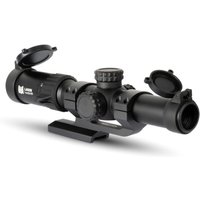
Monstrum Ladon 1-6x24mm LPVO 30mm Tube Rifle Scope, First Focal Plane, CM7 Reticle, Black, FFL16X-CM7
via OpticsPlanet
$134.99
Monstrum Ladon 1-6x24mm LPVO 30mm Tube Rifle Scope, First Focal Plane, CM3 Reticle, Black, FFL16X-CM3
via OpticsPlanet
$134.99
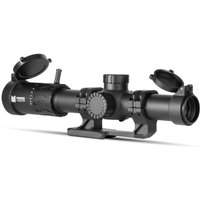
Monstrum Panzer ED 1-6x24mm LPVO 30mm Rifle Scope, First Focal Plane, CM3 Reticle, Black, FFZ16X-B
via OpticsPlanet
$149.99
Buying Advice
Key specs to check before you test: First, know your scope's adjustment value — most MOA scopes click in 1/4 MOA (roughly 0.26 inches per click at 100 yards) or 1/8 MOA increments, while MRAD scopes almost universally click in 0.1 mil (0.36 inches per click at 100 yards, or exactly 1 cm at 100 meters). Second, check total elevation and windage travel — a scope with 60 MOA of total elevation travel has 30 MOA per side from mechanical center. Third, note whether the scope is FFP or SFP: in a first focal plane scope the reticle subtensions are accurate at every magnification, so your tall-target hash marks will agree at any power. In an SFP scope the subtensions are only correct at one magnification (usually the highest), so always test SFP glass at that specific power setting. Finally, verify the parallax adjustment is set correctly for your test distance — residual parallax moves the apparent point of aim when you shift your eye, injecting false error into your data.
Budget tiers and what you get: In the entry tier ($150–$400), scopes from Bushnell, Burris, and Vortex's Crossfire and Diamondback lines generally track acceptably for hunting use but may show 5–15 percent tracking error over large dial-ups — fine for a 300-yard deer rifle, risky for long-range steel. In the mid tier ($400–$1,200), Vortex Viper and PST, Leupold Mark 5HD, and Burris XTR series typically track within 1–3 percent and pass box and return-to-zero tests reliably. In the premium tier ($1,200–$3,500-plus), Nightforce ATACR and NX8, Schmidt & Bender PM II, and March FX and Genesis lines are expected to track within 1 percent and offer rock-solid return-to-zero backed by lifetime or transferable warranties. You generally pay for tighter tolerances, better glass coatings, and more consistent erector spring systems.
Common mistakes buyers make when testing: The biggest error is testing with inaccurate ammunition — if your rifle groups 2 MOA, you cannot measure 1/4 MOA tracking errors, so use the most consistent load you have and shoot groups at each point rather than single shots. Second, many shooters run the tall-target test at 100 yards but only dial 10 MOA, which barely stresses the erector; try dialing at least 20–30 MOA to expose problems in the upper travel range where you will actually shoot at distance. Third, people forget to tap the turret housing lightly after each adjustment — a gentle tap seats the erector spring and removes stiction, giving you a truer reading. Finally, do not ignore wind: even 5 mph of crosswind moves a bullet roughly 0.5 inches at 100 yards with a typical .308 Win 168-grain load, so test on a calm day or use a 25-yard indoor range scaled appropriately.
US-specific context: Most American hunters shoot common calibers like .308 Win, 6.5 Creedmoor, .30-06, and .223 Rem, with the majority of whitetail shots taken under 150 yards from a stand or blind. For that use case, a scope that tracks within 2–3 percent and returns to zero reliably is more than sufficient. Long-range and PRS competitors shooting 600–1,200 yards need sub-1-percent tracking because a 3 percent error on a 30 MOA dial-up equals nearly a full MOA miss — about 10 inches at 1,000 yards. You can buy quality test-ready optics from Amazon.com with the convenience of Prime shipping, or from specialty dealers like OpticsPlanet who often stock hard-to-find tactical models. The aiscopes.us dealer locator also covers all 50 states if you prefer hands-on comparison.
Matching the test to your use case: If you are a hunter who zeros and rarely touches the turret again, the return-to-zero test is your most important check — confirm the scope comes back after being bumped or after seasonal re-zeroing. If you are a PRS or NRL competitor who dials every shot, the tall-target tracking test across your full usable elevation range is critical, followed by the box test for windage consistency. Varmint and prairie dog shooters who dial modest corrections (5–15 MOA) should focus on tracking accuracy in that mid-range band. Rimfire and air-rifle shooters working at 25–75 yards can run scaled versions of these tests at 25 yards — just remember that a 1/4 MOA click only moves impact about 0.065 inches at 25 yards, so precision measurement matters.
Brand landscape: Vortex dominates US market share in the mid tier thanks to an unconditional lifetime warranty and broad availability on Amazon.com and in big-box retailers. Leupold remains the heritage US brand with excellent SFP hunting optics and growing tactical credibility with the Mark 5HD. Nightforce is the PRS and military benchmark for tracking and durability. Schmidt & Bender and March occupy the ultra-premium tier, favored by F-class and ELR competitors who demand the tightest mechanical tolerances. Bushnell and Burris provide solid entry-level options, with Bushnell's Match Pro and Burris XTR III earning respect among budget-conscious competitors. Nikon exited the US riflescope market in 2020 but legacy models still appear on the used market — test them carefully, as warranty support is limited.
Frequently Asked Questions
What is the tall-target test and how do I set it up?
The tall-target test measures whether your turret clicks move the point of impact by the correct amount. Hang a long vertical target (a roll of butcher paper works well) at exactly 100 yards, fire a group at the bottom, then dial up a known amount — say 20 MOA — and fire another group without changing your aim point. The two groups should be separated by exactly 20.94 inches (20 × 1.047 inches per MOA at 100 yards). If the measured distance is significantly off, your scope is not tracking accurately.
How do I perform a box test on a rifle scope?
Start by firing a group at your aim point, then dial a set number of clicks right (for example, 15 MOA), shoot again, dial the same amount up, shoot, dial the same amount left, shoot, then dial back down to your starting position and shoot a final group. The final group should overlap your first group, and the four corner groups should form a precise square. Any distortion or failure to return to start indicates tracking inconsistency or hysteresis in the erector mechanism.
What does a return-to-zero test actually prove?
A return-to-zero test confirms that after you dial the turret away from your zero and then dial it back, the point of impact lands in exactly the same place. This is critical because erector springs can develop a slight set or stiction, causing the reticle not to return precisely. To test it, fire a baseline group, dial up 20 MOA, fire, dial back to zero, and fire again. Scopes with proper zero-stop mechanisms from brands like Nightforce and Leupold tend to perform very well here.
What does a drop test prove about a rifle scope?
A drop test — deliberately dropping or jarring a scoped rifle from a controlled height — tests the mechanical ruggedness of the scope's internals, not its optical tracking. It can reveal whether reticle retention, turret indexing, and internal lens cell alignment survive impact forces similar to a fall from a truck bed or a tumble on a mountain hunt. However, drop tests do not tell you anything about tracking precision. A scope can survive a drop and still have 5 percent tracking error.
Should I test my scope at 25 yards or 100 yards?
One hundred yards is the standard for centerfire testing because each 1/4 MOA click moves impact roughly 0.26 inches — an amount you can easily measure. At 25 yards that same click moves only about 0.065 inches, making measurement error significant. However, if you only have access to a 25-yard indoor range, you can still run a valid tall-target test by multiplying the expected movement by 0.25. For rimfire or air-rifle scopes used at short range, 25 yards is perfectly appropriate.
Does FFP versus SFP affect scope testing results?
Yes, but only if you use the reticle subtensions to measure displacement instead of an external ruler. In an FFP scope the reticle markings are accurate at any magnification, so you can confirm tracking by counting mil or MOA hash marks at whatever power you prefer. In an SFP scope the subtensions are only correct at one designated magnification — typically the highest. Always verify turret tracking with an actual tape measure on the target regardless, as this removes magnification variables entirely.
How many rounds do I need to properly test a scope?
Plan on 30 to 50 rounds for a thorough session covering the tall-target test, box test, and return-to-zero test. Shoot three- to five-round groups at each station to average out rifle and shooter variability. Use your most accurate, consistent ammunition — match-grade factory loads or a proven handload — because ammunition dispersion directly limits how precisely you can measure scope behavior. Budget an extra 10 rounds for fouling shots and re-confirmation if any result looks questionable.
Can parallax error ruin my scope test results?
Absolutely. If your parallax adjustment is not set for the distance you are testing at, shifting your eye position behind the scope will shift the apparent aim point, injecting false error into your groups. Before testing, adjust the side-focus or adjustable objective until the reticle does not move against the target when you shift your head slightly. Most quality scopes from Vortex, Leupold, and Nightforce have side-focus parallax adjustable down to 10–25 yards, making this straightforward at any testing distance.
My scope failed the box test — should I send it back?
First, re-run the test on a calmer day with better ammunition to rule out shooter and environmental error. If the scope still fails — meaning the final group does not return to the starting point by more than 1–2 MOA, or the box is visibly distorted — contact the manufacturer's warranty department. Vortex, Leupold, and Nightforce all have US-based service centers and generally repair or replace scopes with verified tracking defects at no cost under warranty. Document your test with photos and measurements to expedite the claim.
Related guides
Learn how to identify counterfeit rifle scopes, thermal optics, and night vision devices sold on eBay.
How to Sight In a Rifle Scope: Step-by-Step First-Time GuideFirst time sighting in a rifle scope? Our 2026 step-by-step US guide walks you through mounting, bore-sighting…
Match the Right Scope to Your Rifle in 2026Stop wasting money on mismatched optics. Our 2026 guide helps US shooters pair the right rifle scope to every platform—from rimfire and air rifle…
Rifle vs. Scope: Where to Put Your Money for Long RangeLearn exactly how to divide a $1,000–$1,500 budget between your rifle and scope for long-range shooting.
What Height Scope Rings Do You Need for Your Bolt Action?Find the correct scope ring height for 44mm, 50mm, and 56mm objectives on bolt-action rifles. Covers low, medium, high…
Not sure which scope is right for you?
Try our AI-powered scope finder — answer a few questions and get personalised recommendations.
Find My Scope →Get a UK scope tip every day
Follow AiScopes on Facebook for daily buying guides, deals and gear advice.
Follow on Facebook