What Height Scope Rings Do You Need for Your Bolt Action?
Shopping in the US? This page is on our US site: aiscopes.us →
By Peter Makulek · Senior Optics Editor · · Live prices from US retailers
Quick answer: for a 44mm objective on a standard bolt action, medium rings (roughly 0.90–1.00 inch center height) usually provide adequate barrel clearance. A 50mm objective typically needs high rings (about 1.10–1.30 inches), and a 56mm objective almost always requires extra-high rings (1.30 inches or taller). These figures assume a one-piece Picatinny rail or two-piece Weaver-style bases — if you're using traditional turn-in bases sitting lower on the receiver, you may need to go one step taller.
Choosing the wrong ring height is one of the most common and frustrating mistakes bolt-action shooters make. Rings that are too low leave the objective bell contacting the barrel or barrel nut, which can damage your scope, shift your zero, and even crack a lens element under recoil. Rings that are too high force you into an uncomfortable cheek weld, slowing target acquisition and hurting consistency — especially problematic for precision rifle shooters running stages at PRS matches or hunters who need a fast, repeatable mount in the field.
The challenge is that there is no universal "medium" or "high" standard across manufacturers. Vortex, Leupold, Nightforce, and Weaver all define their height categories slightly differently, and actual center-height measurements can vary by a tenth of an inch or more between brands. The only reliable method is to measure the half-diameter of your objective bell (including the housing, not just the glass), add the clearance you want above the barrel (a minimum of 0.050 inches, ideally 0.10 inches), subtract the distance from the center of the bore to the top of your mounting rail, and compare the result to each manufacturer's published ring specifications.
In the US market, bolt-action platforms like the Remington 700, Tikka T3x, Bergara B-14, and Savage 110 are the most common hosts for large-objective scopes. Whether you're running a Leupold VX-5HD 3-15×44 for whitetail in thick Eastern timber, a Vortex Viper PST Gen II 5-25×50 for Western mule deer at 400+ yards, or a Nightforce ATACR 7-35×56 for competitive long-range work beyond 1,000 yards, getting ring height right is a prerequisite for accuracy.
Top Picks — Live US Prices
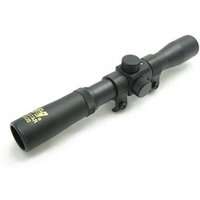
NcSTAR Compact 4x20 Air Gun Rifle Scope, Black, Duplex Reticle - SCA420B
via OpticsPlanet
$12.99

Barska 4X20 Rimfire Rifle Scope, Black Matte AC10730
via OpticsPlanet
$18.99

Daisy Powerline Airgun Scope, 4x15, Crosshair Reticle, Black, 980808-444
via OpticsPlanet
$20.99
Buying Advice
Start with the math, not the label. Every scope manufacturer lists the outer diameter of the objective bell in their specs — and it's always larger than the advertised objective lens diameter because of the housing. A "50mm" scope might have a bell OD of 56–58mm (about 2.24 inches). Divide that OD by two to get the bell radius. Then measure from the center of your bore to the top surface of your mounting rail (most Picatinny rails on Remington 700-pattern actions put this distance at roughly 0.200 inches above bore center). The ring center height you need equals the bell radius plus your desired clearance (0.050–0.10 inches minimum) minus that bore-to-rail measurement. Always round up to the next available ring size rather than down.
Budget tiers matter more than you might expect. Entry-level rings in the $30–$60 range — such as basic Weaver or Bushnell branded steel rings — work fine for hunting rifles that see moderate recoil and aren't repeatedly remounted. Mid-tier rings from Vortex (Pro and Precision Matched series), Leupold (Mark 4 and Backcountry), and Warne run $80–$180 and offer tighter machining tolerances, better lapping surfaces, and more consistent clamping pressure. Premium rings from Nightforce, Spuhr, American Rifle Company (ARC), and S&B-branded mounts ($180–$350+) are built for extreme recoil, repeated removal and reinstallation, and guaranteed return to zero. For a rifle that might see 500+ rounds of .300 Win Mag per year, the premium tier pays for itself.
The most common mistake is ignoring the objective bell housing and measuring only the glass diameter. A scope advertised as 50mm might need rings sized for a 57mm bell. The second-most-common error is choosing rings based on a brand's generic "medium" or "high" label without checking the actual center-height specification in inches or millimeters. A Leupold "high" ring and a Vortex "high" ring are not the same height. Third, many shooters forget to account for a 20-MOA canted rail, which tilts the rear of the scope upward and can reduce clearance at the objective end by a small but meaningful amount — especially with 56mm bells.
For US hunters, context dictates requirements. Most whitetail deer east of the Mississippi are taken at under 150 yards from a stand or blind, so a compact 3-9×40 or a 3-15×44 on low or medium rings keeps the scope close to the bore, improving cheek weld and speeding up snap shots in dim timber. Western hunters pursuing elk or mule deer across open basins at 300–500 yards benefit from 50mm objectives that gather light at dawn and dusk, paired with high rings. Dedicated long-range and PRS competitors often run 56mm objectives on heavy-contour barrels that already sit higher in the stock, which can paradoxically reduce the ring height needed because the barrel profile is thicker and closer to the scope. Always dry-fit before final torquing.
Brand landscape: Vortex's Pro and Precision Matched rings offer excellent value with clearly published center heights. Leupold's Backcountry rings are lightweight aluminum ideal for mountain hunts. Nightforce Ultralite and Titanium rings set the standard for repeatability on tactical and competition rifles. Warne Maxima and Warne Mountain Tech are popular mid-range options widely available on Amazon.com and OpticsPlanet. For European-made scopes like Swarovski Z8i or March FX series with non-standard turret housings, verify that ring inner diameter matches your tube (30mm vs. 34mm vs. 35mm) before worrying about height. A mismatched tube diameter is a far costlier error than being one height increment too tall.
Frequently Asked Questions
How do I measure the ring height I actually need?
Measure the outer diameter of your scope's objective bell (not the glass — the full metal housing) and divide by two to get the radius. Add at least 0.050 inches of clearance above the barrel or barrel channel. Then subtract the distance from bore center to the top of your mounting rail. The result is the minimum ring center height you need. Always round up to the next available ring size to ensure nothing contacts the barrel.
Are scope ring heights standardized across brands?
No. Terms like "low," "medium," "high," and "extra-high" vary by manufacturer. A Vortex "high" ring might have a center height of 1.00 inch while a Leupold "high" is 1.03 inches and a Nightforce "high" is 1.125 inches. Always check the published center-height spec in inches or millimeters for the exact ring model you are buying rather than relying on the generic label.
Does a 20-MOA rail change what ring height I need?
It can. A canted rail tilts the rear of the scope upward relative to the barrel, which reduces clearance at the objective end. For most setups the difference is small — roughly 0.020–0.040 inches less clearance over a 4–5 inch ring spacing — but with a 56mm bell and borderline clearance, it can be enough to cause contact. Dry-fit the scope and check before final torquing.
Can I use rings that are too tall and fix it with a cheek riser?
Technically yes, and many PRS competitors do exactly this with adjustable cheek risers or aftermarket kits. However, raising the cheek piece to compensate for excessively tall rings moves your eye further from the bore, which can introduce parallax issues and make it harder to maintain a consistent sight picture. Use the lowest rings that provide adequate clearance and only add a cheek riser if truly necessary.
Do I need different ring heights for a heavy bull barrel versus a sporter contour?
Potentially, yes. A heavy or bull barrel has a larger outside diameter at the point directly below the objective bell, reducing the gap between barrel and scope. A sporter-contour barrel tapers more aggressively and leaves more room. If your scope-and-ring combination barely clears on a sporter barrel, switching to a heavy-contour barrel of the same rifle may cause contact. Always re-verify clearance after a barrel swap.
What is the minimum clearance I should have between the barrel and objective bell?
A minimum of 0.050 inches (roughly 1.3mm) is generally recommended, but 0.10 inches (2.5mm) is more comfortable and accounts for barrel heat mirage, slight rail flex, and the occasional insertion of a lens cap or sunshade. If you plan to use a scope-mounted bubble level or anti-cant indicator that hangs below the turret housing, verify that also clears the barrel.
Should I use one-piece mounts instead of two-piece rings for large objectives?
One-piece mounts like the Vortex Cantilever, Nightforce Unimount, or Spuhr ISMS simplify alignment and are popular in tactical and PRS circles. They work well for large objectives because manufacturers publish a single, clearly defined center height. For hunting, two-piece rings save weight and allow more flexible positioning along the rail. Either option works; the deciding factors are weight tolerance, recoil level, and whether you plan to remove and remount the scope frequently.
Do 34mm tube scopes need taller rings than 30mm tube scopes?
Not necessarily for barrel clearance — ring height is measured from the base to the center of the tube, and the objective bell diameter (not the tube) determines how close the scope sits to the barrel. However, a 34mm tube scope with a given ring center height will position the top of the turret housing higher above the bore than a 30mm tube in the same height ring, which can affect cheek weld. Always verify that your overall scope-and-ring stack height works with your stock dimensions.
Where can I buy quality scope rings in the US?
Amazon.com carries rings from Vortex, Leupold, Warne, Burris, and Weaver with fast Prime shipping, making it convenient for comparing center-height specs side by side. OpticsPlanet is another strong option with a wider selection of Nightforce, Spuhr, and ARC mounts. For premium or hard-to-find rings, Brownells and MidwayUSA maintain deep inventories. Whichever retailer you choose, confirm the center-height measurement and tube diameter match your scope before ordering.
Related guides
Understand LPVO mount heights from 1.54" to 2.26", cantilever offset, and piggyback red dots. US-focused 2026 guide with brand picks, specs…
Best Optics for Short-Barrel ARs: LPVO vs Prism vs DotFind the best optic for your 10.5"–12.5" AR pistol or SBR. We compare LPVOs, prism sights, and red dots across weight, eye relief…
Best Scopes for the Tikka T3x (Lite, Varmint & CTR)Find the best scopes for every Tikka T3x variant—Lite, Varmint, and CTR. We cover mounting quirks, ring heights, rail gaps…
Not sure which scope is right for you?
Try our AI-powered scope finder — answer a few questions and get personalised recommendations.
Find My Scope →Get a UK scope tip every day
Follow AiScopes on Facebook for daily buying guides, deals and gear advice.
Follow on Facebook