Calculate Group Size & MOA With Your iPhone
By Peter Makulek · Senior Optics Editor · · Live prices from UK retailers
Whether you are zeroing a sub-12 ft-lb springer on rabbits at 30 yards or bedding in a new Vortex or Nightforce scope on a centrefire at 100 metres, knowing your actual group size in MOA (minutes of angle) is the foundation of effective marksmanship. Yet most UK shooters still eyeball their targets, guess at spread, and wonder why their zero wanders. An iPhone Shortcut — a small automation you build inside Apple's free Shortcuts app — can turn a quick photo of your target into a precise MOA figure in seconds, right at the firing point. No laptop, no spreadsheet, no app subscription required.
The concept is straightforward: you photograph the target beside a reference of known size (a ruler, a coin, or the target's own printed ring dimensions), input the centre-to-centre measurement of the widest two shots, enter the distance in yards or metres, and the Shortcut does the arithmetic. Because 1 MOA subtends approximately 1.047 inches at 100 yards — or roughly 29.1 mm at 100 metres — the formula is simple division, yet doing it in your head while cold fingers fumble a biro at a windy range in the Pennines is nobody's idea of fun.
This guide walks you through building that Shortcut step by step, explains what the resulting MOA number actually tells you about your rifle-and-scope combination, and covers the common pitfalls UK shooters hit when measuring groups. We also discuss how the technique applies across disciplines: from benchrest field target with an air rifle scope parallax-set at 10 yards, to long-range foxing with a thermal or night-vision clip-on at 200 metres, to serious PRS-style range shooting out to 1,000 yards and beyond.
Crucially, understanding your real-world group size lets you make honest decisions about equipment. A scope that tracks perfectly in MOA adjustments but sits on a rifle that only groups 3 MOA is telling you to look at bedding, ammo, or technique — not buy a new optic. Conversely, if your handloads cluster inside 0.5 MOA at 100 yards but your turret adjustments do not match, it may be time to look at a Leupold, Zeiss, or Athlon scope with verified tracking. The Shortcut gives you the data; the rest is up to you.
Top Picks — Live UK Prices

Richter Optik Crystal 4x20 Riflescope with Mounts
via BushWear
£9.99

Caldwell Orange Peel Silhouette Target 12x18 5pk
via BushWear
£10.39
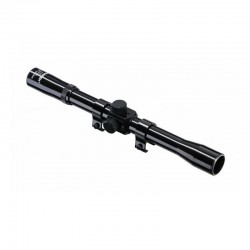
Umarex 4x20 Scope
via DAI Leisure
£19.95
Buying Advice
Understanding the numbers behind MOA is essential before you trust any Shortcut output. One MOA equals 1.047 inches at 100 yards, which is approximately 29.1 mm at 100 metres. At 50 yards — a common zeroing distance for UK airgun shooters — 1 MOA is roughly 0.52 inches or about 13.3 mm. When your Shortcut returns a group size, remember it is measuring the extreme spread (centre-to-centre of the two widest shots). A five-shot group under 1 MOA from a sub-12 ft-lb air rifle at 35 yards is excellent; from a centrefire bolt-action at 100 metres, it is a reasonable baseline. Context matters: always record the number of shots, conditions, and whether you are measuring from a rest or unsupported.
Budget tiers for scopes directly affect your ability to measure and repeat tight groups. Entry-level optics in the £80–£200 bracket — brands like Bushnell or lower-tier Athlon models — will get you shooting but may suffer from inconsistent turret tracking, meaning your MOA adjustments do not reliably move the point of impact by the expected amount. Mid-range glass from £250–£600, including popular Vortex Diamondback and Leupold VX-Freedom lines, tends to offer dependable tracking and clearer glass. Above £600 you enter the territory of Zeiss Conquest, Nightforce SHV, and higher Athlon Ares or Vortex Viper models, where repeatability and optical clarity support sub-MOA work at genuine long range.
A common mistake UK buyers make is conflating group size with zero accuracy. Your group might measure a beautifully tight 0.6 MOA, but if the centre of that group is 3 MOA left and 2 MOA high, you still have a problem. Use your Shortcut to measure group size as a separate exercise from zeroing. Another frequent error is measuring too few shots: a three-shot group is a minimum for a rough check, but five shots give a much more honest picture. Ten-shot groups are better still for serious load development. Also beware of measuring from the outer edge of bullet holes rather than centre-to-centre — this inflates your figure by one bullet diameter.
UK-specific context matters enormously when interpreting your MOA figures. A sub-12 ft-lb air rifle — which in England and Wales requires no licence, though Scotland mandates an Air Weapon Certificate for any air weapon — is realistically limited to humane-kill shots on rabbits, grey squirrels, corvids, and pigeons out to roughly 35–45 yards. At those distances, even a 2 MOA group may be perfectly adequate for ethical pest control. FAC-rated air rifles and centrefire rifles extend effective range considerably, but the principle remains: your group size in MOA tells you the maximum distance at which you can reliably keep shots within a kill zone. For deer stalking — roe, muntjac, or fallow — always check close seasons and ensure your group size at your intended range keeps all shots within the vital area. Consult BASC or your local police firearms licensing department for any queries on legal requirements.
Matching your measurement routine to your discipline is key. If you shoot field target or HFT with an air rifle, you need a scope with close parallax adjustment down to around 10 yards, and your groups will be measured at varying distances — the Shortcut's ability to accept different range inputs is invaluable here. If you are a range shooter punching paper at 100–300 metres, consistency of measurement method matters more than speed. For those using thermal scopes from Pulsar or Hikmicro, or night-vision clip-ons for foxing, group verification is best done in daylight with your day scope first, then confirmed at night; the Shortcut works the same way regardless. Long-range shooters working in MRAD rather than MOA can adapt the formula easily — 0.1 mil equals 1 cm at 100 metres — or simply build a second Shortcut for mil-based calculation.
The brand landscape shapes what turret language your Shortcut needs to speak. Vortex, Leupold, and Bushnell scopes are widely available in MOA turret increments (typically ¼ MOA per click) across their hunting and tactical lines, making them a natural fit for a MOA-based Shortcut. Nightforce, Athlon, and Zeiss increasingly default to MRAD in their tactical and long-range models, reflecting the metric-friendly preference of European and PRS competition shooters. Before building your Shortcut, confirm whether your scope adjusts in MOA or MRAD — mixing the two is a recipe for wasted ammunition and frustration. If you own scopes in both systems, build two Shortcuts and label them clearly. The beauty of iPhone Shortcuts is that they cost nothing and take minutes to duplicate and adapt.
Frequently Asked Questions
How do I create an iPhone Shortcut to calculate group size in MOA?
Open the Shortcuts app on your iPhone and create a new Shortcut. Add an 'Ask for Input' action for group size in inches or millimetres, then another for distance in yards or metres. Use a 'Calculate' action to divide the group size by the distance, then multiply by the appropriate constant (95.5 for inches and yards, or 3438 divided by the metric equivalent). Display the result with a 'Show Result' action. The entire build takes under five minutes and requires no coding knowledge.
What formula does the Shortcut use to convert group size to MOA?
The standard formula is: MOA = (group size in inches ÷ distance in yards) × 95.5. Alternatively, if you work in millimetres and metres, use: MOA = (group size in mm ÷ distance in metres) × 3.438. Both formulas account for the fact that 1 MOA subtends approximately 1.047 inches at 100 yards, or about 29.1 mm at 100 metres. The Shortcut simply automates this arithmetic so you get an instant answer at the firing point.
Can I use this Shortcut for MRAD scopes as well as MOA?
Yes, but you need a different formula. For MRAD, calculate: mils = (group size in cm ÷ distance in metres) × 10. Since 0.1 mil equals 1 cm at 100 metres, the maths is actually simpler in metric. Build a separate Shortcut labelled 'MRAD Group Size' to avoid confusion. Many Nightforce, Athlon, and Zeiss tactical scopes use MRAD turrets, so this variant is well worth having alongside the MOA version.
How many shots should I fire before measuring a group?
A minimum of five shots gives a statistically more meaningful group than three, which can flatter inconsistent rifles or ammo. For serious load development or scope tracking tests, ten-shot groups are preferable. Always fire from a stable rest or bipod to isolate equipment performance from shooter error. Record conditions such as wind and temperature alongside your MOA result for genuinely useful data over time.
Is this Shortcut useful for sub-12 ft-lb air rifle shooters?
Absolutely. At typical airgun engagement distances of 25–40 yards, knowing your group size in MOA helps you determine the maximum ethical range for quarry such as rabbits and grey squirrels. A group of 1.5 MOA at 30 yards means your shots are spreading by roughly 0.47 inches — well within a rabbit's kill zone. Just remember to input the correct distance each time, as airgun trajectories are highly curved and groups can open up dramatically beyond 40–45 yards with sub-12 ft-lb power.
Do I measure group size from the outer edges of bullet holes or from their centres?
Always measure centre-to-centre of the two widest shots. If you measure from the outer edges, you must subtract one bullet diameter (or pellet diameter for airguns) to get the correct figure. Failing to do this is one of the most common errors and will inflate your MOA reading. For instance, with a .22 LR (5.56 mm bullet), measuring outer edge to outer edge and forgetting to subtract 5.56 mm adds roughly 0.19 MOA of false spread at 100 metres.
Can the Shortcut use a photo to measure the group automatically?
A basic Shortcut relies on you inputting the measured group size manually. However, more advanced versions can use the iPhone's camera and a known reference object (such as a ruler placed beside the target) combined with image-analysis techniques to estimate group dimensions from a photograph. Apple's built-in Measure app or third-party APIs can assist, but manual calliper measurement remains more accurate. Start with the simple input version and iterate from there.
How does this help when zeroing a rifle scope like a Vortex or Leupold?
Once you know your group size in MOA, you can calculate exactly how many turret clicks are needed to move the group's centre onto your point of aim. If your scope adjusts in ¼ MOA clicks and your group centre is 2 MOA right, you need 8 clicks left. The Shortcut can be extended to include a click-correction calculator — simply add inputs for the offset in MOA and your scope's click value, then divide to output the number of clicks required.
Does this work for thermal or night-vision scope users?
Yes, though with a practical caveat. Thermal scopes from Pulsar or Hikmicro and night-vision optics are typically zeroed and group-tested during daylight conditions first, then confirmed at night. Your MOA Shortcut works identically regardless of optic type — the physics of angular measurement does not change. However, if your thermal scope is a clip-on mounted ahead of a day scope, verify zero with both units in place, as any added weight or alignment shift can alter group size.
Related guides
Is the Vortex Viper PST Gen I 6–24×50 FFP EBR-1 MOA scope still a smart buy in 2026? UK-focused buying guide covering specs, value, mounts…
Area 419 20 MOA Remington 700 Short Action Scope RailExpert UK guide to the Area 419 20 MOA improved Picatinny rail for Remington 700 short actions. Scope mounting advice, budget tiers in GBP…
384×288 Thermal Scopes Around £399Can you get a genuine 384×288 thermal scope for around £399 in the UK? We break down the specs, brands and trade-offs so you spend wisely on your next…
MOA vs MRAD: Which Should UK Shooters Choose?MOA or MRAD? Our expert guide helps UK shooters pick the right angular measurement system for their discipline…
Not sure which scope is right for you?
Try our AI-powered scope finder — answer a few questions and get personalised recommendations.
Find My Scope →Get a UK scope tip every day
Follow AiScopes on Facebook for daily buying guides, deals and gear advice.
Follow on Facebook