Best Scopes for Foxing with Clip-On Night Vision & Thermal in 2026
By Peter Makulek · Senior Optics Editor · · Live prices from UK retailers
Fox shooting at night is one of the most demanding disciplines in the UK, requiring a day scope that performs brilliantly on its own yet pairs seamlessly with a clip-on night vision or thermal unit. Getting this combination right is the difference between confident, humane shot placement at 200-plus yards and a frustrating evening of missed opportunities. With the market now flooded with budget night vision clip-ons, Pard devices, Hikmicro units and premium thermal options, the choice has never been wider — or more confusing. This guide cuts through the noise to help UK centrefire foxers find the ideal scope and clip-on pairing for 2026.
The core challenge is compatibility. A night vision scope clip-on sits in front of your day optic's objective lens and projects an image through it, meaning your day scope's magnification range, objective diameter, eye relief and reticle type all influence the final night-time picture. Choose poorly and you will battle vignetting, poor resolution or a reticle that vanishes into a green or white haze. Choose well and you retain your familiar daytime zero, turret adjustments and shooting confidence when the lamp goes off and the foxes appear.
UK fox and vermin control also carries specific legal and practical considerations that differ markedly from the American or European market. You must hold the correct firearms certificate conditions for night shooting, your calibre must be appropriate for the quarry and the land, and you need landowner permission. Most foxing permissions specify centrefire rifles in calibres from .222 Remington upward, and the scope setup must allow positive target identification — not just detection — before any shot is taken. This is a welfare and legal imperative, not merely a preference.
In this buying guide we explain the key decision factors for selecting the best scope for fox shooting in the UK in 2026, walk you through first-focal-plane versus second-focal-plane considerations for clip-on use, discuss thermal versus digital night vision clip-ons for foxing at range, and offer honest buying advice across budget, mid-range and premium tiers. Whether you already own a capable centrefire scope or you are building a foxing setup from scratch, this is the definitive resource.
Top Picks — Live UK Prices

Bsa Genesys Hunter 2.5-10x50 Ir Scope
via Sportsman Gun Centre
£253.99
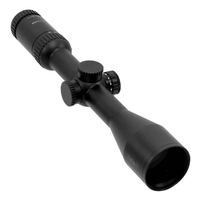
OptiMate Hunter 2-12x50 WA IR Rifle Scope
via Uttings
£279.99
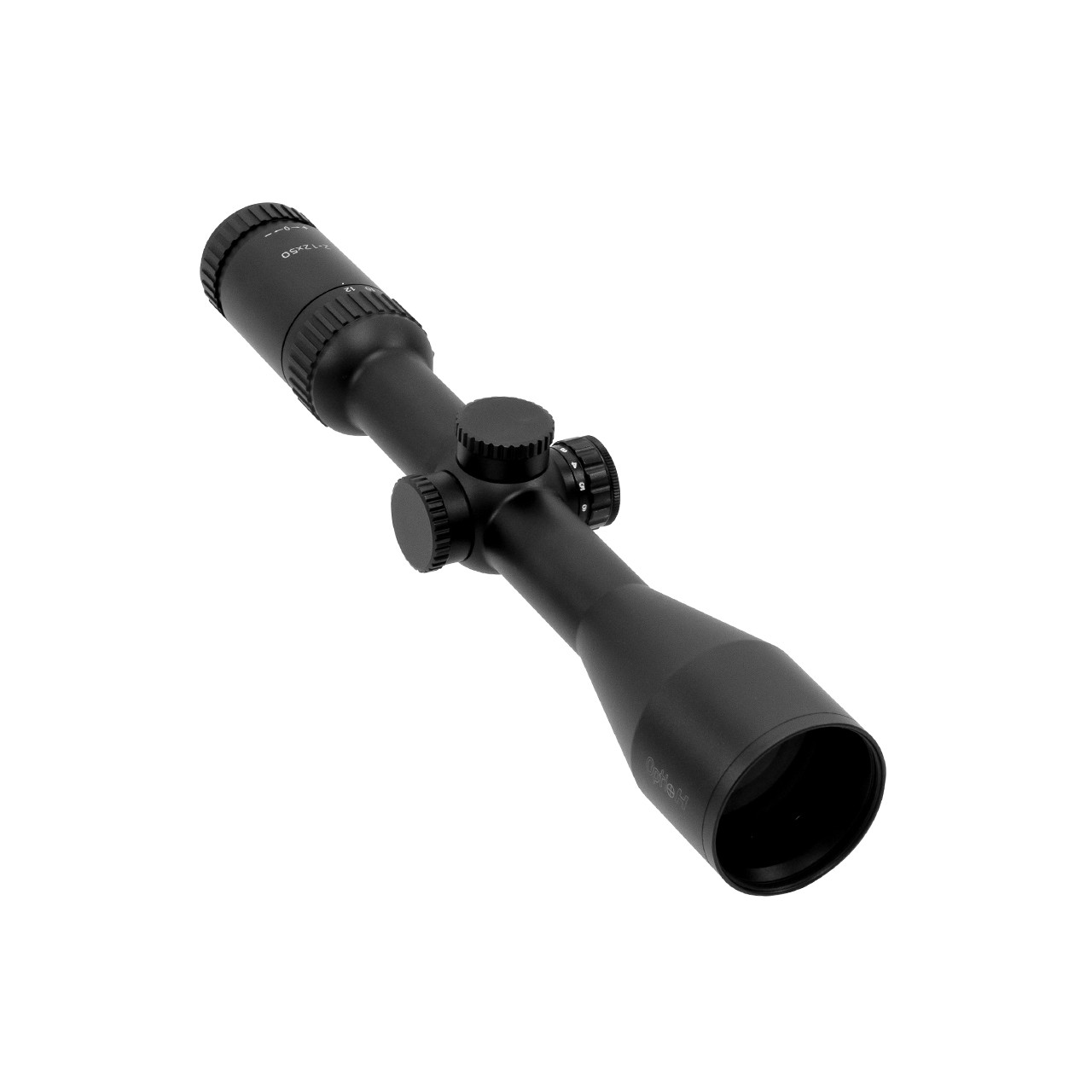
OptiMate Hunter 2-12x50 WA IR BT Rifle Scope
via Livens
£280.00
Buying Advice
Start with the specs that matter most for a foxing day scope destined to pair with a clip-on. Objective lens diameter of 50–56 mm is the sweet spot: large enough to gather light at dusk and to accept most clip-on units without vignetting, yet not so heavy that the rifle becomes unwieldy on a high seat or over a bonnet rest. Magnification range of 3-12× or 4-16× covers both close calling situations and longer shots across open ground. Parallax adjustment down to at least 50 yards is essential — foxes frequently appear at closer ranges than you expect. Look for a reticle that is illuminated with adjustable brightness; at night through a clip-on, a finely etched reticle can disappear against a bright NV image, so a clean, bold crosshair with a central illuminated dot is ideal. In MRAD scopes, remember that 0.1 mil equals 1 cm at 100 metres, and in MOA terms 1 MOA is approximately 1.047 inches at 100 yards — ensure your turret graduations match your ballistic data.
Budget tiers in the UK foxing market break down roughly as follows. Entry-level day scopes in the region of £150–£350 include reliable options from Hawke, MTC and Nikko Stirling that offer good glass clarity and illuminated reticles suitable for pairing with a clip-on. Mid-range scopes from £400–£800 — think Vortex Viper PST Gen II, Leupold VX-Freedom or the higher MTC models — bring noticeably better edge-to-edge sharpness, more forgiving eye boxes and superior coatings that help in low light. Premium optics above £800 from Zeiss, Swarovski, Kahles or Schmidt & Bender deliver exceptional light transmission, bombproof tracking and build quality that justifies the investment for serious foxers who shoot multiple nights a week. On the clip-on side, budget night vision devices under £500 exist — including certain Pard NV007 variants — but expect compromises in detection range and image clarity beyond 150 yards.
Common mistakes UK foxers make when choosing a scope and clip-on pairing include buying a scope with too high a maximum magnification (over 16× often causes severe vignetting with clip-ons), selecting a non-illuminated reticle that becomes invisible at night, and failing to check the clip-on's objective adapter ring fits the scope's outer tube diameter. Another frequent error is assuming that a thermal clip-on completely replaces a lamp and NV setup: while thermal excels at detection — picking up a fox's heat signature in cover at ranges beyond 300 yards — the image resolution for shot placement can be inferior to a good digital night vision unit at moderate ranges. Always test your specific combination at a range before taking it out on permission.
UK-specific context is critical. Under the Firearms Act, your FAC must include conditions permitting the use of sound moderators and night shooting if applicable; many forces now grant these readily for vermin control, but never assume. The most common centrefire foxing calibres in the UK are .223 Remington, .22-250 Remington, .243 Winchester and occasionally .204 Ruger. Your scope must be zeroed for the specific ammunition and distance you expect to shoot — most foxers zero at 100 or 200 yards and use a ballistic turret or holdover marks for other distances. Retailers such as Uttings, John Rothery, Sporting Saint, Jackson Rifles and Edgar Brothers stock the major scope and clip-on brands, and many offer package deals on scope-and-mount combinations. Always buy from a reputable UK dealer who can support warranty claims.
Matching the setup to your use case means being honest about your typical engagement distances, terrain and frequency of night outings. If most of your foxing is calling over pasture at 80–180 yards, a mid-range 3-12×50 scope paired with a Pard NV008P or Hikmicro Cheetah clip-on gives excellent value and a very capable system. If you regularly shoot across arable land at 200–300 yards and need to spot foxes in standing crops or hedgerows, a premium day scope paired with a thermal clip-on such as the Hikmicro Thunder TQ50 or Pulsar Krypton provides the detection advantage you need. For mixed day and night use, a second-focal-plane scope is perfectly adequate and often preferred because the reticle remains a consistent size — making it easier to see through a clip-on regardless of the magnification setting. First-focal-plane scopes are advantageous if you use MRAD holdover at varying magnifications, but the reticle shrinks at low power and can be hard to see through NV devices.
The brand landscape for foxing optics in the UK has evolved rapidly. Pard remains enormously popular for budget night vision clip-ons and has built a loyal following among UK foxers; the NV008P and SA series are the most commonly discussed models on forums. Hikmicro has surged in popularity thanks to competitive pricing on both thermal and digital NV clip-ons with strong after-sales support via UK distributors. Pulsar and Guide Sensmart offer premium thermal clip-ons favoured by professional pest controllers. On the day-scope side, Hawke and MTC dominate the entry and mid tiers with excellent UK-market support, while Vortex's unconditional warranty and strong dealer network make it a popular mid-to-premium choice. At the top end, Zeiss V4, Swarovski Z8i and Schmidt & Bender Klassik lines are all proven on UK foxing rifles. Whichever combination you choose, prioritise compatibility testing, a clean illuminated reticle and an objective diameter that matches your clip-on's requirements.
Frequently Asked Questions
What magnification and reticle style works best on a centrefire day scope used with a Pard or Hikmicro clip-on at night?
A maximum magnification of 12× or 16× is ideal; anything higher tends to cause vignetting with most clip-on units. Choose an illuminated reticle with a simple, bold central aiming point — a fine crosshair with an illuminated dot or a German #4 style works well because it remains visible against the bright NV image. Avoid overly complex Christmas-tree reticles as fine stadia lines can disappear through a clip-on. Ensure your scope's illumination has a wide brightness range so you can dim it sufficiently to avoid glare in the night vision picture.
Can I use a budget night vision clip-on under £500 on my existing foxing scope, and what compatibility issues should I watch for?
Yes, several devices fall near or under this price point, most notably certain Pard NV007 and NV008 variants. The main compatibility issues are objective lens diameter — you need an adapter ring that fits snugly over your scope's objective bell — and eye relief, because the clip-on must project its image cleanly into the scope's front lens. Vignetting at higher magnifications and poor image quality beyond 150 yards are common trade-offs with budget units. Always confirm the clip-on's sensor resolution and IR illuminator range before purchasing, and test the combination at a range before heading onto permission.
Thermal clip-on vs digital night vision clip-on for foxing: which gives better detection and shot placement on foxes at 200-plus yards?
Thermal clip-ons excel at detection because they highlight a fox's heat signature against the background regardless of vegetation, darkness or light fog, often picking up animals at 300 yards and beyond. However, the image resolution of thermal sensors can make precise shot placement harder at extreme range compared to a high-quality digital NV clip-on with a good IR illuminator. For foxing at 200-plus yards across open ground, thermal is generally the superior choice for finding foxes; for dense woodland edges where shots are moderate range, a good digital NV clip-on often provides a sharper aiming picture.
What centrefire calibres and scope setups do UK foxing permissions typically require for night shooting?
The most common UK foxing calibres are .223 Remington, .22-250 Remington, .243 Winchester and .204 Ruger, all of which offer flat trajectories and adequate energy for humane fox dispatch at typical field distances. Your FAC must include conditions for the calibre, night shooting and often a sound moderator. Scope-wise, a variable-power optic in the 3-12×50 or 4-16×50 range zeroed at 100 or 200 yards covers most scenarios. Ensure your scope's turrets or reticle holdovers match the ballistic drop of your chosen load, and always verify permission conditions with the landowner before shooting at night.
Do I need a first-focal-plane or second-focal-plane scope if I'm switching between day and night foxing with a clip-on unit?
For most foxers using a clip-on, a second-focal-plane (SFP) scope is the more practical choice. The reticle stays the same apparent size regardless of magnification, meaning it remains clearly visible through the clip-on whether you are at 4× or 12×. First-focal-plane (FFP) scopes are advantageous if you use MRAD or MOA holdover marks at varying magnifications — the subtensions are always accurate — but the reticle shrinks at low power and can become almost invisible through a night vision device. If you choose FFP, use it at or near maximum magnification at night to keep the reticle legible.
Will my day-scope zero change when I attach a night vision or thermal clip-on?
In principle, a well-designed clip-on should not shift your zero because it projects an image through the existing day scope without altering the optical path of the riflescope itself. In practice, slight zero shifts of 1–2 MOA can occur due to the added weight on the scope or rail, imperfect optical alignment in the clip-on, or movement of the mounting adapter. Always confirm your zero with the clip-on attached at a range before using it in the field, and use a consistent, repeatable mounting system to minimise shift each time you attach and remove the unit.
What scope features help with foxing during the day-to-night transition at dusk?
Large objective lenses (50–56 mm) gather more light in the fading minutes before full dark, extending your effective shooting window. Multi-coated lenses with high light transmission percentages (look for 90%+ across the visible spectrum) make a noticeable difference in twilight conditions. An illuminated reticle lets you maintain a clear aiming point as the background darkens, and a fast-focus eyepiece ensures you can sharpen the reticle quickly as light levels change. A side-parallax turret adjustable down to 50 yards also helps, as foxes coming to a call often appear at surprisingly close range during the transition period.
Is it worth buying a dedicated night vision scope for foxing instead of a day scope plus clip-on?
Dedicated digital or thermal night vision scopes — such as the Pard DS35 or Pulsar Thermion 2 — offer superior image quality at night because the entire optical system is designed for nocturnal use, with no need to project through a separate day optic. The downside is that you lose your day-scope capability on that rifle, meaning you either need a second rifle or must swap optics. For foxers who shoot almost exclusively at night, a dedicated unit can be more practical. For those who mix daytime zeroing, dusk lamping and full-dark clip-on work, the day scope plus clip-on combination remains more versatile and cost-effective.
How do I prevent battery failure and fogging on clip-on units during long winter foxing sessions?
Carry at least two fully charged spare batteries and keep them in an inside pocket close to your body — lithium cells lose capacity rapidly in cold weather. Many Pard and Hikmicro clip-ons accept external USB power banks, which can extend run time significantly on long sits. To prevent fogging when moving from a warm vehicle into cold air, allow the clip-on and scope to acclimatise for ten minutes before switching on, and consider anti-fog lens caps or silica gel pouches in your optics case. A neoprene scope wrap can slow temperature changes and reduce external condensation on the objective lens.
Related guides
Our 2026 UK buyer's guide to the best scopes for fox shooting with a .22LR. Covers day, night and lamping optics, magnification, budget picks and legal considerations for rimfire foxing.
Best Scopes for Foxing and Vermin Control at NightExpert UK guide to the best scopes for fox shooting and night vermin control in 2026. Covers night vision, thermal, Pard add-ons, budget picks, and legal advice for UK shooters.
Best Budget Thermal Scopes & Clip-Ons for Foxing in 2026Our 2026 UK buyer's guide to the best thermal scopes and clip-ons for foxing under £500. Compare Pard, Hikmicro and more for affordable night-time vermin control.
Best Budget Night Vision Scopes for Foxing Under £300Our UK expert guide to the best budget night vision scope options under £300 for fox and vermin control in 2026. Covers digital NV, IR illuminators, clip-ons, and top picks.
Best Night Vision Clip-Ons & Add-Ons for UK Shooters in 2026Our 2026 buyer's guide to the best night vision clip-on scopes for UK foxing and pest control. Covers budget to premium add-ons, PARD models, IR illuminators, law and mounting tips.
Not sure which scope is right for you?
Try our AI-powered scope finder — answer a few questions and get personalised recommendations.
Find My Scope →Get a UK scope tip every day
Follow AiScopes on Facebook for daily buying guides, deals and gear advice.
Follow on Facebook