Thermal Scope, Scanner, or Clip-On: What to Buy First
Shopping in the US? This page is on our US site: aiscopes.us →
By Peter Makulek · Senior Optics Editor · · Live prices from US retailers
Quick answer: if you only hunt hogs or coyotes at night and can dedicate a rifle to that role, buy a dedicated thermal scope with a built-in laser rangefinder first — it gives you the best image quality and fastest target-to-trigger workflow inside 300 yards, which covers the vast majority of nighttime predator and hog engagements across the US. Add a handheld thermal scanner second for field scanning.
The thermal optics market has exploded since 2023, and US hunters now face a genuinely confusing three-way decision. A dedicated thermal riflescope replaces your daytime optic entirely and gives you the best native resolution because its sensor is optimized for the weapon sight role — no adapter rings, no added weight on the turret housing, and often a built-in laser rangefinder (LRF). A handheld thermal monocular is your scanning tool: you glass a field, identify a coyote at 400 yards, then transition to your rifle. Used together, a dedicated scope plus a handheld scanner is the gold-standard night-hunting setup across Texas, Oklahoma, and the Southeast.
A clip-on thermal, by contrast, mounts in front of your existing daytime scope and projects a thermal image through your existing reticle. The appeal is obvious: you keep your zero'd daytime optic, you can run the same rifle for daytime deer season and nighttime hog control, and you only buy one thermal device. The trade-off is image quality (you are looking through two optical systems), added length and weight forward of the turret, and a higher price floor for a clip-on that actually performs well enough to shoot with confidence at 200+ yards.
This guide walks you through every factor — sensor resolution, refresh rate, detection versus recognition range, LRF utility, weight budget, and total system cost — so you can decide what to buy first, what to buy second, and whether a built-in rangefinder justifies the premium. Every recommendation is framed for the US market: common platforms like the AR-15 in .223/5.56 or AR-10 in .308, bolt guns in 6.5 Creedmoor, and the real engagement distances US hunters face on coyote stands and at hog feeders.
Top Picks — Live US Prices
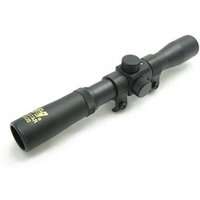
NcSTAR Compact 4x20 Air Gun Rifle Scope, Black, Duplex Reticle - SCA420B
via OpticsPlanet
$12.99

Barska 4X20 Rimfire Rifle Scope, Black Matte AC10730
via OpticsPlanet
$18.99

Daisy Powerline Airgun Scope, 4x15, Crosshair Reticle, Black, 980808-444
via OpticsPlanet
$20.99
Buying Advice
Start with the sensor specs, because they dictate everything else. Thermal scopes are defined by detector resolution (e.g., 640×512 vs 384×288 pixels), pixel pitch (12 µm vs 17 µm), and NETD (noise-equivalent temperature difference, measured in millikelvins — lower is better, with sub-40 mK considered excellent). A 640×512 / 12 µm core gives you roughly 2.8× the pixel density of a 384×288 / 17 µm core, which translates directly into recognition range — the distance at which you can tell a coyote from a fence post. Refresh rate matters for tracking moving animals: 60 Hz is noticeably smoother than 30 Hz when a hog is trotting across a field. For clip-ons, also check the output resolution that feeds into your daytime scope's eyepiece — a mismatch can bottleneck the image.
Budget tiers in 2026 break down roughly as follows. Entry-level dedicated thermal scopes with a 384-core sensor and no LRF sit in the $1,500–$2,500 range and are perfectly serviceable for hog hunting inside 150 yards. Mid-tier units jump to a 640-core sensor, 60 Hz refresh, and often include a built-in laser rangefinder, landing between $3,000 and $5,500 — this is the sweet spot for serious coyote callers who need reliable identification out to 250–350 yards. Premium scopes from brands like Pulsar, iRay, and others push past $6,000 and add features like onboard ballistic calculators, video recording, and Wi-Fi streaming. Clip-ons tend to start around $3,500 for a usable 384-core unit and climb past $8,000 for 640-core models with LRF, which is why many hunters find it cheaper to run a dedicated thermal scope and keep a second rifle for daytime.
The most common mistake buyers make is chasing detection range numbers on the spec sheet. Detection range is the distance at which the unit can see that something warm exists — it might be 1,800 yards on paper — but recognition range (identifying the animal) and identification range (confirming species for a safe, ethical shot) are dramatically shorter, often 40–60% of the detection figure. A scope marketed at '2,000-yard detection' may only let you confidently identify a coyote at 400–500 yards. Always ask for the DRI (Detection, Recognition, Identification) figures based on a 1.7-meter target standard, and mentally benchmark against your realistic shooting distances. Another mistake is underestimating the value of a quality handheld scanner: trying to scan a 200-acre field through a 3× thermal riflescope is painfully slow. A wide-field handheld monocular with 2× or 3× base magnification covers ground ten times faster.
US-specific context matters. In states like Texas, hog hunting at night is legal year-round on private land with landowner permission, and thermal is the dominant technology — AR-platform rifles in .300 Blackout or .308 are extremely popular for this role. Coyote hunting at night is legal in most Western and Southern states but restricted or prohibited in parts of the Northeast and Midwest — always verify your state and county regulations before buying thermal. For purchasing, Amazon.com carries a growing selection of thermal optics from Pulsar, AGM, and others, and the aiscopeus-20 tag on aiscopes.us links directly. OpticsPlanet is another strong US source with frequent financing options on higher-ticket thermal units. Mount compatibility is straightforward on Picatinny-railed rifles; if you run a bolt action with a traditional two-piece base, confirm that the thermal scope's mounting footprint and eye relief work with your platform.
Matching the choice to your use case comes down to three questions. First, do you want one rifle that does day and night duty? If yes, a clip-on preserves your daytime zero and reticle — but budget at least $4,000 for a clip-on that will not frustrate you. Second, do you call coyotes from a stationary position or spot-and-stalk hogs? Callers benefit enormously from a separate handheld scanner for field-wide detection, then a dedicated thermal scope for the shot — two devices, each optimized for its job. Third, do you need ranging capability built in? A built-in LRF eliminates the step of pulling out a separate rangefinder in the dark, and for shots past 150 yards on coyotes (where a 55-grain .223 can drop 4–6 inches between 200 and 300 yards), knowing the exact range before you press the trigger is not a luxury — it is the difference between a clean kill and a miss. If most of your shooting is hogs under 100 yards at a feeder, you can skip the LRF and save $500–$1,000.
On the brand landscape, Pulsar dominates US market share in dedicated thermal riflescopes and is widely available on Amazon.com. iRay (sold under the iRay and InfiRay brand names) has pushed aggressively into the US with excellent 12 µm cores and competitive pricing. AGM Global Vision offers solid entry-level and mid-tier options. Among traditional US optics brands, Burris has thermal options, and Leupold and Bushnell maintain strong reputations in daytime optics — Leupold's LTO series is a popular handheld thermal monocular. Vortex does not currently manufacture a thermal riflescope but their daytime optics pair well with clip-on thermals, and their customer service sets an industry standard. Nightforce's strength is long-range precision glass rather than thermal, but their mounts and rings are commonly used to secure thermal clip-ons to the rifle. As this market matures rapidly, 2026 models routinely outperform 2024 flagships at lower price points, so buying current-generation is almost always the right call.
Frequently Asked Questions
Should I buy a dedicated thermal scope or a clip-on first for coyote hunting?
If you can dedicate a rifle to nighttime predator duty, a dedicated thermal scope delivers better image quality, lower weight, and usually a lower total cost than a comparable clip-on. Clip-ons make sense when you need one rifle to pull double duty across daytime deer season and nighttime coyote or hog hunts. For most US hunters adding a second rifle is practical and affordable, making the dedicated scope the better first purchase.
Is a built-in laser rangefinder worth the extra cost on a thermal scope?
Yes, for coyote hunters shooting past 150 yards. A .223 Remington 55-grain bullet drops roughly 4 inches between 200 and 250 yards, and in the dark you cannot use terrain features to estimate range reliably. A built-in LRF lets you range and shoot without removing your eye from the scope, which is critical on a coyote that may only give you a 5-second window. For hog hunters shooting under 100 yards at feeders, the LRF is a nice-to-have but not essential.
What thermal sensor resolution do I need for hogs and coyotes?
A 384×288 sensor is adequate for hog hunting inside 150 yards, where the targets are large and distances are short. For coyote hunting, where you need to identify a 25-pound animal at 200–350 yards and distinguish it from a domestic dog, a 640×512 sensor is a significant upgrade. The 640-core gives you roughly 2.8 times the pixel count, which directly extends your recognition and identification range.
Can I use a clip-on thermal in front of my daytime scope without losing zero?
A properly mounted clip-on should not shift your rifle's zero because it attaches to the Picatinny rail ahead of the daytime scope and projects a thermal image through the existing optical path. However, the added weight forward of the action can subtly affect harmonics on some lightweight barrels, so you should confirm zero after attaching the clip-on. Quality quick-detach mounts with a repeatable return-to-zero design minimize this concern.
Do I need a handheld thermal scanner if my riflescope already has thermal?
Strongly recommended, yes. Scanning a 200-acre field through a riflescope at 3× magnification is extremely slow and means pointing your muzzle at everything you look at — a serious safety concern. A handheld thermal monocular with a wide field of view lets you detect heat signatures across a broad area quickly and safely, then transition to the rifle only when you have positively identified your target. Many experienced night hunters consider the handheld their most-used piece of thermal gear.
What refresh rate should I look for in a thermal scope — 30 Hz or 60 Hz?
A 60 Hz refresh rate produces a noticeably smoother image, especially when tracking a trotting hog or a coyote moving across your field of view. At 30 Hz, fast-moving targets can appear slightly choppy, which makes precise shot placement harder. For stationary feeder hunting, 30 Hz is acceptable. For calling coyotes or shooting running hogs, 60 Hz is worth the premium.
What is the difference between detection range and identification range on a thermal scope?
Detection range is the maximum distance at which the scope can register that a warm object exists — this number is always the largest and most impressive on the spec sheet. Recognition range is the distance at which you can tell it is an animal rather than a rock. Identification range is the distance at which you can confirm species — for example, distinguishing a coyote from a neighbor's dog. Identification range is typically 40–50% of the detection figure and is the number that actually matters for ethical, legal hunting.
Is night hunting with thermal legal across all US states?
No. Thermal and night-vision hunting regulations vary significantly by state and sometimes by county. Texas, for example, allows thermal for hogs and coyotes on private land year-round. Some Northeastern and Midwestern states restrict or prohibit any form of night hunting or electronic sighting aids. Always check your specific state fish and game regulations before purchasing thermal equipment, and confirm whether you need a separate depredation permit for hogs or predators at night.
What rifle platforms pair best with thermal scopes for hog and coyote hunting?
AR-15 platform rifles in .223 Remington or .300 Blackout are the most popular US choice for coyotes and mid-sized hogs because they offer semi-automatic follow-up shots and easy suppressor attachment. For larger hogs, AR-10 rifles in .308 Winchester or 6.5 Creedmoor provide more energy at range. Bolt-action rifles in .22-250, .243, or 6.5 Creedmoor are also common among dedicated coyote callers. Whichever platform you choose, ensure it has a Picatinny top rail with enough forward space for a clip-on if you plan to add one later.
Related guides
Find the best clip-on thermal imager for your day scope in 2026. We cover mounting, detection range, realistic price tiers…
How to Mount a Rifle Scope the Right WayLearn how to mount a rifle scope correctly with the right tools, torque specs in inch-pounds, Loctite guidelines, and three proven leveling methods.
Tall-Target, Box Test & Return-to-Zero: Test Your Scope RightLearn how to test any rifle scope yourself with the tall-target test, box test, and return-to-zero check.
Not sure which scope is right for you?
Try our AI-powered scope finder — answer a few questions and get personalised recommendations.
Find My Scope →Get a UK scope tip every day
Follow AiScopes on Facebook for daily buying guides, deals and gear advice.
Follow on Facebook