Run & Gun Magnification: Picking the Right Scope for Your LMT
By Peter Makulek · Senior Optics Editor · · Live prices from UK retailers
If you have taken your 20-inch LMT out to a range day or dynamic shoot and found yourself squinting at steel at 600 yards, you are not alone. The classic run-and-gun dilemma is balancing enough top-end magnification for positive target identification at distance against a wide, forgiving field of view for close-in transitions. A 1–6× LPVO that felt brilliant at 100 metres can leave you hunting for a Figure-12 at 500. In the UK, where longer-distance shooting is growing fast at venues such as Diggle, Bisley, and various Scottish hill ranges, getting scope magnification right is a genuine performance question, not just spec-sheet chasing.
The 20-inch barrel on an LMT MWS or similar .308 or 6.5 Creedmoor platform is a superb compromise between portability and ballistic efficiency. With quality ammunition, a .308 from a 20-inch barrel retains enough velocity for reliable hits well past 800 yards, and 6.5 Creedmoor extends that further still. But the rifle is only half the equation. Your scope magnification range, reticle plane (FFP or SFP), turret system, and parallax setting all determine whether you can actually exploit that capability under time pressure. Run-and-gun formats punish you for fiddling with turrets, so your optic needs to be intuitive and fast.
For UK shooters, the legal and practical context matters. Semi-automatic centrefire rifles are prohibited on the mainland, so your LMT is almost certainly a straight-pull variant — fast to cycle, but not self-loading. That changes the tempo of dynamic shooting compared to what you might see in US-based PRS footage. You have a fraction more time between shots, which actually makes a well-chosen magnification range even more valuable: you can afford to dial up for a precise long-range shot and dial back down for the next close barricade position without the clock punishing you as harshly.
This guide breaks down how to choose the right scope magnification for run-and-gun and longer-range shooting from a 20-inch platform in the UK. We will cover the technical specs that matter — FFP versus SFP, MRAD versus MOA, parallax adjustment ranges — and recommend optics across realistic UK budget tiers. Whether you are shooting club-level practical rifle, preparing for a PRS-style match, or simply want to ring steel at longer distances on your syndicate's land, the right glass makes a transformative difference.
Top Picks — Live UK Prices
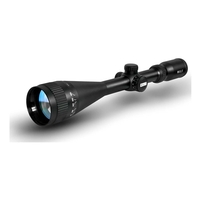
Wulf Fireball LR 4-16x50 AO IR Riflescope
via Uttings
£74.99
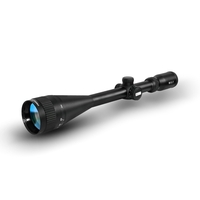
Wulf Fireball LR 6-24x50 AO IR Riflescope
via Uttings
£84.99

Wulf Fireball LR 4-16x50 Half Mil-Dot Rifle Scope
via BushWear
£89.99
Buying Advice
Start with the magnification range. For a 20-inch .308 or 6.5 Creedmoor used in dynamic shooting out to 800 yards or beyond, a 3–18× or 4–16× scope hits the sweet spot. The low end gives you a usable field of view for transitions and close targets inside 100 metres, while the top end provides enough magnification to positively identify and engage steel at distance. A 5–25× offers more reach but the narrower field of view at the bottom end can slow you down on barricade stages. True 1× at the low end is only found on LPVOs, which typically max out at 6× or 10× — not enough for consistent long-range work beyond 500 yards in most shooters' hands.
FFP (first focal plane) scopes are strongly preferred for run-and-gun because the reticle scales with magnification. This means your mil-dot or Christmas-tree holdovers are accurate at any power setting, so you can dial down to 8× for a wider view and still hold off for wind or elevation using the reticle markings without needing to be at maximum magnification. SFP reticles are only accurate at one specific magnification (usually the highest), which forces you to crank to full power before using holdovers — a real time penalty in dynamic formats. Budget-wise, quality FFP scopes start around £400–£500 from brands like Athlon and Vortex, with mid-range options from Bushnell and Leupold sitting between £700 and £1,200, and premium glass from Zeiss pushing above £1,500.
MRAD (milliradian) is the dominant system in UK practical and long-range shooting communities, and for good reason. One milliradian subtends 10 cm at 100 metres — a beautifully intuitive metric-friendly system. MOA works well too (roughly 2.9 cm at 100 metres per click on a ¼ MOA turret), but if you are shooting with a club or attending courses in the UK, you will find that virtually all instruction, range cards, and shared data are in MRAD. Matching your turrets and reticle is essential: an MRAD reticle with MOA turrets is a recipe for confusion under pressure. Whichever you choose, ensure the turrets have positive, tactile clicks and ideally a zero stop so you can always return to your 100-metre zero without counting.
A common mistake UK buyers make is underestimating the importance of parallax adjustment range. Most long-range scopes have a side-focus parallax knob adjustable from around 25 or 50 yards to infinity. For run-and-gun where targets may appear as close as 25 metres, ensure your scope's parallax goes low enough — some budget models only adjust down to 50 yards, leaving close targets slightly blurred. If you also shoot airguns (sub-12 ft-lb, which requires no licence in England and Wales but does need an Air Weapon Certificate in Scotland), note that airgun scopes need parallax adjustment down to roughly 10 yards, and a long-range centrefire scope will not serve double duty. Also beware of buying a scope not rated for the recoil profile of your rifle; springer airguns generate a destructive forward-then-backward double-recoil that will destroy scopes not specifically designed for it.
For UK-specific context, consider where you actually shoot. Many UK ranges restrict maximum distances to 300 or 600 yards, while a handful offer 1,000 yards or more. If your regular range tops out at 300 yards, a 3–15× is ample and saves weight on a rifle you carry all day. If you are travelling to longer ranges or stalking deer — roe, muntjac, and fallow all being common UK quarry with defined open seasons — then 18× or higher at the top end gives you confidence for target identification at distance, which is an ethical obligation as well as a practical one. Always confirm your scope's suitability for the conditions: Scottish hill stalking in rain demands robust waterproofing and fog-proof nitrogen purging, which every reputable brand provides but is worth verifying on budget models.
The brand landscape in the UK is competitive and well-served. Vortex offers exceptional value across their Viper PST II and Razor HD Gen III lines, with a transferable no-questions warranty that UK retailers honour. Leupold's Mark 5HD is a favourite among UK stalkers and PRS shooters for its light weight and outstanding glass clarity. Athlon's Ares and Cronus lines punch well above their price point and have gained a strong UK following. Bushnell's Match Pro and Elite Tactical lines offer solid FFP options under £600. Zeiss sits at the premium end with the Conquest V4 and V6 lines, offering superlative European glass quality. For night-vision and thermal — increasingly popular for UK fox and pest control — Pulsar and HikMicro dominate, though that is a separate buying decision from your daylight long-range optic.
Frequently Asked Questions
What is the best scope for long-range shooting in the UK?
There is no single best scope — it depends on your platform, budget, and shooting discipline. For run-and-gun and practical rifle with a .308 or 6.5 Creedmoor, an FFP scope in the 3–18× or 4–16× range with MRAD turrets is the most versatile choice. The Vortex Viper PST II 5–25×50 and Leupold Mark 5HD 3.6–18×44 are both highly regarded in UK long-range circles. Prioritise glass clarity, reliable turret tracking, and a reticle that matches your turret system.
What is the best scope for long-range shooting and hunting?
For a scope that doubles between range days and UK deer stalking, look for a 3–18× or 4–16× FFP model with an illuminated reticle for low-light woodland shooting. Weight matters if you are hill stalking for roe or red deer, so consider lighter options like the Leupold Mark 5HD. Ensure the scope is fully waterproof and nitrogen-purged for Scottish and Welsh hill conditions. A good all-rounder will have a side-focus parallax knob adjustable from around 25 yards upward.
What is the best scope for a 6.5 Creedmoor at long range?
The 6.5 Creedmoor's flat trajectory and mild recoil make it a superb pairing with precise, high-magnification optics. A 5–25× FFP scope with a detailed holdover reticle (such as a Christmas-tree or Horus-style design) lets you exploit the cartridge's ballistic efficiency out to 1,000 yards and beyond. Brands like Athlon (Cronus BTR), Vortex (Razor HD Gen III), and Bushnell (XRS3) are popular choices in the UK for this calibre. Ensure your turrets match your reticle — MRAD/MRAD is the standard in UK long-range communities.
Can I get a good long-range scope for under £1,000?
Absolutely. The UK market has several excellent FFP long-range scopes under £1,000. The Vortex Diamondback Tactical 6–24×50 FFP sits well under that figure and offers surprisingly good glass and reliable turrets for the money. Athlon's Argos and Midas lines also fall in this bracket with MRAD reticles and solid build quality. At the upper end of the budget, the Bushnell Match Pro 6–24×50 and Vortex Viper PST II 5–25×50 can sometimes be found close to or just under £1,000 depending on the retailer.
What scope magnification do I need for a .308 at long range?
A .308 from a 20-inch barrel is effective to 800–1,000 yards in skilled hands, and a 3–18× or 5–25× scope covers that envelope well. For purely long-range static shooting, 5–25× gives you maximum target detail at distance. For run-and-gun or practical rifle where you need versatility, 3–18× offers a better low-end field of view for close transitions while still providing enough magnification for 600–800 yard shots. Many experienced UK shooters report that they rarely need more than 15–18× in practice, even at 1,000 yards.
What is the difference between FFP and SFP for long-range shooting?
In a first focal plane (FFP) scope, the reticle scales proportionally with magnification, so holdover and windage markings in the reticle are accurate at every power setting. In a second focal plane (SFP) scope, the reticle stays the same apparent size regardless of magnification and is only accurate for holdovers at one specific power (usually maximum). For run-and-gun and dynamic shooting, FFP is strongly preferred because you can use holdovers at any magnification without pausing to dial to full power. SFP scopes can be slightly less expensive, but the tactical disadvantage in timed shooting is significant.
Do I need MRAD or MOA for UK long-range shooting?
Either system works mechanically, but MRAD is the dominant standard in UK practical rifle, PRS, and long-range communities. One MRAD click (0.1 mil) equals 1 cm at 100 metres, which integrates neatly with the metric system used on UK ranges. If you are sharing data, attending courses, or shooting with a spotter, MRAD simplifies communication enormously. MOA is perfectly valid — 1 MOA is approximately 1.047 inches at 100 yards — but you may find yourself constantly converting if everyone around you is calling corrections in mils.
Can I use my long-range scope on an airgun as well?
Generally, no — at least not well. Long-range centrefire scopes typically have a minimum parallax setting of 25–50 yards, whereas airgun shooting (especially with sub-12 ft-lb rifles, which are humane-kill effective only to roughly 35–45 yards on rabbit and squirrel) demands parallax adjustment down to around 10 yards. Additionally, if you are shooting a spring-piston airgun, the unique forward-then-backward double-recoil will destroy scopes not specifically designed for it. Purpose-built airgun scopes are essential for spring-powered rifles. Note that in Scotland, any air weapon requires an Air Weapon Certificate; in England and Wales, sub-12 ft-lb air rifles require no licence.
Is there an equivalent to Escape from Tarkov-style long-range scoping in real UK shooting?
Tarkov's depiction of variable-power scopes, zeroing, and bullet drop is a rough approximation of real-world concepts, but real optics are far more nuanced. In UK practical rifle and PRS-style competitions, you genuinely do dial elevation and hold for wind using MRAD or MOA reticles, and target identification through glass is a real skill. If Tarkov has sparked your interest, the best next step is to contact a UK shooting club affiliated with the NRA (National Rifle Association of the UK) or NSRA, complete your probationary period, and experience real optics on a proper range.
Related guides
Learn how to mount and align a rifle scope for long-range shooting in the UK. Covers base selection, ring torque specs, boresighting and common mistakes…
Can Night-Vision Users See Your Thermal Scope Display?Discover whether your thermal rifle scope's display screen is visible to other night-observation device users.
Goyojo GS515 Night Vision Scope: Is It Any Good for Rats?Is the Goyojo GS515 night vision scope worth it for UK ratting? Our 2026 buying guide covers specs, alternatives, legal context…
Not sure which scope is right for you?
Try our AI-powered scope finder — answer a few questions and get personalised recommendations.
Find My Scope →Get a UK scope tip every day
Follow AiScopes on Facebook for daily buying guides, deals and gear advice.
Follow on Facebook