Best Scope for 300-Yard Hunting Shots in 2026
Shopping in the US? This page is on our US site: aiscopes.us →
By Peter Makulek · Senior Optics Editor · · Live prices from US retailers
Three hundred yards is the outer edge of the distances most hunters will ever shoot at deer, pronghorn or hogs, and it is the point where the scope starts to matter as much as the rifle. At 100 yards almost any scope will do. At 300, you need enough magnification to see the vitals clearly, a reticle that helps you hold for bullet drop, and a parallax setting that does not throw your aim off.
The good news is that you do not need a high-magnification long-range scope to shoot well at 300 yards. A deer's vital zone is roughly 8 to 10 inches across, and at 300 yards that target is easy to see at 9x. That is why the classic 3-9x40 and 4-12x40/44 scopes remain the most practical choice for this distance: they are light, affordable, bright enough for dawn and dusk, and have enough magnification without the narrow field of view of a 5-25x.
This guide explains how much magnification you really need for 300 yards, how to deal with drop and parallax, and compares four scopes that suit that distance: the Vortex Crossfire HD 4-12x44, the Vortex Crossfire HD 3-9x40 with an illuminated BDC reticle, and the Vortex Diamondback 3-9x40 and 4-12x40.
Prices below reflect current US retail as of September 2026 and move with promotions, so check the current price before you buy.
Top Picks — Live US Prices
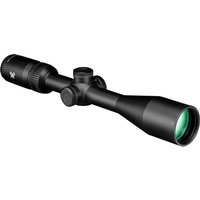
Vortex Crossfire HD 4-12x44mm 1in Tube Rifle Scope, Second Focal Plane, WideRange Plex MOA Reticle, Black, CFR-41202
via OpticsPlanet
$199.00
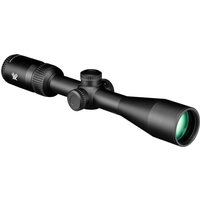
Vortex "Vortex Crossfire HD 3-9x40 mm 1 in Tube Rifle Scope, Second Focal Plane, Illuminated Dead-Hold 2A BDC MOA, Black, 12.5, 17.1oz, CFR-3901I"
via OpticsPlanet
$219.00

Vortex Diamondback 3-9x40mm Rifle Scope, 1 in Tube, Second Focal Plane, Black, Hard Anodized, Non-Illuminated Dead-Hold BDC Reticle, MOA Adjustment, 11.6in, 14.5oz, DBK-01-BDC
via OpticsPlanet
$249.00
Buying Advice
How much magnification do you need for 300 yards? For hunting-sized targets, 8x to 10x is ideal. It gives a clear view of a deer's shoulder and vitals while keeping a field of view wide enough to follow the animal if it moves. Magnification above 12x adds little for hunting at this distance and makes the image shakier from field positions. For small targets at 300 yards, such as steel plates or varmints, 12x to 16x helps.
The Vortex Crossfire HD 4-12x44 (WideRange Plex reticle), at around $199, is the most capable budget pick for 300 yards. Its adjustable objective sets parallax anywhere from 15 yards to infinity, so you can dial it to 300 yards and remove parallax error completely. It has 3.8 inches of eye relief, a 1-inch tube, 70 MOA of elevation travel, a length of 13.4 inches and a weight of 20.7 ounces. The trade-off is its weight, which is heavier than the Diamondbacks.
The Vortex Crossfire HD 3-9x40 with the illuminated Dead-Hold 2A BDC reticle, at around $219, adds an illuminated reticle and holdover marks in a 12.5-inch, 17.1-ounce package. The illumination helps you hold on a dark animal against a dark tree line at first and last light, and the BDC gives you marked holdover points for shots beyond your zero.
The Vortex Diamondback 3-9x40, at around $249, is lighter and shorter at 14.5 ounces and 11.6 inches. It has 3.3 inches of eye relief, 1/4 MOA clicks, 70 MOA of adjustment and a fixed 100-yard parallax setting, and it is available with either a simple V-Plex or a Dead-Hold BDC reticle. If you want one scope that carries easily and covers 50 to 300 yards, this is a strong choice.
The Vortex Diamondback 4-12x40, at around $259, adds a bit more reach in a 12-inch, roughly 14-ounce body with the Dead-Hold BDC reticle. It suits open-country hunters who regularly take shots between 200 and 300 yards and want a little extra magnification for confirming antlers or shot placement.
Plan for bullet drop. With a 200-yard zero, most popular deer cartridges such as the .308 Winchester, 6.5 Creedmoor and .270 Winchester drop about 6 to 8 inches at 300 yards, depending on the load. That is almost the full depth of a deer's vitals, so aiming dead-on at 300 yards is not enough. A BDC reticle gives you marked holdover points, but they are only accurate for the load they were designed for; confirm exactly where each mark lands at 300 yards with your own ammunition before the season.
Understand parallax. A scope with a fixed 100-yard parallax setting will show a small aiming error at 300 yards if your eye is not centered behind the scope. For most hunting shots that error is small, but a consistent cheek weld keeps it to a minimum. An adjustable objective, like the one on the Crossfire HD 4-12x44, lets you set parallax to the exact distance and eliminates the issue.
Finally, remember that 1 MOA is about 1.05 inches at 100 yards and about 3.14 inches at 300 yards. A rifle and load that group within 1.5 MOA will keep shots inside a 5-inch circle at 300 yards, well inside a deer's vitals. Practice from the positions you will actually use while hunting, such as sitting, kneeling or off shooting sticks, before you attempt a 300-yard shot in the field.
Frequently Asked Questions
What magnification scope do I need for 300 yards?
For hunting deer-sized game at 300 yards, 8x to 10x is ideal, which is why 3-9x and 4-12x scopes are the most popular choices. Smaller targets such as steel plates or varmints benefit from 12x to 16x.
Is a 3-9x40 scope good for 300 yards?
Yes. At 9x, a deer's 8-10 inch vital zone is clearly visible at 300 yards. Scopes such as the Vortex Diamondback 3-9x40 (around $249) and Crossfire HD 3-9x40 (around $219) are well suited to shots from close range out to 300 yards.
How much does a bullet drop at 300 yards?
With a 200-yard zero, common deer cartridges such as the .308 Winchester, 6.5 Creedmoor and .270 Winchester drop about 6 to 8 inches at 300 yards, depending on the load. Always confirm your drop with your own rifle and ammunition.
Do I need an adjustable objective for 300 yards?
It is not essential for hunting, but it helps. A scope with parallax fixed at 100 yards shows a small aiming error at 300 yards if your eye is off-center. An adjustable objective, like the Vortex Crossfire HD 4-12x44's 15-yard-to-infinity adjustment, removes that error.
What is the best budget scope for 300 yards?
The Vortex Crossfire HD 4-12x44 at around $199 is the best budget choice because its adjustable objective lets you set parallax to exactly 300 yards, and 12x gives plenty of detail at that distance.
What zero should I use for 300-yard hunting?
A 200-yard zero is a practical choice for most deer cartridges. It keeps the bullet within a few inches of your aim point out to about 250 yards and needs only a modest holdover at 300 yards.
Related guides
Struggling to identify a Night Owl Optics monocular? Our 2026 guide covers model identification, specs to look…
Steiner T6Xi Magnification: Which Power Range Do You Need?Confused by Steiner T6Xi magnification options? Our 2026 guide breaks down every power range — 1-6x, 2.5-15x, 3-18x, 5-30x…
Best Optics for Shooting Beyond 800 YardsFind the best optics for 800+ yard shooting in 2026. Expert guide covers FFP scopes, thermal optics, night vision, spotting scopes…
Best Scopes for Sub-Inch Targets at 40–50 Yards With a .22 Spring RifleNew to spring-piston air rifles? Learn exactly which scope magnification, reticle, and parallax settings let you hit sub-inch targets at 40–50 yards…
Best Slug Gun Scopes for Deer Hunting in 2026Best scope for a slug gun? Compare low-power shotgun scopes from Vortex and Burris for deer, with real 2026 US prices, eye relief and mounting advice.
Not sure which scope is right for you?
Try our AI-powered scope finder — answer a few questions and get personalised recommendations.
Find My Scope →Get a UK scope tip every day
Follow AiScopes on Facebook for daily buying guides, deals and gear advice.
Follow on Facebook