Steiner T6Xi Magnification: Which Power Range Do You Need?
Shopping in the US? This page is on our US site: aiscopes.us →
By Peter Makulek · Senior Optics Editor · · Live prices from US retailers
Quick answer: The Steiner T6Xi line uses a consistent 6× zoom ratio across four models — 1-6×24, 2.5-15×50, 3-18×50, and 5-30×56 — and the right choice depends entirely on your engagement distance. For most US hunters and general-purpose shooters, the 3-18×50 hits the sweet spot: enough low-end magnification for close work and enough top-end to reach past 800 yards with confidence.
The 6× zoom ratio is the engineering thread tying every T6Xi together. Steiner deliberately chose it because a 6× ratio lets the optical designers hold edge-to-edge sharpness, maintain generous eye relief, and keep the eyepiece compact — all without resorting to the optical compromises you see in 8× or 10× ratio scopes. Understanding what that ratio means in practice is the key to picking the right model. A 1-6× gives you a true-1× close-quarters window that zooms to 6× for mid-range precision; a 5-30× gives you enough top-end magnification for reading mirage and spotting splash at 1,000+ yards, but its lowest setting is still 5×, making it less than ideal for snap shots inside 50 yards.
US shooters face a huge range of terrain — tight hardwood stands in the Midwest, open sagebrush flats in Wyoming, and everything in between. Matching your T6Xi magnification to that reality matters far more than chasing the highest number on the dial. If you primarily hunt whitetail from a treestand at 30–150 yards, the 1-6×24 or 2.5-15×50 will outperform a heavier 5-30×56. If you shoot PRS matches or stretch a 6.5 Creedmoor past 1,000 yards on the prairie, the 5-30×56 earns its weight.
All four T6Xi models are first-focal-plane designs with Steiner's Special Competition Reticle (SCR) options in MRAD, making the reticle subtensions accurate at every magnification — a critical advantage for holdover shooting at unknown distances. This guide will walk you through every magnification variant, when each excels, and the common mistakes shooters make when choosing. By the end, you will know exactly which T6Xi belongs on your rifle.
Top Picks — Live US Prices
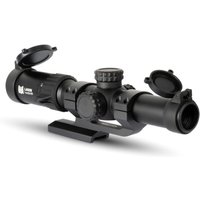
Monstrum Ladon 1-6x24mm LPVO 30mm Tube Rifle Scope, First Focal Plane, CM7 Reticle, Black, FFL16X-CM7
via OpticsPlanet
$134.99
Monstrum Ladon 1-6x24mm LPVO 30mm Tube Rifle Scope, First Focal Plane, CM3 Reticle, Black, FFL16X-CM3
via OpticsPlanet
$134.99
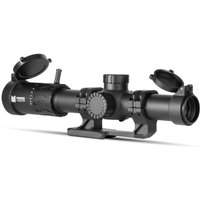
Monstrum Panzer ED 1-6x24mm LPVO 30mm Rifle Scope, First Focal Plane, CM3 Reticle, Black, FFZ16X-B
via OpticsPlanet
$149.99
Buying Advice
Start with the numbers that actually matter. Every T6Xi shares a 6× erector ratio, but the critical specs diverge: the 1-6×24 has a 24 mm objective and weighs roughly 22 oz, making it an ideal LPVO for an AR-15 or lightweight bolt gun. The 5-30×56 uses a 56 mm objective and tips the scales near 35 oz — heavier, but it gathers significantly more light at dusk and gives you 30× for target ID and wind reading at extreme range. Tube diameter is 34 mm across the line, so budget for 34 mm rings or a one-piece mount. Eye relief runs around 3.5–4 inches depending on model; verify this against your stock's length of pull and cheek weld before buying.
Budget tiers in the tactical FFP scope world look roughly like this: entry-level options from Vortex (Viper PST Gen II) and Bushnell (Match Pro) land in the $600–$900 band and deliver solid glass with some compromises in turret repeatability or illumination brightness. The Steiner T6Xi sits in the mid-premium tier at roughly $1,200–$2,200 depending on magnification range — you get demonstrably better glass coatings, tighter turret tolerances, and Steiner's German-heritage quality control. Above that, Kahles K525i, March FX, and Swarovski dS push past $2,500–$4,000 with marginal optical gains but exotic features like integrated ballistic calculators. For most serious competitors and dedicated hunters, the T6Xi price band delivers the best value-to-performance ratio.
The most common mistake is buying more magnification than you need. A 5-30× scope on a 16-inch .223 AR carbine is optical overkill that adds unnecessary weight and limits close-range speed. Conversely, mounting a 1-6× on a heavy-barreled 6.5 PRC rifle built for 1,200-yard steel wastes the platform's capability. Another frequent error is ignoring reticle choice: the T6Xi's MRAD SCR reticle is optimized for mil-based wind and elevation holds, so if your ballistic solver outputs MOA, you either need to switch it to MRAD or look at the MOA-reticle variant if one is offered. Also watch for parallax adjustment range — the 1-6×24 is fixed-parallax at roughly 100 yards, while the higher-magnification models have side-focus parallax knobs adjustable from around 50 yards to infinity.
US-specific context matters. Coyote hunters in the Southwest who shoot at night with clip-on night-vision or thermal devices like the Hikmicro Thunder series need a scope that pairs well with those add-ons; the 3-18×50's generous objective bell and forgiving eye box make it a strong host scope. For PRS and NRL competitors — disciplines that dominate the US long-range scene — the 5-30×56 is the natural pick because stage distances routinely extend past 800 yards and target sizes can be as small as 2 MOA. You can find T6Xi scopes on Amazon.com or through OpticsPlanet, and most Steiner-authorized US dealers are listed through Beretta USA's dealer locator since Steiner is part of the Beretta family.
Matching the scope to your specific use case boils down to three questions. First, what is your realistic maximum engagement distance? If it is under 400 yards, the 1-6× or 2.5-15× will keep your rifle lighter and faster. Second, do you need a true-1× low end for both-eyes-open shooting or CQB transitions? Only the 1-6×24 delivers that. Third, how important is low-light performance? Larger objectives (50 mm, 56 mm) transmit more light, but they also raise the optical axis, potentially requiring taller rings that compromise cheek weld. For most US hunters taking whitetail, mule deer, or elk at realistic field distances under 500 yards, the 3-18×50 offers the best all-around balance of weight, magnification range, and twilight capability.
The competitive brand landscape in 2026 is fierce. Vortex's Razor HD Gen III 1-10× and 6-36× have eroded some of the T6Xi's market share at the LPVO and long-range ends. Leupold's Mark 5HD in 3.6-18× and 5-25× remains a favorite among US military and LE snipers. Zeiss's LRP S5 line targets PRS shooters with outstanding glass clarity. Kahles and March dominate the ultra-premium tier. Where the T6Xi still shines is in its combination of rugged German-made construction, reliable turret tracking, and a reticle design that is clean enough for hunting yet detailed enough for competition. If you value a scope that does both roles without compromise, the T6Xi line remains one of the strongest mid-premium choices on the US market.
Frequently Asked Questions
What does the 6× zoom ratio in the Steiner T6Xi actually mean?
The 6× zoom ratio means the maximum magnification is exactly six times the minimum. So the 1-6×24 goes from 1× to 6×, and the 5-30×56 goes from 5× to 30×. This moderate ratio lets Steiner optimize optical clarity across the entire zoom range without the edge softness or tunneling you sometimes see in higher-ratio designs. It is a deliberate engineering trade-off: you sacrifice extreme zoom versatility in exchange for sharper, brighter images at every power setting.
Which Steiner T6Xi magnification is best for coyote hunting?
For most coyote hunting scenarios in the US — calling at 50–400 yards, often at dawn or dusk — the 2.5-15×50 or 3-18×50 are the strongest choices. The 50 mm objective gathers enough light for low-light shots, and 15–18× is plenty of magnification to ID and hold on a coyote-sized target at 400 yards. If you plan to pair the scope with a clip-on night vision or thermal device for nighttime predator work, the 3-18×50's larger objective and forgiving eye box make it particularly well-suited as a host optic.
Is the Steiner T6Xi 1-6×24 a good LPVO for an AR-15?
Yes, the T6Xi 1-6×24 is an excellent LPVO for an AR-15 platform. At roughly 22 ounces, it keeps the rifle balanced for dynamic shooting. Its true-1× low end allows both-eyes-open target acquisition at close range, and 6× is sufficient for precise shots on steel or game out to 300–400 yards with 5.56 NATO or .300 Blackout. The FFP reticle means holdovers are valid at any magnification — a genuine advantage in fast-paced 3-gun stages or home defense scenarios.
Can I use the Steiner T6Xi 5-30×56 for long range shooting past 1,000 yards?
Absolutely. The 5-30×56 was designed with PRS/NRL competition and extreme-range precision in mind. At 30×, you can read mirage, spot trace, and resolve small steel targets well past 1,000 yards. Its MRAD turrets offer precise 0.1 mil clicks — each click moves the point of impact 1 cm at 100 meters, or roughly 0.36 inches at 100 yards. Paired with a capable cartridge like 6.5 Creedmoor or .300 PRC, this scope will not be the limiting factor at distance.
Are all Steiner T6Xi scopes first focal plane?
Yes, every T6Xi model is a first-focal-plane (FFP) design. This means the reticle scales proportionally with magnification, so your mil-based holdovers and windage corrections remain accurate whether you are zoomed to 3× or 18×. The trade-off is that the reticle appears smaller and thinner at low magnification, which can make it harder to see in dim light. Steiner mitigates this with illuminated center-dot options that stay visible even at the lowest power settings.
What rings or mount do I need for the Steiner T6Xi's 34 mm tube?
All T6Xi models use a 34 mm main tube, so you need 34 mm rings or a one-piece cantilever mount. For AR-platform rifles, a quality one-piece mount like the Geissele or Scalarworks LEAP provides proper eye relief positioning and return-to-zero repeatability. For bolt-action rifles, matched 34 mm ring sets from Vortex, Leupold, or Spuhr work well. Make sure ring height accommodates the objective bell diameter — the 56 mm objective on the 5-30× model requires medium-high or high rings to prevent contact with the barrel.
How does the T6Xi compare to the Vortex Razor HD Gen III in the same magnification range?
Both are top-tier FFP tactical scopes with excellent glass and reliable turrets. The Vortex Razor HD Gen III 1-10× offers a wider zoom ratio (10× versus 6×) in its LPVO form, giving you more top-end at the cost of slightly more weight and a marginally less clean image at maximum power. The Steiner T6Xi tends to have a slight edge in chromatic aberration control and color fidelity thanks to its German optical heritage. Price points are comparable, so the decision often comes down to reticle preference and brand loyalty.
Is the Steiner T6Xi suitable for mounting on an air rifle?
The T6Xi is built to handle centerfire recoil, so it will survive on a PCP air rifle without issue. However, it is massive overkill for most air-rifle applications. Sub-12 ft-lb spring-piston air rifles are only effective to about 50–75 yards, and even powerful PCP platforms top out around 100–150 yards. A lighter, lower-magnification scope in the $200–$500 range is a better match. Additionally, spring-piston air rifles produce a unique double-recoil impulse that can damage scopes not specifically rated for it — the T6Xi is not marketed as springer-rated.
Does the Steiner T6Xi work well as a host scope for clip-on thermal or night vision devices?
Yes, particularly the 3-18×50 and 2.5-15×50 models. Their 50 mm objectives provide a wide enough light cone for most clip-on night-vision and thermal imagers like those from Hikmicro or other popular US-market brands. When using a clip-on device, you typically run the host scope at its lowest magnification to maximize field of view and minimize vignetting. The T6Xi's forgiving eye box and consistent optical quality across the zoom range make it a reliable host for nocturnal predator hunting or hog control.
Related guides
Upgrade your Savage MkII with the right rimfire scope in 2026. We cover FFP vs SFP, parallax settings, MOA vs MRAD, and top picks from Vortex, Leupold…
Best Scopes for Long-Range Rimfire on a CZ 457 MTRFind the best scope for long-range rimfire shooting on a CZ 457 Varmint MTR. We cover FFP reticles, turret quality, parallax…
Not sure which scope is right for you?
Try our AI-powered scope finder — answer a few questions and get personalised recommendations.
Find My Scope →Get a UK scope tip every day
Follow AiScopes on Facebook for daily buying guides, deals and gear advice.
Follow on Facebook