Best Scopes for Sub-Inch Targets at 40–50 Yards With a .22 Spring Rifle
Shopping in the US? This page is on our US site: aiscopes.us →
By Peter Makulek · Senior Optics Editor · · Live prices from US retailers
Hitting a target smaller than one inch across at 40 to 50 yards sounds modest compared to centerfire benchrest shooting, but on a .22-caliber spring-piston air rifle it is genuinely demanding — especially for a new shooter dealing with crosswinds and a roughly six-foot height advantage over the target. The pellet is light (typically 14–18 grains), travels at subsonic velocity, and sheds energy fast. Wind drift that a .22 LR rimfire shooter barely notices can push an airgun pellet a full inch or more off course at 50 yards. Understanding what your scope can and cannot do for you is the first step toward consistent hits.
Spring-piston air rifles add a unique challenge that no rimfire or centerfire shooter faces: the double-recoil impulse. When you pull the trigger, the piston lurches forward, and the rifle actually moves before the pellet leaves the barrel. Cheap scopes designed for firearms — even good rimfire scopes — can have their reticles sheared loose or their erector tubes battered apart by this reversed recoil. You need optics specifically rated for spring or gas-ram air rifles, or at the very least models with a proven track record on springers. This is not marketing hype; it is a genuine mechanical constraint that narrows your choices.
From an elevated position about two meters above the target, geometry is on your side more than you might think. The actual ballistic drop at 40–50 yards with a .22-caliber springer zeroed at 30 yards is only a few inches, and shooting slightly downhill at that range reduces the effective gravitational drop by a tiny fraction. The real enemies are parallax error and wind. A scope with adjustable parallax — sometimes called adjustable objective or side-focus — set precisely at your shooting distance eliminates the optical error that makes your point of aim shift when your eye moves behind the scope. Without that adjustment, even perfect trigger control won't save you.
This guide is written for US-based shooters who want to consistently ring sub-inch steel or punch tiny groups on paper at field-target distances with an entry-level springer. We will walk through the optics technology that matters — FFP versus SFP, MOA versus MRAD holdovers, parallax adjustment ranges, and magnification sweet spots — and then recommend the scopes that survive springer recoil and deliver the precision you need. Whether you are building skills for competitive field target, backyard plinking, or simply learning marksmanship fundamentals before stepping up to rimfire or centerfire, the right scope makes the difference between frustration and satisfaction.
Top Picks — Live US Prices

Barska 4X20 Rimfire Rifle Scope, Black Matte AC10730
via OpticsPlanet
$18.99
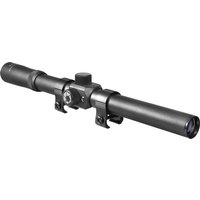
Barska 4x15 Rimfire Rifle Scopes - AC10000 Rifle Scope
via OpticsPlanet
$22.99

Simmons Pro Rimfire 4x32mm Rifle Scope with Rings, Black, Small, SPR432
via OpticsPlanet
$55.99
Buying Advice
Start with the specs that actually move the needle at 40–50 yards on a spring-piston platform. Magnification in the 4–16× range is ideal; you want at least 12× for aiming at sub-inch targets, but going beyond 16× on a springer amplifies every vibration and makes the sight picture swim. Adjustable parallax that goes down to 10 yards (or at least 15) is essential — most centerfire scopes bottom out at 50 or even 100 yards, which means they will show noticeable parallax error at your shooting distance. Look for click values of ¼ MOA or 0.1 MRAD. At 50 yards, one MOA subtends roughly half an inch, so ¼-MOA clicks give you about ⅛-inch adjustments — fine enough to walk onto a tiny target. MRAD users get 0.1-mil clicks, which equal about 0.18 inches at 50 yards. Either system works; pick whichever your reticle markings match.
Budget tiers for airgun-rated scopes break down clearly. Entry-level options from Bushnell, UTG, and Hawke in the $60–$150 range get you adjustable objective parallax and adequate glass, but coatings and turret repeatability are basic. Mid-range scopes from $150–$350 — think Athlon Argos or Vortex Diamondback Tactical — deliver noticeably sharper glass, better turret clicks, and illuminated reticles, though you must verify the specific model is springer rated or mount it on a one-piece rail with an anti-recoil pin. Premium air-rifle-specific optics from brands like Hawke and certain Bushnell Elite lines run $250–$500 and are purpose-built with reinforced erector assemblies. For most new shooters, the mid-range tier offers the best balance of optical quality and durability without over-investing before your shooting skills have matured.
The most common mistake new springer shooters make is mounting a scope designed for a .308 hunting rifle and assuming it will hold zero. Spring-piston recoil is bidirectional — forward then backward — and many conventional scopes simply are not built for it. The second mistake is ignoring parallax. If your scope is factory-set for 100-yard parallax and you are shooting at 45 yards, even a tiny shift in head position behind the eyepiece moves the apparent crosshair position on the target. At sub-inch precision, that error alone can cause a miss. Third, new shooters often over-crank magnification and then wonder why they cannot hold steady. A lower power setting with a sharper image and a wider exit pupil will yield better results than maximum zoom with a dim, jittery picture.
For US buyers, Amazon.com offers the widest selection of airgun-rated scopes with fast shipping and easy returns — critical when you need to verify that a scope survives your specific rifle's recoil characteristics. OpticsPlanet carries deeper inventory of tactical and competition optics from Vortex, Athlon, Nightforce, and Leupold, and often bundles rings and mounts. State-level considerations are minimal for optics purchases (no FFL required), though sales tax varies. If you plan to transition later to rimfire benchrest or PRS-style .22 LR competition, choosing a scope with a quality MRAD or MOA reticle now means you can remount it on a rimfire rifle later and keep building your skills with the same turret language. Many field-target and rimfire benchrest competitors in the US started on springers and carried their optics knowledge forward.
Matching the scope to your specific use case matters. If your primary goal is backyard plinking at steel spinners under an inch, a fixed-parallax scope set at 40 yards and 9–12× can be the simplest, most reliable option — fewer moving parts, fewer things to break on a hard-kicking springer. If you want to shoot field target competitively, you need a large-range adjustable parallax wheel because competitors use it as a rangefinder, reading the distance from the parallax dial before dialing elevation. If you are also considering coyote hunting with a .22-250 centerfire or stepping up to rimfire PRS, plan for a versatile scope with a first-focal-plane MRAD reticle so your subtension marks stay accurate at every magnification — though for a springer-only setup, a second-focal-plane reticle at a known magnification is perfectly adequate and often more affordable.
On the brand landscape, Vortex earns loyalty in the US market with its unconditional lifetime warranty — if the scope breaks on a springer, they replace it, no questions asked, which effectively makes every Vortex model springer-safe from a financial standpoint even if the internals are not purpose-built for bidirectional recoil. Bushnell offers dedicated airgun lines at accessible prices. Athlon provides strong mid-range value with excellent glass for the dollar. Leupold and Nightforce are premium picks that some serious field-target shooters favor, though the investment only makes sense once your shooting fundamentals are solid. Zeiss and Pulsar occupy different niches — precision hunting glass and thermal imaging respectively — and while a thermal scope is fascinating technology, it is overkill and mechanically inappropriate for a spring-piston platform.
Frequently Asked Questions
Is a spring-piston .22 air rifle accurate enough to hit sub-inch targets at 50 yards?
A quality .22-caliber springer shooting premium pellets can group around 0.75 to 1.5 inches at 50 yards when the shooter uses proper artillery hold technique. That is tight enough to hit sub-inch targets regularly, but consistency depends on pellet selection, a well-mounted scope with correct parallax, and calm wind conditions. In gusty crosswinds, even a perfect hold can see the pellet drift an inch or more at that distance.
Does being elevated about 2 meters above the target change my scope zero?
At 40–50 yards with only a 6-foot height difference, the downward angle is very slight — roughly 4 to 7 degrees. The cosine effect on bullet drop at this angle is negligible, amounting to a fraction of a pellet diameter. You can safely ignore the elevation difference and use your normal zero. If the angle were steeper, you would aim slightly low because gravity acts on the horizontal distance, not the line-of-sight distance.
Should I choose FFP or SFP for a .22 springer scope?
For a dedicated springer used at fixed short distances, a second-focal-plane scope is the practical and economical choice. SFP reticles are accurate for holdovers at one specific magnification (usually the maximum), and since you are always shooting at 40–50 yards, you will likely set magnification once and leave it. FFP scopes, where the reticle scales with magnification, offer more versatility if you later move the optic onto a rimfire or centerfire platform for varied distances, but they cost more.
Is the new Arken 2-12× SFP a good choice for this kind of shooting?
Arken has built a strong reputation for value-oriented tactical optics, and a 2-12× SFP offers a useful magnification range that tops out right where you need it for sub-inch targets at 50 yards. The key question is whether the parallax adjustment goes low enough — many Arken models have a 10-yard minimum, which is excellent. However, Arken scopes are not specifically rated for spring-piston recoil, so mounting one on a hard-kicking springer carries some risk to the erector system. On a gas-ram or a mild springer it is worth trying, especially given Arken's warranty support.
What is the best scope for PRS .22 or .22 benchrest shooting?
Rimfire PRS and benchrest competitors typically favor scopes with precise MRAD turrets, a first-focal-plane reticle, adjustable parallax down to 25 yards or less, and high magnification — 5-25× or 4-16× are common ranges. Popular choices include the Athlon Ares ETR, Vortex Razor HD LHT, and for higher budgets the Nightforce NX8 or Competition series. These scopes are designed for centerfire-style turret tracking and glass clarity, and they excel on bolt-action .22 LR platforms. They are not ideal for spring-piston air rifles due to recoil compatibility.
What is the best scope for coyote hunting with a .22-250?
A .22-250 is a flat-shooting, long-range varmint cartridge popular across the western US, and coyote hunters typically want a scope in the 4-16× or 6-24× range with a fine reticle for small targets at 200–400 yards. The Vortex Viper PST Gen II, Leupold VX-3HD, and Athlon Midas TAC are frequently recommended. Adjustable parallax and an illuminated reticle help during dawn and dusk hunts. This is a very different use case from an air rifle — the .22-250 generates normal rearward recoil, so any quality rifle scope will survive it.
What is the best buffer spring for a 9mm PCC with a Kynshot RB5007 buffer?
This is outside the optics domain, but the Kynshot RB5007 hydraulic buffer is designed to reduce felt recoil in pistol-caliber carbines and pairs well with a standard carbine-weight buffer spring or a slightly lighter spring depending on your specific PCC's action cycling. Many users run a standard mil-spec carbine spring successfully. Tuning involves adjusting spring weight to achieve reliable lockback on the last round without excessive bolt velocity. Consult the Kynshot compatibility chart and your PCC manufacturer's recommendations for the best pairing.
How much does wind affect a .22-caliber air rifle pellet at 50 yards?
A .22-caliber pellet at roughly 800 fps can drift 1 to 3 inches in a steady 10 mph crosswind at 50 yards, and gusts make the drift unpredictable. The pellet's low ballistic coefficient — typically 0.020 to 0.035 — means it decelerates rapidly and is at the mercy of air currents for a comparatively long flight time. Reading wind flags or vegetation movement and timing your shots between gusts is the most effective strategy, far more useful than any reticle-based windage holdover at this distance.
Do I need a spotting scope to see hits on sub-inch targets at 40–50 yards?
At 40–50 yards a spotting scope is helpful but not strictly necessary. A rifle scope at 12–16× magnification should let you see pellet holes on paper if you use high-contrast targets. For steel targets, you can hear and see the hit. A budget 20-60× spotting scope from Bushnell or Vortex placed beside you is useful during zeroing sessions to read groups without walking downrange. At this short distance, even a $100 spotting scope delivers adequate clarity.
Related guides
Find out if a 20 MOA rail works with the Vortex Venom at 100 yards. We cover zero offset, turret range, and when a canted base actually helps or hurts…
Nikon Rimfire Scopes: What Happened & What to Buy InsteadNikon rimfire scopes were legendary, but the line is discontinued. We cover what made them great and the best alternatives for .22LR in 2026 for US…
Not sure which scope is right for you?
Try our AI-powered scope finder — answer a few questions and get personalised recommendations.
Find My Scope →Get a UK scope tip every day
Follow AiScopes on Facebook for daily buying guides, deals and gear advice.
Follow on Facebook