HIKMICRO Alpex 4K vs Alpex Pro: Which Digital Day/Night Scope Suits UK Shooters?
By Peter Makulek · Senior Optics Editor · · Live prices from UK retailers
Quick answer: the Alpex 4K and the Alpex Pro are both 50 mm digital day/night scopes with a built-in recorder, an optional laser rangefinder and no built-in IR illuminator, but they take different routes to a good picture. The 4K has a 3840 x 2160 sensor and a brighter lens that opens to F1.2. The Pro has a 12 megapixel sensor with smaller pixels, an F1.8 lens, a longer rangefinder, a closer minimum focus and a lower listed weight. If most of your shooting is at last light and after dark with a good IR torch, the lens and sensor trade-off is the thing to weigh. If weight and rangefinder reach matter more, look at the Pro first.
HIKMICRO's Alpex range includes the Alpex 4K Lite, the Alpex 4K and the Alpex Pro. This guide compares the 4K and the Pro because they are the two that UK buyers weigh against each other. Every figure below is taken from HIKMICRO's own product pages, and where the maker does not publish a number we leave it out rather than guess. We quote no prices, because they change often between dealers.
One safety point before the specs. A maker's detection range is how far the scope can pick out something in the picture. It is not how far a rifle should shoot. A sub-12 ft-lb air rifle stays effective only over short distances, a few tens of yards, however good the scope is. For a centrefire or rimfire rifle, identification and a safe backstop limit the shot, not the sensor.
Top Picks — Live UK Prices
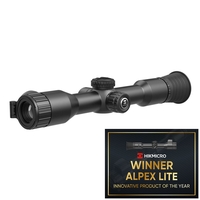
HIKMicro Alpex 4K Lite Digital Day/Night Riflescope
via Uttings
£399.00
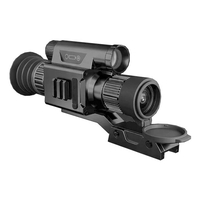
Fuego DS-X7 4K Day & Night Vision Rifle Scope
via Uttings
£299.99
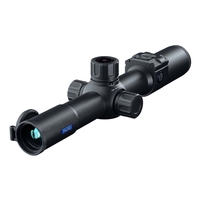
Pard Night Stalker Mini Night Vision Riflescope - 35mm
via Uttings
£339.00
Buying Advice
The sensor and the display. The Alpex 4K uses a 3840 x 2160 CMOS sensor behind a 0.49 inch OLED display of 1920 x 1080. The Alpex Pro uses a 12 megapixel CMOS sensor of 4512 x 2512 pixels with a 1.4 micrometre pixel pitch, behind a larger 0.6 inch AMOLED display, also 1920 x 1080. So both show you a 1080-line picture in the eyepiece. The extra sensor pixels do not appear on the display directly. They give the scope more to work with when it zooms digitally, and they give the processor more information to build the image.
The lens, and why pixels are not everything. The Alpex 4K has a 50 mm lens with an adjustable aperture from F1.2 to F2.5. The Pro has a 50 mm lens at F1.8. A lower F-number lets in more light, so the 4K's lens can be brighter in the dark, and you can close it down in daylight to cut overexposure. Smaller pixels on a sensor generally collect less light each, so a sensor with more, smaller pixels needs help. HIKMICRO says the Pro uses its Light Pro processing, which it describes as the equivalent of an F0.9 lens in brightness, with up to three times the signal-to-noise ratio. That is the maker's claim and we have no figures of our own to confirm it, so judge it on a dark night.
Magnification and field of view. The 4K zooms from 3.5x to 28x, with a field of view of 8.8 by 5.0 degrees, which is about 15.3 by 8.6 metres at 100 metres. The Pro zooms from 4.0x to 24x with 7.2 by 4.0 degrees, about 12.6 by 7 metres at 100 metres. At their lowest setting the 4K shows you a wider scene, which helps you pick up a moving fox. The Pro's minimum focus distance is 3 metres against 10 metres on the 4K, which is useful for close work around buildings.
Rangefinder. Both scopes come with or without a laser rangefinder. The Alpex 4K with the rangefinder is the A50EL. HIKMICRO lists its range as up to 1,000 metres with an accuracy of plus or minus 1 metre. The Pro with the rangefinder is the A50PL, listed at 3 to 1,200 metres, also plus or minus 1 metre. Both calculate a ballistic aim point from the distance and the ammunition data you enter. The versions without a rangefinder, the A50E and the A50P, offer neither. A rangefinder reading depends on the target. A thin, angled or fur-covered animal gives a weaker return than a post, so always check a reading against what you know of the ground.
Daytime detection. HIKMICRO lists a daytime detection range of 1,000 metres for the 4K and 1,500 metres for the Pro. Treat both as maker figures for detecting an object in good light. They say nothing about identifying a roe deer, a fox or a rabbit and what is behind it. What limits identification is magnification, sensor detail, light and air quality, and those depend on your night, not on the data sheet.
Battery, weight and build. The 4K is listed with 11 hours of continuous running, the Pro with about 7 hours. Both figures are HIKMICRO laboratory results at 25 degrees with the hotspot off, so expect less in a cold winter field. Both use two internal rechargeable cells plus a replaceable 18650 external battery, both are rated IP67 and both mount in standard 30 mm rings. The weights are listed on different bases: 1,080 g for the A50E and 1,176 g for the A50EL without the external battery, 852 g for the A50P and 889 g for the A50PL with it. Even though the Pro's figure includes the external battery and the 4K's does not, the Pro is listed as the lighter scope. On a stalking rifle or a heavy-barrelled air rifle, that is a real difference in balance.
What they share. Both list 64 GB of built-in storage, five zeroing profiles, the same recoil rating, a start-up of about three seconds and operating temperatures from minus 30 to plus 55 degrees. Neither page lists a built-in IR illuminator. HIKMICRO says you add an IR torch of your own and names two accessory torches for the range. That is the point to take away: after dark, on either scope, the torch decides much of the picture. Our guide to VCSEL against LED torches and our guide to IR wavelengths will help you choose one.
Choosing between them. If your priority is night work at moderate range with a good IR torch, the 4K's brighter lens and longer battery life are the strongest cards. If you want something lighter, with a longer rangefinder, a wider focus range and a high-resolution sensor for daytime use, the Pro suits you better. If you are not sure, remember that the smaller Alpex 4K Lite exists too, which HIKMICRO describes as under 500 g. Look through both on a dark evening before you buy.
The Rix Tourer T50 4K. You may see it mentioned beside these two. RIX's own page lists a 3840 x 2160 sensor, a 1920 x 1080 display, a 50 mm F1.2 lens, a built-in laser rangefinder rated to 1,640 yards (about 1,500 metres), a ballistic calculator, IP67 protection and 21700 or 18650 batteries. The page does not state the magnification, frame rate or battery runtime, so we do not compare those. Check RIX's manual for them before you set it against the Alpex scopes.
Which fits UK use. For rats and rabbits with a sub-12 ft-lb air rifle at 15 to 40 yards, neither scope is needed, and their weight is out of proportion to the job. For foxing with an FAC rimfire or centrefire rifle, a digital scope with a rangefinder is useful, provided you identify the animal and check your backstop. Our guide to UK night vision and thermal law covers the rules, and this is not legal advice.
Frequently Asked Questions
Is the Alpex Pro better than the Alpex 4K?
Neither is better at everything. The 4K has a brighter F1.2 to F2.5 lens and a longer listed battery life. The Pro has a 12 megapixel sensor, a longer rangefinder, closer minimum focus and a lower listed weight. Choose by how you shoot and test both after dark.
Do the Alpex 4K and Alpex Pro have a built-in IR illuminator?
HIKMICRO lists no built-in illuminator on either product page and offers separate IR torches as accessories. Budget for a torch.
What is the difference between the A50E, A50EL, A50P and A50PL?
The E models are the Alpex 4K and the P models are the Alpex Pro. The L at the end means a built-in laser rangefinder, with a ballistic calculator, so the A50EL and A50PL have one and the A50E and A50P do not.
Does a 4K sensor mean a 4K picture?
No. Both scopes show you a 1920 x 1080 picture on the eyepiece display. The sensor resolution affects how much detail the scope has available, especially when it zooms digitally.
Is the 1,000 m or 1,500 m detection range the distance I can shoot?
No. It is a maker's figure for detecting an object in good light. Safe shooting depends on identifying the target, a safe backstop and the range of your rifle. A sub-12 ft-lb air rifle is effective over only a few tens of yards.
Which Alpex is better for a sub-12 ft-lb air rifle?
Neither is needed for close-range ratting. The weight is high for a light air rifle. If you do want a digital scope on one, consider the lighter Alpex 4K Lite or a smaller unit, and try the rifle with the scope on it first.
Related guides
Our in-depth UK guide to the HIKMICRO Alpex A50T digital night vision scope. Covers specs, performance, price bands, legal context…
VCSEL or LED IR Torch for Digital Night Vision? A UK Foxing and Ratting GuideVCSEL or LED infrared torch for your digital night vision scope? What really differs, what sets range, and how to compare two torches fairly on a dark UK night.
IR Illuminator Wavelengths Explained: 850nm vs 940nm850nm or 940nm IR illuminator for UK night shooting? We explain the real-world differences in range, visibility and stealth so you pick the right…
Best Night Vision Scopes for UK Hunting in 2026Our expert UK guide to the best night vision scopes for hunting in 2026. Covers digital vs intensifier, legality in England, Scotland and Wales…
Not sure which scope is right for you?
Try our AI-powered scope finder — answer a few questions and get personalised recommendations.
Find My Scope →Get a UK scope tip every day
Follow AiScopes on Facebook for daily buying guides, deals and gear advice.
Follow on Facebook