AirHawk Elite II Scope Setup: What You Need to Know
Shopping in the US? This page is on our US site: aiscopes.us →
By Peter Makulek · Senior Optics Editor · · Live prices from US retailers
The Ruger AirHawk Elite II is one of the most popular break-barrel spring-piston air rifles in the US market, and for good reason. It ships with a Mantis-branded 3-9x32 AO scope already mounted, which lowers the barrier to entry for new shooters. But after roughly six weeks of regular use, many owners start asking the same questions: Is the bundled scope holding up? Is parallax adjustment actually doing anything at backyard distances? And would an aftermarket optic be a meaningful upgrade, or is the included glass good enough for what a springer can realistically do? These are the right questions, and this guide is built to answer every one of them with technical precision.
Understanding the optics that ship with budget air rifles is important because the scope is frequently the weakest link in the accuracy chain — not the rifle itself. The Mantis 3-9x32 AO is a second focal plane (SFP) scope with adjustable objective parallax, MOA turrets, and coated optics. On paper that sounds competent, but the real-world performance at the distances a spring-piston air rifle actually shoots — typically 10 to 50 yards, with a practical ceiling around 75 yards — depends heavily on how well the scope handles the unique double-recoil impulse of a springer and whether the adjustable objective genuinely eliminates parallax error at short range.
This guide covers the core optics technology behind scopes like the Mantis 3-9x32 AO: first focal plane versus second focal plane reticles, MOA versus MRAD adjustment systems, and the critical role of parallax correction on short-range platforms. We will also walk through what to look for if you decide the bundled scope is not meeting your needs and you want to upgrade to something better suited for the AirHawk Elite II's specific demands. Every recommendation is grounded in what a break-barrel springer can actually deliver, not centerfire fantasy.
For US shooters, the AirHawk Elite II occupies a sweet spot: it is widely available on Amazon.com and at big-box sporting goods retailers in all 50 states, it requires no FFL transfer, and it is legal for backyard shooting in most jurisdictions. That accessibility means a lot of first-time optics buyers are learning scope fundamentals on this exact platform. Whether you are plinking in a Texas backyard, controlling pests on an Ohio farm, or teaching a new shooter in your Montana garage, the optics principles here apply directly to your setup.
Top Picks — Live US Prices

Monstrum Guardian 3-9x40mm 1in Tube Rifle Scope, Second Focal Plane, Crosshair Reticle, Black, SG3940-B
via OpticsPlanet
$53.99
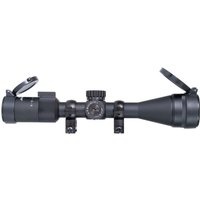
Monstrum Guardian AO Rifle Scope, 3-9x40mm, 1 inch Tube, Second Focal Plane, Crosshair Reticle, Black, SG3940AO-B
via OpticsPlanet
$63.99

Nikko Stirling Mountmaster 3-9x40 AO, 1in Tube Rifle Scope, Second Focal Plane, HMD Reticle, 1/4 MOA, Matte Black, NMM3940AON
via OpticsPlanet
$64.24
Buying Advice
Start with the key specs that matter on a short-range springer scope. Magnification range of 3-9x is ideal — you rarely need more than 9x at 50 yards, and lower magnification at 3x gives you a wider field of view for acquiring targets quickly. The 32mm objective lens is compact and lightweight but admits less light than a 40mm or 50mm objective, so image brightness drops noticeably in low-light conditions. Adjustable objective (AO) parallax is the most critical feature: at 10-25 yards, fixed-parallax scopes set at 100 yards will show significant parallax error, meaning your point of impact shifts when you move your eye behind the scope. A proper AO lets you dial parallax down to as low as 10 yards. On MOA turrets, remember that 1 MOA equals approximately 1.047 inches at 100 yards, so at 25 yards each click moves your impact roughly a quarter of that — small but meaningful for precision pellet placement.
Budget tiers for air rifle scopes in the US market break down clearly. Entry-level optics in the sub-$50 range — including most bundled scopes like the Mantis 3-9x32 — use basic coatings, plastic turret internals, and lenses that may not hold zero under springer recoil. Mid-range scopes from roughly $60 to $150 include models specifically rated for spring-piston recoil, with better glass coatings (fully multi-coated is the standard to look for), metal turret mechanisms, and more reliable AO adjustments. Premium airgun optics from $150 to $300-plus offer features like etched glass reticles, side-focus parallax, locking turrets, and significantly sharper edge-to-edge clarity. The jump from entry to mid-range is the single biggest improvement most AirHawk owners can make.
The most common mistake buyers make is purchasing a centerfire rifle scope for a break-barrel air rifle. Standard centerfire scopes are engineered to handle rearward recoil only. A spring-piston air rifle generates a unique forward-then-backward double-recoil impulse that can shatter internal lenses, strip turret gears, and shift zero in a conventional scope within a few hundred shots. Always confirm that any replacement scope is explicitly rated for spring-piston or magnum air rifle use. Another frequent error is over-magnifying: a 16x or 24x scope on a platform that maxes out at 50-75 yards just amplifies mirage, wobble, and every imperfection in your hold technique without adding useful resolution.
For US buyers, Amazon.com is the most convenient source for airgun-rated scopes with fast shipping and easy returns, while OpticsPlanet carries a broader selection of specialized airgun optics from brands that do not always appear on Amazon. No state-level restrictions apply to purchasing optics themselves, though always check your local ordinances regarding air rifle use in residential areas before setting up a backyard range. The AirHawk Elite II uses a standard 11mm dovetail rail, so ensure any replacement scope or rings are compatible with 11mm dovetail — not Picatinny or Weaver, which are wider at approximately 20-21mm. Adapter rails exist but add height and potential wobble, so a native dovetail mount is preferable.
Matching the optic to your actual use case prevents overspending and disappointment. If you are plinking at tin cans from 10 to 30 yards, the bundled Mantis scope is honestly adequate — just verify it is holding zero and use the AO ring to eliminate parallax at your shooting distance. If you are doing pest control where precise shot placement on small targets matters, upgrade to a mid-range scope with a finer reticle (like a mil-dot or duplex with a fine crosshair) and confirmed springer-rated construction. If you are shooting field target competition, invest in a scope with a reliable side-focus parallax wheel, which many competitors use as a rangefinding tool by noting the focus distance markings.
In the airgun optics landscape, several brands have earned strong reputations among US spring-piston shooters. Hawke is widely regarded as the gold standard for dedicated airgun scopes, offering models specifically engineered for springer recoil with excellent glass quality. UTG and Leapers produce budget-friendly options with legitimate spring-piston ratings. Bushnell and Centerpoint offer some models that crossover well into airgun use. When evaluating any brand, look for explicit language about spring-piston or magnum airgun compatibility — vague terms like 'shockproof' do not guarantee survival under the unique stress pattern of a break-barrel rifle. The Mantis brand itself is essentially a Ruger-spec OEM scope and is not widely sold as a standalone product, which limits parts and support availability.
Frequently Asked Questions
Is the Mantis 3-9x32 AO scope that comes with the Ruger AirHawk Elite II any good?
The Mantis 3-9x32 AO is a serviceable entry-level scope that gets new shooters on paper quickly. Its adjustable objective parallax is a genuine benefit at short airgun distances. However, the glass coatings, turret feel, and build quality are below what you would find in a dedicated mid-range airgun scope, and some users report zero-shift after extended use under springer recoil.
What does the AO (adjustable objective) on the Mantis scope actually do?
The AO ring on the front bell of the scope lets you adjust the focal point of the objective lens to match your target distance, which eliminates parallax error. Parallax causes your point of aim to shift relative to your point of impact when your eye is not perfectly centered behind the scope. At the short distances airguns operate — 10 to 50 yards — parallax correction is critical because fixed-parallax scopes are typically set for 100 yards and will show significant error up close.
What is the difference between FFP and SFP, and which does the Mantis 3-9x32 use?
The Mantis 3-9x32 is a second focal plane (SFP) scope, meaning the reticle stays the same apparent size regardless of magnification. In a first focal plane (FFP) scope, the reticle scales with magnification so that holdover marks and hash marks remain accurate at every power setting. For airgun use at short range with simple duplex reticles, SFP is perfectly fine — FFP scopes are more relevant for long-range centerfire shooting where precise holdovers at varying magnifications matter.
Can I put a regular rifle scope on the Ruger AirHawk Elite II?
You can physically mount one, but it is a bad idea. Standard centerfire scopes are designed for purely rearward recoil. The AirHawk Elite II is a spring-piston air rifle that produces a sharp forward-then-backward recoil impulse, which can destroy internal components of a scope not rated for that stress. Always choose a scope explicitly rated for spring-piston or magnum air rifle use to avoid cracked lenses and stripped turrets.
How far can the Ruger AirHawk Elite II shoot accurately?
The AirHawk Elite II is a break-barrel springer producing energy in the range of roughly 12 to 15 foot-pounds in .177 caliber. At that power level, realistic accuracy — meaning consistent sub-inch groups — extends to about 30-40 yards for most shooters, with 50 yards being achievable with good pellet selection and technique. Beyond 75 yards, pellet energy and trajectory drop make precision impractical regardless of scope quality.
What mount type does the AirHawk Elite II use, and will Picatinny rings fit?
The AirHawk Elite II uses an 11mm dovetail rail, which is the standard for most air rifles. Picatinny and Weaver rings are designed for a wider rail (approximately 20-21mm) and will not clamp properly on an 11mm dovetail. You need rings specifically made for 11mm dovetails, or you can use a dovetail-to-Picatinny adapter rail — though a native 11mm mount is more stable and sits lower.
Should I upgrade the scope or the pellets first for better accuracy?
Upgrade your pellets first. Premium pellets from brands like JSB, H&N, or Crosman Premier are often the single biggest accuracy improvement you can make on a springer, and they cost very little. Once you have found the pellet your rifle shoots best and you are still dissatisfied with optical clarity, zero retention, or parallax adjustment, then a scope upgrade becomes the logical next step.
What does MOA mean on the Mantis scope's turrets, and how do I use it?
MOA stands for minute of angle. One MOA equals approximately 1.047 inches at 100 yards. The Mantis 3-9x32 AO has turrets that adjust in 1/4 MOA increments, so each click moves the point of impact about 0.26 inches at 100 yards. At typical airgun distances of 25 yards, each click moves impact roughly 0.065 inches — very small adjustments, which is why you often need multiple clicks to see a meaningful shift on target.
How do I know if my scope has lost zero on the AirHawk Elite II?
Shoot a five-shot group at a known distance (25 yards is ideal) from a stable rest. If your group is tight but consistently off from your aim point, the scope has shifted zero and needs re-zeroing. If groups are scattered randomly despite a consistent hold, the scope's internals may be damaged by recoil and the scope likely needs replacement rather than adjustment. Testing every few hundred shots helps you catch zero-shift early.
Related guides
Find the best scope for the Ruger American Gen 2 in 2026. Budget-matched US picks for deer, predator, and big-game chamberings with mounting tips and FAQs.
Best Scope for Your First Rifle in 2026: A New Shooter's GuideBuying a scope for your first rifle in 2026? Why the cheapest listing is a bad bet, the right magnification, durability basics…
Best Scopes for the Ruger 10/22 in 2026Find the best scope for a Ruger 10/22 in 2026. Rimfire-specific picks for hunting, plinking, Takedown models, and NRL22 competition — all for US buyers.
Budget Scopes That Survive the Gamo Viper Storm .22Find the best budget rifle scope that handles the brutal reverse recoil of a Gamo Viper Storm .22 air rifle.
Hear Me Out… MOA Is Actually BetterIs MOA really better than MRAD for long-range shooting, hunting, and PRS in 2026? We break down the math, the myths…
Not sure which scope is right for you?
Try our AI-powered scope finder — answer a few questions and get personalised recommendations.
Find My Scope →Get a UK scope tip every day
Follow AiScopes on Facebook for daily buying guides, deals and gear advice.
Follow on Facebook