One Scope, Multiple Rifles: UK Buyer's Guide 2026
By Peter Makulek · Senior Optics Editor · · Live prices from UK retailers
For many UK shooters, the idea of sharing a single high-quality optic across two or more rifles is enormously appealing. A premium scope from the likes of Zeiss, Nightforce or March can easily cost upwards of £2,000, and if you own a deer-stalking rifle and a separate foxing setup — or perhaps a hill rifle and a woodland rifle — duplicating that spend is hard to justify. Quick-detach mount technology has matured to the point where repeatable return to zero is no longer a dream, and in 2026 UK shooters have better options than ever for making a single optic work across their entire battery.
The practical challenge, of course, is consistency. Every time you remove a scope and reattach it, any deviation in seating translates directly into zero shift. At 100 metres, even a tiny error becomes a miss on quarry as small as a muntjac's vital zone or a fox's head. That is why the choice of mounting system is just as important — arguably more so — than the scope itself. This guide focuses on both: optics that lend themselves to being swapped, and the mounts and rail standards that make the process reliable and repeatable for UK stalkers and vermin controllers.
We also need to address the rail ecosystem on your rifles. The UK market has historically been a mix of Picatinny (MIL-STD-1913), Weaver and various proprietary dovetail standards. If you plan to share a scope, every rifle in your battery needs to run the same rail standard, ideally Picatinny, which offers the tightest tolerances and the widest selection of quality quick-detach mounts. Retro-fitting a precision Picatinny base to a bolt-action like a Tikka, Sako, Blaser or CZ is straightforward through UK retailers and gunsmiths, and it is the single most important step in making a shared-scope system work.
This guide covers the key decision factors: FFP versus SFP reticle choice for versatility, MOA versus MRAD turret systems, parallax considerations across different engagement distances, and — most importantly — how quick-detach monomounts and lever-release ring systems actually achieve consistent return to zero. We will then recommend optics and mounts that suit UK stalking and vermin control, provide detailed buying advice with realistic GBP price tiers, and answer the most common questions UK shooters are asking in 2026.
Top Picks — Live UK Prices
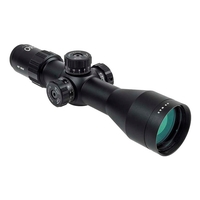
PAO HD MAX 4-16x44 SF FFP Ultra Compact Riflescope
via Uttings
£219.00
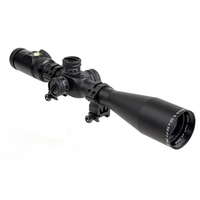
PAO F1 5-20x50 IR SF FFP Rifle Scope
via Uttings
£239.00

Wulf Tornado FFP 6-24x50 W-MIL3 Side Focus Rifle Scope
via BushWear
£249.99
Buying Advice
Understanding the key specifications is vital before committing to a shared-scope system. A first focal plane (FFP) reticle scales with magnification, meaning your holdover and windage marks remain accurate at every power setting — a significant advantage when you are switching between a low-magnification woodland stalk on muntjac and a higher-magnification foxing session at 200 metres. Second focal plane (SFP) reticles are only dimensionally correct at one magnification, so you must remember your reference power. For a scope destined to travel between rifles and roles, FFP is almost always the better choice. On turret systems, MRAD (0.1 mil clicks, where 1 mil subtends 10 cm at 100 metres) is the dominant system among UK stalkers who dial, while MOA (where 1 MOA subtends roughly 1.047 inches at 100 yards, approximately 2.9 cm at 100 metres) still has its adherents. Choose one system and stick with it across your battery.
Budget tiers for a viable shared-scope setup in 2026 break down roughly as follows. At the entry level, around £400–£700 for the optic, you can find solid FFP scopes from Vortex (Viper PST Gen II) or Meopta that offer good glass and reliable tracking, paired with a quality QD mount in the £150–£300 range — names like Tier-One, Spuhr and Recknagel dominate here. In the mid-tier, £800–£1,500, Leupold's Mark 5HD and Nightforce's SHV or NX8 lines deliver excellent optical clarity, bomb-proof mechanicals and illuminated reticles that work well across multiple roles. At the premium end, £1,800 and above, March, Zeiss V8 and Nightforce ATACR represent the peak: optically superb, mechanically flawless and built to endure thousands of mount-unmount cycles without issue.
Common mistakes UK buyers make when building a shared-scope system include mismatching rail standards across rifles. A scope in a Picatinny QD mount will not seat reliably on a Weaver rail — Picatinny cross-slots are spaced at 0.394-inch centres and cut to tighter tolerances. Another frequent error is buying cheap QD rings rather than investing in a quality one-piece monomount. A single-piece lever-release mount, such as those from Tier-One or Spuhr, clamps the scope tube in a rigid cradle and locates on the rail via precision-machined lugs, virtually eliminating the flex and inconsistency that two separate rings can introduce. A third pitfall is failing to test return to zero systematically before relying on the system in the field — we cover how to do this in the FAQ below.
UK-specific context matters enormously here. If you stalk deer in England and Wales, you are bound by minimum calibre and bullet-energy requirements under the Deer Act 1991 — for example, .240 calibre and 1,700 ft-lbs for most species. Your foxing rifle might be a lighter .223 or .204. These different calibres generate very different recoil impulses, and a scope that handles both must be built to sustain repeated battering without internal shift. Note too that all centrefire rifles in the UK require a Firearms Certificate (FAC) granted by your local police force, and any scope you mount on an FAC-rated air rifle (above 12 ft-lb in England and Wales, or any air weapon in Scotland without an Air Weapon Certificate) falls under the same regulatory umbrella. Always check with your local constabulary or BASC for guidance specific to your situation.
Matching the setup to your use case is the final step. If your battery consists of two bolt-action stalking rifles — say a .308 for woodland roe and fallow, and a .243 for open-hill foxing — a 3-18×44 or 4-16×44 FFP scope in a Tier-One monomount on matching Picatinny rails is arguably the ideal UK all-rounder. The magnification range covers everything from 50-metre woodland shots to 300-metre hill work. If one of your rifles is a rimfire for rabbit and squirrel control, consider parallax carefully: you need a scope that adjusts down to at least 25 yards, ideally lower, because rimfire work often happens inside 75 metres. For sub-12 ft-lb airgun use, sharing a centrefire scope is rarely practical — airgun scopes need parallax adjustment down to around 10 yards, and the short engagement distances make a dedicated optic far more sensible.
The brand landscape in 2026 reflects a UK market that has shifted firmly towards MRAD FFP optics with exposed turrets. Nightforce and March dominate the premium end among serious UK stalkers, while Vortex continues to offer extraordinary value in the mid-tier with excellent warranty support via UK distributors. Zeiss and Leupold remain popular with traditional stalkers who value optical brilliance and lighter weight. On the mount side, Tier-One — a British company manufacturing in the UK — has become the default recommendation for precision QD monomounts among UK shooters, with Spuhr (Swedish-made, widely stocked by UK dealers) offering an alternative at a higher price. Recknagel lever-release rings from Germany are another proven option, particularly for shooters who prefer two-piece ring setups over a monomount. Buy from established UK retailers who can advise on rail compatibility and offer proper after-sales support.
Frequently Asked Questions
Can I swap one scope between my deer-stalking rifle and my foxing rifle without re-zeroing every time?
Yes, provided you use a precision quick-detach mount system and identical Picatinny rail bases on both rifles. A quality QD monomount from a manufacturer like Tier-One or Spuhr is engineered to return to zero within 0.1–0.2 MRAD (roughly 1–2 cm at 100 metres) when removed and reattached. However, you should always confirm your zero with a few rounds before taking a shot at live quarry — responsible stalking demands it, and even the best mechanical system can be affected by temperature, knocks during transport, or accumulated wear.
Which quick-detach mount systems offer the most consistent return to zero for UK shooters?
Tier-One monomounts are the most popular choice among UK stalkers, offering British-made precision at a price point around £200–£350 depending on the model. Spuhr's ISMS mounts are considered the gold standard globally and are widely stocked by UK dealers, typically in the £350–£500 range. Recknagel lever-release mounts from Germany also have an excellent reputation. All three brands consistently demonstrate return-to-zero performance well within 0.2 MRAD when properly fitted to a quality Picatinny rail.
Is a one-piece QD monomount better than two-piece rings for swapping a scope between rifles?
In almost every case, yes. A one-piece monomount clamps the scope tube at two or more points within a single rigid chassis, and the entire assembly locates on the rail via a single set of machined lugs and levers. This eliminates the possibility of one ring seating slightly differently from the other, which is the main source of inconsistency with two-piece QD rings. The trade-off is weight and bulk — a monomount is heavier — but for a scope that will be removed and refitted regularly, the consistency advantage is significant.
How much zero shift should I expect when removing and reattaching a scope, and how do I test it?
With a quality QD mount on a true Picatinny rail, you should see less than 0.2 MRAD (2 cm at 100 metres) of shift. To test, zero the rifle carefully, then fire a three-round group to confirm. Remove the scope and mount completely, wait a few minutes, reattach, and fire another three-round group without adjusting the turrets. Repeat this cycle at least five times. Measure the centre-to-centre distance between each group's centroid and your original zero point — this gives you a reliable average return-to-zero figure.
What rail standard do I need on each rifle to make sharing a scope practical?
Picatinny (MIL-STD-1913) is the clear recommendation. Its cross-slots are machined to tighter tolerances than Weaver rails, providing more consistent and repeatable mounting. Critically, Picatinny and Weaver are not fully interchangeable — a Picatinny mount will often not lock securely into Weaver slots. If your rifles currently have Weaver or proprietary dovetail bases, have a gunsmith fit proper Picatinny rails before investing in a QD mount system. Bases are available for virtually every action commonly used in the UK, from Tikka T3x to Sako 85 to Remington 700.
Does sharing a scope between rifles of different calibres cause any problems?
The main concern is recoil. A scope rated for .308 Winchester will handle .243 without issue, but if one of your rifles is chambered in a heavy-recoiling magnum — .300 Win Mag, for instance — you need an optic built to handle that sustained punishment. Premium scopes from Nightforce, March and Zeiss are designed for magnum recoil, but budget optics may suffer accelerated internal wear. Additionally, different calibres mean different ballistic profiles, so you will need to re-dial or use different reticle holdover references when swapping — an FFP MRAD reticle with a ballistic calculator simplifies this considerably.
Should I choose FFP or SFP if I plan to use one scope across multiple rifles and roles?
FFP is strongly recommended for a shared scope. Because the reticle scales proportionally with magnification, your mil-based holdover and wind corrections remain accurate regardless of the power setting. This is particularly valuable when switching between roles — for example, low magnification for driven or woodland deer, and high magnification for longer-range fox control. With an SFP reticle, subtension values are only correct at one specific magnification (usually the highest), which adds cognitive load when you are also adapting to a different rifle and cartridge.
Can I share a scope between a centrefire rifle and a sub-12 ft-lb air rifle?
It is technically possible but rarely practical. Sub-12 ft-lb airguns are humane-kill effective on rabbits and grey squirrels out to roughly 35–45 yards, and airgun scopes are designed with parallax adjustment down to about 10 yards to suit these short distances. Most centrefire scopes only adjust parallax down to 50 or perhaps 25 yards, which leaves significant parallax error at typical airgun ranges. Additionally, spring-powered air rifles produce a unique double-recoil impulse that can destroy scopes not rated for it — so the scope must be springer-rated if one of the platforms is a break-barrel or underlever.
Where should I buy QD mounts and scope rails in the UK?
Purchase from established UK firearms retailers and dealers who can advise on rail compatibility with your specific rifle action. Companies like Sporting Saint, Alan Rhone, RUAG UK (for Recknagel), and Optics Warehouse carry Tier-One, Spuhr and other premium mounting systems. Many UK gunsmiths can also supply and fit Picatinny bases as part of a complete mounting service, ensuring correct torque settings and alignment. Buying from a knowledgeable UK dealer also means access to proper after-sales support if you encounter any return-to-zero issues.
Related guides
Learn how to swap between a day rifle scope and a night vision scope on the same rifle without losing zero.
New Hunter? How to Pick Between Two ScopesFirst-time hunter torn between two rifle scopes? Our 2026 guide breaks down magnification, reticle type, glass quality…
How to Spot Fake Scopes on eBay & Protect Your InvestmentLearn how to identify counterfeit rifle scopes, thermal optics, and night vision devices sold on eBay.
Match the Right Scope to Your Rifle in 2026Stop wasting money on mismatched optics. Our 2026 guide helps US shooters pair the right rifle scope to every platform—from rimfire and air rifle…
Rifle vs. Scope: Where to Put Your Money for Long RangeLearn exactly how to divide a $1,000–$1,500 budget between your rifle and scope for long-range shooting.
AirHawk Elite II Scope Setup: What You Need to KnowAfter six weeks with the Ruger AirHawk Elite II and its Mantis 3-9x32 AO scope, here's the definitive 2026 US buyer's guide to optics upgrades, parallax…
Budget Scopes That Survive the Gamo Viper Storm .22Find the best budget rifle scope that handles the brutal reverse recoil of a Gamo Viper Storm .22 air rifle.
Not sure which scope is right for you?
Try our AI-powered scope finder — answer a few questions and get personalised recommendations.
Find My Scope →Get a UK scope tip every day
Follow AiScopes on Facebook for daily buying guides, deals and gear advice.
Follow on Facebook