Cheap Springer-Rated Scopes for UK Air Rifles
By Peter Makulek · Senior Optics Editor · · Live prices from UK retailers
Spring-piston air rifles remain hugely popular across the UK, from farmyard ratting to garden plinking and competitive HFT. But the brutal double-recoil cycle of a springer — a sharp forward lunge followed by a rearward kick — is uniquely destructive to optics. A scope designed purely for centrefire or rimfire use can have its reticle sheared, its erector tube battered loose, or its lenses dislodged within a single tin of pellets. Finding a scope that is genuinely springer-rated does not have to mean spending a fortune, but it does mean understanding what to look for and what corners you absolutely cannot afford to cut.
The UK airgun market sits within a clear legal framework. In England and Wales, air rifles producing up to 12 ft-lb of muzzle energy require no licence, while anything above that limit is classified as FAC-rated and demands a Firearms Certificate. Scotland requires an Air Weapon Certificate for any air weapon, regardless of power. Northern Ireland operates its own separate regime. This guide is written primarily around the sub-12 ft-lb springer — the bread-and-butter rifle for the vast majority of UK airgun shooters — though much of the advice applies equally to FAC-powered springers. Always check with your local police force or BASC if you are unsure about the rules that apply to you.
At sub-12 ft-lb, your realistic humane-kill range on quarry such as rabbit, grey squirrel, and corvids tops out at roughly 35 to 45 yards. That means you do not need extreme magnification, enormous objective lenses, or complex long-range turret systems. What you do need is a scope with solid, springer-proof internals, a close parallax setting down to around 10 yards, a clear and repeatable reticle, and enough eye relief to stay safe on a recoiling platform. These requirements narrow the field considerably and separate genuinely useful budget scopes from false economies.
In this 2026 guide, we cut through the noise to identify the best cheap springer-rated scopes available to UK shooters. We cover the key specifications that matter, explain what the numbers mean in practical terms, and highlight common mistakes that cost people money. Whether you are topping a new break-barrel or replacing a scope that died on your old HW80, read on before you spend a penny.
Top Picks — Live UK Prices

Richter Optik Crystal 4x20 Riflescope with Mounts
via BushWear
£9.99

Caldwell Orange Peel Silhouette Target 12x18 5pk
via BushWear
£10.39
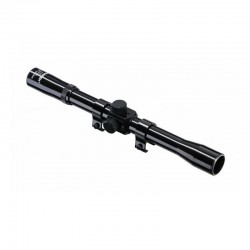
Umarex 4x20 Scope
via DAI Leisure
£19.95
Buying Advice
Understanding key specifications is essential before parting with your cash. Magnification for sub-12 ft-lb springer use rarely needs to exceed 10x or 12x; beyond that, mirage and wobble become more apparent without adding practical advantage at airgun ranges. A 40mm or 50mm objective lens is the sweet spot — large enough for decent light gathering without making the scope unwieldy on a lightweight sporter. Parallax adjustment is critical: airgun scopes must focus down to approximately 10 yards, whereas centrefire scopes typically bottom out at 50 or 100 yards. A scope with a fixed parallax set at 100 yards will appear to have a wandering reticle at 25 yards, destroying your precision. Look for an adjustable objective (AO) ring or a side-focus turret. Second focal plane (SFP) reticles are standard at this price point, meaning your holdover marks are only accurate at one magnification — usually the maximum. That is perfectly adequate for airgun use.
Budget tiers in the UK springer scope market break down roughly as follows. Below about £40, you are in the realm of scopes bundled with rifles — often not genuinely springer-rated and frequently the first thing experienced shooters replace. Between £50 and £100, you start to find purpose-built airgun scopes from brands like Hawke and MTC that genuinely survive springer recoil, offer close parallax, and deliver acceptable glass clarity. From £100 to £180, optical quality takes a notable step up: better coatings, sharper edge-to-edge resolution, and more precise turret clicks. Beyond £200, you are entering mid-range territory with brands such as Vortex and Bushnell offering excellent lifetime warranties and premium-feeling glass, though for a budget-conscious springer shooter this bracket is a luxury rather than a necessity.
The most common mistake UK buyers make is purchasing a cheap scope that is not actually springer-rated. Marketing copy can be vague, so look specifically for terms like 'springer tested', 'bi-directional recoil proof', or 'airgun rated'. A scope described only as 'shockproof' may survive centrefire recoil in one direction but fail catastrophically under a springer's forward lunge. Another frequent error is buying too much magnification and not enough quality — a 3-9×40 with good glass will outperform a 6-24×50 with poor coatings every time at airgun distances. Finally, do not neglect your mounts: a scope rated for springer use will still fail if paired with flimsy mounts on a dovetail rail. Use quality one-piece mounts or individual rings with a proper scope stop, and check them regularly for creep.
UK context matters when choosing your optic. Most sub-12 ft-lb airgun shooting in the UK takes place at ranges from 8 to 45 yards — garden pest control, permission-based rabbit and squirrel shooting, or competitive HFT and benchrest field target. This means your scope needs to perform superbly at close to medium range rather than stretching out to hundreds of metres. Quarry species such as rabbit, grey squirrel, woodpigeon, and corvids can be taken year-round (check specific general licence conditions for birds), but ethical shooting demands clean kill-zone accuracy, which in turn demands a reliable scope. Purchase from established UK retailers — both specialist airgun shops and reputable online dealers — to ensure UK warranty support and correct product versions.
Matching the scope to your specific use case saves money and frustration. If you shoot HFT competitions, a scope with a fine mil-dot or HFT-style reticle and a large side-focus wheel for rapid ranging is ideal; magnification around 10x is a sensible maximum under competition rules where applicable. For farmyard ratting at short range, a compact 3-9×40 with generous eye relief is more practical than a long, heavy high-magnification optic. Pest control at the outer limits of sub-12 ft-lb effectiveness demands the best glass you can afford to place pellets inside a kill zone roughly the size of a one-pence piece at 40 yards. FAC-rated springer owners shooting at extended ranges should consider stepping up in both magnification and budget, though the springer-rating requirement remains paramount.
The brand landscape for affordable springer-rated scopes in the UK is well served. Hawke remains a go-to name with a wide range of airgun-specific models; MTC Optics, a British brand, has earned a strong following for value-for-money glass. Bushnell offers competitive options at the lower-mid tier, and Vortex's unconditional lifetime warranty makes even their entry-level scopes attractive to budget-minded shooters who want long-term peace of mind. Athlon and Leupold have smaller but growing airgun followings in the UK. At the very top end, brands like Swarovski and Nightforce exist but are far beyond what most springer shooters need or want to spend. Thermal and night vision scopes from Pulsar are a separate category entirely and generally not relevant to daytime springer pest control. Focus your budget where it matters: proven springer durability, adequate close-range parallax, and the clearest glass your money can buy.
Frequently Asked Questions
What does 'springer-rated' actually mean for an air rifle scope?
A springer-rated scope is built to withstand the unique double-recoil of a spring-piston air rifle, which kicks both forwards and backwards during the firing cycle. Standard rifle scopes are designed for rearward-only recoil and can suffer internal damage from the forward lunge. Springer-rated scopes use reinforced erector tube assemblies, stronger springs, and more robust locking rings to survive this bi-directional stress. Always look for explicit airgun or springer certification rather than generic 'shockproof' claims.
Can I use a rimfire scope on a spring-piston air rifle?
Generally, no. While rimfire scopes sometimes have close parallax settings suitable for short ranges, they are not built to handle the forward recoil generated by a springer. The erector tube and reticle can be damaged quickly, leading to a shifting zero or complete failure. Some premium rimfire scopes may survive for a while, but it is a false economy — purpose-built airgun scopes are not much more expensive and are designed for the job.
How much should I spend on a springer-rated scope in the UK?
You can find genuinely springer-rated scopes from around £50 to £80 that will do a solid job for general pest control and plinking. Between £100 and £180, optical quality and build improve noticeably, which matters if you shoot competitively or in low light. Spending beyond £200 brings premium features and warranties but is not strictly necessary for most sub-12 ft-lb springer use. Avoid the very cheapest unbranded options below £30, as they frequently lack genuine springer protection.
What magnification do I need for a sub-12 ft-lb springer?
For most UK airgun shooting at ranges up to about 40 yards, a variable scope in the 3-9x or 4-12x range is ideal. Higher magnification amplifies wobble and mirage without practical benefit at typical airgun distances. A 3-9×40 is an excellent all-round choice — versatile enough for close-range ratting and precise enough for 40-yard rabbit shooting. If you shoot HFT, check your league's rules, as some impose magnification limits.
Why do I need close parallax adjustment on an airgun scope?
Airgun shooting commonly takes place at distances as short as 8 to 15 yards, whereas most centrefire scopes have parallax fixed or adjustable only down to 50 or 100 yards. If parallax is not correctly set for your target distance, the reticle appears to shift against the target as your eye moves, introducing aiming errors. A scope with an adjustable objective (AO) or side-focus parallax down to approximately 10 yards eliminates this problem and is essential for consistent airgun accuracy.
Do I need MOA or MRAD turrets for airgun use?
Either system works, but most budget airgun scopes in the UK use MOA adjustments because the market has traditionally favoured them. One MOA equals roughly 1.047 inches at 100 yards, or about 0.3 cm at 10 metres — fine enough for airgun precision. MRAD (milliradian) turrets, where 0.1 mil equals 1 cm at 100 metres, are increasingly popular and arguably simpler for metric-thinking shooters. Choose whichever you are most comfortable calculating with; at airgun ranges, both offer more than adequate precision.
Will a cheap springer scope hold zero on a powerful break-barrel?
It depends on the scope and the rifle. High-powered break-barrel springers like FAC-rated guns or heavy-cocking gas-rams punish scopes harder than lighter sub-12 ft-lb models. A genuinely springer-rated budget scope should hold zero on a sub-12 rifle if paired with quality mounts and a scope stop to prevent rail creep. On more powerful springers, spending a little extra on a mid-range scope from a reputable brand with a solid warranty is a worthwhile investment to avoid repeated replacements.
What mounts should I use with a springer-rated scope?
Use mounts specifically designed for airgun dovetail rails (typically 11mm), not Picatinny or Weaver mounts unless your rifle has a Weaver-compatible rail. One-piece mounts are generally more secure on springers than two separate rings because they spread the recoil forces. Always fit a scope stop — a pin or arrestor block that prevents the scope and mounts from creeping backwards along the rail under recoil. Check mount tightness periodically, especially during the first few hundred shots.
Are thermal or night vision scopes useful on a springer air rifle?
Thermal scopes from brands like Pulsar are excellent tools for spotting quarry in darkness, but they are heavy, expensive, and generally designed for centrefire or PCP platforms rather than springers. The double-recoil of a springer can damage sensitive thermal or night vision electronics. Additionally, UK law restricts the use of artificial light and night vision for certain quarry and situations, so you must check the relevant general licences and local rules before using such equipment. For most springer shooters, a conventional optical scope remains the practical and legal choice.
Related guides
Not sure which scope is right for you?
Try our AI-powered scope finder — answer a few questions and get personalised recommendations.
Find My Scope →Get a UK scope tip every day
Follow AiScopes on Facebook for daily buying guides, deals and gear advice.
Follow on Facebook